
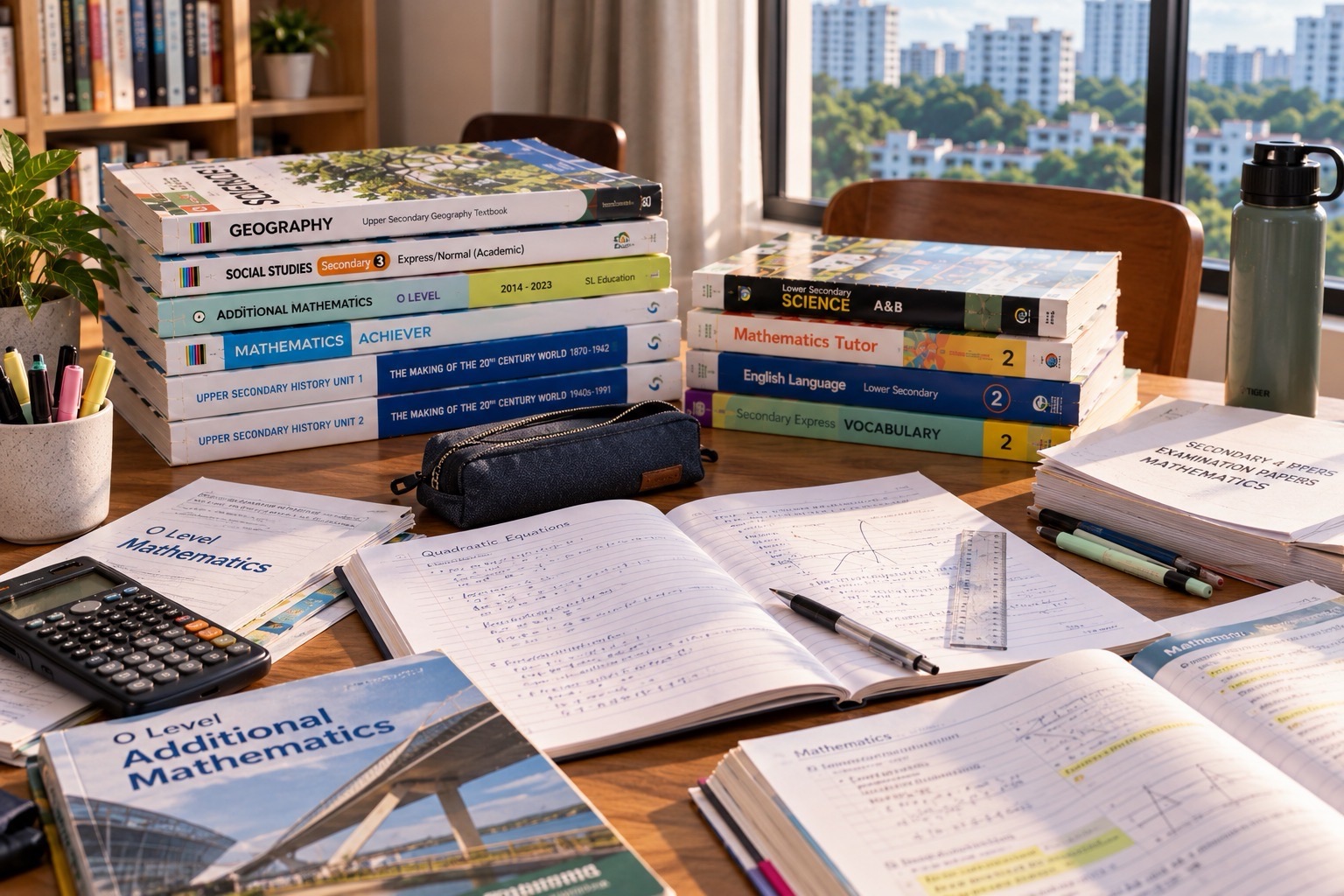
Singapore Math guide to differentiation, the upper secondary Additional Mathematics topic that measures how fast things change, for families and teachers outside Singapore.
A straight line has one gradient.
A curve has a different gradient at every point, and differentiation finds it.
In Singapore Mathematics, students in G3 Additional Mathematics (Secondary 3 to 4) learn the derivatives of powers, trigonometric, exponential and logarithmic functions. They use the product, quotient and chain rules, then apply them to tangents, stationary points, rates of change and maximum and minimum problems.
Integration and kinematics follow directly, and the same ideas are assumed at A-Level.
This guide is useful for families and teachers who want to:
- understand what the Additional Mathematics syllabus includes;
- teach differentiation as gradient and rate, not only as rules;
- prepare a student who is moving into a Singapore secondary school; or
- support a student using Singapore Math materials in another country.
Quick facts
Level: Secondary 3 to 4 (G3 Additional Mathematics, an elective)
Strand: Calculus
Official source: SEAB G3 Additional Mathematics, Syllabus K341 (SEC, from 2027). The 2026 O-Level Additional Mathematics syllabus 4049 has the same content.
Comes after: Exponential and Logarithmic Functions and Trigonometric Functions and Graphs
Leads to: Integration and Kinematics
What Differentiation Means in Singapore Mathematics
The derivative of f(x) is the gradient of the tangent to the graph of y = f(x) at a point.
It is also a rate of change. If y measures volume and x measures time, dy/dx tells you how fast the volume is changing.
Students use the notations f′(x) and dy/dx for the first derivative, and f″(x) and d²y/dx² for the second.
At a stationary point the gradient is zero. These points are where a curve turns, or flattens briefly, and they are central to maximum and minimum problems.
Where Differentiation Sits in the Singapore Syllabus
Differentiation belongs to the Calculus strand of G3 Additional Mathematics, together with integration.
Students learn:
- the derivative as the gradient of a tangent and as a rate of change;
- derivatives of xn for any rational n, sin x, cos x, tan x, ex and ln x, with constant multiples, sums and differences;
- derivatives of products and quotients, and the chain rule;
- increasing and decreasing functions;
- stationary points: maximum and minimum turning points, and stationary points of inflexion;
- the second derivative test to tell maxima from minima; and
- applications to gradients, tangents and normals, connected rates of change, and maxima and minima problems.
| Course | What students do |
|---|---|
| G3 Mathematics, Sec 3 or 4 | Estimate the gradient of a curve by drawing a tangent |
| G3 Additional Mathematics, Sec 3 to 4 | Rules of differentiation and all the applications listed above |
| A-Level H2 Mathematics | Further techniques, with G3 Additional Mathematics as assumed knowledge |
In MOE’s syllabus, G2 Additional Mathematics has narrower calculus. This page describes G3.
How Singapore Teaches Differentiation
1. Start from the gradient of a curve
Students draw tangents to a curve and estimate gradients, as in G3 Mathematics. They see that the gradient changes from point to point.
2. Learn the power rule with rational powers
d/dx (xn) = nxn − 1. Roots and reciprocals are rewritten first: √x = x1/2 and 1/x² = x−2.
3. Add the standard functions
sin x gives cos x, cos x gives −sin x, tan x gives sec²x, ex gives ex and ln x gives 1/x. The trigonometric results need x in radians.
4. Combine with the three rules
The chain rule handles a function inside a function, such as (2x + 1)5. The product and quotient rules handle uv and u/v.
5. Apply to curves
Students find where a function is increasing or decreasing, locate stationary points and decide their nature. They find tangents and normals at given points.
6. Apply to change
Connected rates of change link two rates with the chain rule, for example dV/dt = (dV/dr) × (dr/dt). Maxima and minima problems ask for the best value of a quantity in context.
Worked Examples
Stationary points and their nature
Question: Find the stationary points of y = x³ − 6x² + 9x + 1 and determine their nature.
Step 1. dy/dx = 3x² − 12x + 9 = 3(x − 1)(x − 3).
Step 2. dy/dx = 0 when x = 1 or x = 3.
Step 3. When x = 1, y = 1 − 6 + 9 + 1 = 5. When x = 3, y = 27 − 54 + 27 + 1 = 1.
Step 4. d²y/dx² = 6x − 12. At x = 1 it is −6, which is negative, so (1, 5) is a maximum point.
Step 5. At x = 3 it is 6, which is positive, so (3, 1) is a minimum point.
Check: The x³ term is positive, so the curve rises, falls, then rises again: maximum first, minimum second.
Connected rates of change
Question: Air is pumped into a spherical balloon at 50 cm³ per second. The volume is V = (4/3)πr³. Find the rate at which the radius is increasing when r = 5 cm.
Step 1. dV/dr = 4πr². When r = 5, dV/dr = 100π.
Step 2. Chain rule: dV/dt = (dV/dr) × (dr/dt), so 50 = 100π × dr/dt.
Step 3. dr/dt = 50 ÷ (100π) = 1/(2π) = 0.159 cm per second, correct to 3 significant figures.
Check: Units: cm³ per second divided by cm² gives cm per second.
Common Mistakes
- Differentiating before rewriting. 2/x is not differentiated as a fraction. Fix: write it as 2x−1 first, which gives −2x−2.
- Multiplying derivatives for a product. The derivative of x sin x is not 1 × cos x. Fix: use the product rule, giving sin x + x cos x.
- Forgetting the inner derivative. d/dx (sin 3x) is 3 cos 3x, not cos 3x. Fix: in the chain rule, always multiply by the derivative of the inside.
- Working in degrees. The rule d/dx (sin x) = cos x assumes radians. Fix: set the calculator to radians for calculus.
- Trusting a zero second derivative. For y = x³ at x = 0, d²y/dx² = 0 but the point is a stationary point of inflexion. Fix: check the sign of dy/dx on each side.
- Using the tangent gradient for a normal. A normal is perpendicular to the tangent. Fix: take the negative reciprocal.
Teaching Differentiation Outside Singapore
- Calculus in secondary school. In Singapore, these rules are taught in Additional Mathematics, the upper secondary elective, before A-Level.
- Spelling. The syllabus writes “inflexion”. Many other books write “inflection”. Both mean the same.
- No derivatives on the formula list. The list includes trigonometric identities and triangle formulae, but not the derivative results. Students must know them.
- Timing. The Singapore Math Grade Levels guide explains why grade-by-grade comparisons are unreliable.
- Examination format. Additional Mathematics has two papers of 2 hours 15 minutes, 90 marks each, with all questions compulsory. An approved calculator may be used in both, and leaving out essential working loses marks.
How to Practise Differentiation at Home
- Rewrite five expressions with roots or fractions as powers of x, then differentiate them.
- Differentiate two functions with the chain rule, saying “outside, then inside”.
- Differentiate one product and one quotient, labelling u and v first.
- Find the stationary points of one cubic and test their nature.
- Find the tangent and the normal to a curve at one point.
- Once a week, solve one connected rates or maximum problem and check the units.
A short, mixed set each day builds speed and accuracy together.
Try These
- Differentiate y = 4x³ − 2/x.
- Differentiate y = (2x + 1)5.
- Differentiate y = x sin x.
- Find the equation of the normal to y = x² − 3x at the point where x = 1.
Answers
- dy/dx = 12x² + 2/x². Write 2/x as 2x−1, whose derivative is −2x−2, and subtract it.
- dy/dx = 10(2x + 1)4. The chain rule gives 5(2x + 1)4 × 2.
- dy/dx = sin x + x cos x, by the product rule.
- y = x − 3. At x = 1, y = −2 and dy/dx = 2(1) − 3 = −1, so the normal has gradient 1.
What Comes Next
Differentiation opens the rest of the Calculus strand.
- Integration reverses differentiation and finds areas.
- Kinematics uses derivatives to move from displacement to velocity to acceleration.
- At A-Level, H2 Mathematics builds further differentiation techniques on this base.
A student who sees each derivative as a gradient and a rate understands what the rules are for.
Frequently Asked Questions
When do Singapore students learn differentiation?
In G3 Additional Mathematics, the upper secondary elective taken in Secondary 3 to 4. In G3 Mathematics, the related skill is estimating the gradient of a curve by drawing a tangent.
Which functions are students expected to differentiate?
xn for any rational n, sin x, cos x, tan x, ex and ln x, with multiples, sums and differences. Products, quotients and composite functions use the three rules.
Are stationary points of inflexion included?
Yes. The syllabus lists maximum and minimum turning points and stationary points of inflexion.
Why do the trigonometric derivatives need radians?
Results such as d/dx (sin x) = cos x are true only when x is measured in radians. In degrees, an extra constant factor appears in every answer.
Do the derivative results appear on the formula list?
No. The formula list does not include the derivative results.
Does Additional Mathematics prepare students for H2 Mathematics?
Yes. The syllabus says it prepares students for A-Level H2 Mathematics, and MOE treats G3 Additional Mathematics as assumed knowledge for H2. It is not a formal entry requirement.
Helpful Reading
- Singapore Mathematics | International Edition: Integration
- Singapore Mathematics | International Edition: Kinematics
- Singapore Mathematics | International Edition: Trigonometric Functions and Graphs
- Why Does Differentiation Feel Like a Collection of Rules?
- Secondary 3 Additional Mathematics | Differentiation
- Additional Mathematics Synthesis Guide 31: Increasing and Decreasing Functions and Stationary Points
- How to Make Sense of the SEC G3 Additional Mathematics Syllabus
- SEAB G3 Additional Mathematics Syllabus K341
Differentiation in Singapore Mathematics
A derivative is a gradient.
It is also a rate.
Rewrite as powers first.
Outside, then inside.
Check the nature of every stationary point.
Taught this way, differentiation stops being a pile of rules.
It becomes a way to measure change.
Ask Bukit Timah Tutor
Bukit Timah Tutor teaches Mathematics in small groups of three students in Singapore.
If your child is learning Singapore Mathematics at home, in an international school or in a Singapore school, and you are unsure where to begin with this topic, send us a short message with the student’s level and one example of the work.
Bukit Timah Tutor
8 Fourth Avenue, Singapore 268674
Near Sixth Avenue MRT
Three-student Mathematics tutorials
By appointment
Properly taught kids shine a bright light into the future.
Singapore Mathematics | International Edition is a Bukit Timah Tutor guide series for families and teachers outside Singapore. It is not a textbook and is not affiliated with MOE, SEAB or any publisher. Syllabus details were checked against MOE and SEAB documents in October 2026. Always confirm current requirements with your school.
← Previous: Singapore Mathematics | International Edition: Proofs in Plane Geometry
Next: Singapore Mathematics | International Edition: Integration →
All 100 topics in the International Edition