
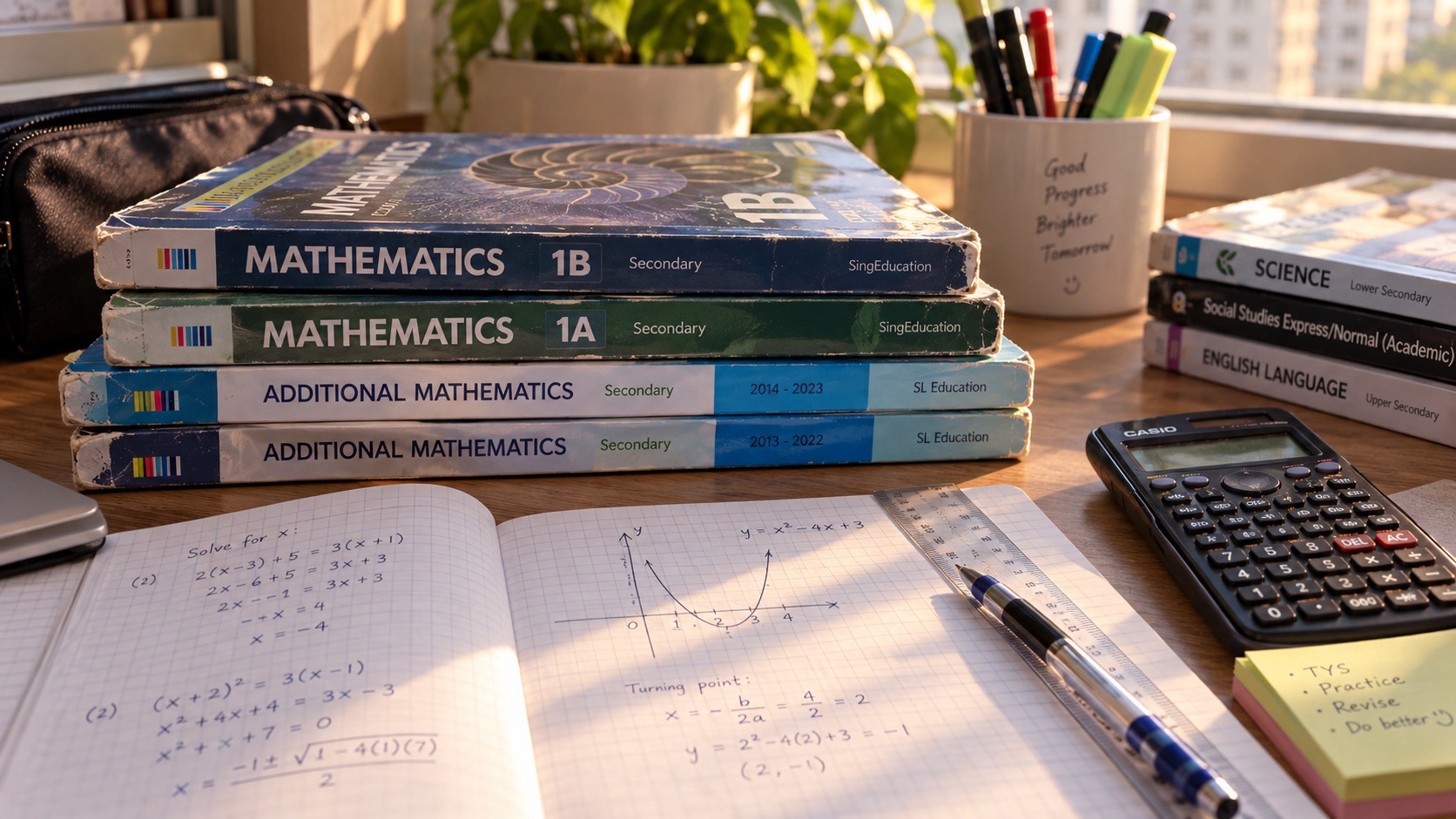
Singapore Math guide to kinematics, the upper secondary Additional Mathematics topic that uses calculus to describe motion in a straight line, for families and teachers outside Singapore.
Position, velocity and acceleration are three views of one motion.
Calculus is the bridge between them.
In Singapore Mathematics, kinematics is part of G3 Additional Mathematics (Secondary 3 to 4). Students apply differentiation and integration to the displacement, velocity and acceleration of a particle moving in a straight line.
It brings together almost every calculus skill in the course, which makes it a natural final topic.
This guide is useful for families and teachers who want to:
- understand what the Additional Mathematics syllabus includes;
- teach the difference between displacement and distance clearly;
- prepare a student who is moving into a Singapore secondary school; or
- support a student using Singapore Math materials in another country.
Quick facts
Level: Secondary 3 to 4 (G3 Additional Mathematics, an elective)
Strand: Calculus
Official source: SEAB G3 Additional Mathematics, Syllabus K341 (SEC, from 2027). The 2026 O-Level Additional Mathematics syllabus 4049 has the same content.
Comes after: Differentiation, Integration and Distance-Time and Speed-Time Graphs
Leads to: A-Level Mathematics, where G3 Additional Mathematics is assumed knowledge for H2 Mathematics
What Kinematics Means in Singapore Mathematics
A particle moves along a straight line through a fixed point O. Its displacement s is its position relative to O, with one direction counted as positive.
Velocity v is the rate of change of displacement: v = ds/dt. Acceleration a is the rate of change of velocity: a = dv/dt.
Going the other way, integrating acceleration gives velocity, and integrating velocity gives displacement. Each integration needs a starting condition to find the constant.
Signs carry meaning. A negative velocity means the particle is moving in the negative direction. A velocity of zero means it is momentarily at rest, and it may be changing direction.
Where Kinematics Sits in the Singapore Syllabus
Kinematics sits in the Calculus strand of G3 Additional Mathematics. The syllabus describes it as the application of differentiation and integration to problems involving displacement, velocity and acceleration of a particle moving in a straight line.
Students use:
- differentiation, to go from displacement to velocity and from velocity to acceleration;
- integration, to go from acceleration to velocity and from velocity to displacement;
- given conditions, such as the position or velocity at t = 0, to find constants;
- stationary values, to find when a particle is at rest or when its velocity is greatest; and
- the functions students can differentiate and integrate in the course, such as powers, ex and trigonometric functions.
| Course | What students do |
|---|---|
| G3 Mathematics | Interpret distance-time and speed-time graphs in real-world contexts |
| G3 Additional Mathematics, Sec 3 to 4 | Displacement, velocity and acceleration in a straight line, using calculus |
| G2 Additional Mathematics | Kinematics is excluded from its calculus |
Questions use a few fixed phrases. Each one translates into a condition on s, v, a or t.
| Phrase in a question | What it means |
|---|---|
| Passes through O | s = 0 |
| Initially | t = 0 |
| At instantaneous rest | v = 0 |
| Changes direction | v = 0 and v changes sign |
| Greatest or least velocity | a = 0 |
| Speeding up | v and a have the same sign |
How Singapore Teaches Kinematics
1. Start with a number line
Students mark O, choose a positive direction and track a particle’s position over time. They see why displacement can be negative.
2. Differentiate down the chain
From s, they find v = ds/dt and a = dv/dt, and interpret each sign.
3. Integrate up the chain
From a, they find v by integration and use a given velocity to fix the constant. They repeat the process to find s.
4. Find the moments of rest
Setting v = 0 shows when the particle stops. These times split the motion into stages.
5. Separate displacement and distance
Displacement is the final position relative to O. Total distance adds up the length of each stage, whatever its direction.
Worked Examples
Velocity, rest and total distance
Question: A particle moves in a straight line so that, t seconds after passing a fixed point O, its velocity is v = t² − 6t + 8 m/s. Find (a) its acceleration when t = 1, (b) when it is at instantaneous rest, and (c) the total distance travelled in the first 4 seconds.
Step 1. a = dv/dt = 2t − 6. When t = 1, a = −4 m/s².
Step 2. v = 0 gives (t − 2)(t − 4) = 0, so the particle is at rest when t = 2 and t = 4.
Step 3. s = t³/3 − 3t² + 8t + c. Since s = 0 when t = 0, c = 0.
Step 4. When t = 2, s = 8/3 − 12 + 16 = 20/3 m. When t = 4, s = 64/3 − 48 + 32 = 16/3 m.
Step 5. It moves 20/3 m out to t = 2, then 20/3 − 16/3 = 4/3 m back.
Step 6. Total distance = 20/3 + 4/3 = 8 m.
Check: The displacement after 4 seconds is only 16/3 m, so distance and displacement differ, as expected for a particle that turned round.
From acceleration to displacement
Question: A particle starts from rest at O. Its acceleration is a = 6 − 2t m/s². Find its velocity and its displacement when t = 3.
Step 1. v = 6t − t² + c. It starts from rest, so v = 0 when t = 0, and c = 0.
Step 2. When t = 3, v = 18 − 9 = 9 m/s.
Step 3. s = 3t² − t³/3 + k. It starts at O, so k = 0.
Step 4. When t = 3, s = 27 − 9 = 18 m.
Check: v = t(6 − t) is positive for 0 < t < 3, so the particle never turns round, and the distance travelled is also 18 m.
Common Mistakes
- Treating displacement as distance. If a particle turns round, its displacement is smaller than the distance it travels. Fix: find when v = 0 and work stage by stage.
- Ignoring the constant. Integrating without + c, or setting c = 0 without a reason, gives wrong positions. Fix: use the given starting condition every time.
- Confusing “at rest” with “zero acceleration”. At rest means v = 0. Greatest velocity means a = 0. Fix: write the condition in symbols before solving.
- Reading negative acceleration as slowing down. A particle with negative v and negative a is speeding up. Fix: compare the signs of v and a.
- Dropping units. Answers need m, m/s and m/s², or the units the question uses. Fix: state units at the end of each step.
- Using degrees for trigonometric motion. With v = 2 sin t, the value of t inside the sine is taken in radians for the calculus. Fix: set the calculator to radians.
Teaching Kinematics Outside Singapore
- Where it sits. In Singapore, calculus-based kinematics is part of Additional Mathematics. If your course has a separate mechanics or physics unit, similar ideas may appear there.
- Notation. Singapore materials use s, v and a, with t in seconds. SI units are used in the examination.
- Timing. The Singapore Math Grade Levels guide explains why grade-by-grade comparisons are unreliable.
- Prerequisites. Students need differentiation, integration, solving quadratic equations and confident use of radians.
- Calculators. An approved calculator may be used in both papers. Working is still needed for each stage of the motion.
How to Practise Kinematics at Home
- Draw a number line with O and act out a short motion: forward, stop, back.
- Given one expression for s, find v and a, and say what each sign means.
- Given one expression for a, integrate twice using the starting conditions.
- Find every time the particle is at rest, then list the stages of the motion.
- Work out the total distance stage by stage and compare it with the displacement.
- Once a week, rewrite one worded question entirely in symbols before solving.
A sketch of the motion on a line saves a lot of algebra.
Try These
- A particle has displacement s = t³ − 3t² m. Find its velocity and acceleration when t = 2.
- A particle has acceleration a = 6t − 4 m/s² and initial velocity 3 m/s. Find its velocity when t = 2.
- A particle starts at O with velocity v = 4 − 2t m/s. Find its displacement after 3 seconds and the distance it travels in that time.
- A particle has velocity v = 6e−2t m/s. Find its acceleration when t = 0.
Answers
- v = 0 m/s and a = 6 m/s². Here v = 3t² − 6t and a = 6t − 6.
- 7 m/s. Integrating gives v = 3t² − 4t + 3, and 12 − 8 + 3 = 7.
- Displacement 3 m, distance 5 m. s = 4t − t², which is 4 m at the rest point t = 2 and 3 m at t = 3, so the particle goes 4 m out and 1 m back.
- −12 m/s². a = dv/dt = −12e−2t, which is −12 when t = 0.
What Comes Next
Kinematics is the final page of this series, and a good place to look ahead.
- After secondary school, H2 Mathematics builds further calculus on the Additional Mathematics base.
- Mathematics After Secondary School in Singapore explains the routes into pre-university study.
- The International Edition hub lists all 100 topics, from primary number work to this one.
A student who can describe motion with calculus has met one of the main reasons calculus exists.
Frequently Asked Questions
When do Singapore students learn kinematics?
In G3 Additional Mathematics, the upper secondary elective taken in Secondary 3 to 4, after differentiation and integration.
Is kinematics really in the Additional Mathematics syllabus?
Yes. Problems on displacement, velocity and acceleration of a particle moving in a straight line are listed in both the 2026 syllabus 4049 and the 2027 syllabus K341.
Is kinematics in G2 Additional Mathematics?
No. MOE’s syllabus excludes kinematics from G2 Additional Mathematics calculus.
Do students need the constant-acceleration equations?
The syllabus item is about using differentiation and integration. Students work from the expression given for s, v or a.
Is kinematics needed for H2 Mathematics?
The calculus skills are. SEAB’s H2 Mathematics syllabus appends a list of assumed Additional Mathematics knowledge, and kinematics itself is not on that list.
Why does my child get the distance wrong?
Usually the particle turned round and the stages were not separated. Find when v = 0 first.
Helpful Reading
- Singapore Mathematics | International Edition: Differentiation
- Singapore Mathematics | International Edition: Integration
- Singapore Mathematics | International Edition: Distance-Time and Speed-Time Graphs
- Additional Mathematics Synthesis Guide 35: Kinematics from Calculus
- Secondary 3 Additional Mathematics | Kinematics
- H2 Mathematics 9758 | Complete Topic Map, Papers and Preparation
- How to Make Sense of the SEC G3 Additional Mathematics Syllabus
- SEAB G3 Additional Mathematics Syllabus K341
- MOE G2 and G3 Additional Mathematics Syllabuses
Kinematics in Singapore Mathematics
Differentiate down.
Integrate up.
Use the starting condition.
Find every moment of rest.
Distance is not displacement.
Taught this way, kinematics stops being a list of question types.
It becomes calculus describing something real: motion.
Ask Bukit Timah Tutor
Bukit Timah Tutor teaches Mathematics in small groups of three students in Singapore.
If your child is learning Singapore Mathematics at home, in an international school or in a Singapore school, and you are unsure where to begin with this topic, send us a short message with the student’s level and one example of the work.
Bukit Timah Tutor
8 Fourth Avenue, Singapore 268674
Near Sixth Avenue MRT
Three-student Mathematics tutorials
By appointment
Properly taught kids shine a bright light into the future.
Singapore Mathematics | International Edition is a Bukit Timah Tutor guide series for families and teachers outside Singapore. It is not a textbook and is not affiliated with MOE, SEAB or any publisher. Syllabus details were checked against MOE and SEAB documents in October 2026. Always confirm current requirements with your school.
← Previous: Singapore Mathematics | International Edition: Integration
All 100 topics in the International Edition