
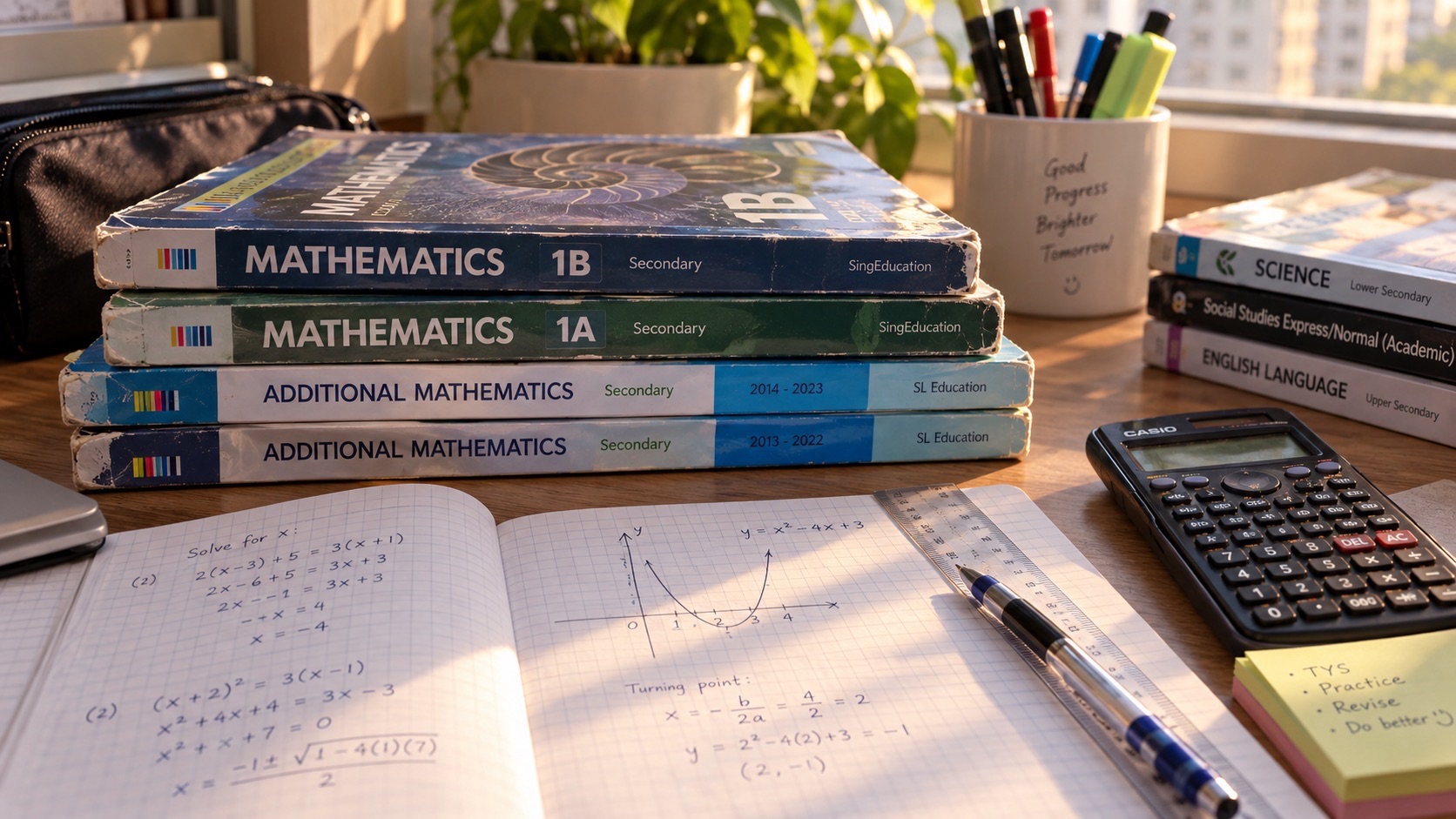
Singapore Math Pythagoras’ theorem guide for families and teachers outside Singapore. What Secondary 2 students learn, how the theorem is taught and tested, and how to practise it at home.
In a right-angled triangle, the square on the longest side equals the sum of the squares on the other two sides.
Few results in school Mathematics are used as often.
In Singapore Mathematics, Pythagoras’ theorem is a Secondary 2 topic in G3 Mathematics, and it is also in G2 Mathematics. Students use it to find unknown sides, and they use its converse to decide whether a triangle is right-angled.
In Secondary 3 or 4 it returns in three-dimensional problems and coordinate geometry, and, for G3 students, in the magnitude of a vector.
This guide is useful for families and teachers who want to:
- understand what Singapore expects at Secondary 2;
- teach the theorem and its converse in a clear sequence;
- prepare a student who is moving into a Singapore secondary school; or
- support a student using Singapore Math materials in another country.
Quick facts
Level: Secondary 2 (G3 Mathematics; also in G2 Mathematics), with problems in two and three dimensions in Secondary 3 or 4
Strand: Geometry and Measurement
Official source: SEAB G3 Mathematics syllabus K310 (SEC, from 2027; O-Level 4052 in 2026), with year placement from MOE’s 2020 secondary Mathematics syllabus
Comes after: Triangles and Approximation and Significant Figures
Leads to: Trigonometric Ratios and Coordinate Geometry
What Pythagoras’ Theorem Means in Singapore Mathematics
In a right-angled triangle, the hypotenuse is the side opposite the right angle. It is always the longest side.
If the hypotenuse is c and the other two sides are a and b, then a² + b² = c².
The theorem is a statement about areas. A square drawn on the hypotenuse has the same area as the two squares on the other sides put together.
Students use the result in two directions. Given two sides, they find the third. Given three sides, they test whether the triangle is right-angled.
That second use is the converse: if a² + b² = c², then the angle opposite c is a right angle.
Most answers are not whole numbers. A side of √65 cm is written as 8.06 cm, correct to 3 significant figures.
Where Pythagoras’ Theorem Sits in the Singapore Syllabus
The SEAB G3 Mathematics syllabus places the topic in the Geometry and Measurement strand, under “Pythagoras’ theorem and trigonometry”. MOE’s teaching syllabus places it in Secondary 2.
At Secondary 2, the syllabus lists:
- “use of Pythagoras’ theorem”; and
- “determining whether a triangle is right-angled given the lengths of three sides”.
The same content appears in G2 Mathematics.
In Secondary 3 or 4, the topic widens. The syllabus includes “problems in two and three dimensions including those involving angles of elevation and depression and bearings”. Pythagoras’ theorem is a working tool in many of these problems.
| Level | Where Pythagoras’ theorem is used |
|---|---|
| Secondary 2 | Finding an unknown side; testing whether a triangle is right-angled |
| Secondary 2 | Alongside sine, cosine and tangent in right-angled triangles |
| Secondary 3 or 4 | Problems in two and three dimensions, including bearings, elevation and depression |
| Secondary 3 or 4 | The length of a line segment from the coordinates of its end points |
| Secondary 3 or 4 (G3 only) | The magnitude of a vector, √(x² + y²) |
The theorem is not on the formula list printed with the examination paper. Students are expected to know it.
How Singapore Teaches Pythagoras’ Theorem
1. Find the hypotenuse first
Before any calculation, students mark the right angle and label the side opposite it. That side is c.
2. See the squares
Squares drawn on the sides of a 3, 4, 5 triangle have areas 9, 16 and 25. Since 9 + 16 = 25, the area idea becomes visible.
3. Find the longest side
Add the two squares, then take the square root of the total.
4. Find a shorter side
Subtract: a² = c² − b². Students decide between adding and subtracting by asking one question: is the unknown side the hypotenuse?
5. Test with the converse
Square the longest side and compare it with the sum of the squares of the other two. Equal results mean the triangle is right-angled.
6. Look for the hidden right angle
Later problems hide the triangle in a ladder against a wall, an isosceles triangle cut in half or a cuboid. In a cuboid 3 cm by 4 cm by 12 cm, the base diagonal is 5 cm, and the diagonal through the solid is √(5² + 12²) = 13 cm.
The order of these steps matters. Students who learn only “a² + b² = c²” often add when they should subtract.
Worked Examples
Finding a shorter side
Question: A ladder 6.5 m long leans against a vertical wall. Its foot is 2.5 m from the wall on level ground. How high up the wall does the ladder reach?
Step 1. The wall meets the ground at a right angle. The ladder is opposite that angle, so it is the hypotenuse: c = 6.5 m.
Step 2. Let the height be h m. Then h² + 2.5² = 6.5².
Step 3. h² = 6.5² − 2.5² = 42.25 − 6.25 = 36.
Step 4. h = √36 = 6. The ladder reaches 6 m up the wall.
Check: 6² + 2.5² = 36 + 6.25 = 42.25 = 6.5². The height is shorter than the ladder, as it must be.
Is the triangle right-angled?
Question: A triangle has sides 9 cm, 12 cm and 15 cm. Is it right-angled?
Step 1. The longest side is 15 cm, and 15² = 225.
Step 2. For the other two sides, 9² + 12² = 81 + 144 = 225.
Step 3. The results are equal, so the triangle is right-angled. The right angle is opposite the 15 cm side.
Check: 9, 12, 15 is the 3, 4, 5 triangle with every side multiplied by 3.
A non-example helps. For sides 7 cm, 8 cm and 11 cm, 7² + 8² = 113 but 11² = 121. The results differ, so that triangle is not right-angled.
Common Mistakes
- Adding when a shorter side is unknown. The answer comes out longer than the hypotenuse. Fix: identify the hypotenuse first, and subtract when it is the side you are given.
- Taking the wrong side as the hypotenuse. In a rotated diagram, the hypotenuse may be at the top or on the left. Fix: find the right angle; the hypotenuse is always opposite it.
- Square-rooting term by term. √(5² + 8²) is not 5 + 8. Fix: add the squares first, then take one square root. √89 = 9.43, not 13.
- Rounding too early. Rounding √65 to 8.1 and reusing it spreads the error into later parts. Fix: keep the full calculator value and round only the final answer.
- Testing the converse with the wrong side. Comparing 9² + 15² with 12² proves nothing. Fix: always compare the square of the longest side with the sum of the other two squares.
- Mixing units. A 90 cm side and a 1.2 m side cannot go into one calculation as 90 and 1.2. Fix: convert first, so 0.9 m and 1.2 m give a hypotenuse of 1.5 m.
Teaching Pythagoras’ Theorem Outside Singapore
The theorem itself is the same everywhere. The differences are in naming, timing and exam conventions.
- The name. Singapore and UK materials say “Pythagoras’ theorem”. Many US materials say “the Pythagorean theorem”. They are the same result.
- Timing. In Singapore it is a Secondary 2 topic. Your local curriculum may place it at a different stage, so decide by readiness rather than age. The Singapore Math Grade Levels guide explains why direct conversions are unreliable.
- Prerequisites. Students need squares, square roots and rounding to significant figures, which are Secondary 1 content in Singapore. Weak squaring slows everything that follows.
- Calculators. An approved calculator may be used in both papers of G3 Mathematics. The arithmetic is rarely the obstacle; setting up the right equation is.
- Accuracy. Unless a question says otherwise, non-exact answers are given correct to 3 significant figures.
How to Practise Pythagoras’ Theorem at Home
A short, regular routine works better than one long weekend session.
- Learn the squares from 1² to 20², and the common sets 3, 4, 5 and 5, 12, 13.
- Draw three right-angled triangles in different orientations and mark the hypotenuse on each.
- Solve one “find the hypotenuse” question and one “find a shorter side” question, saying aloud whether you add or subtract.
- Test two triangles with the converse: one that is right-angled and one that is not.
- Find one right-angled triangle in a real object, such as a ramp, a door or a screen diagonal, and measure it.
- Once a week, mix in a trigonometry or coordinates question so the student must choose the method.
Ten to fifteen minutes is enough when the work is focused.
Try These
- The two shorter sides of a right-angled triangle are 9 cm and 40 cm. Find the hypotenuse.
- A right-angled triangle has a hypotenuse of 17 cm and one side of 8 cm. Find the third side.
- Is a triangle with sides 10 cm, 24 cm and 26 cm right-angled?
- The two shorter sides of a right-angled triangle are 4 cm and 7 cm. Find the hypotenuse, correct to 3 significant figures.
Answers
- 41 cm, because 9² + 40² = 81 + 1600 = 1681 = 41².
- 15 cm, because 17² − 8² = 289 − 64 = 225, and √225 = 15.
- Yes. The longest side is 26 cm, and 10² + 24² = 100 + 576 = 676 = 26².
- 8.06 cm, because √(4² + 7²) = √65 = 8.062 to 3 decimal places.
What Comes Next
Pythagoras’ theorem supports much of the geometry that follows.
- In Secondary 2, Trigonometric Ratios use the same right-angled triangles to connect sides with angles.
- In Secondary 3 or 4, Coordinate Geometry uses the theorem to find the length of a line segment.
- In Secondary 3 or 4, Bearings, Elevation and Depression combine it with trigonometry in two and three dimensions.
- For G3 students, Vectors use it for the magnitude √(x² + y²).
A student who always finds the hypotenuse first is well placed for all of these.
Frequently Asked Questions
When do Singapore students learn Pythagoras’ theorem?
In Secondary 2 in G3 Mathematics, and the topic is also in G2 Mathematics. It is used again in Secondary 3 or 4 in two- and three-dimensional problems and in coordinate geometry.
Is Pythagoras’ theorem on the formula list?
No. The formula list provided in the G3 Mathematics examination includes items such as the cone and sphere formulae, the sine rule and the cosine rule. Pythagoras’ theorem is expected to be known.
Do students need to prove the theorem?
The syllabus wording is “use of Pythagoras’ theorem”, so the emphasis is on applying it. Seeing why it works with squares on the sides still helps students remember it.
What is the converse, and is it tested?
The converse says that if a² + b² = c², the triangle is right-angled. The syllabus includes “determining whether a triangle is right-angled given the lengths of three sides”.
Can students use a calculator?
Yes. An approved calculator may be used in both papers of G3 Mathematics.
Is the topic different in G2 Mathematics?
The Secondary 2 content is shared by G2 and G3. Vectors, where the magnitude formula relies on the theorem, are G3 only.
Helpful Reading
- Singapore Mathematics | International Edition: Trigonometric Ratios
- Singapore Mathematics | International Edition: Coordinate Geometry
- Singapore Mathematics | International Edition: Triangles
- Secondary Mathematics: Pythagoras Converse, Right-Triangle Tests and Pythagorean Triples
- Secondary Mathematics: Trigonometry, Pythagoras, Bearings and Elevation
- Geometry to Trigonometry and Vectors | Mathematics Dependency Corridor
- How to Make Sense of the SEC G3 Mathematics Syllabus
- SEAB G3 Mathematics Syllabus K310 (PDF)
- MOE Secondary Mathematics Syllabuses (2020)
Pythagoras’ Theorem in Singapore Mathematics
Find the right angle.
Name the hypotenuse.
Add to find it. Subtract to find the others.
Square the longest side to test the converse.
Taught this way, the theorem is more than a formula.
It becomes the measuring tool that trigonometry, coordinates and vectors all rely on.
Ask Bukit Timah Tutor
Bukit Timah Tutor teaches Mathematics in small groups of three students in Singapore.
If your child is learning Singapore Mathematics at home, in an international school or in a Singapore school, and you are unsure where to begin with this topic, send us a short message with the student’s level and one example of the work.
Bukit Timah Tutor
8 Fourth Avenue, Singapore 268674
Near Sixth Avenue MRT
Three-student Mathematics tutorials
By appointment
Properly taught kids shine a bright light into the future.
Singapore Mathematics | International Edition is a Bukit Timah Tutor guide series for families and teachers outside Singapore. It is not a textbook and is not affiliated with MOE, SEAB or any publisher. Syllabus details were checked against MOE and SEAB documents in October 2026. Always confirm current requirements with your school.
← Previous: Singapore Mathematics | International Edition: Areas and Volumes of Similar Figures
Next: Singapore Mathematics | International Edition: Trigonometric Ratios →
All 100 topics in the International Edition