
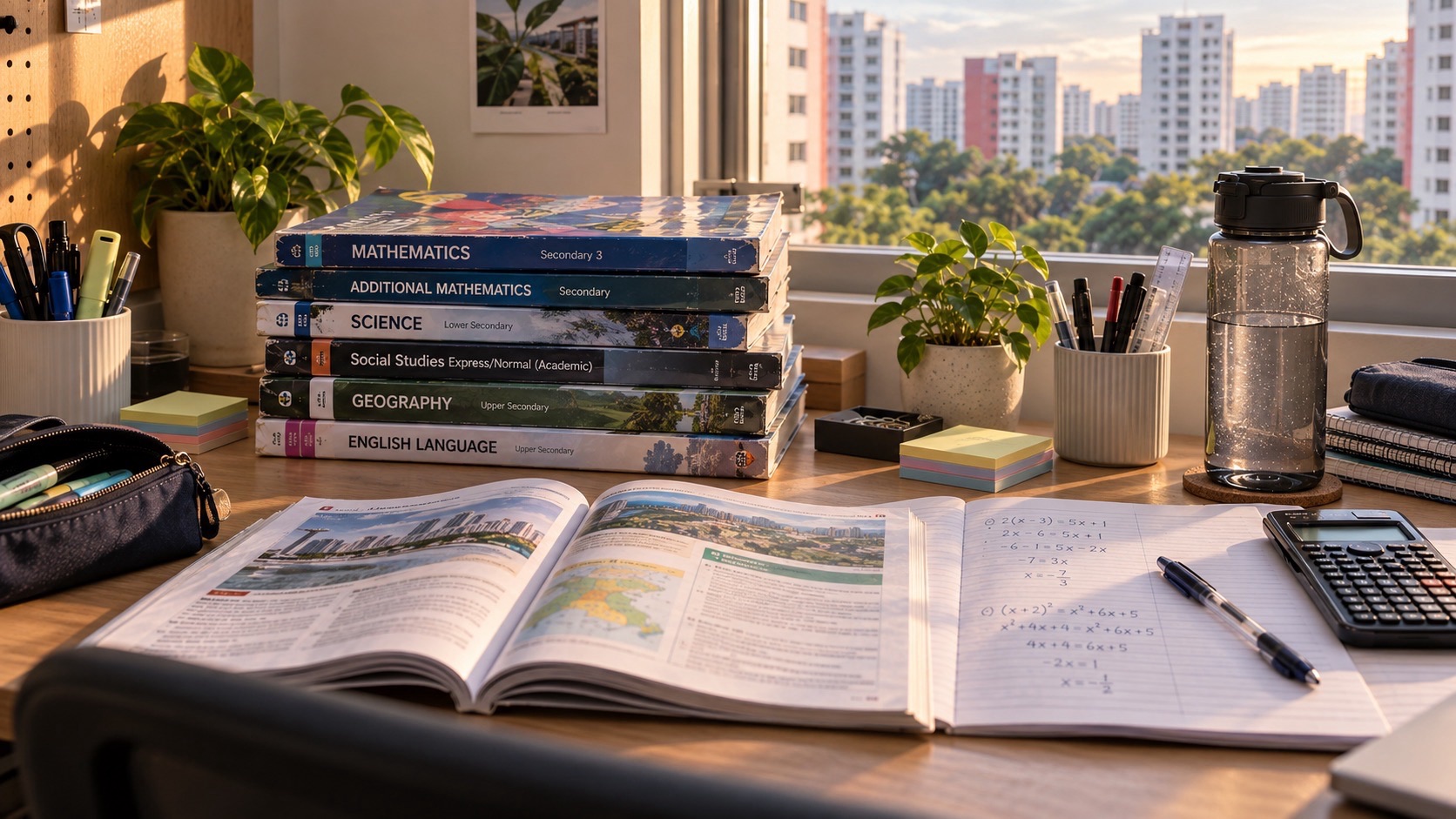
Singapore Math polygons and angle sums guide for families and teachers outside Singapore. What Secondary 1 students learn about triangles, quadrilaterals and regular polygons, how Singapore teaches them, and how to practise them at home.
A polygon is a closed shape made of straight sides.
One idea, splitting a polygon into triangles, explains every interior angle sum.
In Singapore Mathematics, Secondary 1 students study the properties of triangles, special quadrilaterals and regular polygons, including their symmetry. They find the sums of the interior and exterior angles of any convex polygon, and construct simple figures with compasses, ruler, set squares and protractors.
These properties feed into congruence, similarity, circle properties and proof.
This guide is useful for families and teachers who want to:
- understand what Singapore expects at Secondary 1;
- teach polygon angle sums at home in a clear sequence;
- prepare a student who is moving into a Singapore secondary school; or
- support a student using Singapore Math materials in another country.
Quick facts
Level: Secondary 1 (G3 and G2; G2 timing can differ)
Strand: Geometry and Measurement (G1 Angles, triangles and polygons)
Official source: SEAB G3 Mathematics syllabus K310 (2027 SEC; O-Level 4052 in 2026), with year placement from MOE’s 2020 secondary Mathematics syllabus
Comes after: Angles and Parallel Lines and Quadrilaterals
Leads to: Congruence and Similarity and Circle Properties
What Polygons and Angle Sums Mean in Singapore Mathematics
A polygon with n sides can be split into (n − 2) triangles by drawing diagonals from one vertex. Each triangle has an angle sum of 180°, so:
Sum of interior angles = (n − 2) × 180°.
At each vertex, the interior angle and the exterior angle lie on a straight line, so they add up to 180°.
Walking once round a convex polygon, you turn through the exterior angle at each corner and finish facing the way you started. That is one full turn, so:
Sum of exterior angles = 360°.
A polygon is convex when every interior angle is smaller than 180°. In a regular polygon all sides are equal and all angles are equal, so each exterior angle is 360° ÷ n.
Where Polygons and Angle Sums Sit in the Singapore Syllabus
This work is part of sub-strand G1, “Angles, triangles and polygons”. MOE places it in Secondary 1.
The syllabus lists:
- “properties of triangles, special quadrilaterals and regular polygons”, naming the regular pentagons, hexagons, octagons and decagons, “including symmetry properties”;
- “classifying special quadrilaterals on the basis of their properties”;
- “angle sum of interior and exterior angles of any convex polygon”; and
- “construction of simple geometrical figures from given data using compasses, ruler, set squares and protractors, where appropriate”.
The same content is in G2 Mathematics (K210).
| Regular polygons | Sides | Interior angle sum | Each exterior angle | Each interior angle | Lines of symmetry |
|---|---|---|---|---|---|
| Pentagons | 5 | 540° | 72° | 108° | 5 |
| Hexagons | 6 | 720° | 60° | 120° | 6 |
| Octagons | 8 | 1080° | 45° | 135° | 8 |
| Decagons | 10 | 1440° | 36° | 144° | 10 |
Primary school prepares the ground. Triangle properties and angle sums, and the properties of parallelograms, rhombuses and trapeziums, are Primary 5 topics. Line symmetry is a Primary 4 topic.
How Singapore Teaches Polygons and Angle Sums
1. Review triangles and quadrilaterals
Students recall the angle sum of a triangle and the properties of isosceles, equilateral and right-angled triangles, then the special quadrilaterals.
2. Classify by properties
A square is a special rectangle and also a special rhombus. Students sort quadrilaterals by their sides, angles, diagonals and symmetry, not by how they look.
3. Derive the interior angle sum
Students split polygons into triangles from one vertex and look for the pattern: 4 sides, 2 triangles; 5 sides, 3 triangles; n sides, (n − 2) triangles.
4. Explain the exterior angle sum
Walking round the shape, or turning a pencil at each corner, shows that the exterior angles make one full turn.
5. Work regular polygons both ways
Students find an angle from the number of sides, and the number of sides from an angle.
6. Construct with instruments
Students construct triangles and other simple figures from given lengths and angles, leaving their construction arcs visible.
Worked Examples
Interior angle of a regular decagon
Question: Find the size of each interior angle of a regular decagon.
Step 1. A decagon has 10 sides. Interior angle sum = (10 − 2) × 180° = 1440°.
Step 2. Each interior angle = 1440° ÷ 10 = 144°.
Check: Each exterior angle = 360° ÷ 10 = 36°, and 180° − 36° = 144°.
Finding the number of sides
Question: Each exterior angle of a regular polygon is 24°. How many sides does it have? Find its interior angle sum.
Step 1. The exterior angles add up to 360°, so n = 360° ÷ 24° = 15.
Step 2. Interior angle sum = (15 − 2) × 180° = 13 × 180° = 2340°.
Check: Each interior angle = 180° − 24° = 156°, and 15 × 156° = 2340°.
An unknown angle in an irregular polygon
Question: A convex polygon with five sides has angles 100°, 95°, 120°, 110° and x. Find x.
Step 1. Interior angle sum = (5 − 2) × 180° = 540°.
Step 2. 100° + 95° + 120° + 110° = 425°.
Step 3. x = 540° − 425° = 115°.
Check: 115° is smaller than 180°, which fits a convex polygon, and 425° + 115° = 540°.
A construction follows the same careful spirit. To construct a triangle with sides 7 cm, 6 cm and 5 cm, draw the 7 cm side with a ruler. Set the compasses to 6 cm and draw an arc from one end, then set them to 5 cm and draw an arc from the other end. Join the point where the arcs cross to both ends.
Common Mistakes
- Using n × 180° instead of (n − 2) × 180°. The sum is then far too large. Fix: count the triangles from one vertex to see why it is n − 2.
- Dividing the sum by n for an irregular polygon. Only a regular polygon has equal angles. Fix: check the word “regular” before dividing.
- Confusing interior and exterior angles. Fix: the exterior angle sits outside, on the extended side, and the pair adds up to 180°.
- Thinking the exterior angle sum depends on n. Fix: for any convex polygon it is always 360°.
- Classifying by appearance. A tilted square is still a square. Fix: list the properties before naming the shape.
- Rubbing out construction arcs. The method then disappears. Fix: leave the arcs visible and draw lightly.
Teaching Polygons and Angle Sums Outside Singapore
Polygon facts are universal, but some words differ.
- Trapezium. Singapore and British English say trapezium; American English says trapezoid.
- Set squares. A set square is the triangular drawing instrument. In American English it is often simply called a triangle.
- Convex polygons. The syllabus states the angle sums for convex polygons, so keep Secondary 1 practice to convex shapes.
- Timing. These are Secondary 1 topics in Singapore. Decide by readiness rather than age. The Singapore Math Grade Levels guide explains why direct conversions are unreliable.
- Instruments. Candidates bring geometrical instruments for both G3 Mathematics papers, so students should be comfortable with compasses, a protractor and set squares.
How to Practise Polygons at Home
A short, regular routine works better than one long session.
- Draw polygons with 4 to 8 sides and split each into triangles from one vertex. Record the pattern.
- Learn the interior and exterior angles of the four named regular polygons.
- Solve one “find the number of sides” question and one “find the angle” question each session.
- Sort a set of quadrilateral drawings by their properties, including lines of symmetry.
- Construct one triangle from three given sides with compasses and a ruler.
- Once a week, mix polygon questions with parallel-line questions.
Ten to fifteen minutes is enough when the work is focused.
Try These
- Find the sum of the interior angles of a hexagon.
- Find each interior angle of a regular octagon.
- Each interior angle of a regular polygon is 160°. How many sides does it have?
- Can a regular polygon have an exterior angle of 50°? Explain.
Answers
- 720°. (6 − 2) × 180° = 4 × 180° = 720°.
- 135°. Each exterior angle is 360° ÷ 8 = 45°, and 180° − 45° = 135°.
- 18 sides. Each exterior angle is 180° − 160° = 20°, and 360° ÷ 20° = 18.
- No. 360° ÷ 50° = 7.2, which is not a whole number of sides.
What Comes Next
Polygon properties are used throughout later geometry.
- Congruence and Similarity compares triangles and polygons by their corresponding angles and sides.
- Circle Properties in Secondary 3 or 4 combines angle sums with circle facts.
- In Additional Mathematics, Proofs in Plane Geometry uses the properties of triangles and special quadrilaterals.
A student who can explain where (n − 2) × 180° comes from usually remembers it for good.
Frequently Asked Questions
When do Singapore students learn polygon angle sums?
In Secondary 1 in G3 Mathematics. The same content is in G2 Mathematics, though G2 timing can differ.
Why is the interior angle sum (n − 2) × 180°?
Diagonals from one vertex split a polygon with n sides into n − 2 triangles, and each triangle has angles adding up to 180°.
Which regular polygons do students need to know?
The syllabus names regular polygons with 5, 6, 8 and 10 sides, together with their symmetry properties.
Is symmetry part of this topic?
Yes. The syllabus includes the symmetry properties of triangles, special quadrilaterals and regular polygons. For example, a regular hexagon has 6 lines of symmetry.
Are geometrical constructions still taught?
Yes. The syllabus includes constructing simple figures from given data with compasses, ruler, set squares and protractors.
Does the angle sum rule work for any polygon?
The syllabus states it for convex polygons, so keep Secondary 1 practice to convex shapes.
Helpful Reading
- Singapore Mathematics | International Edition: Angles and Parallel Lines
- Singapore Mathematics | International Edition: Quadrilaterals
- Singapore Mathematics | International Edition: Congruence and Similarity
- Secondary Mathematics: Special Quadrilaterals, Properties, Diagonals, Symmetry and Classification
- Secondary Mathematics: Angles, Similarity and Geometric Reasoning
- Geometry and Measurement | Mathematics Knowledge Object
- How to Make Sense of the SEC G3 Mathematics Syllabus
- SEAB G3 Mathematics Syllabus K310
Polygons in Singapore Mathematics
Split into triangles.
Count n − 2.
Exterior angles make one full turn.
Regular means equal sides and equal angles.
Taught this way, polygon formulas stop being things to memorise.
They become results a student can rebuild in a minute.
That confidence carries into congruence, circles and proof.
Ask Bukit Timah Tutor
Bukit Timah Tutor teaches Mathematics in small groups of three students in Singapore.
If your child is learning Singapore Mathematics at home, in an international school or in a Singapore school, and you are unsure where to begin with this topic, send us a short message with the student’s level and one example of the work.
Bukit Timah Tutor
8 Fourth Avenue, Singapore 268674
Near Sixth Avenue MRT
Three-student Mathematics tutorials
By appointment
Properly taught kids shine a bright light into the future.
Singapore Mathematics | International Edition is a Bukit Timah Tutor guide series for families and teachers outside Singapore. It is not a textbook and is not affiliated with MOE, SEAB or any publisher. Syllabus details were checked against MOE and SEAB documents in October 2026. Always confirm current requirements with your school.
← Previous: Singapore Mathematics | International Edition: Angles and Parallel Lines
Next: Singapore Mathematics | International Edition: Congruence and Similarity →
All 100 topics in the International Edition