
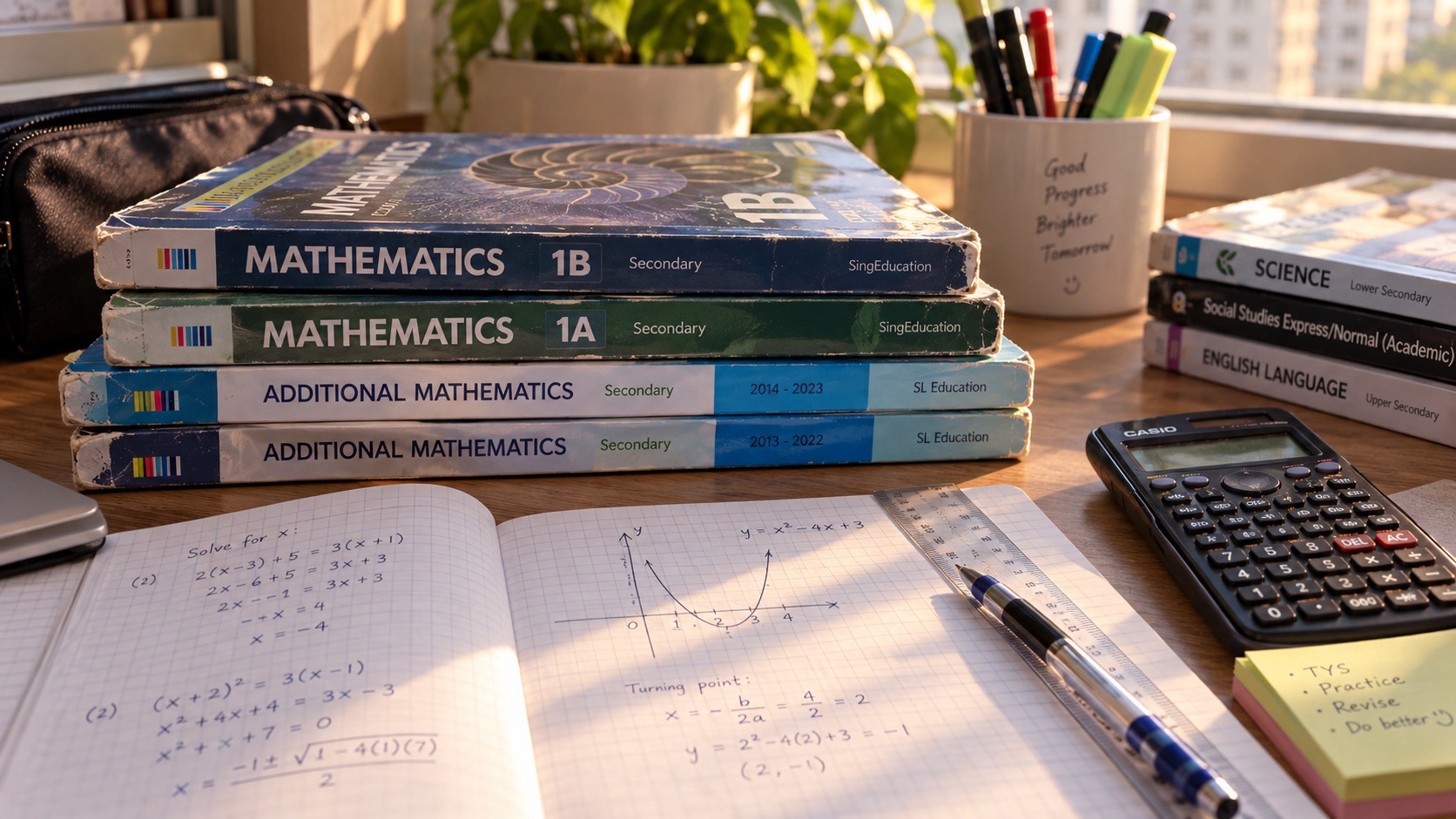
Singapore Math rate and speed guide for families and teachers outside Singapore. What Secondary 1 students learn about average rate, average speed and converting units such as km/h to m/s, and how to practise at home.
Speed is a rate: distance per unit of time.
Average speed is where many students first go wrong.
In Singapore Mathematics, rate is a Primary 5 topic, and speed is not part of the current primary syllabus. In Secondary 1, G3 Mathematics introduces average rate and average speed, and conversion of units such as km/h to m/s.
These ideas lead to distance-time and speed-time graphs, and later to kinematics in Additional Mathematics.
This guide is useful for families and teachers who want to:
- understand what Singapore expects at Secondary 1;
- teach average speed at home in a clear sequence;
- prepare a child who is moving into a Singapore secondary school; or
- support a student using Singapore Math materials in another country.
Quick facts
Level: Secondary 1 (G3 Mathematics; also in G2)
Strand: Number and Algebra
Official source: MOE Secondary Mathematics Syllabuses (2020) and SEAB G3 Mathematics syllabus K310
Comes after: Rate and Time and the 24-Hour Clock
Leads to: Distance-Time and Speed-Time Graphs and Kinematics
What Rate and Speed Mean in Singapore Mathematics
A rate compares two different kinds of quantity: litres per minute, dollars per kilogram, pages per hour.
Speed is the rate of distance travelled per unit of time.
Average speed = total distance ÷ total time.
Average rate works in the same way: the total amount divided by the total time, or by the total number of units.
The word “average” matters. A car rarely travels at one steady speed. Average speed describes the whole trip as if it had been made at one steady speed.
Distance, speed and time are linked by three forms of the same relationship: distance = speed × time, speed = distance ÷ time, and time = distance ÷ speed.
Where Rate and Speed Sit in the Singapore Syllabus
At Primary 5, rate is taught as the amount of one quantity per unit of another. Students find the rate, the total amount or the number of units, given the other two.
Speed is not in the 2021 primary syllabus. The words “speed”, “km/h” and “distance” do not appear in its content.
In Secondary 1, G3 Mathematics (N4 Rate and speed) includes:
- average rate and average speed; and
- conversion of units, for example km/h to m/s.
G2 Mathematics includes this content too.
The G3 syllabus also lists transport schedules and travel plans among its everyday contexts, and asks students to interpret “distance-time and speed-time graphs”.
| Level | What students do |
|---|---|
| Primary 3 | Time: the 24-hour clock; start time, finish time and duration |
| Primary 5 | Rate as the amount of one quantity per unit of another |
| Secondary 1 | Average rate and average speed; conversion such as km/h to m/s |
| Secondary 1 to 4 | Distance-time and speed-time graphs in real-world problems |
| Additional Mathematics, Secondary 3 to 4 | Kinematics: displacement, velocity and acceleration |
How Singapore Teaches Rate and Speed
1. Start from rate
Students already know rates such as “$3 per kilogram”. Speed is introduced as one more rate: kilometres per hour, or metres per second.
2. Use the three forms
Students practise finding distance, speed or time when the other two are given, and write units at every step.
3. Build average speed from totals
For a trip in parts, find the total distance and the total time first. Only then divide.
4. Convert time carefully
45 minutes is 3/4 of an hour, or 0.75 h. 20 minutes is 1/3 of an hour.
5. Convert speed units
1 km/h = 1000 m ÷ 3600 s = 5/18 m/s. So to change km/h to m/s, multiply by 5/18, which is the same as dividing by 3.6.
6. Apply rate to other quantities
The same thinking gives average rates for machines, taps and printers: total output divided by total time.
Units carry the logic of every step, so students are taught to write them throughout.
Worked Examples
Average speed for a two-part trip
Question: A car travels 120 km at 60 km/h, then another 120 km at 40 km/h. Find its average speed for the whole trip.
Step 1. Time for the first part = 120 ÷ 60 = 2 h.
Step 2. Time for the second part = 120 ÷ 40 = 3 h.
Step 3. Total distance = 240 km. Total time = 5 h.
Step 4. Average speed = 240 ÷ 5 = 48 km/h.
Check: At 48 km/h for 5 h, the car covers 48 × 5 = 240 km.
The tempting answer, 50 km/h, is the average of the two speeds. It is wrong because the car spends longer at the slower speed.
Converting km/h to m/s
Question: Convert 72 km/h to m/s.
Step 1. 72 km = 72 000 m.
Step 2. 1 h = 3600 s.
Step 3. 72 000 ÷ 3600 = 20, so the speed is 20 m/s.
Check: 20 m/s for 3600 s covers 20 × 3600 = 72 000 m, which is 72 km in one hour.
Common Mistakes
- Averaging the speeds. The average of 60 km/h and 40 km/h is not the average speed of the trip. Fix: always use total distance ÷ total time.
- Writing minutes as a decimal of an hour. 45 minutes is 0.75 h, not 0.45 h. Fix: divide the minutes by 60.
- Converting in the wrong direction. 72 km/h × 3.6 gives 259.2, which is far too large. Fix: for the same speed, the number in m/s is smaller than the number in km/h.
- Leaving out rest time. If a trip includes a stop, the average speed for the whole trip includes the time stopped. Fix: read whether the question asks about the whole trip.
- Mixing units. Using kilometres with metres per second gives nonsense. Fix: choose one set of units before calculating.
- Dropping units from the answer. A bare number does not say whether it is km/h or m/s. Fix: write the unit every time.
Teaching Rate and Speed Outside Singapore
- Timing. In Singapore’s current syllabus, speed begins in Secondary 1. If a Singapore Math primary book includes speed, it may follow an earlier syllabus or a different edition. The Singapore Math Grade Levels guide explains why direct conversions are unreliable.
- Units. Singapore uses metric units, so speeds are given in km/h or m/s. Practise converting between these two before any others.
- Speed and velocity. G3 Mathematics uses speed. Velocity, with displacement and acceleration, appears later in Additional Mathematics kinematics.
- The 24-hour clock. Timetable questions often use 24-hour times, which Singapore students meet in Primary 3.
- Calculators. An approved calculator may be used in both G3 Mathematics papers. Estimating first still catches many conversion errors.
How to Practise Rate and Speed at Home
Real journeys make this topic memorable.
- Time a walk of a measured distance and find the speed in m/s and in km/h.
- Convert three speeds each way, km/h to m/s and m/s to km/h.
- Use a bus or train timetable to find journey times, including 24-hour times.
- Once a week, work out the average speed for a two-part trip.
- Solve one rate problem that is not about motion, such as a tap or a printer.
- Before calculating, estimate whether the answer should be bigger or smaller than the numbers given.
A few real examples teach more than a page of formulas.
Try These
- Convert 90 km/h to m/s.
- Convert 12 m/s to km/h.
- A cyclist rides 18 km in 45 minutes, rests for 15 minutes, then rides 12 km in 30 minutes. Find the average speed for the whole trip, including the rest, in km/h.
- A machine fills 1440 bottles in 2 hours. Find its average rate in bottles per minute.
Answers
- 25 m/s. 90 000 m ÷ 3600 s = 25.
- 43.2 km/h. 12 × 3.6 = 43.2.
- 20 km/h. The total distance is 30 km and the total time is 90 minutes, or 1.5 h, so 30 ÷ 1.5 = 20.
- 12 bottles per minute. 2 hours = 120 minutes, and 1440 ÷ 120 = 12.
What Comes Next
- Distance-Time and Speed-Time Graphs appear in real-world problems across secondary school.
- Linear Graphs and Gradient in Secondary 1 explains gradient, which gives the speed on a distance-time graph.
- Kinematics in Additional Mathematics uses differentiation and integration for displacement, velocity and acceleration.
A firm grasp of average speed makes each of these topics easier to start.
Frequently Asked Questions
When do Singapore students learn speed?
In Secondary 1, in G3 Mathematics. G2 Mathematics includes it too. Rate is taught in Primary 5, but speed is not part of the 2021 primary syllabus.
Why is average speed not the average of the speeds?
Because the trip may spend different amounts of time at each speed. Average speed is total distance ÷ total time.
How do I convert km/h to m/s?
Multiply by 1000 to change kilometres to metres, then divide by 3600 to change hours to seconds. This is the same as dividing by 3.6.
Is rate the same as speed?
Speed is one kind of rate: distance per unit of time. Rates can compare many other quantities.
Is speed tested in the PSLE?
The PSLE assesses the primary syllabus, and the 2021 syllabus does not include speed. Older practice papers may follow a different syllabus, so check the year.
Do G2 students learn average speed?
Yes. Average rate, average speed and unit conversion are in G2 Mathematics as well as G3.
Helpful Reading
- Singapore Mathematics | International Edition: Rate
- Singapore Mathematics | International Edition: Distance-Time and Speed-Time Graphs
- Singapore Mathematics | International Edition: Kinematics
- Secondary Mathematics: Distance-Time, Speed-Time and Motion Graphs
- Real-World Mathematics: Transport, Speed, Travel Time and Fuel
- Why Unit Conversion Mistakes Happen in Mathematics
- How to Make Sense of the SEC G3 Mathematics Syllabus
- SEAB G3 Mathematics Syllabus K310
- MOE Secondary Mathematics Syllabuses (2020)
Rate and Speed in Singapore Mathematics
Speed is a rate.
Totals first, then divide.
Minutes over sixty, not after a decimal point.
Write the units every time.
Taught this way, average speed stops being a trap.
It becomes the first step towards graphs of motion and, later, kinematics.
Ask Bukit Timah Tutor
Bukit Timah Tutor teaches Mathematics in small groups of three students in Singapore.
If your child is learning Singapore Mathematics at home, in an international school or in a Singapore school, and you are unsure where to begin with this topic, send us a short message with the student’s level and one example of the work.
Bukit Timah Tutor
8 Fourth Avenue, Singapore 268674
Near Sixth Avenue MRT
Three-student Mathematics tutorials
By appointment
Properly taught kids shine a bright light into the future.
Singapore Mathematics | International Edition is a Bukit Timah Tutor guide series for families and teachers outside Singapore. It is not a textbook and is not affiliated with MOE, SEAB or any publisher. Syllabus details were checked against MOE and SEAB documents in October 2026. Always confirm current requirements with your school.
← Previous: Singapore Mathematics | International Edition: Map Scales
Next: Singapore Mathematics | International Edition: Algebraic Expressions →
All 100 topics in the International Edition