
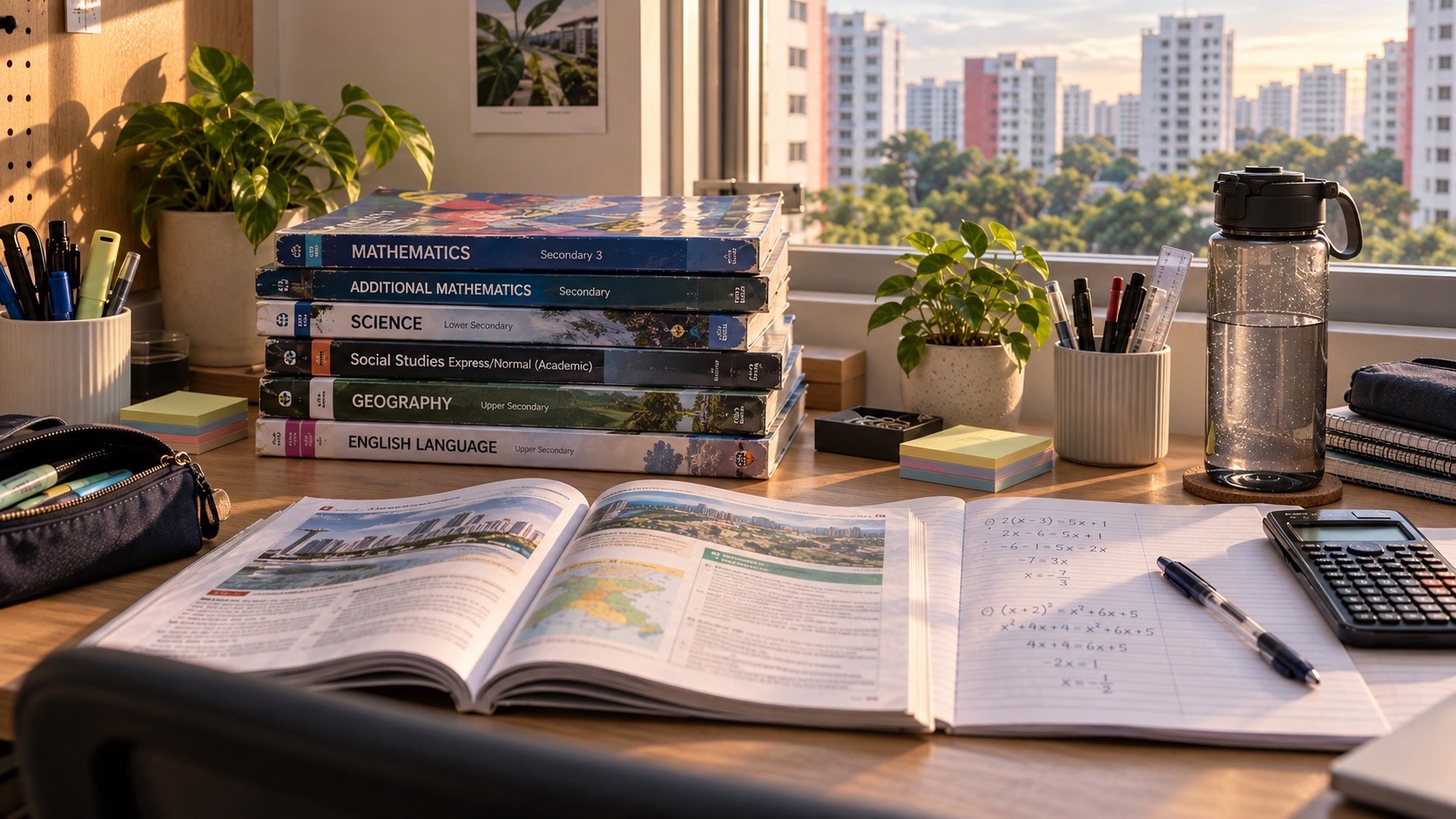
Singapore Math area and circumference of a circle guide for families and teachers outside Singapore. What Primary 6 students learn about circles, semicircles and quarter circles, how Singapore teaches them, and how to practise at home.
A circle is set by one length: its radius.
Everything else, the diameter, the circumference and the area, follows from it.
In Singapore Mathematics, the area and circumference of a circle is a Primary 6 topic. Students find the area and circumference of a circle, the area and perimeter of semicircles and quarter circles, and the area and perimeter of composite figures that combine these with squares, rectangles and triangles.
In Secondary 3 or 4, the same ideas grow into arc length, sector area and radians.
This guide is useful for families and teachers who want to:
- understand what Singapore expects at Primary 6;
- teach circle area and circumference at home in a clear sequence;
- prepare a child who is moving into a Singapore school; or
- support a student using Singapore Math materials in another country.
Quick facts
Level: Primary 6 (Standard Mathematics)
Strand: Measurement and Geometry
Official source: MOE Primary Mathematics Syllabus, the 2021 syllabus first examined at PSLE in 2026
Comes after: Area of a Triangle and Area and Perimeter
Leads to: Arc Length, Sector Area and Radians and Prisms and Cylinders
What Circle Area and Circumference Mean in Singapore Mathematics
The radius r is the distance from the centre of a circle to its edge. The diameter d goes right across through the centre, so d = 2r.
The circumference is the distance around the circle. It is the circle’s perimeter.
For every circle, the circumference divided by the diameter gives the same number, called π (pi). It is a little more than 3.
Circumference = π × d = 2 × π × r.
Area = π × r × r, written πr².
Singapore students meet circles, half circles and quarter circles as shapes in Primary 1. In Primary 6 they measure them.
Where Circles Sit in the Singapore Syllabus
In the current primary syllabus, the area and circumference of a circle is taught in Primary 6 Standard Mathematics.
At Primary 6, students learn:
- the area and circumference of a circle;
- the area and perimeter of a semicircle and a quarter circle; and
- the area and perimeter of composite figures made up of squares, rectangles, triangles, semicircles and quarter circles.
Circles do not appear in the Foundation Mathematics content lists.
| Level | What students do with circles |
|---|---|
| Primary 1 | Identify, name and describe circles, half circles and quarter circles |
| Primary 6 | Area and circumference; semicircles and quarter circles; composite figures |
| Secondary 1 | Volume and surface area of a cylinder |
| Secondary 3 or 4 | Arc length, sector area, area of a segment, radians, and properties of circles |
How Singapore Teaches Circle Area and Circumference
1. Name the parts
Students mark the centre, a radius and a diameter on a drawn circle, and see that the diameter is twice the radius.
2. Measure around
Wrapping a string around a tin and comparing it with the diameter shows that the circumference is a little more than 3 diameters. This is π.
3. Use the circumference formula
Circumference = π × d, or 2 × π × r when the radius is given.
4. Build the area formula
A circle cut into many thin slices and rearranged looks almost like a rectangle. Its length is half the circumference, πr, and its height is r. So the area is πr².
5. Take parts of a circle
A semicircle is half a circle and a quarter circle is a quarter. For perimeter, the straight edges must be added to the curved part.
6. Combine with other shapes
Composite figures join or remove circle parts from squares, rectangles and triangles. Students plan which areas to add and which to subtract.
Worked Examples
Area and circumference of a circle
Question: A circle has a radius of 10 cm. Take π = 3.14. Find its circumference and its area.
Step 1. Circumference = 2 × π × r = 2 × 3.14 × 10.
Step 2. 2 × 10 = 20, and 20 × 3.14 = 62.8 cm.
Step 3. Area = π × r × r = 3.14 × 10 × 10.
Step 4. 10 × 10 = 100, and 100 × 3.14 = 314 cm².
Check: The diameter is 20 cm, and 3 × 20 = 60, so a circumference a little more than 60 cm is reasonable.
Perimeter and area of a semicircle
Question: A semicircle has a diameter of 14 cm. Take π = 22/7. Find its perimeter and its area.
Step 1. The curved edge is half the circumference: 1/2 × 22/7 × 14 = 1/2 × 44 = 22 cm.
Step 2. The straight edge is the diameter, 14 cm.
Step 3. Perimeter = 22 + 14 = 36 cm.
Step 4. The radius is 7 cm. Area = 1/2 × 22/7 × 7 × 7 = 1/2 × 154 = 77 cm².
Check: A full circle of radius 7 cm has an area of 154 cm², and half of that is 77 cm².
The step most often missed is Step 2. The perimeter of a semicircle includes its straight edge.
Common Mistakes
- Mixing up radius and diameter. The child uses the diameter in πr² and gets four times the area. Fix: write r = and d = before any formula.
- Leaving out the straight edges. The perimeter of a semicircle or quarter circle is given as the curved part only. Fix: trace the whole boundary with a finger and list every piece.
- Using 2πr for area or πr² for perimeter. The two formulas are swapped. Fix: area has a squared unit, so its formula has r × r.
- Writing cm for an area. Fix: lengths take cm, areas take cm².
- Using a different value of π from the question. Answers then differ from the expected one. Fix: underline the value of π stated in the question and use only that.
- Rounding too early. In longer calculations, rounding a middle step changes the final answer. Fix: keep full values until the last step.
Teaching Circles Outside Singapore
The formulas are the same in every English-language curriculum. A few points help when you use Singapore materials elsewhere.
- The value of π. Teach your child to use the value of π a question states, such as 3.14 or 22/7, rather than a favourite habit.
- Semicircle and half circle. The Primary 1 content says “half circle” and the Primary 6 content says “semicircle”. They mean the same shape.
- Timing. In Singapore’s current syllabus, circle area and circumference is a Primary 6 topic. Your local curriculum may teach it at a different stage, so decide by readiness rather than age. The Singapore Math Grade Levels guide explains why direct conversions are unreliable.
- Calculators. PSLE Paper 1 does not allow calculators, so multiplying by 3.14 or 22/7 should be manageable on paper. Paper 2 allows calculators.
- Later convention. In G3 Mathematics, unless an answer in terms of π is required, students use the calculator value of π or 3.142.
How to Practise Circles at Home
A short, regular routine works better than one long weekend session.
- Measure the diameter and circumference of three round objects with a string and ruler.
- Divide each circumference by its diameter and notice that the result is always a little over 3.
- Find the circumference and area of one circle given its radius, and one given its diameter.
- Draw a semicircle and a quarter circle and list every edge of each boundary.
- Solve one composite figure question by writing a plan first: add or subtract.
- Once a week, mix circle questions with triangle and rectangle questions.
Ten to fifteen minutes is enough when the work is focused.
Try These
- Find the circumference of a circle with a diameter of 21 cm. Take π = 22/7.
- Find the area of a circle with a radius of 5 cm. Take π = 3.14.
- Find the perimeter of a quarter circle with a radius of 14 cm. Take π = 22/7.
- A square has sides of 10 cm. A quarter circle of radius 10 cm is drawn inside it, centred at one corner. Find the area of the part of the square outside the quarter circle. Take π = 3.14.
Answers
- 66 cm, because 22/7 × 21 = 66.
- 78.5 cm², because 3.14 × 5 × 5 = 78.5.
- 50 cm. The curved edge is 1/4 × 2 × 22/7 × 14 = 22 cm, and the two radii add 28 cm.
- 21.5 cm². The square is 100 cm² and the quarter circle is 1/4 × 3.14 × 10 × 10 = 78.5 cm².
What Comes Next
Circles return several times in secondary school.
- In Secondary 1, Prisms and Cylinders uses the area of a circle as the base of a cylinder.
- In Secondary 3 or 4, Arc Length, Sector Area and Radians takes any fraction of a circle, not only halves and quarters.
- In Secondary 3 or 4, Circle Properties studies chords, tangents and angles in circles.
A student who always starts from the radius usually finds these later topics easier to learn.
Frequently Asked Questions
When do Singapore students learn the area and circumference of a circle?
In the current primary syllabus, it is taught in Primary 6. Circles are first named as shapes in Primary 1.
Are circles part of Foundation Mathematics?
No. Circles do not appear in the Primary 5 or Primary 6 Foundation Mathematics content.
Which value of π should my child use?
The one the question gives. If a question says π = 3.14 or π = 22/7, use exactly that value.
What is the perimeter of a semicircle?
Half the circumference plus the diameter. The straight edge is part of the boundary.
Do primary students learn arc length and sectors?
Only halves and quarters of a circle at Primary 6. Arc length and sector area for any angle are Secondary 3 or 4 content.
Why does the area formula use r²?
Area counts squares, so it needs two lengths multiplied together. In πr², the radius is used twice.
Helpful Reading
- Singapore Mathematics | International Edition: Area of a Triangle
- Singapore Mathematics | International Edition: Arc Length, Sector Area and Radians
- Singapore Mathematics | International Edition: Prisms and Cylinders
- Primary Mathematics: Circles and Composite Figures | Worked Learning Guide
- Why Does My Child Misread Mathematics Diagrams?
- Geometry and Measurement | Mathematics Knowledge Object
- How to Make Sense of the PSLE Mathematics Syllabus
- MOE Primary Mathematics Syllabus
Circles in Singapore Mathematics
Start from the radius.
Around is circumference.
Inside is area.
Count every edge, straight and curved.
Taught this way, circles stop being two formulas to mix up.
They become one length and the ideas that grow from it.
That clarity carries a student from Primary 6 into cylinders, sectors and circle properties.
Ask Bukit Timah Tutor
Bukit Timah Tutor teaches Mathematics in small groups of three students in Singapore.
If your child is learning Singapore Mathematics at home, in an international school or in a Singapore school, and you are unsure where to begin with this topic, send us a short message with the student’s level and one example of the work.
Bukit Timah Tutor
8 Fourth Avenue, Singapore 268674
Near Sixth Avenue MRT
Three-student Mathematics tutorials
By appointment
Properly taught kids shine a bright light into the future.
Singapore Mathematics | International Edition is a Bukit Timah Tutor guide series for families and teachers outside Singapore. It is not a textbook and is not affiliated with MOE, SEAB or any publisher. Syllabus details were checked against MOE and SEAB documents in October 2026. Always confirm current requirements with your school.
← Previous: Singapore Mathematics | International Edition: Volume of Cubes and Cuboids
Next: Singapore Mathematics | International Edition: Angles →
All 100 topics in the International Edition