
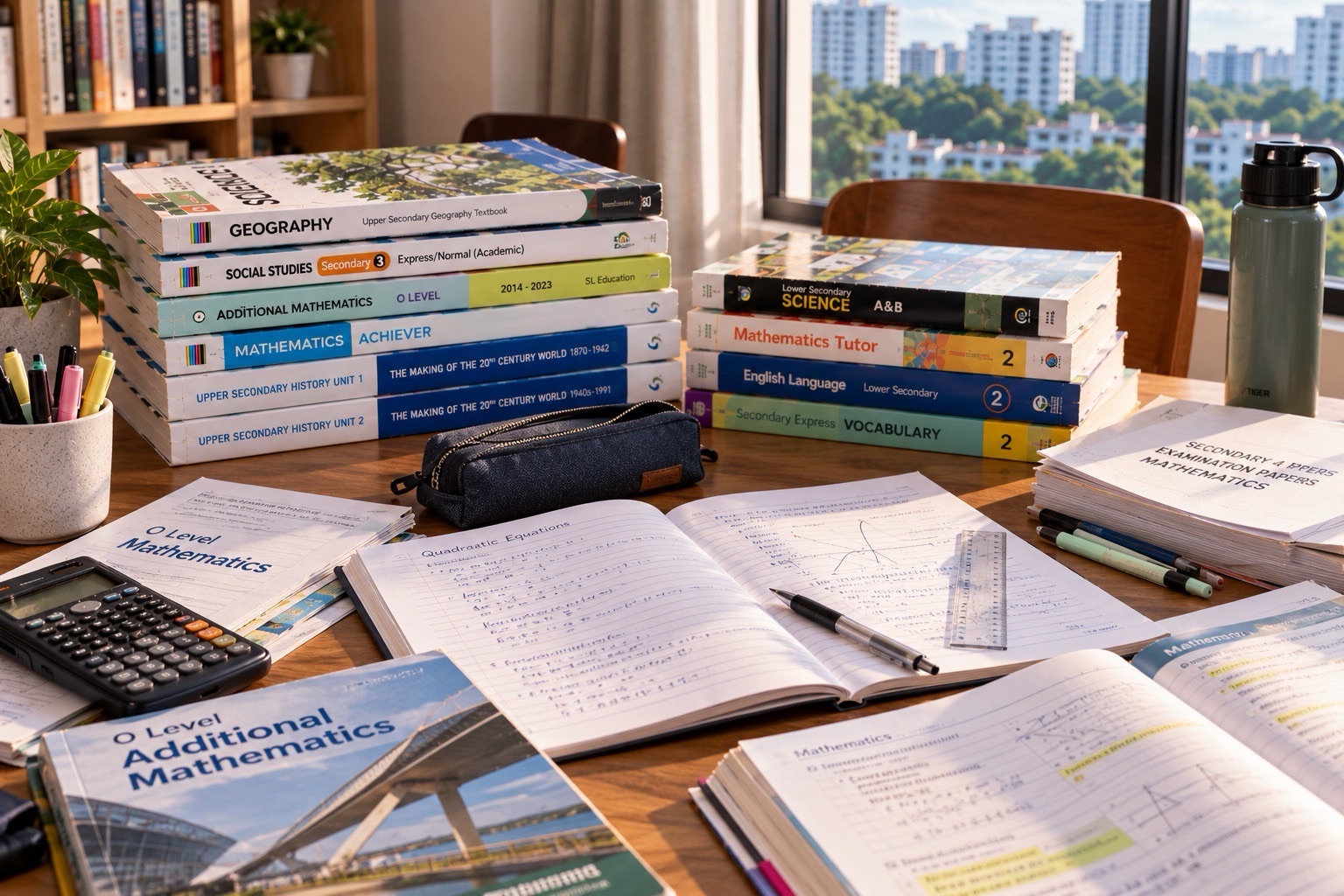
Singapore Math angles guide for families and teachers outside Singapore. What Primary 3, 4 and 5 students learn about angles, perpendicular and parallel lines, how Singapore teaches them, and how to practise at home.
An angle is an amount of turn between two lines that meet.
Children can see it long before they can measure it.
In Singapore Mathematics, angles are taught across three years. In Primary 3, students meet the idea of an angle, right angles, and perpendicular and parallel lines. In Primary 4, they name, measure and draw angles in degrees. In Primary 5, they use angle facts to find unknown angles.
In Secondary 1, these facts extend to angles formed with parallel lines and to angle sums of polygons.
This guide is useful for families and teachers who want to:
- understand what Singapore expects from Primary 3 to Primary 5;
- teach angles at home in a clear sequence;
- prepare a child who is moving into a Singapore school; or
- support a student using Singapore Math materials in another country.
Quick facts
Level: Primary 3, Primary 4 and Primary 5 (Standard Mathematics)
Strand: Measurement and Geometry
Official source: MOE Primary Mathematics Syllabus, the 2021 syllabus first examined at PSLE in 2026
Comes after: 2D and 3D Shapes and Area and Perimeter
Leads to: Triangles, Quadrilaterals and Angles and Parallel Lines
What Angles Mean in Singapore Mathematics
When two straight lines meet at a point, they make an angle. The point is called the vertex, and the lines are the arms.
The size of an angle depends on how far one arm has turned from the other, not on how long the arms are drawn.
A right angle is a quarter turn, like the corner of a page. It measures 90°.
Two lines are perpendicular when they meet at a right angle.
Two lines are parallel when they stay the same distance apart and never meet, however far they are extended.
Angles are measured in degrees. A full turn is 360°, and a half turn, which makes a straight line, is 180°.
Where Angles Sit in the Singapore Syllabus
In the current primary syllabus, angles are taught in Primary 3, Primary 4 and Primary 5.
At Primary 3, students learn:
- the concept of an angle;
- right angles, and angles greater than or smaller than a right angle; and
- to identify and draw perpendicular and parallel lines.
At Primary 4, students learn:
- to name angles using notation such as ∠ABC and ∠a;
- to measure angles in degrees; and
- to draw an angle of a given size.
At Primary 5, students learn:
- angles on a straight line;
- angles at a point;
- vertically opposite angles; and
- to find unknown angles.
| Level | What students do with angles |
|---|---|
| Primary 3 | Concept of angle, right angles, greater or smaller than a right angle, perpendicular and parallel lines |
| Primary 4 | Naming, measuring in degrees and drawing angles |
| Primary 5 | Angles on a straight line, at a point, vertically opposite; unknown angles; angle sum of a triangle |
| Secondary 1 | Right, acute, obtuse and reflex angles; corresponding, alternate and interior angles with parallel lines |
Foundation Mathematics students meet perpendicular and parallel lines, angle notation, measuring and drawing, and the Primary 5 angle facts in Primary 5.
How Singapore Teaches Angles
1. Feel the turn
Children open and close a pair of card strips joined at one end. A bigger opening is a bigger angle, whatever the strip length.
2. Use the right angle as a measure
A folded paper corner makes a right-angle checker. Students test corners in the room: equal to, greater than or smaller than a right angle.
3. Spot perpendicular and parallel lines
Students find them in letters, windows and floor tiles, then draw them on square grids, where the grid lines help.
4. Name and measure
In Primary 4, students name an angle by its three letters, with the vertex in the middle, and measure it with a protractor.
5. Learn three angle facts
Angles on a straight line add up to 180°. Angles at a point add up to 360°. Vertically opposite angles are equal.
6. Find unknown angles
Students choose the fact that fits the diagram, write a short statement and calculate.
Worked Examples
Two crossing lines
Question: Two straight lines cross. One of the four angles formed is 65°. Find the other three.
Step 1. The angle opposite the 65° angle is vertically opposite, so it is also 65°.
Step 2. Each angle next to the 65° angle lies on a straight line with it, so it is 180° − 65° = 115°.
Step 3. The four angles are 65°, 115°, 65° and 115°.
Check: 65 + 115 + 65 + 115 = 360, which matches angles at a point.
Angles at a point
Question: Three angles meet at a point. Two of them are 140° and 95°. Find the third angle, ∠x.
Step 1. Angles at a point add up to 360°.
Step 2. 140° + 95° = 235°.
Step 3. ∠x = 360° − 235° = 125°.
Check: 140 + 95 + 125 = 360.
Writing the angle fact before calculating, such as “angles at a point”, helps the child choose the right total and makes the working easy to follow.
Common Mistakes
- Judging size by arm length. A child thinks an angle drawn with long arms is larger. Fix: compare openings by laying one angle on top of the other.
- Reading the wrong protractor scale. A 50° angle is read as 130°. Fix: start from the 0 on the arm lying along the base line and count up on that scale, then ask whether the angle is smaller or greater than a right angle.
- Putting the vertex letter in the wrong place. ∠BAC and ∠ABC are different angles. Fix: the middle letter is always the vertex.
- Using 180° when the angles are at a point. The answer is off by 180°. Fix: check whether the angles fill a straight line or a full turn.
- Assuming lines are parallel or perpendicular because they look it. Fix: use only the markings and facts given, not the appearance of the drawing.
- Calling slanted lines non-perpendicular. Perpendicular lines do not have to be horizontal and vertical. Fix: test the meeting point with a right-angle checker.
Teaching Angles Outside Singapore
Degree measure is the same across English-language curricula. A few points help when you use Singapore materials elsewhere.
- Angle names. At Primary 3 the syllabus describes angles as greater than or smaller than a right angle. The words acute, obtuse and reflex appear in the Secondary 1 content list.
- Notation. Singapore writes ∠ABC for the angle at B. Some materials write the same angle with a small hat over the B. Both name the vertex in the middle.
- Timing. In Singapore’s current syllabus, angles run from Primary 3 to Primary 5. Your local curriculum may order this differently, so decide by readiness rather than age. The Singapore Math Grade Levels guide explains why direct conversions are unreliable.
- Tools. A ruler, protractor and set square (a plastic right-angled triangle) make measuring and drawing perpendicular and parallel lines easier at home.
- Prerequisites. Unknown-angle questions need subtraction from 180 and 360. Make these quick before Primary 5 work.
How to Practise Angles at Home
A short, regular routine works better than one long weekend session.
- Make a right-angle checker from folded paper and test five corners at home.
- Find two pairs of perpendicular lines and two pairs of parallel lines in the room.
- Draw three angles, estimate each one, then measure with a protractor.
- Draw an angle of a given size, such as 70°, and check it with the protractor.
- Solve two unknown-angle questions, writing the angle fact first.
- Once a week, mix straight-line, point and vertically opposite questions so the child must choose.
Ten to fifteen minutes is enough when the work is focused.
Try These
- Which of these angles are greater than a right angle: 35°, 90°, 120°, 89°?
- Two angles lie on a straight line. One is 72°. Find the other.
- Four angles meet at a point. Three of them are 150°, 80° and 75°. Find the fourth.
- Two straight lines cross. One angle is 38°. Find the angle vertically opposite it and an angle next to it.
Answers
- Only 120°. A right angle is 90°, so 90° itself is not greater.
- 108°, because 180 − 72 = 108.
- 55°. The three angles add up to 305°, and 360 − 305 = 55.
- 38° opposite, and 142° next to it, because 180 − 38 = 142.
What Comes Next
Angles feed almost every later geometry topic.
- In Primary 5, Triangles adds the angle sum of 180°.
- In Primary 5 and 6, Quadrilaterals uses angle facts inside parallelograms, rhombuses and trapeziums.
- In Secondary 1, Angles and Parallel Lines introduces corresponding, alternate and interior angles.
A student who states the angle fact before calculating usually finds these later topics easier to learn.
Frequently Asked Questions
When do Singapore students learn angles?
In the current primary syllabus, angles are taught in Primary 3, Primary 4 and Primary 5. Perpendicular and parallel lines are Primary 3 content.
When do students start measuring angles in degrees?
In Primary 4. Primary 3 compares angles with a right angle without measuring.
What are vertically opposite angles?
When two straight lines cross, the angles directly across from each other are vertically opposite. They are always equal.
Do primary students learn acute, obtuse and reflex angles?
Those three names are listed in the Secondary 1 content. The primary syllabus describes angles as greater or smaller than a right angle and measures them in degrees.
Are angles part of Foundation Mathematics?
Yes. Primary 5 Foundation Mathematics includes perpendicular and parallel lines, angle notation, measuring and drawing, and angles on a straight line, at a point and vertically opposite.
My child measures well but gets unknown angles wrong. Why?
Unknown-angle questions need the right fact first. Ask the child to name the fact, such as “angles on a straight line”, before writing any numbers.
Helpful Reading
- Singapore Mathematics | International Edition: Triangles
- Singapore Mathematics | International Edition: Quadrilaterals
- Singapore Mathematics | International Edition: Angles and Parallel Lines
- Why Does My Child Misread Mathematics Diagrams?
- Geometry and Measurement | Mathematics Knowledge Object
- Secondary Mathematics: Angles, Similarity and Geometric Reasoning
- MOE Primary Mathematics Syllabus
- SEAB PSLE Mathematics (0008) Syllabus
Angles in Singapore Mathematics
Feel the turn first.
Compare with a right angle.
Name the vertex in the middle.
State the fact, then calculate.
Taught this way, angles stop being numbers on a protractor.
They become relationships a child can reason with.
That habit carries a student from Primary 3 into triangles, parallel lines and polygons.
Ask Bukit Timah Tutor
Bukit Timah Tutor teaches Mathematics in small groups of three students in Singapore.
If your child is learning Singapore Mathematics at home, in an international school or in a Singapore school, and you are unsure where to begin with this topic, send us a short message with the student’s level and one example of the work.
Bukit Timah Tutor
8 Fourth Avenue, Singapore 268674
Near Sixth Avenue MRT
Three-student Mathematics tutorials
By appointment
Properly taught kids shine a bright light into the future.
Singapore Mathematics | International Edition is a Bukit Timah Tutor guide series for families and teachers outside Singapore. It is not a textbook and is not affiliated with MOE, SEAB or any publisher. Syllabus details were checked against MOE and SEAB documents in October 2026. Always confirm current requirements with your school.
← Previous: Singapore Mathematics | International Edition: Area and Circumference of a Circle
Next: Singapore Mathematics | International Edition: 2D and 3D Shapes →
All 100 topics in the International Edition