
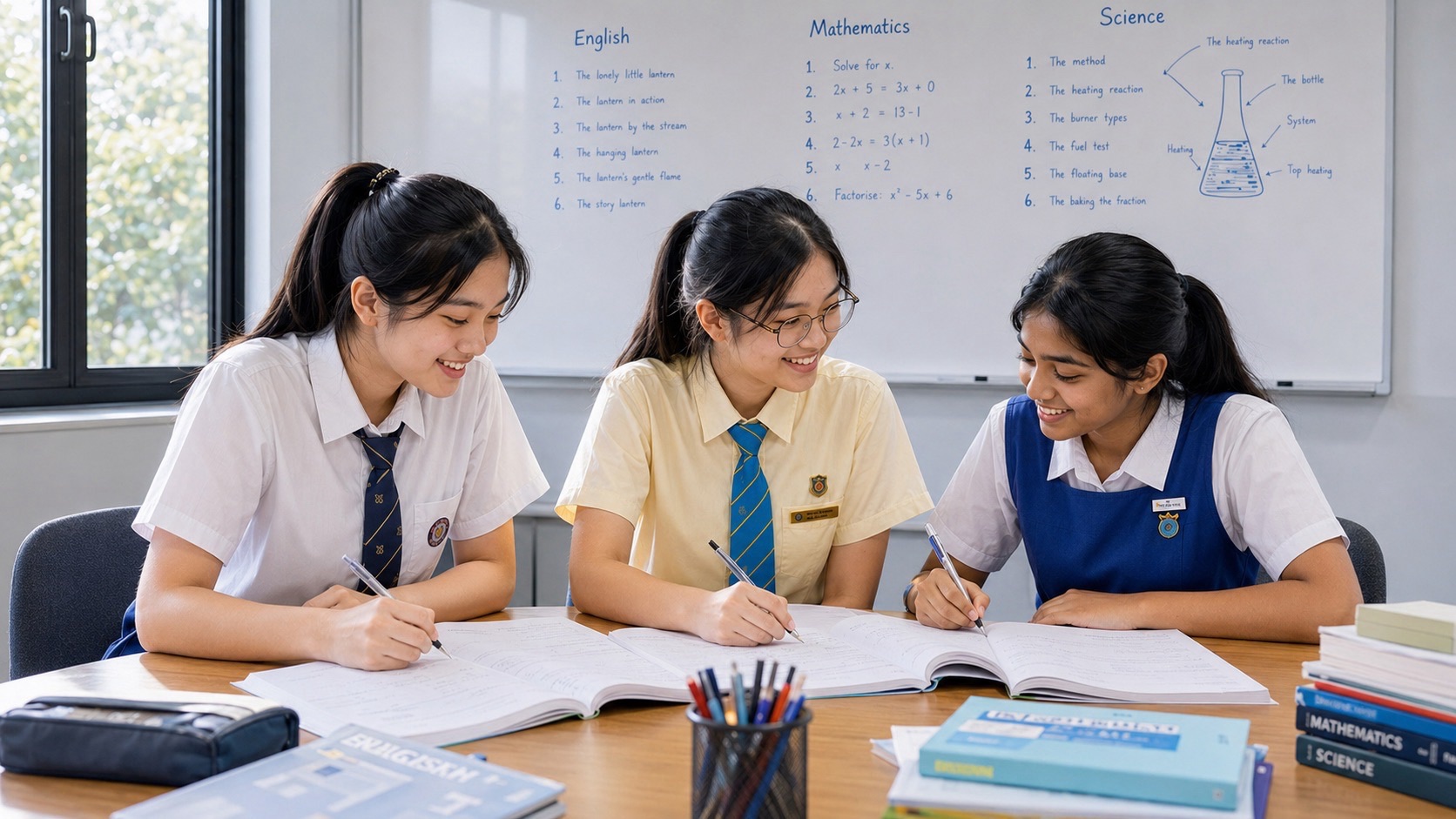
Singapore Math volume of cubes and cuboids guide for families and teachers outside Singapore. What Primary 5 and Primary 6 students learn about volume, how Singapore teaches it with unit cubes and tanks, and how to practise it at home.
Volume is the amount of space a solid takes up.
For a cuboid, it is a count of unit cubes.
In Singapore Mathematics, the volume of cubes and cuboids is a Primary 5 and Primary 6 topic. In Primary 5, students build solids from unit cubes, use cm³ and m³, draw on an isometric grid, and work with liquid in a rectangular tank. In Primary 6, they work backwards from a volume to a missing length, edge or height.
In Secondary 1, volume extends to prisms and cylinders, and conversion between cm³ and m³ is added.
This guide is useful for families and teachers who want to:
- understand what Singapore expects at Primary 5 and Primary 6;
- teach volume at home in a clear sequence;
- prepare a child who is moving into a Singapore school; or
- support a student using Singapore Math materials in another country.
Quick facts
Level: Primary 5 and Primary 6 (Standard Mathematics)
Strand: Measurement and Geometry
Official source: MOE Primary Mathematics Syllabus, the 2021 syllabus first examined at PSLE in 2026
Comes after: Area and Perimeter and Length, Mass and Volume
Leads to: Prisms and Cylinders and Pyramids, Cones and Spheres
What Volume Means in Singapore Mathematics
A unit cube is a cube with edges of 1 unit. A cube with 1 cm edges has a volume of 1 cubic centimetre, written 1 cm³.
The volume of a solid is the number of unit cubes needed to build it.
A cuboid that is 4 cm long, 3 cm wide and 2 cm high holds 2 layers of 4 × 3 = 12 cubes. That is 24 cm³.
So volume of a cuboid = length × breadth × height, and volume of a cube = edge × edge × edge.
Singapore also connects volume with liquid. One cubic centimetre holds 1 ml, so 1000 cm³ holds 1 ℓ. This lets students find how much water a tank holds.
Where Volume Sits in the Singapore Syllabus
In the current primary syllabus, the volume of cubes and cuboids is taught in Primary 5 and Primary 6.
At Primary 5, students learn:
- to build solids with unit cubes;
- to measure volume in cubic units, cm³ or m³;
- to draw cubes and cuboids on an isometric grid;
- the volume of a cube or cuboid;
- to find the volume of liquid in a rectangular tank; and
- the relationship between ℓ (or ml) and cm³.
Conversion between cm³ and m³ is excluded at Primary 5.
At Primary 6, students learn to find:
- one dimension of a cuboid from its volume and the other dimensions;
- the edge of a cube from its volume;
- the height of a cuboid from its volume and base area; and
- the area of a face from the volume and one dimension.
| Level | What students do |
|---|---|
| Primary 2 and 3 | Liquid volume in ℓ and ml, and converting between ℓ and ml |
| Primary 5 | Unit cubes, cm³ and m³, isometric drawing, volume of cube and cuboid, tanks, ℓ and ml with cm³ |
| Primary 6 | A missing dimension, the edge of a cube, height from volume and base area, area of a face |
| Secondary 1 | Volume and surface area of prism and cylinder, conversion between cm³ and m³ |
| Secondary 2 | Volume and surface area of pyramid, cone and sphere |
Foundation Mathematics students meet unit cubes, cm³ and m³ and the isometric grid in Primary 5, then cube and cuboid volume, tanks and ℓ or ml with cm³ in Primary 6.
How Singapore Teaches Volume
1. Build with unit cubes
Students stack interlocking cubes into solids and count them. Volume begins as “how many cubes”.
2. Count in layers
A cuboid is a stack of identical layers. One layer of 4 by 3 has 12 cubes; 2 layers have 24. This is where length × breadth × height comes from.
3. Draw on an isometric grid
Students draw cubes and cuboids on an isometric dot grid so that a flat drawing shows three faces. They learn that some cubes are hidden.
4. Connect cm³ with ml and ℓ
Pouring 1 ℓ of water into a 10 cm by 10 cm by 10 cm container shows that 1000 cm³ = 1 ℓ.
5. Fill a tank
A rectangular tank holds water to a certain depth. The water itself is a cuboid, so its volume is length × breadth × depth of water.
6. Work backwards
In Primary 6, students divide the volume by the base area to find a height, or find the edge of a cube from its volume.
Worked Examples
Water in a rectangular tank
Question: A rectangular tank measures 40 cm by 25 cm by 30 cm high. It is filled with water to a depth of 18 cm. How many litres of water are in the tank?
Step 1. The water forms a cuboid 40 cm by 25 cm by 18 cm.
Step 2. Volume of water = 40 × 25 × 18.
Step 3. 40 × 25 = 1000, and 1000 × 18 = 18 000 cm³.
Step 4. 1000 cm³ = 1 ℓ, so 18 000 cm³ = 18 ℓ.
Check: A full tank holds 40 × 25 × 30 = 30 000 cm³, or 30 ℓ. The water fills 18 cm of the 30 cm height, and 18/30 of 30 ℓ is 18 ℓ.
The height of the tank, 30 cm, is not needed for the answer. Many children use it anyway, so ask which height belongs to the water.
Finding the depth from the volume (Primary 6)
Question: A tank has a base 50 cm by 40 cm. It contains 30 ℓ of water. Find the depth of the water.
Step 1. 30 ℓ = 30 × 1000 = 30 000 cm³.
Step 2. Base area = 50 × 40 = 2000 cm².
Step 3. Depth = volume ÷ base area = 30 000 ÷ 2000 = 15 cm.
Check: 50 × 40 × 15 = 30 000 cm³, which is 30 ℓ.
Common Mistakes
- Adding the dimensions. 8 + 5 + 3 is not a volume. Fix: return to layers of cubes and say “rows times columns times layers”.
- Using the tank height instead of the water depth. The answer is the volume of a full tank. Fix: shade the water on the drawing and use only its height.
- Mixing ℓ and cm³. A child writes 18 000 ℓ. Fix: remember that 1 ℓ = 1000 cm³ and 1 ml = 1 cm³, and check whether the answer is sensible.
- Counting only visible cubes. In a solid drawn on a grid, hidden cubes are missed. Fix: count layer by layer from the bottom.
- Treating 1 m³ as 100 cm³. One cubic metre is 100 cm by 100 cm by 100 cm, which is 1 000 000 cm³. Fix: keep cm³ and m³ apart at primary level; the conversion is Secondary 1 content.
- Writing cm² for a volume. Area and volume units get swapped. Fix: area counts squares (²), volume counts cubes (³).
Teaching Volume Outside Singapore
Singapore uses metric units throughout, so volume is given in cm³, m³, ℓ and ml.
- Cuboid and rectangular prism. Singapore says “cuboid”. In the US, the same solid is usually called a rectangular prism.
- The litre symbol. The Singapore syllabus writes litres as ℓ. You may also see L. Both mean the same unit.
- Timing. In Singapore’s current syllabus, volume of cubes and cuboids is a Primary 5 and Primary 6 topic. Your local curriculum may introduce it at a different stage, so decide by readiness rather than age. The Singapore Math Grade Levels guide explains why direct conversions are unreliable.
- Prerequisites. Volume depends on area of rectangles, multiplication of three numbers and the ℓ and ml conversions from earlier years.
- Calculators. PSLE Paper 1 does not allow calculators, so products such as 40 × 25 × 18 should be manageable on paper. Paper 2 allows them.
How to Practise Volume at Home
A short, regular routine works better than one long weekend session.
- Build cuboids from interlocking cubes and count the cubes in each layer.
- Measure a cereal box or shoe box in cm and find its volume.
- Fill a measuring jug and pour it into a box to see 1000 cm³ as 1 ℓ.
- Draw two cuboids on isometric dot paper.
- Solve one tank question and say aloud which height is the water.
- Once a week, give a volume and two dimensions and ask for the third.
Ten to fifteen minutes is enough when the work is focused.
Try These
- Find the volume of a cuboid 8 cm long, 5 cm wide and 3 cm high.
- A cube has a volume of 64 cm³. Find the length of one edge.
- A tank 30 cm by 20 cm by 25 cm high is full of water. How many litres does it hold?
- A tank has a base area of 600 cm². It contains 4.8 ℓ of water. Find the depth of the water.
Answers
- 120 cm³, because 8 × 5 × 3 = 120.
- 4 cm, because 4 × 4 × 4 = 64.
- 15 ℓ. The volume is 30 × 20 × 25 = 15 000 cm³, and 15 000 cm³ = 15 ℓ.
- 8 cm. 4.8 ℓ = 4800 cm³, and 4800 ÷ 600 = 8.
What Comes Next
Volume of cubes and cuboids opens the way to the rest of mensuration.
- In Secondary 1, Prisms and Cylinders uses the same idea: base area × height.
- In Secondary 2, Pyramids, Cones and Spheres adds new solids and formulas.
- Primary 4 Nets show the faces of a cuboid laid flat, which later supports surface area.
A student who sees volume as layers of cubes usually finds these later topics easier to learn.
Frequently Asked Questions
When do Singapore students learn the volume of cubes and cuboids?
In the current primary syllabus, it is taught in Primary 5 and Primary 6. Primary 6 adds finding a missing dimension.
Do primary students convert between cm³ and m³?
No. Conversion between cm³ and m³ is excluded at Primary 5. It is listed in Secondary 1.
Why does the syllabus link litres and cm³?
Because many problems involve water in a tank. Knowing that 1 ml = 1 cm³ and 1 ℓ = 1000 cm³ lets students move between the two.
What is an isometric grid?
It is a grid of dots arranged in triangles. It lets students draw a cube or cuboid so that three faces are visible.
Is volume part of Foundation Mathematics?
Yes. Foundation students meet unit cubes and the isometric grid in Primary 5, and cube and cuboid volume with tanks in Primary 6.
My child can find the volume but not the height. Why?
Working backwards needs a clear sense that volume = base area × height. Ask the child to find the base area first, then divide.
Helpful Reading
- Singapore Mathematics | International Edition: Length, Mass and Volume
- Singapore Mathematics | International Edition: Area and Perimeter
- Singapore Mathematics | International Edition: Prisms and Cylinders
- Primary Mathematics: Measurement, Units, Perimeter, Area and Volume | Worked Learning Guide
- Why Does My Child Keep Making Mathematics Unit-Conversion Mistakes?
- Geometry and Measurement | Mathematics Knowledge Object
- MOE Primary Mathematics Syllabus
- SEAB PSLE Formats Examined in 2026
Volume in Singapore Mathematics
Cubes first.
Then layers.
Then length × breadth × height.
Know which height belongs to the water.
Taught this way, volume stops being three numbers multiplied together.
It becomes a picture of space being filled.
That picture carries a student from Primary 5 into prisms, cylinders and every later solid.
Ask Bukit Timah Tutor
Bukit Timah Tutor teaches Mathematics in small groups of three students in Singapore.
If your child is learning Singapore Mathematics at home, in an international school or in a Singapore school, and you are unsure where to begin with this topic, send us a short message with the student’s level and one example of the work.
Bukit Timah Tutor
8 Fourth Avenue, Singapore 268674
Near Sixth Avenue MRT
Three-student Mathematics tutorials
By appointment
Properly taught kids shine a bright light into the future.
Singapore Mathematics | International Edition is a Bukit Timah Tutor guide series for families and teachers outside Singapore. It is not a textbook and is not affiliated with MOE, SEAB or any publisher. Syllabus details were checked against MOE and SEAB documents in October 2026. Always confirm current requirements with your school.
← Previous: Singapore Mathematics | International Edition: Area of a Triangle
Next: Singapore Mathematics | International Edition: Area and Circumference of a Circle →
All 100 topics in the International Edition