
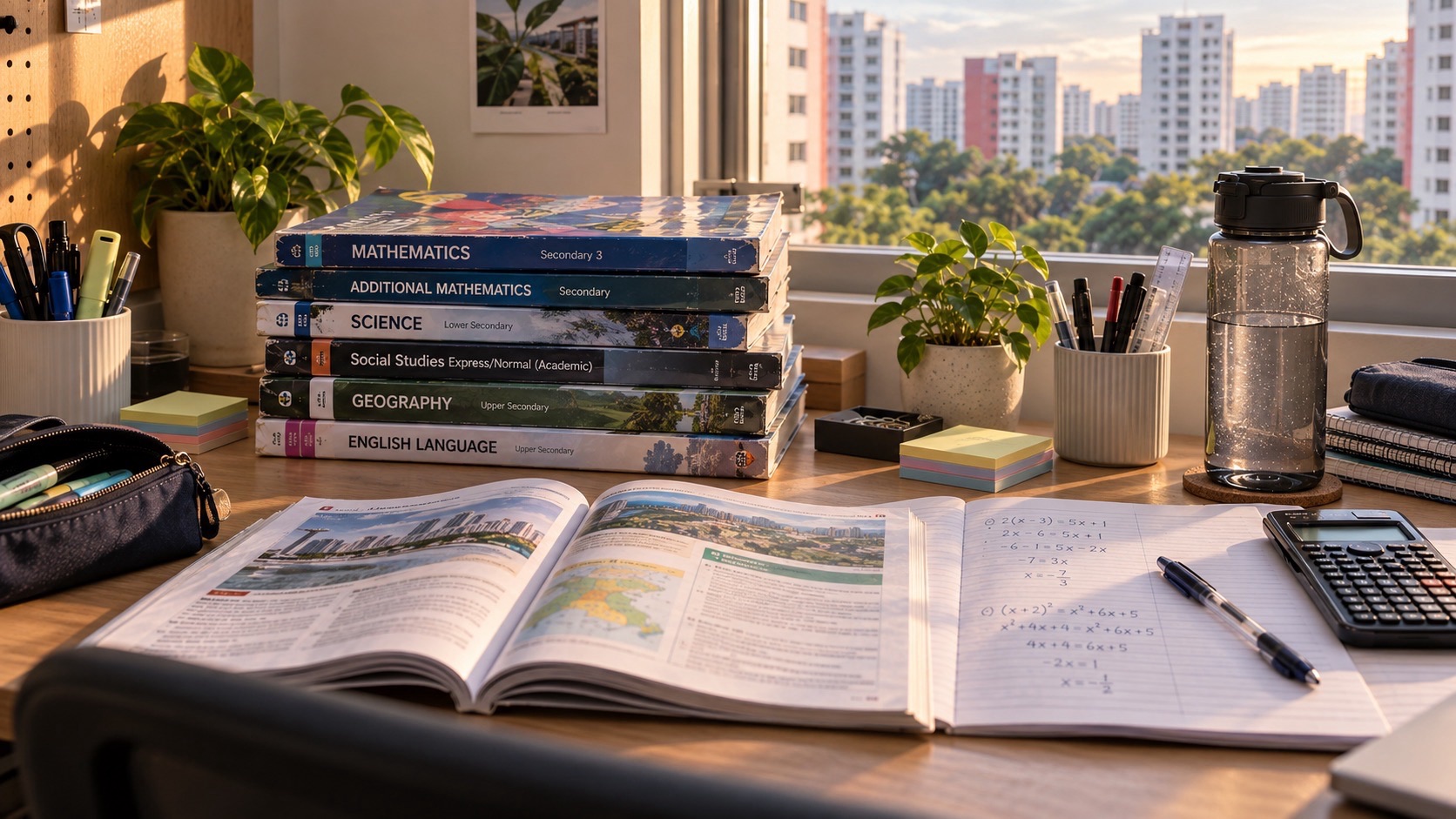
Singapore Math nets guide for families and teachers outside Singapore. What Primary 4 students learn about nets and flat drawings of solids, how Singapore teaches them, and how to practise at home.
A net is a flat shape that folds up to make a solid.
Unfold a cereal box carefully, and the cardboard you see is its net.
In Singapore Mathematics, nets are a Primary 4 topic. Students identify and draw 2D representations of solids, identify the nets of a cube, cuboid, prism and pyramid, and say which solid a given net will form.
In Primary 5, students draw cubes and cuboids on an isometric grid, and in Secondary 1 the faces shown by a net become the surface area of a solid.
This guide is useful for families and teachers who want to:
- understand what Singapore expects at Primary 4;
- teach nets at home in a clear sequence;
- prepare a child who is moving into a Singapore school; or
- support a student using Singapore Math materials in another country.
Quick facts
Level: Primary 4 (common to all students)
Strand: Measurement and Geometry
Official source: MOE Primary Mathematics Syllabus, the 2021 syllabus first examined at PSLE in 2026
Comes after: 2D and 3D Shapes and Line Symmetry
Leads to: Volume of Cubes and Cuboids and Prisms and Cylinders
What Nets Mean in Singapore Mathematics
A solid such as a cube has flat faces joined along edges. If you cut along some of the edges and lay the faces flat, without any face overlapping, you get a net.
A net must fold back into the solid with every face in place and no gaps or overlaps.
A 2D representation of a solid is different. It is a drawing on flat paper that shows what the solid looks like, such as a cube drawn with three faces visible.
Primary 4 students work with both: drawings that show a solid, and nets that build one.
The solids named in this topic are the cube, cuboid, cone, cylinder, prism and pyramid.
A prism has two identical end faces joined by rectangles. A pyramid has one base and triangular faces that meet at a single point.
Where Nets Sit in the Singapore Syllabus
In the current primary syllabus, nets are a Primary 4 topic. The Primary 1 to 4 syllabus is common to all students.
At Primary 4, students learn to:
- identify 2D representations of a cube, cuboid, cone, cylinder, prism and pyramid;
- draw 2D representations of a cube, cuboid, prism and pyramid;
- identify the nets of a cube, cuboid, prism and pyramid; and
- identify the solid that a given net will form.
The cone and cylinder appear only in the first item. The net items name the cube, cuboid, prism and pyramid.
| Level | Related work with solids |
|---|---|
| Primary 2 | Identify, name and classify the cube, cuboid, cone, cylinder and sphere |
| Primary 4 | 2D representations of solids, nets of cube, cuboid, prism and pyramid |
| Primary 5 | Draw cubes and cuboids on an isometric grid; volume of cube and cuboid |
| Secondary 1 | Volume and surface area of prism and cylinder |
| Secondary 2 | Volume and surface area of pyramid, cone and sphere |
How Singapore Teaches Nets
1. Unfold real boxes
Children open out small boxes and see the flat net. They then fold it back and watch the faces return to place.
2. Count and match faces
Before folding, students count the faces and check their shapes. A cube needs 6 squares; a triangular prism needs 2 triangles and 3 rectangles.
3. Predict, then fold
Students look at a possible net, predict whether it will fold into the solid, then cut it out and test.
4. Picture opposite faces
In a cube net, squares that are separated by one square in a straight row become opposite faces. Seeing this helps children reject nets that overlap.
5. Draw solids on paper
Students draw cubes, cuboids, prisms and pyramids so that the flat drawing suggests depth, often on dot or square grid paper.
Worked Examples
Is this a net of a cube?
Question: Six squares are arranged as a row of four, with one square above the second square in the row and one square below the third square. Is this a net of a cube?
Step 1. Fold the row of four squares into a loop. They become the four side faces of the cube.
Step 2. The square above the second square folds down to become the top.
Step 3. The square below the third square folds up to become the bottom.
Step 4. Every face has a place and none overlap, so yes, it is a net of a cube.
Check: If both extra squares were above the row, they would both fold to the top. The cube would have no bottom, so that arrangement is not a net.
Which solid does the net form?
Question: One net has 2 triangles and 3 rectangles. Another has 1 square and 4 triangles. Name the solid each one forms.
Step 1. The first net has two identical end faces, the triangles, joined by rectangles. That is a prism with triangular ends: a triangular prism.
Step 2. The second net has one base, the square, and triangles that will meet at a point. That is a pyramid with a square base: a square pyramid.
Check: A triangular prism has 5 faces: 2 + 3 = 5. A square pyramid also has 5 faces: 1 + 4 = 5. The face count alone does not tell them apart, but the shapes of the faces do.
Common Mistakes
- Thinking six squares always make a cube. Six squares in a 2 by 3 block cannot fold into a cube. Fix: fold and test, and remember that only three faces of a cube meet at each corner.
- Mixing up prisms and pyramids. Fix: a prism has two matching ends joined by rectangles; a pyramid has one base and triangles meeting at a point.
- Ignoring face sizes in a cuboid net. Faces that should meet along an edge have different edge lengths, so the net cannot close. Fix: check that matching edges are the same length.
- Missing overlaps. Two squares fold onto the same face. Fix: label the squares top, bottom, front, back, left and right before folding.
- Counting only the faces in a drawing. A drawing of a cube shows three faces, so the child expects a net of three squares. Fix: hold a real cube and count all six faces.
- Expecting only one net. A cube has 11 different nets. Fix: find several by experiment rather than memorising one.
Teaching Nets Outside Singapore
The idea of a net is the same across English-language curricula. A few points help when you use Singapore materials elsewhere.
- Cuboid and rectangular prism. Singapore says “cuboid”. In the US, the same solid is usually called a rectangular prism.
- Naming prisms and pyramids. Both are named by the shape of their base or end face: a triangular prism, a square pyramid.
- Timing. In Singapore’s current syllabus, nets are a Primary 4 topic. Your local curriculum may introduce them at a different stage, so decide by readiness rather than age. The Singapore Math Grade Levels guide explains why direct conversions are unreliable.
- Prerequisites. Children need the Primary 2 solids and secure names for squares, rectangles and triangles.
- Materials. Card, scissors and tape are worth more here than worksheets. Folding builds the picture that later questions depend on.
How to Practise Nets at Home
A short, regular routine works better than one long weekend session.
- Unfold an empty box along its edges and lay the net flat.
- Draw a cube net on square grid paper, cut it out and fold it.
- Draw three six-square shapes and predict which will fold into a cube, then test each one.
- Build a triangular prism and a square pyramid from card nets.
- Draw a cube and a cuboid on dot or square grid paper so that three faces show.
- Once a week, show a net and ask which solid it forms before folding.
Ten to fifteen minutes is enough when the work is focused and hands-on.
Try These
- How many squares are in the net of a cube?
- A net has 1 square and 4 triangles. Which solid does it form?
- A net has 2 triangles and 3 rectangles. Which solid does it form?
- Six squares are arranged in a block 2 squares high and 3 squares wide. Is this a net of a cube?
Answers
- 6, one for each face of the cube.
- A square pyramid. The square is the base and the four triangles meet at the top.
- A triangular prism. The triangles are the two ends and the rectangles join them.
- No. Four squares in a 2 by 2 block would all need to fold around one corner, but only three faces of a cube meet at a corner.
What Comes Next
Nets prepare students for measuring solids.
- In Primary 5, Volume of Cubes and Cuboids adds isometric drawing and measuring the space inside.
- In Secondary 1, Prisms and Cylinders finds surface area by adding the areas of all the faces a net shows.
- In Secondary 2, Pyramids, Cones and Spheres finds volume and surface area of further solids.
A child who can fold a net in their head usually finds these later topics easier to learn.
Frequently Asked Questions
When do Singapore students learn nets?
In the current primary syllabus, nets are taught in Primary 4. Students identify nets of the cube, cuboid, prism and pyramid.
Do Primary 4 students learn nets of cones and cylinders?
The syllabus lists the cone and cylinder for identifying 2D representations. The net items name only the cube, cuboid, prism and pyramid.
What is a 2D representation of a solid?
It is a flat drawing that shows what the solid looks like, such as a cube drawn with its top, front and side faces visible.
How many nets does a cube have?
Eleven different nets, not counting ones that are simply turned or flipped versions of each other.
Are nets part of Foundation Mathematics?
Nets are Primary 4 content, and the Primary 1 to 4 syllabus is common to all students. They do not appear again in the Foundation lists for Primary 5 and 6.
My child finds nets hard to picture. What helps?
Cutting and folding real nets. After enough folding, most children begin to picture the result before they fold.
Helpful Reading
- Singapore Mathematics | International Edition: 2D and 3D Shapes
- Singapore Mathematics | International Edition: Volume of Cubes and Cuboids
- Singapore Mathematics | International Edition: Prisms and Cylinders
- Primary Mathematics: Nets and 3D Visualisation | Worked Learning Guide
- Secondary Mathematics: Pyramids, Prisms, Nets, Slant Heights and Mensuration
- Geometry and Measurement | Mathematics Knowledge Object
- MOE Primary Mathematics Syllabus
Nets in Singapore Mathematics
Unfold it.
Count the faces.
Predict, then fold.
Check that every face has its own place.
Taught this way, nets stop being puzzles on a worksheet.
They become a way of seeing a solid from the inside out.
That picture carries a student from Primary 4 into volume and surface area.
Ask Bukit Timah Tutor
Bukit Timah Tutor teaches Mathematics in small groups of three students in Singapore.
If your child is learning Singapore Mathematics at home, in an international school or in a Singapore school, and you are unsure where to begin with this topic, send us a short message with the student’s level and one example of the work.
Bukit Timah Tutor
8 Fourth Avenue, Singapore 268674
Near Sixth Avenue MRT
Three-student Mathematics tutorials
By appointment
Properly taught kids shine a bright light into the future.
Singapore Mathematics | International Edition is a Bukit Timah Tutor guide series for families and teachers outside Singapore. It is not a textbook and is not affiliated with MOE, SEAB or any publisher. Syllabus details were checked against MOE and SEAB documents in October 2026. Always confirm current requirements with your school.
← Previous: Singapore Mathematics | International Edition: Line Symmetry
Next: Singapore Mathematics | International Edition: Graphs and Charts →
All 100 topics in the International Edition