
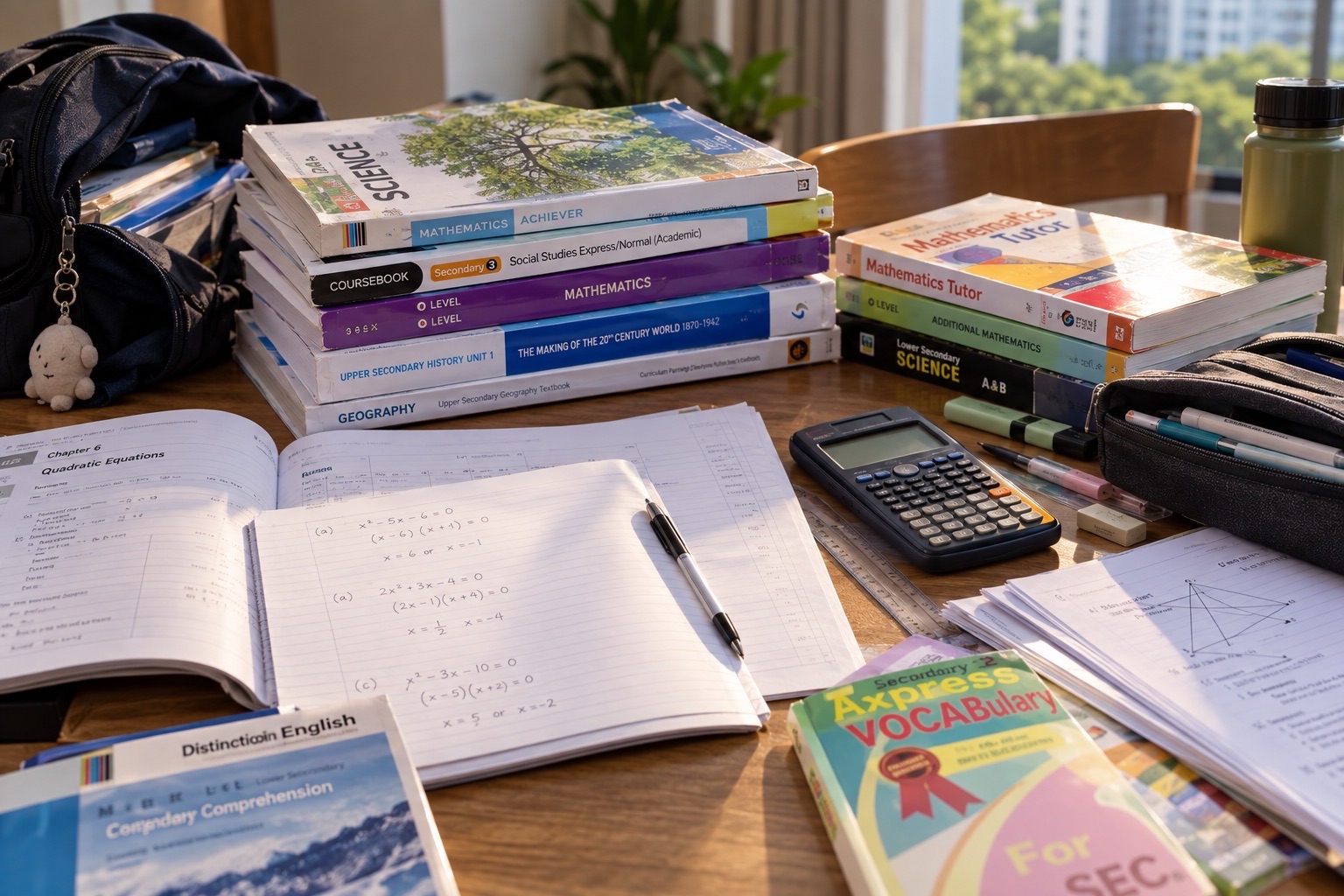
Singapore Math quadratic functions and inequalities guide for families and teachers outside Singapore. What Secondary 3 and 4 Additional Mathematics students learn about maximum and minimum values, conditions on roots, and solving quadratic inequalities.
A quadratic can be solved, but it can also be studied.
Additional Mathematics asks students to do both.
In Singapore Mathematics, G3 Mathematics already teaches students to solve quadratic equations and draw their graphs. Additional Mathematics, an elective in Secondary 3 and 4, goes further: completing the square to find maximum and minimum values, deciding when a quadratic is always positive, testing how many roots an equation has, and solving quadratic inequalities.
These ideas return in coordinate geometry, calculus and H2 Mathematics.
This guide is useful for families and teachers who want to:
- understand what Singapore expects in Additional Mathematics;
- teach quadratic functions and inequalities at home in a clear sequence;
- prepare a child who is moving into a Singapore secondary school; or
- support a student using Singapore Math materials in another country.
Quick facts
Level: Secondary 3 to 4, G3 Additional Mathematics (an elective)
Strand: Algebra
Official source: SEAB G3 Additional Mathematics Syllabus K341 (from 2027), with the same content as O-Level Additional Mathematics 4049 (2026)
Comes after: Quadratic Equations and Quadratic Graphs in G3 Mathematics
Leads to: Surds and Differentiation
What Quadratic Functions Mean in Additional Mathematics
A quadratic function has the form y = ax² + bx + c, where a ≠ 0.
Its graph is a curve with one turning point. If a > 0, the turning point is a minimum. If a < 0, it is a maximum.
Completing the square rewrites the function as y = a(x − h)² + k. The turning point is then (h, k), and the maximum or minimum value is k.
The expression b² − 4ac, usually called the discriminant, decides how many real roots ax² + bx + c = 0 has:
- b² − 4ac > 0: two real roots (two different roots);
- b² − 4ac = 0: two equal roots; and
- b² − 4ac < 0: no real roots.
The syllabus describes these conditions rather than naming the discriminant, but the condition is the same.
The same test answers questions about a line and a curve. Substitute the line into the curve to get one quadratic equation. Two real roots mean the line meets the curve at two points, equal roots mean it is a tangent, and no real roots mean it does not meet the curve.
Where Quadratic Functions and Inequalities Sit in the Singapore Syllabus
Additional Mathematics is an elective for students with an aptitude and interest in mathematics. MOE’s syllabus covers Secondary 3 to 4, and it assumes knowledge of G3 Mathematics.
Under Quadratic functions, students learn:
- finding the maximum or minimum value of a quadratic function using the method of completing the square;
- conditions for y = ax² + bx + c to be always positive (or always negative); and
- using quadratic functions as models.
Under Equations and inequalities, students learn:
- conditions for a quadratic equation to have two real roots, two equal roots or no real roots;
- the related conditions for a given line to intersect a given curve, be a tangent to it, or not intersect it;
- solving simultaneous equations in two variables by substitution, with one of the equations being linear; and
- solving quadratic inequalities, and representing the solution on the number line.
| Course | Quadratic content |
|---|---|
| G3 Mathematics, Secondary 2 | Factorising and solving by factorisation; graphs of y = ax² + bx + c |
| G3 Mathematics, Secondary 3 or 4 | Quadratic formula; completing the square for y = x² + px + q; sketching in given forms |
| G3 Additional Mathematics, Secondary 3 to 4 | Maximum and minimum values; always positive or negative; root conditions; line and curve; quadratic inequalities |
Both Additional Mathematics papers allow an approved calculator, and the formula list includes the quadratic formula.
How Singapore Teaches Quadratic Functions and Inequalities
1. Complete the square with a = 1
Students start from x² + 6x + 11 = (x + 3)² + 2, so the minimum value is 2 when x = −3.
2. Extend to any a
Take a out of the x terms first, complete the square inside the bracket, then multiply back.
3. Link the form to the graph
The sign of a gives the shape. The completed-square form gives the turning point. Students sketch to check.
4. Test the roots
Calculate b² − 4ac and decide between two real roots, equal roots or none. For “always positive”, require a > 0 and b² − 4ac < 0.
5. Bring lines and curves together
Substitute the linear equation into the curve, rearrange to one quadratic equal to 0, then apply the root condition.
6. Solve inequalities with a sketch
Factorise, find the roots, sketch the curve and read off where it lies above or below the x-axis. Show the answer on a number line.
Worked Examples
Maximum value by completing the square
Question: Find the maximum value of y = −2x² + 8x + 3 and the value of x at which it occurs.
Step 1. Take −2 out of the x terms: y = −2(x² − 4x) + 3.
Step 2. Complete the square inside: x² − 4x = (x − 2)² − 4.
Step 3. y = −2[(x − 2)² − 4] + 3 = −2(x − 2)² + 8 + 3 = −2(x − 2)² + 11.
Step 4. Since −2(x − 2)² is never positive, the maximum value is 11, when x = 2.
Check: At x = 2, y = −8 + 16 + 3 = 11.
A line that does not meet a curve
Question: Find the range of values of k for which the line y = 2x + k does not meet the curve y = x² + 4x + 6.
Step 1. Substitute: x² + 4x + 6 = 2x + k.
Step 2. Rearrange: x² + 2x + (6 − k) = 0.
Step 3. No intersection means no real roots: b² − 4ac < 0.
Step 4. 2² − 4(1)(6 − k) < 0, so 4 − 24 + 4k < 0, so 4k < 20, so k < 5.
Check: When k = 5, the equation is x² + 2x + 1 = (x + 1)² = 0, which has equal roots, so the line is a tangent. Values below 5 move the line away from the curve.
A quadratic inequality
Question: Solve x² − x − 6 > 0.
Step 1. Factorise: (x − 3)(x + 2) > 0.
Step 2. The roots are x = −2 and x = 3.
Step 3. The curve opens upwards, so it is above the x-axis outside the roots.
Step 4. x < −2 or x > 3. On a number line, draw open circles at −2 and 3, with arrows pointing outwards.
Check: x = 4 gives 16 − 4 − 6 = 6 > 0, and x = 0 gives −6, which is not greater than 0.
Common Mistakes
- Not multiplying back by a. In −2(x² − 4x), the −4 from completing the square becomes +8 outside the bracket. Fix: expand the final form to check it matches the original.
- Wrong sign for the turning point. (x − 2)² + 11 has its turning point at x = 2, not x = −2. Fix: ask which x makes the bracket zero.
- Using b² − 4ac before rearranging. The condition only works on one quadratic equal to 0. Fix: collect every term on one side first.
- Mixing up “real” and “two real” roots. “Real roots” in a question allows equal roots, so it means b² − 4ac ≥ 0. Fix: read the wording and choose > or ≥ deliberately.
- Reversing an inequality answer. Students write −2 < x < 3 for (x − 3)(x + 2) > 0. Fix: sketch the curve and shade where it is above the axis.
- Writing an impossible inequality. “3 < x < −2” describes no numbers. Fix: write “x < −2 or x > 3”.
Teaching Quadratic Functions Outside Singapore
The mathematics is standard. The course structure and wording may be unfamiliar.
- Additional Mathematics. In Singapore this is a separate elective in Secondary 3 and 4. Mathematics is compulsory at upper secondary, so students who take Additional Mathematics study both subjects.
- The discriminant. Singapore’s syllabus describes the conditions in words. Most textbooks call b² − 4ac the discriminant, and this guide uses that name.
- Timing. Your local curriculum may place this content at a different stage, so decide by readiness rather than age. The Singapore Math Placement guide can help.
- Calculators. An approved calculator may be used in both papers, and many calculators can solve quadratics. Omission of essential working loses marks, so the algebra must be written out.
- Prerequisites. Students need fluent factorisation, the quadratic formula and confident sketching of quadratic graphs from G3 Mathematics.
How to Practise Quadratic Functions at Home
A short daily routine builds fluency.
- Complete the square for two quadratics with a = 1 and one with a ≠ 1.
- State the turning point and sketch each graph.
- Calculate b² − 4ac for three equations and say how many real roots each has.
- Solve one line-and-curve question with an unknown constant.
- Solve one quadratic inequality using a sketch and a number line.
- Once a week, check one answer by substituting a value back in.
A sketch beside every inequality saves many marks.
Try These
- Express x² + 6x + 11 in the form (x + a)² + b and state its minimum value.
- Find the values of k for which x² + kx + 9 = 0 has two equal roots.
- Solve x² − 5x + 4 ≤ 0.
- Solve the simultaneous equations y = x + 1 and x² + y² = 25.
- A ball’s height is h = 20t − 5t² metres after t seconds. Find its maximum height.
Answers
- (x + 3)² + 2. The minimum value is 2, when x = −3.
- k = 6 or k = −6, because k² − 36 = 0.
- 1 ≤ x ≤ 4. (x − 1)(x − 4) ≤ 0, and the curve is below or on the axis between the roots.
- x = 3, y = 4 or x = −4, y = −3. Substituting gives 2x² + 2x − 24 = 0, so (x + 4)(x − 3) = 0.
- 20 m. h = −5(t − 2)² + 20, so the maximum is at t = 2.
What Comes Next
Quadratics appear throughout Additional Mathematics.
- Surds give exact roots when b² − 4ac is not a perfect square.
- Coordinate Geometry of Circles uses the same line-and-curve conditions for a line and a circle.
- Differentiation finds maximum and minimum points of curves that are not quadratic.
A student who can complete the square and test the roots without hesitation has the core algebra the course relies on.
Frequently Asked Questions
When do Singapore students learn quadratic functions and inequalities?
In G3 Additional Mathematics, which covers Secondary 3 to 4. The groundwork, solving quadratic equations and drawing their graphs, is in G3 Mathematics from Secondary 2.
Does the syllabus use the word “discriminant”?
No. It describes the conditions for two real, two equal or no real roots. “Discriminant” is the standard name for b² − 4ac, the expression those conditions use.
When is a quadratic always positive?
When a > 0 and b² − 4ac < 0. The curve opens upwards and never touches the x-axis.
Is Additional Mathematics required for H2 Mathematics?
MOE’s H2 Mathematics syllabus lists G3 Additional Mathematics as assumed knowledge. Students without it may still take H2 Mathematics but must bridge the gap during the course.
Are calculators allowed?
Yes. An approved calculator may be used in both Additional Mathematics papers, and the quadratic formula is on the formula list.
Why does my child get inequality answers backwards?
Usually because they skip the sketch. Drawing the curve and shading the required region makes the direction clear.
Helpful Reading
- Singapore Mathematics | International Edition: Quadratic Equations
- Singapore Mathematics | International Edition: Quadratic Graphs
- Singapore Mathematics | International Edition: Surds
- Additional Mathematics Synthesis Guide 21: Quadratic Functions, Completing the Square, Global Bounds and Modelling
- Additional Mathematics Synthesis Guide 22: Simultaneous Equations, Line–Curve Intersections, Discriminants and Tangency Conditions
- Can I Take H2 Mathematics Without Additional Mathematics?
- How to Make Sense of the SEC G3 Additional Mathematics Syllabus
- SEAB G3 Additional Mathematics Syllabus K341
- MOE G2 and G3 Additional Mathematics Syllabuses
Quadratic Functions in Singapore Mathematics
Complete the square.
Read the turning point.
Test the roots.
Sketch before you solve.
Taught this way, a quadratic stops being an equation to grind through.
It becomes a shape a student can reason about.
That habit carries a student into calculus and H2 Mathematics.
Ask Bukit Timah Tutor
Bukit Timah Tutor teaches Mathematics in small groups of three students in Singapore.
If your child is learning Singapore Mathematics at home, in an international school or in a Singapore school, and you are unsure where to begin with this topic, send us a short message with the student’s level and one example of the work.
Bukit Timah Tutor
8 Fourth Avenue, Singapore 268674
Near Sixth Avenue MRT
Three-student Mathematics tutorials
By appointment
Properly taught kids shine a bright light into the future.
Singapore Mathematics | International Edition is a Bukit Timah Tutor guide series for families and teachers outside Singapore. It is not a textbook and is not affiliated with MOE, SEAB or any publisher. Syllabus details were checked against MOE and SEAB documents in October 2026. Always confirm current requirements with your school.
← Previous: Singapore Mathematics | International Edition: Probability
Next: Singapore Mathematics | International Edition: Surds →
All 100 topics in the International Edition