
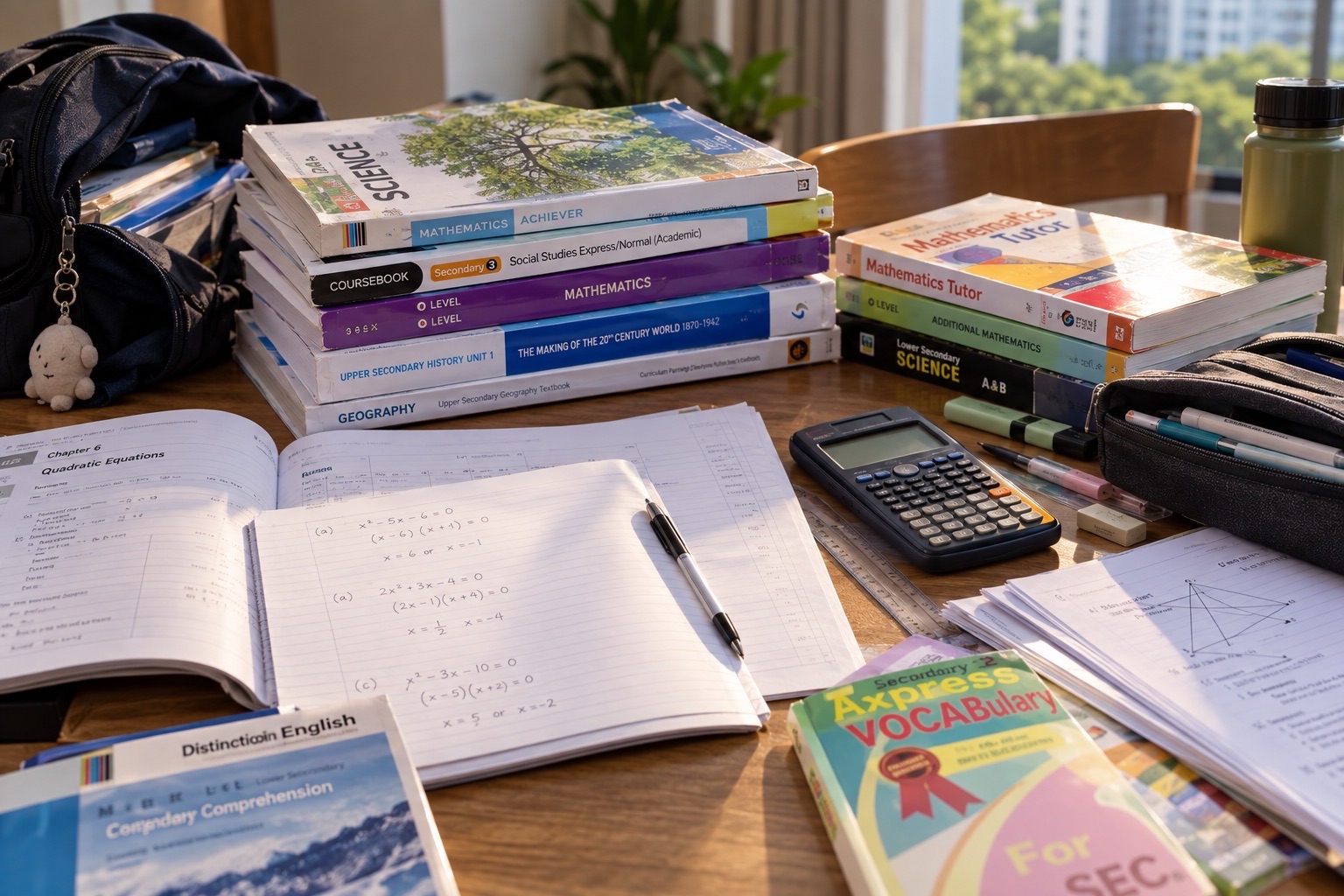
Singapore Math quadratic equations guide for families and teachers outside Singapore. What students learn from Secondary 2 to Secondary 4, the four solving methods, and how to practise them at home.
A quadratic equation has an x² term, and it often has two solutions.
Singapore spreads the methods from Secondary 2 to Secondary 3 or 4, so each one can be learned properly.
In Singapore Mathematics, G3 students solve quadratic equations by factorisation in Secondary 2. In Secondary 3 or 4, they add the quadratic formula, completing the square and the graphical method, and solve fractional equations that reduce to quadratic equations.
Additional Mathematics then studies when a quadratic equation has two real roots, two equal roots or no real roots.
This guide is useful for families and teachers who want to:
- understand when each method appears in the Singapore syllabus;
- teach the methods in a clear order and know when to use each one;
- prepare a student who is moving into a Singapore secondary school; or
- support a student using Singapore Math materials in another country.
Quick facts
Level: Secondary 2 (factorisation) and Secondary 3 or 4 (formula, completing the square, graphs, fractional equations), G3 Mathematics
Strand: Number and Algebra (N7 Equations and inequalities)
Official source: MOE Secondary Mathematics Syllabuses (2020 Secondary 1 cohort onwards) and SEAB G3 Mathematics syllabus K310 for the SEC from 2027 (O-Level 4052 in 2026)
Comes after: Factorisation and Simultaneous Equations
Leads to: Quadratic Graphs and Quadratic Functions and Inequalities
What Quadratic Equations Mean in Singapore Mathematics
A quadratic equation can be written as ax² + bx + c = 0, where a is not zero.
Its solutions are also called roots. x² − 7x + 10 = 0 has two roots, x = 2 and x = 5.
The idea behind factorisation is simple. If two numbers multiply to give 0, at least one of them must be 0.
On a graph, the roots are the x-coordinates of the points where the curve y = ax² + bx + c meets the x-axis.
Students often find this topic heavy because it gathers several methods in one place. The site’s page Why Do Quadratic Equations Feel Like Several Different Topics at Once? explores that experience. This page sets out what Singapore teaches, and when.
Where Quadratic Equations Sit in the Singapore Syllabus
In MOE’s teaching syllabus for G3 Mathematics, quadratic equations are spread over Secondary 2 and Secondary 3 or 4.
| Level | What G3 students learn |
|---|---|
| Secondary 2 | Solving quadratic equations by factorisation |
| Secondary 3 or 4 | Solving quadratic equations by use of the formula |
| Secondary 3 or 4 | Solving by completing the square for y = x² + px + q |
| Secondary 3 or 4 | Solving by the graphical method |
| Secondary 3 or 4 | Solving fractional equations that can be reduced to quadratic equations |
| Secondary 3 or 4 | Formulating a quadratic equation to solve problems |
The syllabus wording for completing the square uses x² + px + q, so the coefficient of x² is 1.
G2 Mathematics also includes quadratic equations, including the Secondary 3 or 4 methods. Sketching quadratic graphs in completed-square and factorised forms is G3-only.
Additional Mathematics adds the conditions for a quadratic equation to have two real roots, two equal roots or no real roots, and solving quadratic inequalities.
How Singapore Teaches Quadratic Equations
1. Rearrange to equal zero
Every method starts from ax² + bx + c = 0. Students first move all the terms to one side.
2. Factorise and use the zero product idea
If (x − 3)(x + 4) = 0, then x − 3 = 0 or x + 4 = 0, so x = 3 or x = −4.
3. Use the formula when factorising fails
x = [−b ± √(b² − 4ac)]/(2a). Non-exact answers are given to 3 significant figures unless the question asks otherwise.
4. Complete the square
x² + px + q is rewritten as (x + p/2)² − (p/2)² + q. This shows where the formula comes from, and it links to sketching graphs given in completed-square form.
5. Solve graphically
Draw y = ax² + bx + c accurately on graph paper and read where it meets the x-axis, or where it meets a given line.
6. Choose a method
Factorise if it works quickly. Otherwise use the formula or completing the square. A graph gives estimates and shows how many roots to expect.
Worked Examples
Factorisation (Secondary 2)
Question: Solve 2x² + 5x = 12.
Step 1. Rearrange to equal zero: 2x² + 5x − 12 = 0.
Step 2. Factorise: (2x − 3)(x + 4) = 0.
Step 3. So 2x − 3 = 0 or x + 4 = 0.
Step 4. x = 1.5 or x = −4.
Check: 2(2.25) + 5(1.5) = 4.5 + 7.5 = 12, and 2(16) + 5(−4) = 32 − 20 = 12.
The formula (Secondary 3 or 4)
Question: Solve x² − 4x − 3 = 0, giving your answers correct to 3 significant figures.
Step 1. Write down a = 1, b = −4 and c = −3.
Step 2. b² − 4ac = (−4)² − 4(1)(−3) = 16 + 12 = 28.
Step 3. x = (4 ± √28)/2.
Step 4. x = 4.65 or x = −0.646, correct to 3 significant figures.
Check: Substitute x = 4.65: 21.6225 − 18.6 − 3 = 0.0225, which is close to 0. The small difference comes from rounding.
Completing the square gives the same roots. x² − 4x − 3 = (x − 2)² − 7, so (x − 2)² = 7 and x = 2 ± √7.
Common Mistakes
- Not rearranging to zero first. x² − 3x = 10 is written as x(x − 3) = 10, giving “x = 10 or x − 3 = 10”. Fix: rearrange to x² − 3x − 10 = 0, then (x − 5)(x + 2) = 0, so x = 5 or x = −2.
- Dividing by x and losing a root. From x² = 5x, students divide by x and find only x = 5. Fix: write x² − 5x = 0, so x(x − 5) = 0, and x = 0 or x = 5.
- Formula sign errors with a negative b. For x² − 4x − 3 = 0, students use −b = −4. Fix: write b = −4 first, so −b = 4.
- Squaring a negative b wrongly. Fix: (−4)² = 16, not −16. Use brackets when entering it on a calculator.
- Rounding too early. Fix: keep the full calculator value of the square root until the last step, then round to 3 significant figures.
- Keeping an impossible answer. A length of −4 cm cannot be correct. Fix: check each root against the context and say which root is rejected and why.
Teaching Quadratic Equations Outside Singapore
A few points are worth knowing when you use Singapore materials elsewhere.
- Terminology. “Roots” and “solutions” mean the same here. Singapore writes “factorise” where US materials write “factor”.
- Timing. Singapore spreads the methods from Secondary 2 to Secondary 3 or 4. Your local course may teach them together. The Singapore Math Grade Levels guide explains why direct grade conversions are unreliable.
- The formula. The formula list printed in the G3 Mathematics syllabus covers compound interest, mensuration, trigonometry and statistics, so students should know the quadratic formula themselves. In Additional Mathematics, the quadratic formula is on the list provided.
- Calculators. An approved calculator may be used in both G3 Mathematics papers. Students still write the substitution into the formula, because “Omission of essential working will result in loss of marks.”
- Completing the square. In Additional Mathematics, completing the square is also used to find the maximum or minimum value of a quadratic function.
How to Practise Quadratic Equations at Home
A short, regular routine works better than one long weekend session.
- Rearrange three equations so that one side is zero.
- Solve two by factorisation, checking each root in the original equation.
- For students in Secondary 3 or 4, solve one with the formula, writing a, b and c first.
- Solve the same equation by completing the square and compare the answers.
- Plot or sketch one graph and read off the roots.
- Once a week, try one word problem that leads to a quadratic and decide which root to reject.
Ten to fifteen minutes is enough when the work is focused.
Try These
- Solve x² + 2x − 15 = 0.
- Solve 3x² = 12x.
- Solve x² + 6x + 2 = 0 by completing the square, giving your answers correct to 3 significant figures.
- A rectangle has width x cm, length (x + 3) cm and area 40 cm². Find x.
Answers
- x = −5 or x = 3, since (x + 5)(x − 3) = 0.
- x = 0 or x = 4, since 3x² − 12x = 3x(x − 4) = 0. Dividing by x would lose x = 0.
- x = −0.354 or x = −5.65. The equation becomes (x + 3)² − 7 = 0, so x = −3 ± √7.
- x = 5. x(x + 3) = 40 gives x² + 3x − 40 = 0, so (x + 8)(x − 5) = 0. The root x = −8 is rejected because a width cannot be negative.
What Comes Next
- Quadratic Graphs studies the graph of y = ax² + bx + c in Secondary 2. In Secondary 3 or 4, G3 students sketch graphs in forms such as y = (x − p)² + q.
- In Additional Mathematics, Quadratic Functions and Inequalities covers the conditions for real roots and quadratic inequalities.
- Exact roots such as 2 ± √7 lead into Surds in Additional Mathematics.
A student who can choose a method and check the roots is well prepared for each of these.
Frequently Asked Questions
When do Singapore students learn quadratic equations?
Factorisation is Secondary 2. The formula, completing the square, the graphical method and fractional equations that reduce to quadratics are Secondary 3 or 4, in G3 Mathematics.
Is the quadratic formula given in the examination?
Not in G3 Mathematics, whose printed formula list covers compound interest, mensuration, trigonometry and statistics. In Additional Mathematics, the quadratic formula is on the list provided.
Which method should my child use?
Try factorisation first. If no factor pair works quickly, use the formula. Use completing the square when the question asks for it, or when it gives a neat exact answer.
Why does completing the square matter if the formula always works?
It shows where the formula comes from. The completed-square form y = (x − p)² + q also gives the turning point of the graph, and G3 students sketch graphs in this form in Secondary 3 or 4.
Are quadratic equations in G2 Mathematics?
Yes, including the Secondary 3 or 4 methods. Sketching quadratic graphs in completed-square and factorised forms is G3-only.
What is a fractional equation that reduces to a quadratic?
An equation such as 2/x + 3/(x + 1) = 2. Multiplying every term by x(x + 1) gives 2x² − 3x − 2 = 0, so (2x + 1)(x − 2) = 0 and x = −1/2 or x = 2.
Helpful Reading
- Singapore Mathematics | International Edition: Factorisation
- Singapore Mathematics | International Edition: Quadratic Graphs
- Singapore Mathematics | International Edition: Quadratic Functions and Inequalities
- Why Do Quadratic Equations Feel Like Several Different Topics at Once?
- Secondary Mathematics: Quadratic Equations, Factorisation and Roots
- Secondary Mathematics: Fractional Equations, Denominator Restrictions and Quadratic Reduction
- MOE Secondary Mathematics Syllabuses (2020)
- SEAB G3 Mathematics Syllabus K310
Quadratic Equations in Singapore Mathematics
Make one side zero.
Factorise if you can.
Use the formula when you cannot.
Complete the square to see the structure.
Check every root, and reject the ones the context rules out.
Taught this way, quadratic equations stop feeling like four separate topics.
They become one problem with several tools, and that choice carries a student into graphs, Additional Mathematics and beyond.
Ask Bukit Timah Tutor
Bukit Timah Tutor teaches Mathematics in small groups of three students in Singapore.
If your child is learning Singapore Mathematics at home, in an international school or in a Singapore school, and you are unsure where to begin with this topic, send us a short message with the student’s level and one example of the work.
Bukit Timah Tutor
8 Fourth Avenue, Singapore 268674
Near Sixth Avenue MRT
Three-student Mathematics tutorials
By appointment
Properly taught kids shine a bright light into the future.
Singapore Mathematics | International Edition is a Bukit Timah Tutor guide series for families and teachers outside Singapore. It is not a textbook and is not affiliated with MOE, SEAB or any publisher. Syllabus details were checked against MOE and SEAB documents in October 2026. Always confirm current requirements with your school.
← Previous: Singapore Mathematics | International Edition: Simultaneous Equations
Next: Singapore Mathematics | International Edition: Linear Inequalities →
All 100 topics in the International Edition