
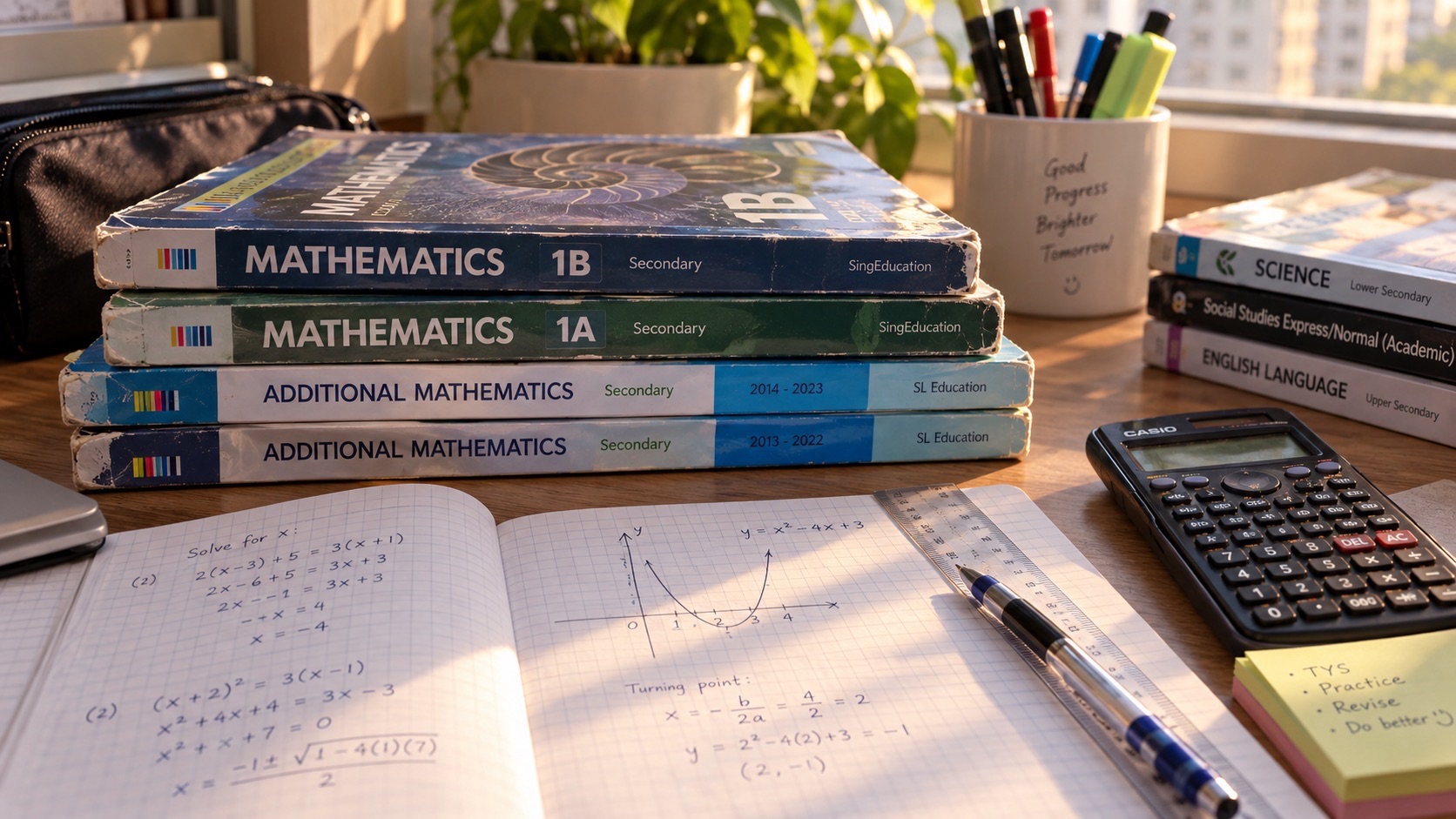
Singapore Math simultaneous equations guide for families and teachers outside Singapore. What Secondary 2 students learn about solving a pair of linear equations by elimination, substitution and graphs, and how to practise at home.
Two unknowns need two facts.
Simultaneous equations supply those two facts and ask for the pair of values that satisfies both.
In Singapore Mathematics, simultaneous linear equations are a Secondary 2 topic in G3 Mathematics. Students solve pairs of linear equations in two variables by substitution, elimination and the graphical method, and form a pair of equations from a word problem.
In Additional Mathematics, the substitution method returns for pairs where only one equation is linear.
This guide is useful for families and teachers who want to:
- understand what Singapore expects in Secondary 2 equations;
- teach the three methods in a clear sequence;
- prepare a student who is moving into a Singapore secondary school; or
- support a student using Singapore Math materials in another country.
Quick facts
Level: Secondary 2 (G3 Mathematics; G2 Mathematics also includes this content)
Strand: Number and Algebra (N7 Equations and inequalities)
Official source: MOE Secondary Mathematics Syllabuses (2020 Secondary 1 cohort onwards) and SEAB G3 Mathematics syllabus K310 for the SEC from 2027 (O-Level 4052 in 2026)
Comes after: Linear Equations and Linear Graphs and Gradient
Leads to: Quadratic Equations and Quadratic Functions and Inequalities
What Simultaneous Equations Mean in Singapore Mathematics
A single equation such as x + y = 10 has many solutions: x = 3 and y = 7, x = 4 and y = 6, x = −1 and y = 11, and so on.
A second equation, such as x − y = 2, narrows the choice. Only x = 6 and y = 4 satisfy both.
“Simultaneous” means that both equations are true at the same time.
On a graph, each linear equation is a straight line. The solution is the point where the two lines meet, here (6, 4).
Many students find it hard at first to see why adding or subtracting two equations is allowed. The site’s page Why Are Simultaneous Equations Difficult to Understand? looks at that question in detail.
Where Simultaneous Equations Sit in the Singapore Syllabus
In MOE’s teaching syllabus for G3 Mathematics, simultaneous linear equations are Secondary 2 content.
At Secondary 2, students learn:
- solving simultaneous linear equations in two variables by substitution and elimination methods;
- solving them by the graphical method;
- drawing graphs of linear equations of the form ax + by = c; and
- formulating a pair of linear equations in two variables to solve problems.
G2 Mathematics also includes simultaneous linear equations.
| Level | What students do |
|---|---|
| Secondary 1 | Linear equations in one variable; graphs of y = ax + b |
| Secondary 2 | Pairs of linear equations by substitution, elimination and graphs; graphs of ax + by = c |
| Additional Mathematics | Simultaneous equations in two variables by substitution, with one of the equations being linear |
| H2 Mathematics | Solving a system of linear equations using a graphing calculator or graphing software |
How Singapore Teaches Simultaneous Equations
1. Start with a table of values
Students list pairs that satisfy x + y = 10 and pairs that satisfy x − y = 2, then find the pair that appears in both lists.
2. Eliminate one unknown
Add or subtract the equations so that one letter disappears. If needed, multiply one or both equations first so the coefficients match.
3. Substitute
Make one letter the subject of one equation and substitute it into the other. This works well when a coefficient is 1.
4. Solve graphically
Draw both lines on the same axes and read the point of intersection. This links the algebra to Linear Graphs and Gradient.
5. Form equations from words
Choose two letters, write two equations from two facts, and solve.
6. Check in both equations
A solution must satisfy both original equations, not just one of them.
Seeing the same answer from a table, from algebra and from a graph is what makes the idea stick.
Worked Examples
Elimination
Question: Solve 3x + 2y = 16 and 5x − 3y = 14.
Step 1. Multiply the first equation by 3: 9x + 6y = 48.
Step 2. Multiply the second equation by 2: 10x − 6y = 28.
Step 3. Add the two new equations, so the y terms cancel: 19x = 76, so x = 4.
Step 4. Substitute x = 4 into the first equation: 12 + 2y = 16, so y = 2.
Check: 3(4) + 2(2) = 16 and 5(4) − 3(2) = 14.
Forming and solving a pair of equations
Question: At a school fair, 3 drinks and 2 sandwiches cost $13. 1 drink and 4 sandwiches cost $16. Find the cost of one drink and one sandwich.
Step 1. Let one drink cost $d and one sandwich cost $s. Then 3d + 2s = 13 and d + 4s = 16.
Step 2. From the second equation, d = 16 − 4s.
Step 3. Substitute into the first: 3(16 − 4s) + 2s = 13, so 48 − 10s = 13.
Step 4. 10s = 35, so s = 3.5. Then d = 16 − 4(3.5) = 2.
Check: 3 × $2 + 2 × $3.50 = $13, and $2 + 4 × $3.50 = $16.
A drink costs $2 and a sandwich costs $3.50. The answer is given in dollars and cents, in the context of the question.
Common Mistakes
- Adding when the equations should be subtracted. With 2x + 3y = 12 and 2x + y = 8, students add and still have x. Fix: if the matching coefficients have the same sign, subtract. If they have opposite signs, add.
- Multiplying only one side. Students multiply the left-hand side of an equation by 3 but not the right. Fix: multiply every term, including the number on the right.
- Sign errors when subtracting a whole equation. (5x − 2y) − (3x − 2y) is treated as leaving −4y. Fix: subtract term by term. −2y − (−2y) = 0, so the result is 2x.
- Stopping after one unknown. Fix: substitute back to find the second unknown, and state both values.
- Checking in only one equation. Fix: check in both original equations.
- Reading a graph too roughly. Fix: choose a sensible scale and draw the lines with a ruler. Where possible, confirm the reading algebraically.
Teaching Simultaneous Equations Outside Singapore
A few points are worth knowing when you use Singapore materials elsewhere.
- Terminology. Many US materials say “systems of linear equations”. Singapore and UK materials say “simultaneous equations”.
- Methods. The syllabus names substitution, elimination and the graphical method. Students should be comfortable with all three and able to choose.
- Timing. In Singapore, this is Secondary 2 content in G3 Mathematics. The Singapore Math Placement guide helps you judge readiness rather than relying on age.
- Bar models. Many model-drawing word problems involve two unknowns. Writing them as a pair of equations helps students see the link between primary and secondary methods.
- Calculators. An approved calculator may be used in both G3 Mathematics papers. Whatever the calculator can do, the syllabus note is clear: “Omission of essential working will result in loss of marks.”
How to Practise Simultaneous Equations at Home
A short, regular routine works better than one long weekend session.
- Make a table of pairs for two simple equations and find the common pair.
- Solve one pair by elimination where only one equation needs multiplying.
- Solve one pair by elimination where both equations need multiplying.
- Solve one pair by substitution.
- Draw one pair as graphs and compare the intersection with the algebraic answer.
- Form and solve one word problem with two unknowns.
Ten to fifteen minutes is enough when the work is focused.
Try These
- Solve x + y = 12 and x − y = 4.
- Solve 2x + 3y = 13 and 2x − y = 1.
- Solve y = 2x − 1 and 3x + 2y = 12.
- Two numbers have a sum of 50 and a difference of 14. Find them.
Answers
- x = 8 and y = 4. Adding the equations gives 2x = 16.
- x = 2 and y = 3. Subtracting the second equation from the first gives 4y = 12.
- x = 2 and y = 3. Substitute y = 2x − 1: 3x + 2(2x − 1) = 12, so 7x = 14.
- 32 and 18. If a + b = 50 and a − b = 14, then 2a = 64, so a = 32 and b = 18.
What Comes Next
- Quadratic Equations begin in Secondary 2 with factorisation and add the formula, completing the square and the graphical method in Secondary 3 or 4.
- Quadratic Graphs extend graph work from straight lines to curves.
- In Additional Mathematics, Quadratic Functions and Inequalities includes pairs of equations where one is linear and the other is not, solved by substitution.
A student who can choose between elimination and substitution with confidence is ready for these.
Frequently Asked Questions
When do Singapore students learn simultaneous equations?
In Secondary 2, in G3 Mathematics. Students first solve linear equations in one variable in Secondary 1.
Which method is best, elimination or substitution?
Either works. Elimination is usually quicker when the coefficients can be matched easily. Substitution suits pairs where one letter already has a coefficient of 1 or is the subject.
Why learn the graphical method if algebra is exact?
It shows what a solution means: the point where two lines cross. It also gives a quick visual check on an algebraic answer.
Can a pair of linear equations have no solution?
Yes. If the two lines are parallel, such as x + y = 3 and x + y = 5, they never meet, so no pair of values satisfies both.
Are simultaneous equations in G2 Mathematics?
Yes. G2 Mathematics includes simultaneous linear equations.
What changes in Additional Mathematics?
One of the two equations may be non-linear, such as a quadratic. Students solve these pairs by substitution, using the equation that is linear.
Helpful Reading
- Singapore Mathematics | International Edition: Linear Equations
- Singapore Mathematics | International Edition: Linear Graphs and Gradient
- Singapore Mathematics | International Edition: Quadratic Equations
- Why Are Simultaneous Equations Difficult to Understand?
- Secondary Mathematics: Simultaneous Equations, Elimination and Modelling
- Secondary Mathematics: Graphical Solutions, Equations, Intersections and Roots
- How to Make Sense of the SEC G3 Mathematics Syllabus
- MOE Secondary Mathematics Syllabuses (2020)
- SEAB G3 Mathematics Syllabus K310
Simultaneous Equations in Singapore Mathematics
Two unknowns, two facts.
Match a coefficient, then eliminate.
Or make one letter the subject and substitute.
See the answer where two lines cross.
Check in both equations.
Taught this way, simultaneous equations stop being a trick.
They become a way of combining information, and that habit carries a student into quadratic equations and Additional Mathematics.
Ask Bukit Timah Tutor
Bukit Timah Tutor teaches Mathematics in small groups of three students in Singapore.
If your child is learning Singapore Mathematics at home, in an international school or in a Singapore school, and you are unsure where to begin with this topic, send us a short message with the student’s level and one example of the work.
Bukit Timah Tutor
8 Fourth Avenue, Singapore 268674
Near Sixth Avenue MRT
Three-student Mathematics tutorials
By appointment
Properly taught kids shine a bright light into the future.
Singapore Mathematics | International Edition is a Bukit Timah Tutor guide series for families and teachers outside Singapore. It is not a textbook and is not affiliated with MOE, SEAB or any publisher. Syllabus details were checked against MOE and SEAB documents in October 2026. Always confirm current requirements with your school.
← Previous: Singapore Mathematics | International Edition: Linear Equations
Next: Singapore Mathematics | International Edition: Quadratic Equations →
All 100 topics in the International Edition