
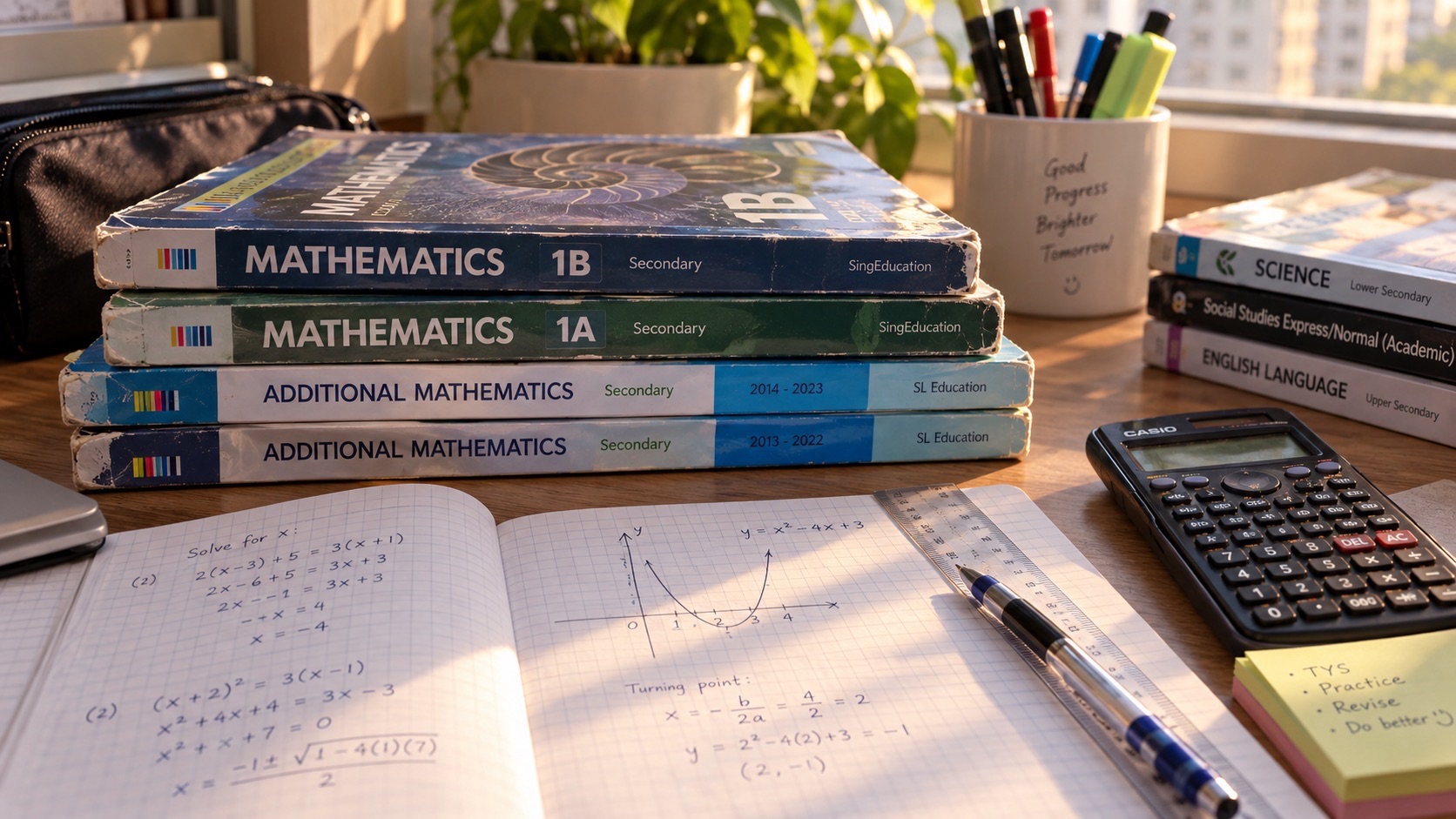
Singapore Math probability guide for families and teachers outside Singapore. What Secondary 2 to 4 students learn about chance, from single events to combined events with possibility diagrams and tree diagrams.
Probability is a number for uncertainty.
It runs from 0, impossible, to 1, certain.
In Singapore Mathematics, probability begins in Secondary 2 with probability as a measure of chance and the probability of single events, found by listing all the possible outcomes. In Secondary 3 or 4, students move to simple combined events, using possibility diagrams and tree diagrams, and they add and multiply probabilities.
Students who continue to H2 Mathematics later meet counting methods and conditional probability.
This guide is useful for families and teachers who want to:
- understand what Singapore expects in secondary probability;
- teach probability at home in a clear sequence;
- prepare a child who is moving into a Singapore secondary school; or
- support a student using Singapore Math materials in another country.
Quick facts
Level: Secondary 2 to Secondary 4 (G3 Mathematics; also in G2 Mathematics)
Strand: Statistics and Probability
Official source: SEAB G3 Mathematics Syllabus K310 (2027), with the same content as O-Level Mathematics 4052 (2026); year placement from MOE’s 2020 secondary teaching syllabus
Comes after: Multiplying Fractions and Statistical Diagrams
Leads to: probability in H2 Mathematics; see also Sets and Venn Diagrams for set language
What Probability Means in Singapore Mathematics
The probability of an event is a measure of how likely it is to happen.
When all outcomes are equally likely, the probability of an event is the number of favourable outcomes divided by the total number of possible outcomes.
So the first skill is listing outcomes completely. A student who misses one outcome, or counts one twice, gets the wrong probability however careful the arithmetic.
The second skill is combining events. Singapore students learn two rules:
- Mutually exclusive events cannot happen at the same time. For these, P(A or B) = P(A) + P(B).
- Independent events do not affect each other. For these, P(A and B) = P(A) × P(B).
The probability that an event does not happen is 1 minus the probability that it does.
Where Probability Sits in the Singapore Syllabus
Probability is not part of the primary syllabus. It starts in Secondary 2.
In Secondary 2, students learn:
- probability as a measure of chance; and
- probability of single events, including listing all the possible outcomes in a simple chance situation to calculate the probability.
In Secondary 3 or 4, students learn:
- probability of simple combined events, including using possibility diagrams and tree diagrams, where appropriate; and
- addition and multiplication of probabilities for mutually exclusive events and independent events.
| Level | Probability content |
|---|---|
| Secondary 2 | Probability as a measure of chance; single events by listing outcomes |
| Secondary 3 or 4 | Simple combined events; possibility diagrams and tree diagrams; adding and multiplying probabilities |
| H2 Mathematics | Counting, permutations and combinations; conditional probability in simple cases; Venn and tree diagrams |
This content is in both G2 and G3 Mathematics.
How Singapore Teaches Probability
1. Describe chance in words, then numbers
Impossible, unlikely, even chance, likely and certain become 0, values between 0 and 1, and 1.
2. List the outcomes
For one coin, one die or one spinner, write the full list of outcomes before counting favourable ones.
3. Use a possibility diagram for two actions
A grid for two dice shows all 36 equally likely outcomes. Students read probabilities straight from it.
4. Use a tree diagram for stages
Each branch carries a probability. The branches from one point add to 1.
5. Multiply along, add across
Multiply along a path for “and”. Add the results of separate paths for “or”, because separate paths are mutually exclusive.
6. Use the complement
“At least one” is often quickest as 1 − P(none).
Worked Examples
A single event
Question: A bag holds 3 red, 5 blue and 2 green balls. One ball is taken at random. Find the probability that it is blue, and the probability that it is not green.
Step 1. There are 3 + 5 + 2 = 10 equally likely outcomes.
Step 2. P(blue) = 5/10 = 1/2.
Step 3. P(green) = 2/10 = 1/5, so P(not green) = 1 − 1/5 = 4/5.
Check: 8 balls are not green, and 8/10 = 4/5.
A possibility diagram
Question: Two fair six-sided dice are thrown and the scores are added. Find the probability that the total is 7, and the probability that the total is at least 10.
Step 1. A 6 by 6 grid shows 36 equally likely outcomes.
Step 2. A total of 7 comes from (1, 6), (2, 5), (3, 4), (4, 3), (5, 2) and (6, 1). P(7) = 6/36 = 1/6.
Step 3. A total of 10 or more comes from (4, 6), (5, 5), (6, 4), (5, 6), (6, 5) and (6, 6). P(at least 10) = 6/36 = 1/6.
Check: The totals 2 to 12 are not equally likely, which is why the grid is needed.
A tree diagram with independent events
Question: On any day, the probability that a bus is late is 0.2, independently of other days. Find the probability that over two days the bus is late on both days, on exactly one day, and on at least one day.
Step 1. Each day’s branches are late (0.2) and not late (0.8).
Step 2. Both late: 0.2 × 0.2 = 0.04.
Step 3. Exactly one: late then not late, or not late then late. 0.2 × 0.8 + 0.8 × 0.2 = 0.16 + 0.16 = 0.32.
Step 4. At least one: 1 − P(neither) = 1 − 0.8 × 0.8 = 1 − 0.64 = 0.36.
Check: 0.04 + 0.32 + 0.64 = 1, so every path has been counted.
Common Mistakes
- Adding when the question says “and”. Two events both happening needs multiplication along a path. Fix: underline “and” and “or” before working.
- Adding events that overlap. On one die, “even” and “greater than 3” share 4 and 6, so their probabilities cannot simply be added. Fix: list the outcomes; the answer is 4/6 = 2/3.
- Confusing independent with mutually exclusive. Independent events can happen together; mutually exclusive events cannot. Fix: ask “can both happen?” and “does one affect the other?” separately.
- Treating unequal outcomes as equal. A total of 7 on two dice is more likely than a total of 2. Fix: use a possibility diagram.
- Branches that do not add to 1. Fix: check every set of branches from one point.
- Answers above 1. A probability can never be greater than 1. Fix: treat any such answer as a signal to recheck.
Teaching Probability Outside Singapore
The rules are the same internationally. Some names and habits differ.
- Terminology. Singapore says “possibility diagram”. Many books call this a sample space diagram or an outcome grid.
- Form of the answer. An exact fraction such as 1/6 is acceptable. Non-exact answers are given to 3 significant figures unless the question says otherwise.
- Timing. Singapore starts probability in Secondary 2 and combined events in Secondary 3 or 4. Your local programme may start earlier, so decide by readiness rather than age. The Singapore Math Grade Levels guide explains why direct conversions are unreliable.
- Calculators. An approved calculator may be used in both G3 Mathematics papers. A tree diagram is still working, and omitting essential working loses marks.
- Prerequisites. Students need confident fractions, multiplying fractions and decimals, and systematic listing.
How to Practise Probability at Home
Real experiments make the numbers believable.
- Toss a coin 20 times and record the results. Compare the fraction of heads with 1/2.
- List every outcome for one die, then for two coins.
- Draw a full possibility diagram for two dice and colour the cells for one event.
- Draw a two-stage tree diagram for a simple real situation, such as rain on two days.
- For each answer, check that the probabilities of all outcomes add to 1.
- Once a week, mix “and”, “or” and “at least one” questions so the student must choose the method.
Ten to fifteen minutes is enough when the work is focused.
Try These
- A letter is chosen at random from the word SINGAPORE. Find the probability that it is a vowel.
- Two fair coins are tossed. Find the probability of at least one head.
- The probability of rain on any day is 0.3, independently of other days. Find the probability of no rain on either of two days.
- A fair die is thrown and a fair coin is tossed. Find the probability of a 6 and a head.
- A fair die is thrown. Find the probability of an even number or a 5.
Answers
- 4/9. SINGAPORE has 9 letters, and 4 of them (I, A, O, E) are vowels.
- 3/4. The outcomes are HH, HT, TH and TT, and three include a head.
- 0.49, because 0.7 × 0.7 = 0.49.
- 1/12, because 1/6 × 1/2 = 1/12 for independent events.
- 2/3. The events are mutually exclusive, so 3/6 + 1/6 = 4/6 = 2/3.
What Comes Next
G3 Mathematics probability is the foundation for later work.
- Sets and Venn Diagrams give the language of union and intersection, which later probability uses.
- Students who take Additional Mathematics meet n! and nCr in the Binomial Theorem. The same numbers count combinations in H2 probability.
- H2 Mathematics adds counting principles, permutations and combinations, conditional probability in simple cases, and the binomial distribution.
A student who lists outcomes carefully and chooses “add” or “multiply” for a reason is ready for that step.
Frequently Asked Questions
When do Singapore students learn probability?
Probability of single events is Secondary 2 content. Combined events, possibility diagrams, tree diagrams and the addition and multiplication of probabilities are Secondary 3 or 4 content.
Is probability taught in Singapore primary schools?
No. The current primary syllabus has no probability topic. It begins in Secondary 2.
What is the difference between mutually exclusive and independent?
Mutually exclusive events cannot happen together, so their probabilities are added for “or”. Independent events do not affect each other, so their probabilities are multiplied for “and”.
Is conditional probability in G3 Mathematics?
The G3 Mathematics syllabus names mutually exclusive and independent events. Conditional probability is named in H2 Mathematics.
Should answers be fractions or decimals?
Either can be correct. Exact fractions are fine, and non-exact answers are given to 3 significant figures unless the question asks otherwise.
Do G2 students learn the same probability?
Yes. The probability content appears in both the G2 and G3 Mathematics syllabuses.
Helpful Reading
- Singapore Mathematics | International Edition: Statistical Diagrams
- Singapore Mathematics | International Edition: Sets and Venn Diagrams
- Singapore Mathematics | International Edition: Binomial Theorem
- Why Does Probability Feel So Counterintuitive in Mathematics?
- Secondary Mathematics: Probability Trees, Conditional Events and Without-Replacement Reasoning
- H2 Mathematics 9758 | Probability and Conditional Probability
- How to Make Sense of the SEC G3 Mathematics Syllabus
- SEAB G3 Mathematics Syllabus K310
- MOE Secondary Mathematics Syllabuses (2020)
Probability in Singapore Mathematics
List every outcome.
Count with care.
Multiply along a path.
Add across separate paths.
Check that everything adds to 1.
Taught this way, probability stops feeling like guesswork.
It becomes careful counting, and that habit carries a student from Secondary 2 into H2 statistics.
Ask Bukit Timah Tutor
Bukit Timah Tutor teaches Mathematics in small groups of three students in Singapore.
If your child is learning Singapore Mathematics at home, in an international school or in a Singapore school, and you are unsure where to begin with this topic, send us a short message with the student’s level and one example of the work.
Bukit Timah Tutor
8 Fourth Avenue, Singapore 268674
Near Sixth Avenue MRT
Three-student Mathematics tutorials
By appointment
Properly taught kids shine a bright light into the future.
Singapore Mathematics | International Edition is a Bukit Timah Tutor guide series for families and teachers outside Singapore. It is not a textbook and is not affiliated with MOE, SEAB or any publisher. Syllabus details were checked against MOE and SEAB documents in October 2026. Always confirm current requirements with your school.
← Previous: Singapore Mathematics | International Edition: Standard Deviation
Next: Singapore Mathematics | International Edition: Quadratic Functions and Inequalities →
All 100 topics in the International Edition