
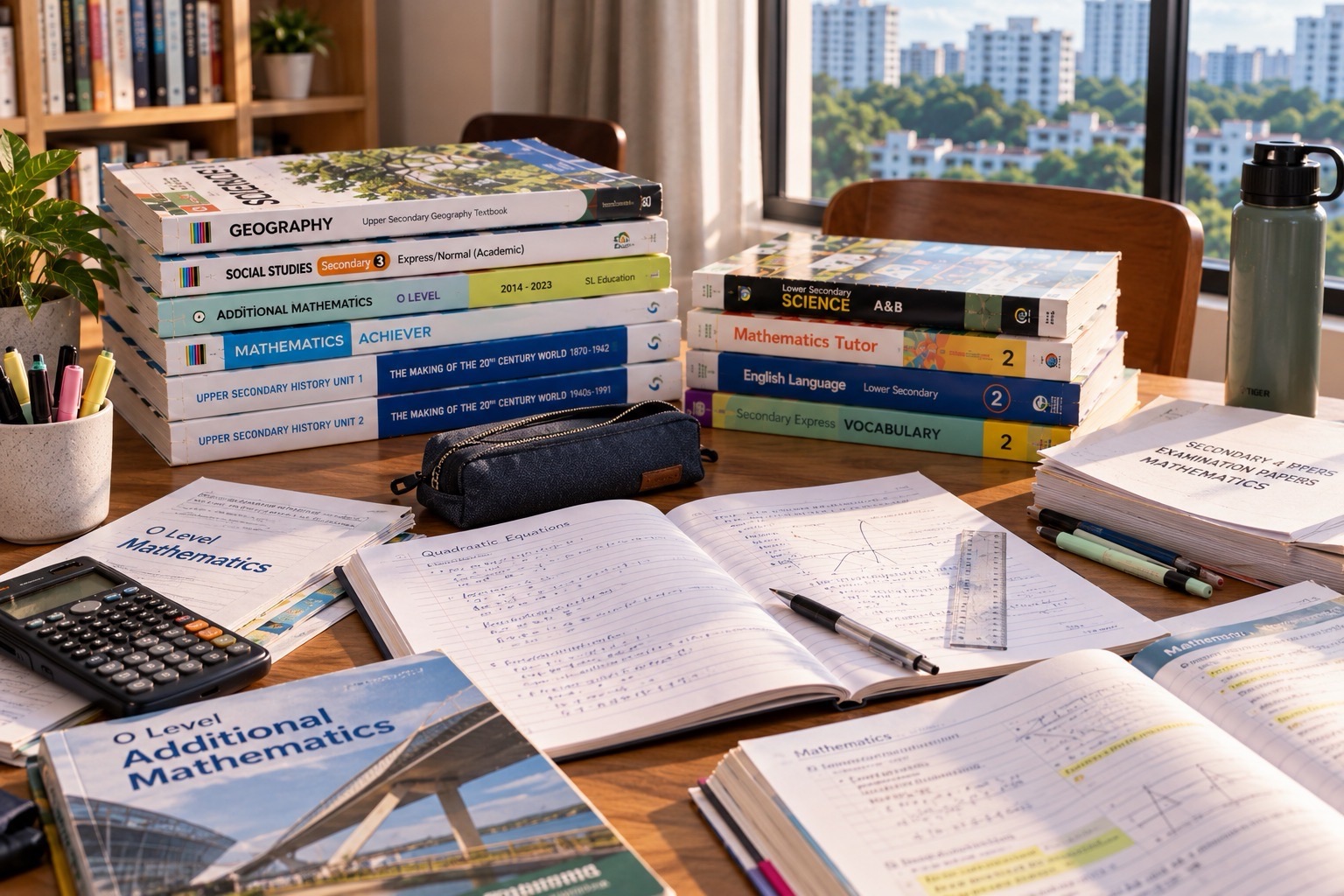
Singapore Math multiplying fractions guide for families and teachers outside Singapore. How Primary 4 fraction of a set leads into the Primary 5 multiplication of fractions, how Singapore teaches each case, and how to practise at home.
“3/4 of 12” and “3/4 × 12” give the same answer.
Seeing why is the heart of this topic.
In Singapore Mathematics, the starting idea is fraction of a set, taught in Primary 4 in the current primary syllabus. Fractions are not multiplied at Primary 4.
Multiplication of fractions begins in Primary 5, with a set list of cases, several marked “without calculator”. Dividing fractions follows in Primary 6.
This guide is useful for families and teachers who want to:
- understand what Singapore expects at Primary 4 and Primary 5;
- teach multiplication of fractions with meaning, not only a rule;
- prepare a child who is moving into a Singapore school; or
- support a student using Singapore Math materials in another country.
Quick facts
Level: Primary 4 (fraction of a set); Primary 5 (multiplying fractions)
Strand: Number and Algebra
Official source: MOE Primary Mathematics Syllabus, the 2021 syllabus first examined at PSLE in 2026
Comes after: Mixed Numbers and Improper Fractions and Multiplication and Division
Leads to: Fractions and Division and Dividing Fractions
What Multiplying Fractions Means in Singapore Mathematics
Fraction of a set comes first. 3/4 of 12 apples means: split the 12 apples into 4 equal groups and take 3 of the groups. Each group has 3 apples, so 3/4 of 12 is 9.
In Primary 5, the same idea is written as multiplication: 3/4 × 12 = 36/4 = 9.
Multiplying two fractions extends the idea. 3/4 × 2/5 means 3/4 of 2/5. On a rectangle cut into 4 rows and 5 columns, 2 columns show 2/5, and 3 of the 4 rows of those columns show 3/4 of it. That is 6 of the 20 small parts, so 3/4 × 2/5 = 6/20 = 3/10.
The rule follows from the picture: multiply the numerators, multiply the denominators, then simplify.
Multiplying by a proper fraction makes a number smaller. Children often expect multiplication to make things bigger, so this needs to be said aloud.
Where Multiplying Fractions Sits in the Singapore Syllabus
In the current primary syllabus, the topic is split across two years.
At Primary 4, students learn fraction of a set. Fractions are not multiplied at Primary 4.
At Primary 5, students learn:
- multiplying a proper or improper fraction by a whole number, without calculator;
- multiplying a proper fraction by a proper or improper fraction, without calculator;
- multiplying two improper fractions; and
- multiplying a mixed number by a whole number.
These are the listed cases. Multiplying two mixed numbers is not among them.
Primary 5 Foundation Mathematics includes multiplying a fraction by a whole number and a proper fraction by a proper or improper fraction, without calculator.
| Level | What students do |
|---|---|
| Primary 4 | Fraction of a set, for example 3/4 of 12 |
| Primary 5 | Fraction × whole number; proper fraction × proper or improper fraction; improper × improper; mixed number × whole number |
| Primary 6 | Divide a proper fraction by a whole number, and a whole number or proper fraction by a proper fraction |
How Singapore Teaches Multiplying Fractions
1. Fraction of a set with objects
Share 12 counters into 4 equal groups and take 3 groups. Children say “3 quarters of 12 is 9”.
2. Draw it as a model
A bar of 12 split into 4 equal units shows 1 unit = 3, so 3 units = 9. This is the same unit thinking used later in ratio.
3. Write it as multiplication
3/4 of 12 becomes 3/4 × 12. Children check that the answer matches the model.
4. Fraction times fraction on a rectangle
Shade 2/5 of a rectangle in one direction and 3/4 in the other. The overlap is the product.
5. Simplify before multiplying
In 2/3 × 9/10, divide 9 and 3 by 3, and 2 and 10 by 2. Smaller numbers mean fewer errors.
6. Mixed number times whole number
Change 2 1/3 to 7/3, or multiply each part: 2 × 4 + 1/3 × 4.
Worked Examples
Fraction of a set (Primary 4)
Question: A class has 28 pupils. 3/7 of them wear glasses. How many pupils wear glasses?
Step 1. Split 28 pupils into 7 equal groups: 28 ÷ 7 = 4 pupils in each group.
Step 2. Take 3 groups: 3 × 4 = 12 pupils.
Step 3. 12 pupils wear glasses.
Check: 4/7 of the class do not wear glasses: 4 × 4 = 16. 12 + 16 = 28.
Proper fraction × proper fraction (Primary 5)
Question: Find 2/3 × 9/10. Give your answer in simplest form.
Step 1. Simplify first: 9 and 3 share a factor of 3, giving 3 and 1. 2 and 10 share a factor of 2, giving 1 and 5.
Step 2. The product is now 1/1 × 3/5.
Step 3. Multiply: 1 × 3 = 3 and 1 × 5 = 5. The answer is 3/5.
Check: Without simplifying first: 2 × 9 = 18 and 3 × 10 = 30, and 18/30 = 3/5.
A mixed-number case works the same way. 2 1/3 × 4 = 7/3 × 4 = 28/3 = 9 1/3. Multiplying each part gives the same: 2 × 4 = 8 and 1/3 × 4 = 4/3 = 1 1/3, so 8 + 1 1/3 = 9 1/3.
Common Mistakes
- Finding a common denominator first. A child renames 2/3 × 9/10 as 20/30 × 27/30. Fix: common denominators are for adding and subtracting. For multiplying, multiply straight across.
- Multiplying the whole number into both terms. 2/3 × 4 is written as 8/12. Fix: write 4 as 4/1, so 2/3 × 4/1 = 8/3.
- Multiplying only the whole-number part. 2 1/3 × 4 is worked as 8 1/3. Fix: change to an improper fraction, or multiply both parts by 4.
- Expecting a bigger answer. A child rejects 3/10 as the answer to 3/4 × 2/5 because it is smaller. Fix: “3/4 of something” must be less than that something.
- Cancelling in the wrong place. In 2/3 + 3/4, a child cancels the two 3s as if it were a product. Fix: cancel only when multiplying, and only a numerator with a denominator.
Teaching Multiplying Fractions Outside Singapore
The rule is universal. The Singapore sequence is worth noting.
- The word “of”. Singapore students meet “of” through fraction of a set at Primary 4, and write it with the × sign from Primary 5.
- Timing. In Singapore’s current syllabus, fractions are multiplied from Primary 5, not Primary 4. Your local curriculum may differ, so decide by readiness. The Singapore Math Grade Levels guide explains why grade conversions are unreliable.
- Cancelling. Some materials call simplifying before multiplying “cross-cancelling”. It means dividing a numerator and a denominator by a common factor.
- Prerequisites. Students need multiplication tables, equivalent fractions and simplest form.
- Calculators. The syllabus marks several of these cases “without calculator”, and PSLE Paper 1 does not allow calculators.
How to Practise Multiplying Fractions at Home
Short practice with objects first, then written work.
- Find a fraction of a set using real objects, such as 2/5 of 15 sweets.
- Draw the same problem as a bar split into equal units.
- Rewrite it as a multiplication and check the answer matches.
- At Primary 5 level, multiply two proper fractions on a drawn rectangle.
- Do two written products, simplifying before multiplying.
- Once a week, do one mixed number × whole number in two different ways.
Ten to fifteen minutes is enough when each step is explained.
Try These
- Find 5/8 of 24.
- Find 3/5 × 10.
- Find 4/9 × 3/8. Give your answer in simplest form.
- Find 1 3/4 × 6. Give your answer as a mixed number.
Answers
- 15. 24 ÷ 8 = 3, and 5 × 3 = 15.
- 6. 3/5 × 10 = 30/5 = 6.
- 1/6. Cancel 4 with 8 to give 1 and 2, and 3 with 9 to give 1 and 3. Then 1/3 × 1/2 = 1/6.
- 10 1/2. 1 3/4 = 7/4, and 7/4 × 6 = 42/4 = 21/2 = 10 1/2.
What Comes Next
Multiplication of fractions supports several Primary 5 and 6 topics.
- Fractions and Division shows that a fraction can be read as a division.
- In Primary 6, Dividing Fractions uses multiplication by the reciprocal.
- Percentage uses the same “fraction of a quantity” thinking with hundredths.
A child who can explain why 3/4 of 12 is 9 is ready for each of these.
Frequently Asked Questions
When do Singapore students learn to multiply fractions?
In the current primary syllabus, fractions are multiplied from Primary 5. Primary 4 has fraction of a set, but no multiplication of fractions.
Is “fraction of a set” the same as multiplying?
They give the same answer. Primary 4 works it out by grouping. Primary 5 writes it as multiplication.
Do Primary 5 students multiply two mixed numbers?
That case is not in the Primary 5 list. The mixed-number case listed is a mixed number multiplied by a whole number.
Should my child simplify before or after multiplying?
Either gives the right answer. Simplifying first keeps the numbers small and reduces errors.
Why does multiplying by a fraction make the answer smaller?
Multiplying by a proper fraction means taking part of a quantity. Part of something is less than the whole of it.
Are calculators allowed?
The syllabus marks several cases “without calculator”, and PSLE Paper 1 does not allow calculators. Children should be fluent by hand.
Helpful Reading
- Singapore Mathematics | International Edition: Mixed Numbers and Improper Fractions
- Singapore Mathematics | International Edition: Fractions and Division
- Singapore Mathematics | International Edition: Dividing Fractions
- Primary Mathematics: Fractions of a Quantity, Equivalence and Operations
- Singapore Math Bar Model | A Guide to Model Drawing
- Why Do Fractions Keep Causing Problems in Later Mathematics?
- How to Make Sense of the PSLE Mathematics Syllabus in Singapore
- MOE Primary Mathematics Syllabus
Multiplying Fractions in Singapore Mathematics
“Of” comes first.
Group, then take.
Multiply straight across.
Simplify early.
Expect a smaller answer when the fraction is proper.
Taught this way, multiplying fractions is not a rule to trust blindly.
It is fraction of a set, written in a shorter form.
Ask Bukit Timah Tutor
Bukit Timah Tutor teaches Mathematics in small groups of three students in Singapore.
If your child is learning Singapore Mathematics at home, in an international school or in a Singapore school, and you are unsure where to begin with this topic, send us a short message with the student’s level and one example of the work.
Bukit Timah Tutor
8 Fourth Avenue, Singapore 268674
Near Sixth Avenue MRT
Three-student Mathematics tutorials
By appointment
Properly taught kids shine a bright light into the future.
Singapore Mathematics | International Edition is a Bukit Timah Tutor guide series for families and teachers outside Singapore. It is not a textbook and is not affiliated with MOE, SEAB or any publisher. Syllabus details were checked against MOE and SEAB documents in October 2026. Always confirm current requirements with your school.
← Previous: Singapore Mathematics | International Edition: Mixed Numbers and Improper Fractions
Next: Singapore Mathematics | International Edition: Fractions and Division →
All 100 topics in the International Edition