
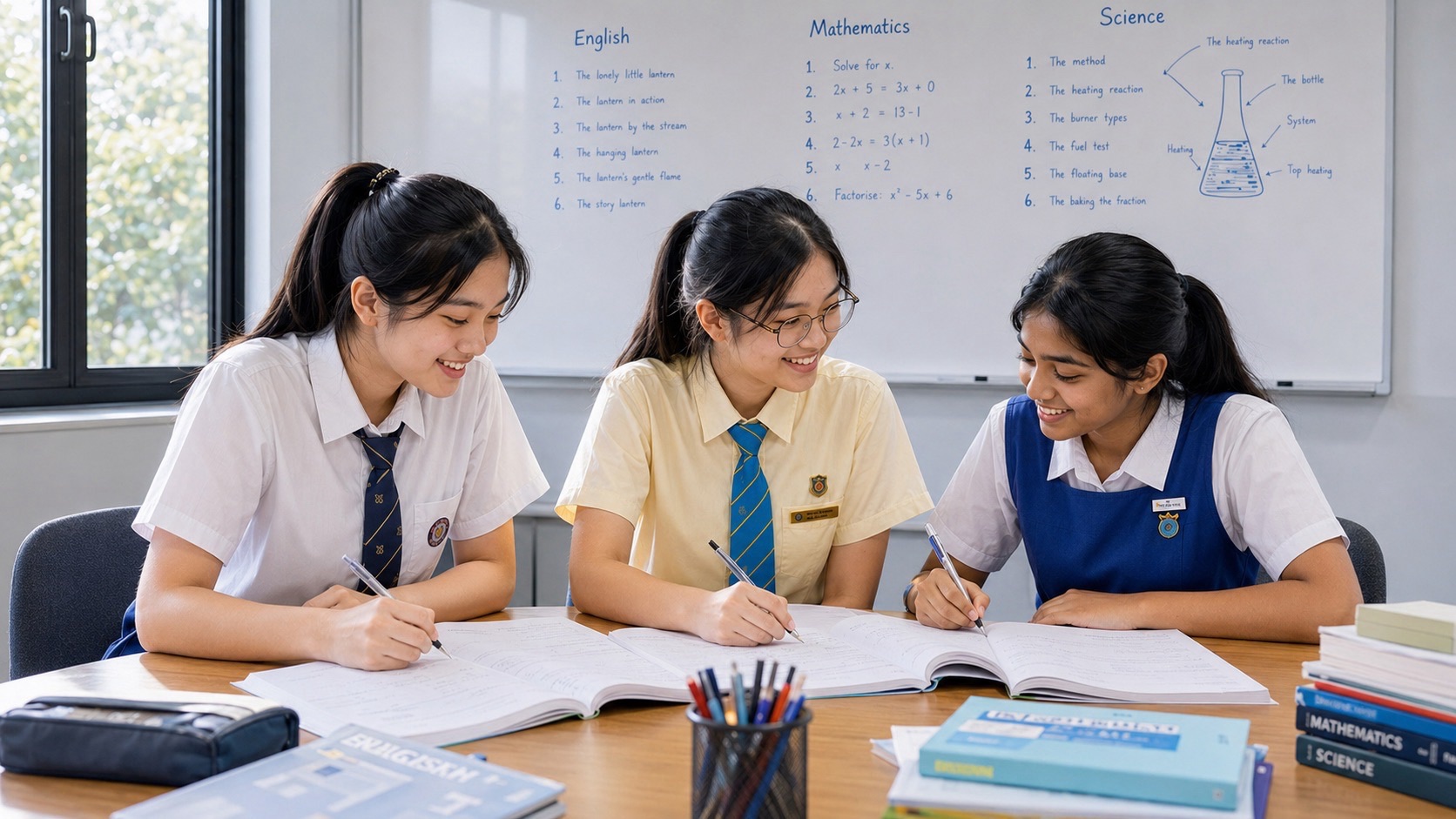
Singapore Math percentage guide for families and teachers outside Singapore. What Primary 5 and Primary 6 students learn about percentage, how Singapore teaches it through fractions, decimals and models, and how to practise it at home.
A percentage is a fraction out of 100.
The hard part is rarely the calculation. It is knowing which whole the percentage belongs to.
In Singapore Mathematics, percentage begins in Primary 5. Students write a part of a whole as a percentage, use the % symbol and find a percentage part of a whole. They also apply percentage to discount, GST and annual interest.
In Primary 6 they find the whole from a part and its percentage, and work with percentage increase and decrease. Secondary 1 then adds percentages greater than 100% and reverse percentages.
This guide is useful for families and teachers who want to:
- understand what Singapore expects at Primary 5 and Primary 6;
- teach percentage at home in a clear sequence;
- prepare a child who is moving into a Singapore school; or
- support a student using Singapore Math materials in another country.
Quick facts
Level: Primary 5 and Primary 6 (Standard Mathematics)
Strand: Number and Algebra
Official source: MOE Primary Mathematics Syllabus, the 2021 syllabus first examined at PSLE in 2026
Comes after: Decimals and Fractions and Division
Leads to: Discount, GST and Interest and Percentage Increase and Decrease
What Percentage Means in Singapore Mathematics
Per cent means “out of 100”. So 35% means 35 out of every 100, or 35/100.
A percentage is therefore one more way of writing a fraction or a decimal: 1/4 = 25/100 = 0.25 = 25%.
The whole is always 100%. Every percentage is a part of some whole, and that whole must be named.
“40% of the class” and “40% of the boys” are different amounts, even though the percentage is the same.
Singapore students often picture the whole as a bar labelled 100%, divided into equal parts. Ten parts of 10% each is a common starting model. The Singapore Math Bar Model guide explains the drawing method itself.
Where Percentage Sits in the Singapore Syllabus
In the current primary syllabus, percentage is taught in Primary 5 and Primary 6.
At Primary 5, students learn:
- expressing a part of a whole as a percentage;
- the use of the % symbol;
- finding a percentage part of a whole; and
- finding discount, GST and annual interest.
At Primary 6, students learn:
- finding the whole given a part and the percentage; and
- percentage increase and decrease.
| Level | What students do with percentage |
|---|---|
| Primary 5 | Part of a whole as a percentage, the % symbol, a percentage part of a whole, discount, GST and annual interest |
| Primary 6 | Finding the whole from a part and its percentage, percentage increase and decrease |
| Secondary 1 | One quantity as a percentage of another, comparing by percentage, percentages greater than 100%, increasing or decreasing by a given percentage, reverse percentages |
Foundation Mathematics includes percentage at Primary 6: a part of a whole as a percentage, a percentage part of a whole, and discount, GST and annual interest. Finding the whole and percentage increase and decrease are not in the Foundation content list.
This page covers the core ideas. Money applications have their own page, Discount, GST and Interest, and changes have theirs, Percentage Increase and Decrease.
How Singapore Teaches Percentage
1. Start with a hundred square
Shade 37 small squares out of 100 and say “37 per cent”. The whole grid is 100%.
2. Connect fractions, decimals and percentages
Write the same amount three ways: 3/5 = 60/100 = 0.6 = 60%. Students who can move between these forms choose whichever makes a question easier.
3. Write a part of a whole as a percentage
Write the part as a fraction of the whole, then change it to hundredths. 18 out of 24 is 18/24 = 3/4 = 75/100 = 75%.
4. Find a percentage of a quantity
30% of 250 is 30/100 × 250 = 75. Many students find 10% first: 10% of 250 is 25, so 30% is 3 × 25 = 75.
5. Find the whole from a part
At Primary 6, the part and its percentage are known. If 40% is 36, then 10% is 36 ÷ 4 = 9 and 100% is 90.
6. Always ask “percentage of what?”
Before calculating, students name the whole. This single habit prevents most percentage errors later.
The order of these steps matters. Children who learn “divide and multiply by 100” without seeing a part and a whole often cannot tell which number to divide by.
Worked Examples
A part of a whole as a percentage
Question: In a class of 40 pupils, 14 wear glasses. What percentage of the pupils wear glasses?
Step 1. The whole is the class: 40 pupils. The part is 14 pupils.
Step 2. As a fraction, the part is 14/40.
Step 3. 14/40 = 7/20 = 35/100 = 35%.
Step 4. 35% of the pupils wear glasses.
Check: 10% of 40 is 4, so 35% is 3.5 × 4 = 14 pupils.
Finding the whole (Primary 6)
Question: Sam spent 35% of his savings on a book. The book cost $28. How much were his savings?
Step 1. 35% of the savings = $28.
Step 2. 5% = $28 ÷ 7 = $4.
Step 3. 100% = 20 × $4 = $80.
Step 4. His savings were $80.
Check: 35% of $80 = 35/100 × $80 = $28.
A bar model helps in the second example. Draw a bar for the savings, mark 100% at the end, shade 35% and label it $28.
Common Mistakes
- Treating % as a whole number. A child works out 25% of 80 as 25 × 80. Fix: read 25% as 25/100 before calculating.
- Using the wrong whole. In a group of 20 boys and 30 girls, a child says the boys are 20/30 of the group. Fix: the whole is 50 children, so the boys are 20/50 = 40%.
- Mixing units. 50 cm as a percentage of 2 m is not 50/2. Fix: convert first. 50 cm out of 200 cm is 25%.
- Giving the part when the whole is asked. In Primary 6 questions, a child stops at the amount for 1% or 10%. Fix: label 100% on the model and check that the answer matches it.
- Rounding too early. Rounding a fraction to a decimal halfway through makes the final percentage wrong. Fix: keep exact fractions until the last step.
Teaching Percentage Outside Singapore
The % symbol and the idea of “per hundred” are shared across English-language curricula.
A few points are worth knowing when you use Singapore materials.
- Spelling. British-style writing often uses “per cent”; US writing uses “percent”. Both mean out of 100.
- Local contexts. Singapore questions use Singapore dollars and GST. If your country uses another tax or currency, the method stays the same.
- Timing. In Singapore’s current syllabus, percentage is a Primary 5 and Primary 6 topic. Your local curriculum may place it differently, so decide by readiness rather than age. The Singapore Math Grade Levels guide explains why direct conversions are unreliable.
- Prerequisites. Percentage depends on equivalent fractions, decimals and multiplying a fraction by a whole number. If those are weak, repair them first.
- Working without a calculator. PSLE Paper 1 does not allow calculators, so students need mental methods such as finding 10%, 5% and 1%.
How to Practise Percentage at Home
A short, regular routine works better than one long weekend session.
- Shade a hundred square and name the percentage shaded and not shaded.
- Write two fractions as percentages, using denominators that convert easily to 100.
- Find 10%, 5% and 1% of one amount, then build other percentages from them.
- Solve one “part of a whole” question and say the whole aloud first.
- For Primary 6, solve one “find the whole” question with a bar model.
- Once a week, mix percentage with fractions and ratio so the child must decide which form to use.
Ten to fifteen minutes is enough when the work is focused.
Try These
- Write 3/5 as a percentage.
- Find 15% of 260.
- 27 of the 36 pupils in a class walk to school. What percentage of the class walk to school?
- 60% of a number is 84. What is the number?
Answers
- 60%. 3/5 = 60/100.
- 39. 10% of 260 is 26 and 5% is 13, so 15% is 26 + 13 = 39.
- 75%. 27/36 = 3/4 = 75/100.
- 140. 60% is 84, so 10% is 14 and 100% is 140.
What Comes Next
Percentage leads straight into applications and changes.
- In Primary 5, Discount, GST and Interest applies percentage to prices and savings.
- In Primary 6 and Secondary 1, Percentage Increase and Decrease compares a new amount with an original amount.
- In Primary 6, Ratio uses the same part and whole thinking with units.
A student who always names the whole usually finds these later topics much easier.
Frequently Asked Questions
When do Singapore students learn percentage?
Percentage starts in Primary 5 and continues in Primary 6. It returns in Secondary 1, where percentages greater than 100% and reverse percentages are added.
What is the difference between Primary 5 and Primary 6 percentage?
Primary 5 finds a percentage of a whole and writes a part as a percentage. Primary 6 works backwards to find the whole, and adds percentage increase and decrease.
Do primary students meet percentages greater than 100%?
Percentages greater than 100% are listed in the Secondary 1 content. At primary level, a percentage usually describes a part of a whole. Primary 6 percentage increase already gives a new amount larger than the original, so the idea is not entirely new when it arrives.
Is percentage part of Foundation Mathematics?
Yes, at Primary 6. Foundation students write a part as a percentage, find a percentage part of a whole, and work with discount, GST and annual interest.
Should my child use fractions or the 10% method?
Both are useful. The 10% method is quick for mental work. Fractions are clearer when the percentage is awkward, such as 35% of 40.
Why does Singapore teach percentage after fractions and decimals?
Percentage is written in hundredths, so it rests on equivalent fractions and decimals. A child who is secure with those meets percentage as a new notation, not a new idea.
Helpful Reading
- Singapore Mathematics | International Edition: Decimals
- Singapore Mathematics | International Edition: Discount, GST and Interest
- Singapore Mathematics | International Edition: Percentage Increase and Decrease
- Primary Mathematics: Ratio, Rate and Percentage | Worked Learning Guide
- Why Are Ratio, Rate and Percentage So Easy to Confuse?
- Fractions, Decimals and Percentages | Mathematics Knowledge Object
- How to Make Sense of the PSLE Mathematics Syllabus in Singapore
- MOE Primary Mathematics Syllabus
Percentage in Singapore Mathematics
Out of 100.
Name the whole first.
Find 10%, then build.
Work backwards from a known part.
Taught this way, percentage stops being a formula to remember.
It becomes another way of seeing fractions and decimals.
That habit carries a student from Primary 5 into discount, change and proportion.
Ask Bukit Timah Tutor
Bukit Timah Tutor teaches Mathematics in small groups of three students in Singapore.
If your child is learning Singapore Mathematics at home, in an international school or in a Singapore school, and you are unsure where to begin with this topic, send us a short message with the student’s level and one example of the work.
Bukit Timah Tutor
8 Fourth Avenue, Singapore 268674
Near Sixth Avenue MRT
Three-student Mathematics tutorials
By appointment
Properly taught kids shine a bright light into the future.
Singapore Mathematics | International Edition is a Bukit Timah Tutor guide series for families and teachers outside Singapore. It is not a textbook and is not affiliated with MOE, SEAB or any publisher. Syllabus details were checked against MOE and SEAB documents in October 2026. Always confirm current requirements with your school.
← Previous: Singapore Mathematics | International Edition: Decimals
Next: Singapore Mathematics | International Edition: Discount, GST and Interest →
All 100 topics in the International Edition