
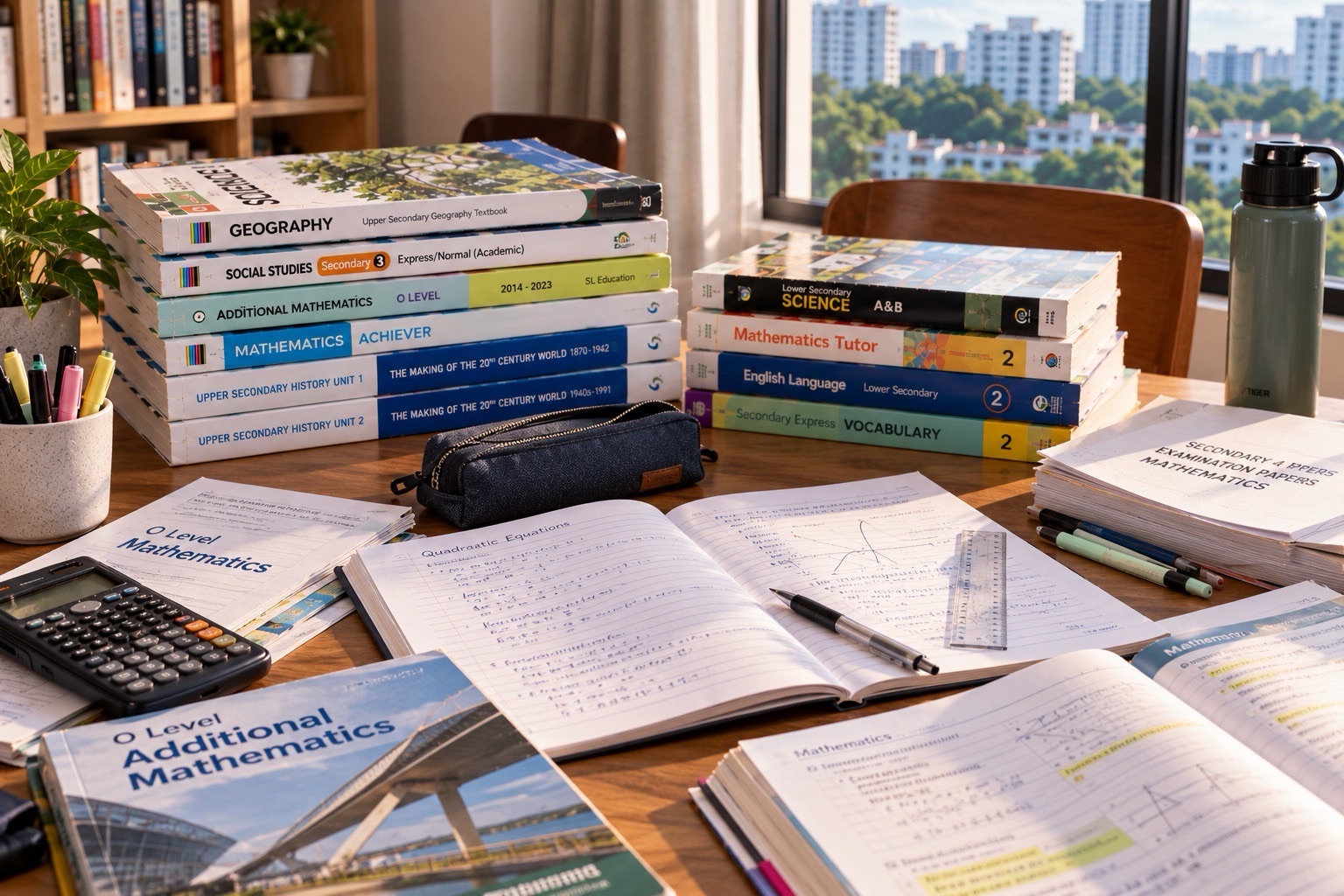
Singapore Math direct and inverse proportion guide for families and teachers outside Singapore. What Secondary 2 students learn about quantities that change together, and how to practise proportion at home.
Some quantities grow together. Others trade off against each other.
Proportion is the Mathematics of both.
In Singapore Mathematics, rate is a Primary 5 topic and ratio is a Primary 6 topic. In Secondary 1, ratios extend to rational numbers. In Secondary 2, G3 Mathematics adds direct and inverse proportion, alongside map scales.
Proportion then runs through similar figures, graphs and many real-world problems.
This guide is useful for families and teachers who want to:
- understand what Singapore expects at Secondary 2;
- teach proportion at home in a clear sequence;
- prepare a child who is moving into a Singapore secondary school; or
- support a student using Singapore Math materials in another country.
Quick facts
Level: Secondary 2 (G3 Mathematics; also in G2)
Strand: Number and Algebra
Official source: MOE Secondary Mathematics Syllabuses (2020) and SEAB G3 Mathematics syllabus K310
Leads to: Map Scales and Congruence and Similarity
What Direct and Inverse Proportion Mean in Singapore Mathematics
Two quantities are in direct proportion when one is always the same multiple of the other. If one doubles, the other doubles. If one is zero, so is the other.
In symbols, y = kx, where k is a constant.
Two quantities are in inverse proportion when their product stays the same. If one doubles, the other halves.
In symbols, y = k/x, which is the same as xy = k.
The constant k carries the meaning of the problem. It might be the price per kilogram, or the total amount of work to be done.
Many textbooks write y ∝ x for “y is directly proportional to x”.
Where Proportion Sits in the Singapore Syllabus
In G3 Mathematics, proportion belongs to N2 Ratio and proportion:
- Secondary 1: ratios involving rational numbers, and writing a ratio in its simplest form; and
- Secondary 2: map scales (distance and area), and direct and inverse proportion.
The syllabus wording is simply “direct and inverse proportion”. G2 Mathematics includes this content too.
The primary groundwork comes from rate in Primary 5, described as the amount of one quantity per unit of another, and ratio in Primary 6.
| Level | What students do |
|---|---|
| Primary 5 | Rate: finding the rate, the total amount or the number of units, given the other two |
| Primary 6 | Ratio with whole numbers |
| Secondary 1 | Ratios involving rational numbers; linear functions y = ax + b and their graphs |
| Secondary 2 | Direct and inverse proportion; map scales |
How Singapore Teaches Direct and Inverse Proportion
1. Start from rate
Students already know how to find the value of one unit. If 4 pens cost $6, one pen costs $1.50. This unitary method is the bridge into proportion.
2. Decide which type it is
Ask: if one quantity doubles, what happens to the other? If it doubles too, try direct proportion. If it halves, try inverse proportion. If neither, the relationship may not be a proportion at all.
3. Write the equation and find k
Use one known pair of values. For direct proportion, k = y ÷ x. For inverse proportion, k = x × y.
4. Use k to find the missing value
Substitute the new value into y = kx or y = k/x.
5. Check with a table of values
In direct proportion, y ÷ x is the same for every pair. In inverse proportion, x × y is the same for every pair.
6. Connect to graphs
The graph of y = kx is a straight line through the origin, a special case of the Secondary 1 linear functions. Inverse proportion gives a curve, met again with reciprocal graphs in Secondary 3 or 4.
Both the unitary method and the equation method should give the same answer. Using one to check the other builds confidence.
Worked Examples
Direct proportion
Question: 5 m of cloth costs $32. What is the cost of 8 m of the same cloth?
Step 1. The cost is directly proportional to the length, so cost = k × length.
Step 2. 32 = 5k, so k = 6.40. One metre costs $6.40.
Step 3. 8 m costs 8 × $6.40 = $51.20.
Check: 8 m is 1.6 times as long as 5 m, and 1.6 × $32 = $51.20.
Inverse proportion
Question: 6 workers take 10 days to paint a building. Working at the same rate, how long would 4 workers take?
Step 1. The number of days is inversely proportional to the number of workers.
Step 2. The total work is 6 × 10 = 60 worker-days.
Step 3. 4 workers take 60 ÷ 4 = 15 days.
Check: 4 × 15 = 60. Fewer workers need more days, which makes sense.
The phrase “at the same rate” matters. Without it, the problem cannot assume inverse proportion.
Common Mistakes
- Calling every increase direct proportion. A taxi fare with a fixed starting charge rises with distance, but it is not directly proportional. Fix: test both rules: does doubling double, and does zero give zero?
- Using the direct method on an inverse problem. More workers do not take more days. Fix: decide the type before calculating.
- Ignoring the assumptions. Proportion problems assume a steady rate. Fix: look for words such as “at the same rate” and say them aloud.
- Mixing units. Combining minutes with hours, or grams with kilograms, gives a wrong k. Fix: convert everything to the same units first.
- Finding k and stopping. k is a tool, not the answer. Fix: always write the final equation and substitute the new value.
- Writing the wrong form. For inverse proportion, y = kx is the wrong equation. Fix: write y = k/x or xy = k before substituting.
Teaching Direct and Inverse Proportion Outside Singapore
- Other names. Some textbooks call these direct variation and inverse variation. The ideas are the same.
- The ∝ symbol. Many books use ∝ to mean “is proportional to”. Teach how to read it, then how to turn it into an equation with k.
- The unitary method. Singapore primary work on rate uses “per unit” thinking. Students who learnt it can move into proportion quickly, and the method remains a useful check.
- Timing. In Singapore’s current syllabus, direct and inverse proportion are Secondary 2 content. Your local curriculum may place them earlier or later, so decide by readiness. The Singapore Math Grade Levels guide explains why.
- Calculators. An approved calculator may be used in both G3 Mathematics papers. Even so, a quick mental estimate catches answers that move the wrong way.
How to Practise Proportion at Home
Everyday situations make the two types easy to feel.
- Find a direct proportion while shopping, such as price per kilogram.
- Find an inverse proportion at home, such as sharing a fixed amount of food among more people.
- Make a small table of values for each and test y ÷ x and x × y.
- Find k and write the equation for each situation.
- Solve one direct and one inverse problem a day.
- Once a week, mix the two types with a “neither” case, so the child must decide.
The decision about which type it is matters as much as the calculation.
Try These
- 3 kg of rice cost $7.20. Find the cost of 5 kg of the same rice.
- y is directly proportional to x, and y = 14 when x = 4. Find y when x = 10.
- 8 identical taps fill a tank in 45 minutes. How long would 6 of these taps take?
- A taxi charges a fixed $4 plus $0.50 per kilometre. Is the fare directly proportional to the distance?
Answers
- $12.00. One kilogram costs $7.20 ÷ 3 = $2.40, and 5 × $2.40 = $12.00.
- 35. k = 14 ÷ 4 = 3.5, so y = 3.5 × 10 = 35.
- 60 minutes. The total is 8 × 45 = 360 tap-minutes, and 360 ÷ 6 = 60.
- No. A 10 km trip costs $9 and a 20 km trip costs $14, so doubling the distance does not double the fare. At 0 km, the fare would still be $4.
What Comes Next
- Map Scales is taught in the same Secondary 2 sub-strand and uses ratio and proportion together.
- In Congruence and Similarity, the corresponding sides of similar figures are proportional.
- Cubic, Reciprocal and Exponential Graphs in Secondary 3 or 4 includes the reciprocal curve behind inverse proportion.
- Rate and Speed applies proportional thinking to distance and time.
A student who can tell the two types apart usually handles these later topics with less effort.
Frequently Asked Questions
When do Singapore students learn direct and inverse proportion?
In Secondary 2 in G3 Mathematics, and G2 Mathematics includes it too. Rate comes in Primary 5, ratio in Primary 6, and ratios with rational numbers in Secondary 1.
What is the difference between direct and inverse proportion?
In direct proportion, the quotient y ÷ x stays the same. In inverse proportion, the product x × y stays the same.
How can I tell whether two quantities are proportional?
Make a table of values. If y ÷ x is constant, it is direct proportion. If x × y is constant, it is inverse proportion. If neither is constant, it is not a simple proportion.
Is every straight-line graph a direct proportion?
No. Only a straight line through the origin shows direct proportion. The taxi fare above gives a straight line that does not pass through the origin.
Is proportion taught in primary school?
In the current syllabus, direct and inverse proportion are listed in Secondary 2. Primary students study rate in Primary 5 and ratio in Primary 6, which prepare for it.
What is the constant of proportionality?
It is k, the fixed number linking the two quantities. In y = kx it is the value of y for each unit of x.
Helpful Reading
- Singapore Mathematics | International Edition: Ratio
- Singapore Mathematics | International Edition: Rate
- Singapore Mathematics | International Edition: Map Scales
- Secondary Mathematics: Direct and Inverse Proportion, Variation and Rates
- Ratio, Rate and Proportion | Mathematics Knowledge Object
- Why Are Ratio, Rate and Percentage So Easy to Confuse?
- How to Make Sense of the SEC G3 Mathematics Syllabus
- SEAB G3 Mathematics Syllabus K310
- MOE Secondary Mathematics Syllabuses (2020)
Proportion in Singapore Mathematics
One doubles, the other doubles: direct.
One doubles, the other halves: inverse.
Find k, then use it.
Check with a table.
Taught this way, proportion stops being two formulas to remember.
It becomes a question a student asks of any relationship.
That question carries into scale, similarity and graphs.
Ask Bukit Timah Tutor
Bukit Timah Tutor teaches Mathematics in small groups of three students in Singapore.
If your child is learning Singapore Mathematics at home, in an international school or in a Singapore school, and you are unsure where to begin with this topic, send us a short message with the student’s level and one example of the work.
Bukit Timah Tutor
8 Fourth Avenue, Singapore 268674
Near Sixth Avenue MRT
Three-student Mathematics tutorials
By appointment
Properly taught kids shine a bright light into the future.
Singapore Mathematics | International Edition is a Bukit Timah Tutor guide series for families and teachers outside Singapore. It is not a textbook and is not affiliated with MOE, SEAB or any publisher. Syllabus details were checked against MOE and SEAB documents in October 2026. Always confirm current requirements with your school.
← Previous: Singapore Mathematics | International Edition: Indices
Next: Singapore Mathematics | International Edition: Map Scales →
All 100 topics in the International Edition