
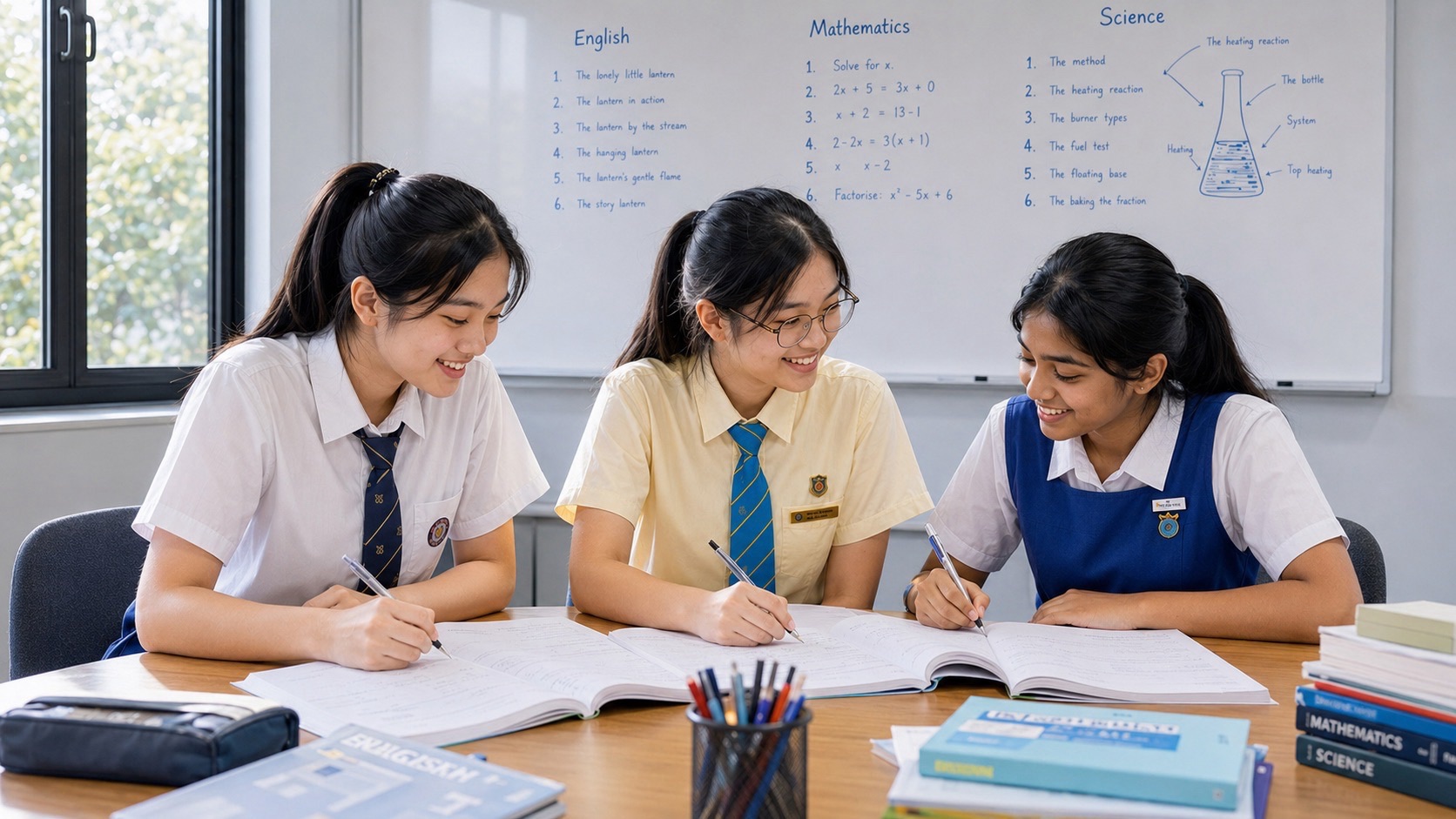
Secondary 3 Mathematics is where time management stops being a last-minute examination trick and starts becoming part of mathematical control.
A student can know the Mathematics and still underperform if too much time is spent on the wrong question, if a difficult problem is allowed to trap the whole paper, if routine algebra is too slow, if checking is left until the final minute, or if the student repeatedly restarts instead of finishing a viable route.
That is why Secondary 3 Mathematics paper pacing, exam time management, question triage, leaving strategy, return strategy and checking discipline should be trained before Secondary 4.
Under Singapore’s Full Subject-Based Banding framework, Mathematics is taken at G1, G2 or G3 subject level. From the 2027 graduating cohort, students receive the Singapore-Cambridge Secondary Education Certificate, or SEC, with Mathematics offered at the relevant subject level. The 2027 Mathematics subject codes are K110 for G1, K210 for G2 and K310 for G3.
School-based Secondary 3 assessments do not all use identical paper lengths, topic distributions or internal weighting. Schools may sequence content differently across Secondary 3 and Secondary 4. So this article does not pretend there is one universal minute-per-question formula for every school test.
Instead, it explains the deeper pacing system that transfers across school papers and later SEC preparation:
Time should follow marks, certainty, progress and recoverability — not panic.
50-Second Router
- If the student always runs out of time: go to “Running out of time is a symptom, not a diagnosis”.
- If one hard question destroys the whole paper: go to “The leaving rule”.
- If the student skips too much: go to “Leaving is not abandoning”.
- If the student finishes but loses many easy marks: go to “Checking should be distributed, not postponed”.
- If the student is slow because working is messy: go to “Pacing begins with fluency and working architecture”.
- If the student panics when the first question is hard: go to “Question order is not emotional order”.
- If the student wants a practical routine: go to “The Secondary 3 paper-pacing protocol”.
- If the student also takes Additional Mathematics: go to “Mathematics and A-Math need separate clocks”.
This Article Has a Distinct Job
This page belongs to our How Secondary 3 Mathematics Works in Singapore | SEC G1, G2 & G3 series.
It does not duplicate the estate-wide national assessment owner How Paper 1 and Paper 2 Work in SEC Secondary Mathematics | G1, G2 & G3, which explains the official paper architecture.
It also does not duplicate How Secondary 3 Mathematics Assessment Readiness Works, which owns the broader test-to-diagnosis cycle.
This page owns the stage-specific pacing problem:
- how to distribute time across a Secondary 3 Mathematics paper;
- how to decide whether to continue or leave;
- how to return without restarting from zero;
- how to protect accessible marks;
- how to pace multi-part questions;
- how to check without wasting time;
- how to train speed without damaging accuracy;
- how to distinguish slow Mathematics from poor paper strategy.
The Short Answer
Paper pacing is the management of mathematical attention under a time constraint.
A strong student does not merely “work faster”.
The student manages four resources:
- time — finite minutes;
- attention — the ability to reason accurately;
- confidence — knowledge of what is and is not currently secure;
- recoverability — the ability to return to unfinished work later.
The pacing cycle is:
Read → Estimate → Start → Monitor → Decide → Leave or Continue → Return → Verify
Time Is Not Distributed Equally Across Questions
Students sometimes attempt to divide total examination time evenly by the number of questions.
That can be misleading because questions differ in:
- mark value;
- number of parts;
- reading load;
- algebraic length;
- reasoning demand;
- diagram complexity;
- calculator work;
- uncertainty of method selection.
A better principle is proportional rather than equal:
More marks can justify more time, but only while progress remains mathematically productive.
A five-mark question may deserve more time than a one-mark question.
But a five-mark question that has produced no viable route after a reasonable attempt should not be allowed to consume fifteen minutes simply because the student has already invested five.
The Sunk-Time Trap
One of the most expensive examination mistakes is continuing because time has already been spent.
The student thinks:
I have already spent six minutes. I cannot leave now.
But those six minutes are already gone.
The decision should be based on the next minute, not the previous six.
Ask:
- Do I now know the route?
- Am I making progress?
- Is the remaining work routine?
- Is there a nearby mark I can still secure?
- Would another question produce marks more reliably right now?
This is mathematical triage.
The First Thirty Seconds Matter
Pacing begins before calculation.
A student who starts writing immediately may lose more time than a student who spends a few seconds understanding the structure.
Before committing to a long question, ask:
- What is the target?
- What information is given?
- What topic or structure is present?
- What method is likely?
- How many steps will the route probably require?
- Can I see an entry point?
If the entry point is clear, begin.
If not, decide whether a short exploratory attempt is justified or whether another question should be taken first.
Question Order Is Not Emotional Order
Some students experience the paper emotionally.
If Question 1 is difficult, they conclude the entire paper is difficult.
If an early question is unfamiliar, confidence falls before later accessible questions are even seen.
The paper’s printed order is not a judgement on the student’s ability.
Nor does difficulty always increase smoothly from front to back.
The student should treat each question as a fresh decision.
A difficult first question should not be allowed to define the next twenty.
The Green–Amber–Red Triage
A useful mental classification is:
Green
The route is clear. The Mathematics is familiar. Begin and finish efficiently.
Amber
The structure is partly visible. A short attempt may unlock the route.
Red
No reliable entry point is visible yet, or the route is becoming disproportionately expensive.
Red does not mean impossible.
It means not now.
A strong paper strategy secures green marks, develops amber questions and returns to red questions with remaining time and a calmer mind.
The Leaving Rule
Students need an explicit rule for leaving a question.
Otherwise they rely on emotion.
A useful leaving rule is:
Leave when progress has stopped, not merely when the question feels uncomfortable.
Signs that progress has stopped include:
- the same line is being rewritten repeatedly;
- no new information has been derived for several steps;
- the method requires information the question does not provide;
- the algebra is expanding uncontrollably;
- the student is trying random formulas;
- the student is staring rather than reasoning;
- the route has become much longer than the marks suggest.
At that point, the next minute may be worth more elsewhere.
Leaving Is Not Abandoning
Students sometimes resist leaving because they interpret it as surrender.
That is the wrong model.
Leaving is a time-allocation decision.
A good leave has three parts:
- Record any valid partial working.
- Mark the exact point where you became uncertain.
- Create a visible return marker.
This preserves recoverability.
When the student returns, the previous thinking is still available.
The Return Marker
A useful return marker might be a small star, box or symbol beside the question number.
But the marker should carry meaning.
- One mark: unfinished but route known.
- Two marks: method uncertain.
- Circle: answer needs checking.
The exact symbols do not matter.
The point is to convert vague memory into a return queue.
Return Without Restarting
When students revisit a question, they often reread everything and begin from zero.
That wastes the value of the first attempt.
Instead, return using this sequence:
- Read the target again.
- Find the last line you trust.
- Identify why you stopped.
- Ask whether a new representation is now visible.
- Continue from the last reliable state.
This turns leaving into a controlled pause rather than a reset.
Running Out of Time Is a Symptom, Not a Diagnosis
Students often say:
I just need to work faster.
Sometimes that is true.
Often it is incomplete.
Running out of time can be caused by:
- slow routine algebra;
- weak calculator fluency;
- poor method selection;
- too many false starts;
- overwriting simple working;
- rechecking easy questions excessively;
- refusing to leave difficult questions;
- re-reading long questions because the first reading was weak;
- poor retrieval of formulas or relationships;
- anxiety caused by unstable foundations.
Each cause needs a different intervention.
The result-diagnosis owner is How to Diagnose a Secondary 3 Mathematics Result.
Pacing Begins With Fluency and Working Architecture
Time strategy cannot compensate indefinitely for slow routine Mathematics.
If a student needs four minutes to perform algebra that should eventually feel routine, every later question inherits that cost.
Likewise, messy working slows the paper because the student repeatedly has to reconstruct their own logic.
Good working architecture reduces time by making the route visible.
- one transformation per line where clarity helps;
- label important intermediate values;
- keep units visible where needed;
- avoid unnecessary rewriting;
- align algebra cleanly;
- mark derived angles or lengths on diagrams;
- keep calculator values consistent with the written route.
The fastest reliable solution is often the clearest one.
Speed Should Be Built on Stable Mathematics
Trying to increase speed before understanding is stable creates fragile performance.
A safer progression is:
correct slowly → correct consistently → correct in mixed conditions → correct efficiently → correct under time pressure
Timed practice belongs near the end of this progression, not at the beginning.
Marks Per Minute Is a Diagnostic, Not a Mechanical Rule
Students sometimes want a universal “minutes per mark” formula.
It can be useful as a rough orientation when a specific paper structure is known.
But it should not become mechanical.
Questions differ.
A short reasoning question may be worth several marks and require little calculation.
A routine multi-part question may offer many marks efficiently.
An unfamiliar problem may require more initial thinking before marks begin to appear.
Use marks-per-minute as a drift detector:
Am I spending an amount of time that is now out of proportion to the marks and progress available?
Protect the Easy and Medium Marks First
A paper is usually not won by solving the hardest question first.
It is built by securing accessible credit reliably.
This does not mean avoiding challenge.
It means protecting the parts of the paper where the expected return is high.
Strong pacing therefore asks:
- Which marks are currently accessible?
- Which marks require only routine execution?
- Which question needs deeper reasoning but has a visible route?
- Which question is currently consuming attention without producing progress?
The Secure-Marks Pass
One possible paper strategy is a two-pass or three-pass system.
Pass 1: secure
Complete questions where the route is clear and marks are accessible.
Pass 2: develop
Return to amber questions that require more thought but now have enough remaining time.
Pass 3: recover and check
Attempt red questions, recover incomplete parts and run targeted checks.
This structure should be adapted to the student and paper.
It is not a law.
Its purpose is to prevent one difficult question from blocking access to later marks.
Do Not Skip So Aggressively That Reading Becomes Fragmented
There is an opposite pacing problem.
Some students jump around the paper so aggressively that they repeatedly pay the cost of reorientation.
Every switch requires:
- new reading;
- new representation;
- new topic activation;
- new calculator or diagram context.
Leaving should therefore be strategic, not restless.
If progress is healthy, finish the question.
If progress has stopped, leave.
Multi-Part Questions Need Local Pacing
A multi-part question may contain easy and difficult parts.
Do not treat the entire question as one block.
For each part, ask:
- Is this independent?
- Does it depend on an earlier result?
- Can I earn this mark even if the previous part failed?
- Can I use the given or stated result from an earlier “show that” part?
This matters especially when part (a) goes wrong.
A student should not automatically abandon parts (b) and (c) if they can still be attempted from stated or derived information.
Use Handoffs Properly
Words such as hence, using your answer, given that and from the graph indicate result handoffs.
These handoffs can save time because earlier work has already produced a useful object.
Ignoring the handoff may lead to unnecessary recalculation.
The task-reading owner is How Mathematical Language & Task Reading Work in Secondary 3 Mathematics.
Checking Should Be Distributed, Not Postponed
Students often imagine checking as a final ten-minute activity.
That is risky because time may not remain.
Better checking is distributed.
- Check a sign immediately after a long algebraic transformation.
- Check a unit before leaving a measurement question.
- Check a probability range before moving on.
- Check a solved equation by substitution before the context is forgotten.
- Check a graph against the equation while both are active in memory.
These local checks are cheap because the relevant information is already loaded mentally.
The Final Check Should Be Selective
If time remains, do not reread the whole paper with equal attention.
Prioritise high-risk items:
- questions marked for checking;
- high-mark answers produced unusually quickly;
- questions with many algebraic steps;
- measurement answers with units or rounding;
- probability answers near 0 or 1;
- questions where the final answer looks implausible;
- answers changed during the paper;
- multi-part questions where an earlier error may have propagated.
Checking should follow risk.
Do Not Change a Correct Answer Without Evidence
Students sometimes mistrust their first answer simply because it was reached quickly.
During checking, they change it based on vague discomfort.
A better rule is:
Change an answer only when you can identify mathematical evidence that the original route is wrong.
Evidence may be:
- a failed substitution;
- wrong unit;
- impossible sign;
- probability outside 0 to 1;
- graph contradiction;
- geometric impossibility;
- misread command word.
Checking should increase confidence through evidence, not destabilise correct work through anxiety.
Calculator Speed Is Not Calculator Rushing
Calculator fluency can save time, but rushed entry can create silent errors.
A strong sequence is:
- write or identify the mathematical expression;
- estimate the answer range;
- enter carefully;
- inspect the display;
- record enough precision;
- round only as required.
The student should become faster at entering correct mathematics, not faster at guessing what to type.
Do Not Recalculate What the Mathematics Already Knows
Students sometimes repeatedly recompute a quantity that has already been established.
This can happen because working is poorly labelled or the student does not trust an earlier result.
Use named intermediate values.
If a length, angle, rate, probability or algebraic expression has been found and verified, reuse it where appropriate.
Good working preserves useful results so later parts can inherit them.
Pacing in Algebra
Algebra can consume time through repeated expansion, unnecessary rearrangement and avoidable sign repair.
Students should train:
- stable expansion and factorisation;
- equation balance;
- formula rearrangement;
- clean substitution;
- recognition of when a form is already useful;
- substitution checks rather than full reworking.
The dedicated owner is How Algebra Works in Secondary 3 Mathematics.
Pacing in Geometry & Measurement
Geometry pacing improves when the diagram is annotated before calculation begins.
Students lose time when they repeatedly reread the prose because important conditions were never transferred to the diagram.
Useful habits include:
- mark equal lengths;
- mark parallel lines;
- label known angles;
- identify the target;
- write derived values onto the diagram;
- check units before finalising measurement answers.
The dedicated owner is How Geometry & Measurement Work in Secondary 3 Mathematics.
Pacing in Statistics & Probability
Statistics can become slow when students calculate before deciding what comparison matters.
Probability can become slow when outcome structure is not organised first.
Useful habits include:
- identify the statistic before calculator entry;
- read axes and frequencies once carefully;
- organise probability events using lists, tables or trees where useful;
- check totals and ranges before leaving;
- write the interpretation while the numbers are still active in memory.
The dedicated owner is How Statistics & Probability Work in Secondary 3 Mathematics.
Pacing in G1 Mathematics
At Secondary 3 G1, time control should prioritise dependable execution in practical and mathematical contexts.
The student should increasingly be able to:
- read the task once accurately;
- identify the required quantity;
- work with number, percentage, rate, algebra, measurement, data and probability efficiently at the required level;
- use the calculator without unnecessary trial-and-error;
- check units and practical reasonableness;
- leave a difficult item when progress has genuinely stopped;
- return using existing partial work.
The target is reliable completion, not racing.
Pacing in G2 Mathematics
At Secondary 3 G2, method selection begins to consume more time.
The student should increasingly manage:
- topic switching;
- multi-step algebra;
- geometry and trigonometric method choice;
- data interpretation;
- probability structure;
- longer contextual questions;
- selective checking;
- leaving and return strategy.
The pacing bottleneck is often not arithmetic speed alone.
It is route-choice speed.
Pacing in G3 Mathematics
At Secondary 3 G3, the paper increasingly demands dense switching between representations and methods.
The student should increasingly manage:
- longer algebraic chains;
- unfamiliar questions;
- multiple plausible routes;
- more demanding reasoning;
- multi-part dependencies;
- greater verification load;
- preservation of time for higher-demand questions.
Efficiency comes from structure recognition, not simply faster handwriting.
Mathematics and A-Math Need Separate Clocks
Students taking Additional Mathematics can make a serious pacing mistake by importing one subject’s tempo into the other.
A-Math may contain longer symbolic chains and different paper demands.
Mathematics includes its own data, probability, measurement, modelling and broad-topic switching requirements.
The student should therefore practise paper pacing separately for each subject.
Shared algebraic fluency can help both, but question triage and time allocation should be calibrated to the actual paper being attempted.
The interface owner is How Mathematics & Additional Mathematics Interact at Secondary 3.
The Secondary 3 Paper-Pacing Protocol
A practical protocol can be trained in stages.
Before the paper
- Know the paper duration and marks for the actual school assessment.
- Know whether calculators are permitted.
- Know the school’s topic scope.
- Decide a rough checkpoint schedule.
During the paper
- Read the question fully.
- Identify the target.
- Start if the route is visible.
- Monitor whether progress is occurring.
- Leave if progress has stopped beyond a reasonable point.
- Mark a return symbol.
- Protect accessible marks elsewhere.
- Return to amber and red questions.
- Run targeted checks.
After the paper
- Identify questions lost through knowledge.
- Identify questions lost through time.
- Identify questions where time was overspent.
- Identify questions left despite being solvable.
- Update the pacing rule before the next timed set.
Use Checkpoints, Not Constant Clock-Watching
Students who look at the clock after every question can create unnecessary anxiety.
A better approach is to use checkpoints.
For example, in a school test, the student may decide to check the clock after a major section, after a certain number of marks, or at a pre-agreed fraction of the paper.
The exact checkpoint depends on the paper.
The principle is:
Use the clock to detect drift, not to create it.
The Halfway Audit
At a sensible midpoint, ask:
- Am I roughly where I expected to be?
- Have I accumulated too many unfinished questions?
- Have I overspent on one section?
- Do I need to shorten checking temporarily?
- Are the remaining questions likely to be more demanding?
This allows correction before the final minutes.
Pacing Data Should Be Recorded After Practice Papers
Do not record only the final score.
Record:
- time completed;
- questions left unfinished;
- questions overspent;
- questions returned to successfully;
- marks lost through time versus knowledge;
- accuracy in the final section;
- number of answers changed during checking.
This creates a pacing profile.
The profile is more useful than repeatedly saying, “Work faster next time.”
The Three Common Pacing Profiles
Profile 1: Accurate but incomplete
Likely needs fluency, method-selection speed or better leaving strategy.
Profile 2: Complete but inaccurate
Likely rushing, under-checking or working beyond current stability.
Profile 3: Variable
Some papers are excellent; others collapse.
This can indicate weak-link volatility, uneven topic retrieval, emotional pacing or poor response to difficult early questions.
The student needs a different intervention depending on the profile.
Accuracy Before Speed, Then Accuracy at Speed
The final goal is not slow perfection.
Nor is it fast error.
The goal is reliable Mathematics under realistic time conditions.
That requires two phases:
- Build accurate mathematical execution.
- Compress the time cost without losing the structure.
Students should know which phase a skill is currently in.
The 10-Minute Pacing Drill
Pacing can be trained without always doing full papers.
Use a short mixed set designed for ten minutes.
- one routine question;
- one medium multi-step question;
- one unfamiliar question;
- one deliberate trap requiring reading accuracy.
Afterward, review not only correctness but decisions:
- Which question was attempted first?
- Where was time overspent?
- Was leaving necessary?
- Was the return successful?
- Which check caught an error?
Short drills reduce the cost of strategy training.
The 30-Minute Section Drill
Once the student can manage short sets, use a larger mixed section.
The student should practise:
- checkpoint use;
- green–amber–red triage;
- leaving with partial work;
- return markers;
- targeted final checking.
The purpose is to build paper behaviour before full-paper endurance is required.
Full Papers Should Come After Section Control
A full paper combines Mathematics, pacing, endurance and emotional regulation.
If the student has not yet learned to manage ten- or thirty-minute sections, repeated full papers may simply rehearse poor pacing.
The training sequence should be:
question control → short mixed set → timed section → full paper
Pacing Should Be Practised With Unfamiliar Questions
Familiar questions underestimate decision time.
In a real assessment, the student may need to interpret a new context before selecting the method.
Therefore some timed practice should include unfamiliar surface forms.
This tests whether the student can:
- stay calm while reading;
- identify the hidden structure;
- decide whether to continue;
- leave without panic;
- return productively.
Pacing Should Be Practised With Easy Questions Too
Students sometimes rush easy questions because they are saving time for difficult ones.
This can create unnecessary mark leakage.
The correct goal for routine questions is:
fast enough to be efficient, slow enough to remain reliable.
Routine marks should be protected because they are often the cheapest marks on the paper.
The Final-Five-Minutes Protocol
If five minutes remain, the student needs a priority order.
- Complete any almost-finished question with a clear route.
- Return to a high-mark question where one missing step can unlock credit.
- Check high-risk answers already completed.
- Scan for missing units, unanswered subparts or blank responses.
- Attempt short accessible items before beginning a completely opaque long question.
The exact order can vary, but the student should not spend the final minutes randomly rereading the paper.
The Blank-Answer Scan
Near the end, scan for blanks.
A blank may represent:
- a forgotten subpart;
- a deliberately skipped question;
- a result written in working but not transferred to the answer;
- a place where partial credit may still be available.
A blank scan is cheap and can recover avoidable marks.
Do Not Spend the Final Minute Starting a Long Route Blindly
If almost no time remains, full problem solving may no longer be realistic.
But the student can still record useful mathematical structure:
- define the unknown;
- write the relevant formula;
- state a geometric relationship;
- draw the tree structure;
- write the equation that would be solved.
Do not invent working merely to fill space.
Write valid Mathematics that shows the intended route.
How Parents Can See a Pacing Problem
Parents do not need to know every formula to recognise pacing patterns.
- The last page is repeatedly blank.
- Early pages contain excessive working for routine questions.
- The student reports spending ten minutes on one question.
- Accuracy is good in untimed homework but poor in tests.
- Answers late in the paper become much messier.
- The student finishes with time but loses avoidable easy marks.
- The student changes correct answers during checking without mathematical evidence.
These are useful signals to bring to the tutor.
Five Questions a Parent Can Ask
- Where did you spend the most time?
- Which question should you have left earlier?
- Which question did you return to successfully?
- Did time disappear because the Mathematics was slow or because the strategy was poor?
- What pacing rule will you change next time?
A Tutor’s Pacing Diagnostic
- Compare timed and untimed accuracy.
- Measure routine algebra speed.
- Observe reading time on unfamiliar questions.
- Track false starts.
- Track questions left and returned to.
- Identify overspent questions.
- Inspect accuracy deterioration late in the paper.
- Observe checking behaviour.
- Test whether leaving rules are followed.
- Separate knowledge failure from pacing failure.
The tutor should not prescribe “faster” until the mechanism has been identified.
The Three-Student Small-Group Advantage
Paper pacing becomes visible in a small group because the tutor can observe the student’s decision process, not only the finished script.
One student may spend too long trying to perfect every line.
Another may rush routine questions and leak marks.
A third may refuse to leave difficult problems.
These students need different pacing interventions even if they all “run out of time”.
Our mathematics classes are deliberately small, with a maximum of three students, because these micro-decisions are easier to see and correct before they become examination habits.
What Secondary 3 Should Hand to Secondary 4
By the end of Secondary 3, the student should increasingly have:
- a realistic sense of routine-question speed;
- a leaving rule;
- a return-marker system;
- a method for preserving partial work;
- a checkpoint habit;
- distributed checking;
- experience with short timed mixed sets;
- experience with timed sections;
- enough fluency that routine work does not consume the entire paper;
- the confidence to treat one difficult question as one difficult question, not as a verdict on the whole examination.
The broader handover is covered in How Secondary 3 Mathematics Prepares a Student for Secondary 4.
The Secondary 3 Time-Allocation Route
- Singapore Mathematics Hub
- How Secondary 3 Mathematics Works | SEC G1, G2 & G3
- How Secondary 3 Mathematics Assessment Readiness Works
- How Problem-Solving Independence Changes in Secondary 3 Mathematics
- How Mathematical Language & Task Reading Work in Secondary 3 Mathematics
- How to Diagnose a Secondary 3 Mathematics Result
- How Paper 1 and Paper 2 Work in SEC Secondary Mathematics
- Secondary 3 Mathematics
Official Singapore References
For current national syllabus and assessment requirements, use the official Singapore Examinations and Assessment Board SEC syllabus pages:
- 2027 SEC G1 syllabuses — Mathematics K110
- 2027 SEC G2 syllabuses — Mathematics K210
- 2027 SEC G3 syllabuses — Mathematics K310
School-specific Secondary 3 paper duration, topic scope, weighting and assessment format should always be confirmed with the student’s school.
Final Principle
Time management in Mathematics is not the art of hurrying.
It is the art of allocating mathematical attention where it can still produce reliable credit.
A strong student does not merely solve.
The student also decides when to continue, when to leave, what to preserve, when to return and what deserves checking.
Read before rushing. Secure accessible marks. Continue while progress is real. Leave when progress stops. Mark the return point. Come back without restarting. Check by risk. Protect accuracy while building speed.
That is how time allocation and paper pacing should work in Secondary 3 Mathematics.