
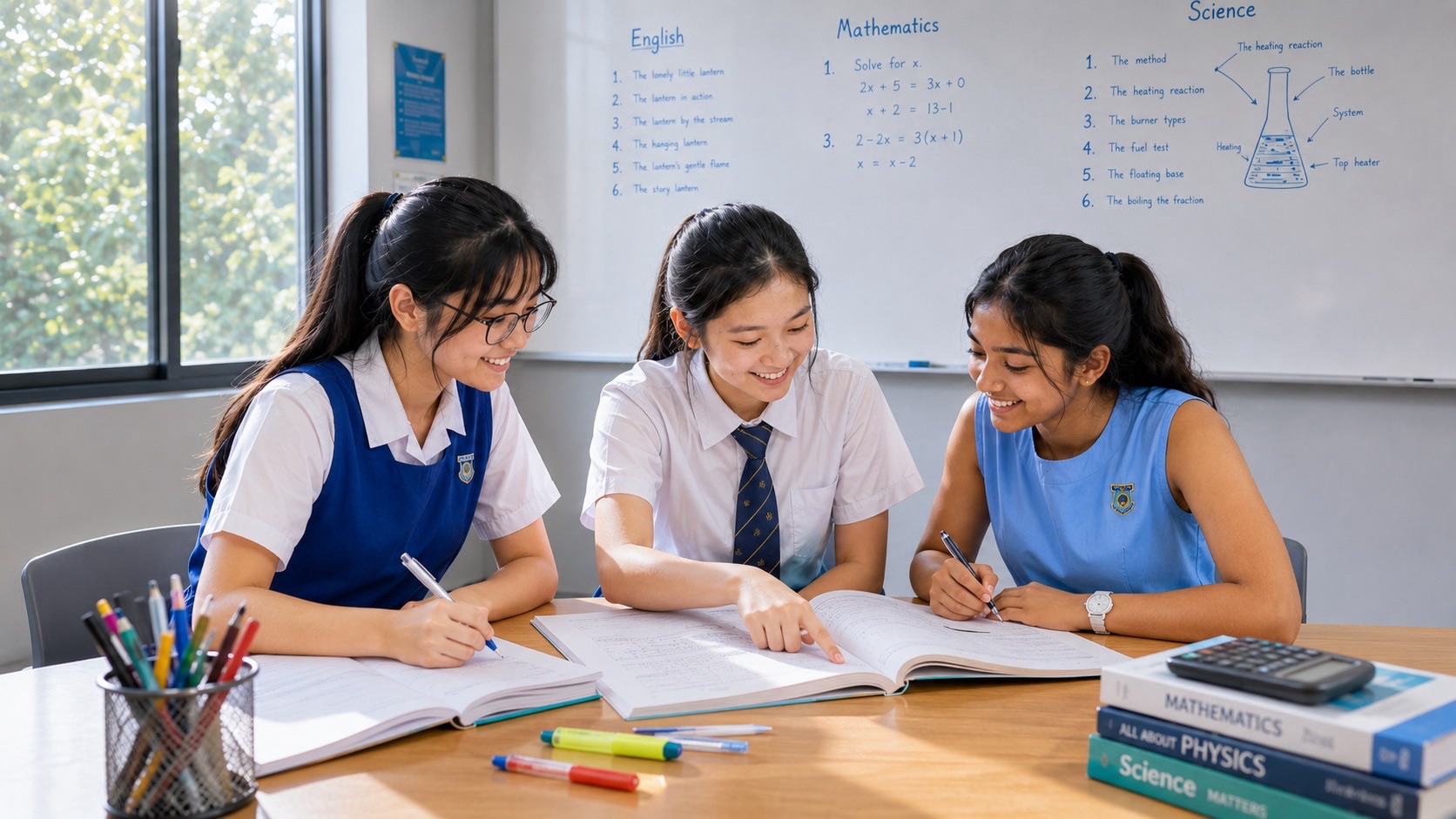
Secondary 3 is the point where Mathematics and Additional Mathematics begin to feel like two separate subjects running on some of the same machinery.
They are not the same subject. They should not be taught as if one is merely the harder version of the other. They do not have identical syllabus ownership, identical assessment demands or identical purposes.
But they do interact.
Algebra learned in Mathematics can support Additional Mathematics. Graph interpretation can transfer. Coordinate thinking can transfer. Trigonometric fluency can transfer. Mathematical working habits can transfer. Checking discipline can transfer. Problem-solving independence can transfer.
And the reverse is also true: stronger symbolic control developed in Additional Mathematics can make parts of Mathematics feel easier.
The danger appears when this relationship is misunderstood.
A student may begin treating Additional Mathematics as the “real” mathematics and neglect Statistics, Probability, Measurement or real-world modelling in Mathematics. Another student may use an A-Math method automatically in a Mathematics question without checking whether it is appropriate, expected or efficient. A third student may carry one damaged algebraic foundation into both subjects and appear to have two separate problems when the real failure is shared.
The correct model is:
Mathematics and Additional Mathematics are separate systems with shared infrastructure.
That is the key to planning them properly at Secondary 3.
The 2027 SEC Boundary
For the 2027 Singapore-Cambridge Secondary Education Certificate, SEAB lists:
- G1 Mathematics — K110
- G2 Mathematics — K210
- G2 Additional Mathematics — K232
- G3 Mathematics — K310
- G3 Additional Mathematics — K341
The official G1 list includes Mathematics but does not list Additional Mathematics. The Mathematics–Additional Mathematics interface therefore arises primarily in the G2 and G3 routes.
That boundary matters because it prevents an old habit of speaking loosely about “Math” and “A-Math” without first identifying the subject level.
At Secondary 3, the useful question is not simply:
Is the student taking A-Math?
The useful question is:
Which Mathematics level is the student taking, which Additional Mathematics level is the student taking, and which shared dependencies must be strong enough to support both?
This Article Has a Distinct Job
This page belongs to our How Secondary 3 Mathematics Works in Singapore | SEC G1, G2 & G3 series.
It does not replace the canonical Additional Mathematics owner at How Secondary 3 Additional Mathematics Works in Singapore | SEC G2 & G3.
It also does not duplicate the separate level-specific A-Math guides:
- How Secondary 3 G2 Additional Mathematics Works | K232
- How Secondary 3 G3 Additional Mathematics Works | K341
This page owns the interface between the subjects:
- what Mathematics should supply to Additional Mathematics;
- what Additional Mathematics can strengthen inside Mathematics;
- what must remain separate;
- how to diagnose shared versus subject-specific weaknesses;
- how to allocate study time without allowing one subject to cannibalise the other;
- how to prepare both systems for Secondary 4.
The Short Answer
Mathematics supplies a broad quantitative foundation. Additional Mathematics builds a denser symbolic and functional system on top of substantial parts of that foundation.
The two subjects interact most strongly through:
- algebra;
- equations;
- functions and graphs;
- coordinate thinking;
- trigonometry;
- mathematical modelling;
- working discipline;
- verification;
- method selection.
But Mathematics also contains important territory that A-Math does not automatically protect, especially broader data work, probability, measurement, real-world quantitative interpretation and other syllabus-specific structures.
The correct planning principle is therefore:
Share the infrastructure. Preserve the ownership.
The Official Syllabuses Confirm the Dependency
The 2027 G2 Additional Mathematics syllabus explicitly states that knowledge of the G2 Mathematics syllabus, together with certain additional topics, is assumed. Material from G2 Mathematics that is not repeated in the A-Math syllabus may still be required indirectly in A-Math questions.
The 2027 G3 Additional Mathematics syllabus similarly states that knowledge of the G3 Mathematics syllabus is assumed and may be required indirectly in response to A-Math questions.
This creates an important educational fact:
Additional Mathematics does not float above Mathematics. It rests on it.
When the base is weak, the upper system becomes more expensive to operate.
The Shared Infrastructure Layer
Think of Mathematics and Additional Mathematics as two buildings sharing some underground services.
The buildings are separate.
But both may depend on the same electricity, water or structural foundation.
In Secondary 3 Mathematics, the shared infrastructure often includes:
- signed-number control;
- fraction fluency;
- algebraic notation;
- expansion and factorisation;
- equation balance;
- substitution;
- formula rearrangement;
- coordinate interpretation;
- graph reading;
- trigonometric basics where relevant;
- calculator fluency;
- clear mathematical working.
When one of these fails, both subjects can deteriorate at once.
Algebra Is the Main Bridge
The most important shared bridge is algebra.
In Mathematics, algebra supports equations, graphs, coordinate relationships, proportion, formulae, geometry and modelling.
In Additional Mathematics, algebra becomes even more central. Quadratic functions, equations and inequalities, surds, polynomials, partial fractions, binomial expansions, logarithms, trigonometric relationships and calculus all place strong demands on symbolic fluency.
This means one damaged algebraic engine can create a misleading picture.
The student may say:
- “I am weak in graphs.”
- “I am weak in A-Math quadratics.”
- “I am weak in trigonometry.”
- “I am weak in formulas.”
But the common failure may be:
- weak factorisation;
- poor sign control;
- fraction instability;
- invalid equation transformations;
- substitution errors.
Repair the shared infrastructure once, and both subjects may improve.
Why Factorisation Has Disproportionate Value
Factorisation is a good example of shared leverage.
In Mathematics, factorisation supports algebraic simplification and equation work.
In Additional Mathematics, factorisation becomes part of a much larger symbolic system. It may support quadratic equations, polynomial reasoning, partial fractions, identities and later manipulations.
A student who treats factorisation as one old chapter may repeatedly pay the cost of relearning it.
A student who treats factorisation as infrastructure keeps it active.
Graphs Are the Second Major Bridge
Mathematics teaches students to interpret relationships graphically.
Additional Mathematics deepens the functional and symbolic relationship between equations and graphs.
The strongest shared habit is this:
An equation and a graph are two representations of the same mathematical relationship.
This allows one representation to check the other.
- Roots can correspond to axis intersections.
- Equal values can correspond to graph intersections.
- Gradient can connect graphical steepness to algebraic relationships.
- Turning behaviour can reveal structural information about a function.
The exact content differs by subject and level, but the representational habit transfers.
Trigonometry Is Shared but Not Identical
Trigonometric ideas appear in Mathematics and become more extensive in Additional Mathematics.
The shared foundation includes disciplined interpretation of angles, side relationships, calculator mode, exact versus approximate values where relevant, and geometric plausibility.
Additional Mathematics then extends the system into functions, identities, equations and more advanced relationships according to the syllabus.
The correct teaching move is not to collapse the two topics.
It is to make the dependency visible:
secure Mathematics trigonometry → build Additional Mathematics trigonometry → return stronger symbolic control to Mathematics.
Mathematical Working Is Another Shared System
Both subjects benefit from working that preserves reasoning.
A strong solution makes visible:
- the relationship being used;
- substitution;
- major algebraic transformations;
- intermediate results;
- units where relevant;
- the final answer;
- checks where appropriate.
Students who compress too much mentally may survive simple Mathematics questions and then collapse in denser A-Math algebra because the chain becomes impossible to audit.
Good working is therefore shared infrastructure for cognition as well as assessment.
Verification Transfers Across Both Subjects
A student who develops independent checking in one subject should use it in the other.
- Solve an equation, then substitute.
- Factorise, then expand.
- Differentiate, then inspect whether the sign or behaviour makes sense.
- Integrate, then differentiate the result where appropriate.
- Solve graphically, then compare algebraically.
- Estimate a Mathematics answer before trusting calculator output.
The specific checks differ, but the habit is shared:
Do not ask only whether an answer has been produced. Ask what independent evidence supports it.
What Must Remain Separate: Statistics and Probability
One major reason Mathematics cannot be treated as “A-Math but easier” is that Mathematics owns important statistical and probability work.
A student who spends nearly all revision time on Additional Mathematics may become symbolically strong while allowing data interpretation, statistical comparison and probability structure to weaken.
That creates a dangerous illusion:
the student feels mathematically strong because difficult algebra is going well, while marks remain vulnerable in parts of Mathematics that A-Math does not rehearse.
The Mathematics timetable therefore needs protected time for its own syllabus.
What Must Remain Separate: Measurement and Real-World Quantitative Judgement
Mathematics also trains broad work with measurement, units, scale, data, finance and real-world quantitative decisions.
These may require less symbolic sophistication than an A-Math function or calculus question, but they demand a different kind of mathematical judgement.
The student must decide:
- what the quantities mean;
- which units are appropriate;
- how a numerical result returns to the real situation;
- whether rounding changes the decision;
- whether the model itself is reasonable.
Additional Mathematics does not automatically replace this training.
What Must Remain Separate: Assessment Conventions
The subjects have different syllabuses and papers.
A method that is mathematically valid may not always be the clearest or most appropriate way to answer a Mathematics question simply because the student knows a more advanced A-Math method.
The student should ask:
- Is this method within the Mathematics knowledge expected here?
- Does it communicate the required reasoning clearly?
- Is there a simpler route?
- Will the working remain understandable and markable?
Advanced knowledge is useful only when it improves control rather than obscures it.
The G2 Interface: K210 Mathematics and K232 Additional Mathematics
At G2, the official K232 Additional Mathematics syllabus assumes knowledge of G2 Mathematics and also specifies additional assumed topics.
This makes the dependency explicit.
A student taking both subjects should therefore protect the K210 foundation while building the K232 extension.
A useful planning sequence is:
- stabilise G2 Mathematics algebra;
- identify the additional assumed bridge content;
- build K232 topics on top of that base;
- keep K210 statistics, probability, geometry, measurement and real-world work active;
- test both subjects independently under mixed conditions.
The student should not use A-Math progress as a substitute for Mathematics progress.
The G3 Interface: K310 Mathematics and K341 Additional Mathematics
At G3, the interface is even denser.
The official K341 syllabus assumes knowledge of G3 Mathematics. That is not a decorative statement. It means the A-Math system expects the student to arrive with substantial mathematical infrastructure already operating.
The K310–K341 interface should therefore be managed deliberately.
- G3 Mathematics supplies broad algebraic, graphical, geometric, statistical, probabilistic and modelling capability.
- G3 Additional Mathematics intensifies symbolic, functional, trigonometric and calculus-related demands.
- Shared algebra should be maintained at a level high enough that routine manipulation does not consume excessive attention.
- Mathematics-only domains should remain protected in the revision schedule.
- Errors should be tracked by shared mechanism and by subject-specific ownership.
The objective is two strong subjects, not one strong subject carrying one neglected subject.
Where G1 Fits
For 2027 school candidates, the G1 syllabus list includes Mathematics K110 but not Additional Mathematics.
This means the Secondary 3 G1 Mathematics planning job is different.
The focus should remain on building reliable Mathematics capability at G1: number, ratio, percentage, algebra, geometry, measurement, statistics, probability, interpretation, checking and practical mathematical independence.
If future progression toward more demanding Mathematics is relevant, the correct bridge is not to pretend the student is already taking Additional Mathematics.
The bridge is to strengthen the foundational Mathematics that later routes would depend on.
The Shared Error Problem
When a student takes both Mathematics and Additional Mathematics, the same weakness can appear twice.
Examples include:
- negative-sign errors in Mathematics equations and A-Math functions;
- fraction instability in Mathematics ratio work and A-Math algebra;
- factorisation weakness in Mathematics quadratics and A-Math polynomial work;
- graph-reading weakness in Mathematics relationships and A-Math functions;
- calculator-entry weakness in trigonometric work across both subjects;
- poor working structure causing errors in long solutions in both papers.
If the tutor treats each appearance as a separate chapter problem, the student may receive twice the worksheets without repairing the shared cause.
The correct diagnostic question is:
Is this a Mathematics problem, an Additional Mathematics problem, or a shared infrastructure problem?
The First Wrong Line Should Be Tagged Twice
When reviewing an error, tag it by subject and by mechanism.
For example:
- Subject: G3 Additional Mathematics
- Question: quadratic function
- Mechanism: sign error during expansion
- Shared? yes — same mechanism can damage K310 algebra
Or:
- Subject: G3 Mathematics
- Question: cumulative frequency
- Mechanism: quartile interpretation
- Shared? no — primarily Mathematics-owned data skill
This prevents overgeneralisation.
The Shared Repair Rule
If the weakness is shared, repair it at the infrastructure level.
Then reconnect it to both subjects.
The cycle is:
shared failure → isolate mechanism → repair directly → Mathematics retest → A-Math retest → delayed mixed retest
This is more efficient than repairing the same algebra twice under different chapter names.
The Separate Repair Rule
If the weakness belongs mainly to one subject, do not force a cross-subject explanation.
A probability-tree problem is not improved simply because the student can differentiate.
A partial-fractions problem is not repaired by doing more Mathematics statistics.
Preserve subject ownership.
This discipline keeps the learning map clean.
Do Not Let Additional Mathematics Cannibalise Mathematics
This is one of the most common Secondary 3 planning risks.
A-Math often feels more difficult and therefore receives more attention.
The student may spend several evenings repairing A-Math algebra while assuming Mathematics will take care of itself.
Then Mathematics marks leak through:
- statistics;
- probability;
- mensuration;
- real-world modelling;
- data interpretation;
- answer-form errors;
- lack of mixed-paper practice.
Difficulty should not determine the whole timetable.
Importance and vulnerability should.
Do Not Let Mathematics Become Only A-Math Preparation
The reverse error is also possible.
A tutor may over-focus on the Mathematics topics that transfer into Additional Mathematics because those topics feel strategically valuable.
But Mathematics is a complete subject in its own right.
Its statistical, probabilistic, geometric, measurement and modelling demands deserve direct teaching even when they do not strengthen A-Math.
The correct direction is not:
Mathematics exists to feed A-Math.
It is:
Mathematics and A-Math share useful infrastructure while each retains its own educational job.
The Study-Time Allocation Problem
When both subjects are taken, study time should not be split mechanically 50–50.
A better allocation considers:
- which subject has the next major assessment;
- which subject has the larger recurring error cluster;
- which shared dependency would improve both;
- which Mathematics-only domains are being neglected;
- whether one subject is consuming time because fluency is too low;
- whether the student is retaining older work.
Time should move toward the highest-leverage constraint.
A Practical Two-Subject Weekly System
One possible Secondary 3 structure is:
- Shared infrastructure block: algebra, graphs or trigonometric fluency that supports both subjects.
- Mathematics-only block: statistics, probability, mensuration, real-world problem solving or another current K210/K310 need.
- A-Math-only block: current K232/K341 topic.
- Mixed retrieval block: older questions from both subjects, clearly labelled by subject but not by chapter.
- Error-log block: classify shared versus subject-specific mistakes.
The exact proportions should change through the year.
The architecture is more important than the fixed timetable.
The Cognitive-Load Problem
Taking Mathematics and Additional Mathematics together increases cognitive load because similar symbols can appear inside different problem families.
The student may know both subjects individually but experience interference when switching.
Examples include:
- using an A-Math technique automatically when a simpler Mathematics method would be clearer;
- mixing formula conventions;
- confusing similar-looking graph tasks with different objectives;
- carrying calculator settings or assumptions from one topic into another;
- losing track of which syllabus owns which result.
The solution is not to isolate the subjects completely.
The solution is controlled switching.
Controlled Switching Builds Discrimination
Once individual skills are stable, practise switching between the subjects deliberately.
For example:
- one Mathematics graph question;
- one A-Math function question;
- one Mathematics trigonometry question;
- one A-Math trigonometric identity question;
- one Mathematics modelling question;
- one A-Math quadratic modelling question.
The student should state before solving:
- which subject this belongs to;
- what the target is;
- which method family is relevant;
- what check will be used.
This trains boundary awareness.
Mathematics Can Stabilise A-Math
When an A-Math student struggles, it is tempting to repair only inside the A-Math chapter.
Sometimes the better repair is to step backward into Mathematics-level structure.
If a student is failing quadratic manipulation, revisit factorisation and equation balance.
If a student is struggling with functions, revisit graphs as relationships.
If a student is struggling with trigonometric equations, revisit angle and ratio meaning before adding more symbolic complexity.
Returning to the foundation is not going backward.
It is repairing the load-bearing structure.
A-Math Can Strengthen Mathematics
The interaction also works in the other direction.
Students who become more fluent in A-Math algebra may find Mathematics algebra easier.
Students who understand functions more deeply may read graphs with greater confidence.
Students who learn to keep long symbolic chains organised may improve working discipline across Mathematics.
But this transfer should be treated as a benefit, not assumed automatically.
The student still needs to practise Mathematics in Mathematics contexts.
The First Wrong Line Diagnostic
When a student loses marks in either subject, locate the first wrong line and ask two questions.
- What mechanism failed?
- Is the mechanism shared or subject-specific?
A useful classification includes:
- sign control;
- fractions;
- factorisation;
- equation balance;
- substitution;
- graph interpretation;
- method selection;
- trigonometric setup;
- calculator execution;
- statistics interpretation;
- probability structure;
- calculus-specific reasoning;
- partial-fraction setup;
- subject-specific formula use.
This prevents the student from receiving broad labels such as “weak in Math” or “bad at A-Math”.
The Mathematics–A-Math Interface Diagnostic
A useful Secondary 3 diagnostic asks:
- Is Mathematics algebra stable?
- Does A-Math algebra fail at the same points?
- Can the student move between equations and graphs?
- Can the student distinguish Mathematics trigonometry from A-Math trigonometry?
- Are Mathematics-only domains being neglected?
- Does the student use advanced methods appropriately?
- Can the student switch subjects without carrying the wrong assumptions?
- Is the combined workload sustainable under time pressure?
- Can the student retain old topics in both subjects?
- Can the student check answers independently in both systems?
The answers tell us where the interface is healthy and where it is leaking.
When A-Math Is Failing but Mathematics Is Strong
This suggests the shared foundation may be reasonably stable and the problem could be A-Math-specific.
Possible causes include:
- the jump in abstraction;
- new symbolic structures;
- insufficient fluency with A-Math-specific methods;
- weak topic sequencing;
- too little deliberate practice;
- poor handling of long algebraic chains.
Do not automatically reteach all Mathematics foundations if the evidence says they are secure.
When Both Mathematics and A-Math Are Falling
This is where shared infrastructure should be investigated urgently.
Look first at:
- fractions;
- negative signs;
- algebraic manipulation;
- equation solving;
- formula substitution;
- graph interpretation;
- working organisation;
- calculator control;
- study load and fatigue.
One shared repair may release pressure in both subjects.
When A-Math Is Strong but Mathematics Is Falling
This pattern is especially informative.
It suggests the student may have strong symbolic fluency but be neglecting Mathematics-specific demands.
Check:
- statistics;
- probability;
- mensuration;
- data interpretation;
- real-world modelling;
- answer form;
- paper timing;
- mixed Mathematics retrieval.
This student does not necessarily need more algebra.
The student may need Mathematics protected from A-Math cannibalisation.
When Both Subjects Are Strong
Do not simply increase difficulty endlessly.
Use the opportunity to improve:
- transfer;
- verification;
- method efficiency;
- mixed-paper endurance;
- mathematical communication;
- retention;
- independent error correction.
The next ceiling is often not knowledge.
It is reliability.
The Secondary 3 to Secondary 4 Handover
By the end of Secondary 3, a student taking both subjects should ideally hand Secondary 4 two distinct but connected systems.
Mathematics should hand over:
- stable algebra;
- graph fluency;
- geometry and measurement control;
- statistics and probability competence;
- real-world modelling;
- mixed method selection;
- independent checking.
Additional Mathematics should hand over:
- stronger symbolic fluency;
- stable function reasoning;
- working quadratic and polynomial structures according to level;
- trigonometric foundations appropriate to the course;
- clear long-form algebraic working;
- independent verification;
- readiness for the denser Secondary 4 A-Math system.
The shared infrastructure should be strong enough that neither subject spends Secondary 4 repeatedly repairing the same basic algebra.
A Parent’s Interface Dashboard
Parents do not need to teach both subjects to monitor whether the interface is healthy.
- Mathematics score trend: several assessments.
- A-Math score trend: several assessments.
- Shared error: does the same algebra mistake appear in both?
- Math-only risk: are Statistics, Probability or Measurement being neglected?
- A-Math-only risk: are new symbolic topics unstable?
- Retention: can older work still be retrieved in both subjects?
- Workload: is one subject consuming nearly all study time?
- Independence: can the student correct errors without immediate tutor input?
Five Questions a Parent Can Ask
- Is this mistake specific to Mathematics, specific to A-Math, or shared?
- Which algebra skill is currently helping or hurting both subjects?
- Which Mathematics topic are you neglecting because A-Math feels harder?
- Can you explain when an A-Math method is useful and when a simpler Mathematics method is better?
- What should be fixed before both subjects enter Secondary 4?
A Tutor’s Interface Checklist
- Confirm the Mathematics level.
- Confirm the Additional Mathematics level.
- Inspect recent scripts from both subjects.
- Tag each major error by subject and mechanism.
- Identify shared algebraic dependencies.
- Repair shared dependencies once.
- Reconnect the repair to both subjects.
- Protect Mathematics-only content.
- Protect A-Math-specific content.
- Monitor workload and retention.
- Run subject-switching practice only after individual skills are stable.
This keeps the programme coherent without erasing subject boundaries.
How Bukit Timah Tutor Uses the Interface
At Bukit Timah Tutor, we do not treat Mathematics and Additional Mathematics as one large subject.
We treat them as separate systems with carefully managed shared dependencies.
We separate:
- shared algebra weakness from subject-specific weakness;
- Mathematics graphs from A-Math function work;
- Mathematics trigonometry from A-Math trigonometric extensions;
- Mathematics-only statistics and probability from A-Math symbolic work;
- understanding problems from workload problems;
- method knowledge from independent method selection.
Our mathematics classes are deliberately small, with a maximum of three students, because the interface becomes visible in working: where the same sign error repeats, where a method crosses subjects correctly, where it crosses incorrectly, and where one subject is being neglected because the other is louder.
The long-term target is:
Let shared foundations strengthen both subjects while preserving the distinct mathematical job of each.
The Secondary 3 Mathematics–A-Math Route
- Singapore Mathematics Hub
- How Secondary 3 Mathematics Works | SEC G1, G2 & G3
- How Secondary 3 Additional Mathematics Works | SEC G2 & G3
- How Secondary 3 G2 Additional Mathematics Works | K232
- How Secondary 3 G3 Additional Mathematics Works | K341
- How Algebra Works in Secondary 3 Additional Mathematics
- How Algebra Works in Secondary 3 Mathematics
- How Secondary 3 Mathematics Prepares a Student for Secondary 4
Official Singapore References
For the current 2027 SEC subject codes and syllabus boundaries, use the official Singapore Examinations and Assessment Board pages:
- 2027 SEC G1 syllabuses — Mathematics K110
- 2027 SEC G2 syllabuses — Mathematics K210 and Additional Mathematics K232
- 2027 SEC G3 syllabuses — Mathematics K310 and Additional Mathematics K341
School-specific eligibility, subject combinations and sequencing should always be confirmed with the student’s school.
Final Principle
Mathematics and Additional Mathematics interact most powerfully when the student understands both the connection and the boundary.
Mathematics gives breadth.
Additional Mathematics gives greater symbolic depth.
Algebra, graphs, trigonometry, working and checking can strengthen both.
Statistics, probability, measurement and broader Mathematics modelling still need their own protected attention.
Share the foundation. Preserve the syllabus. Diagnose the mechanism. Repair once when the weakness is shared. Repair separately when it is not. Protect both subjects from cannibalising the other.
That is how Mathematics and Additional Mathematics should interact at Secondary 3.