
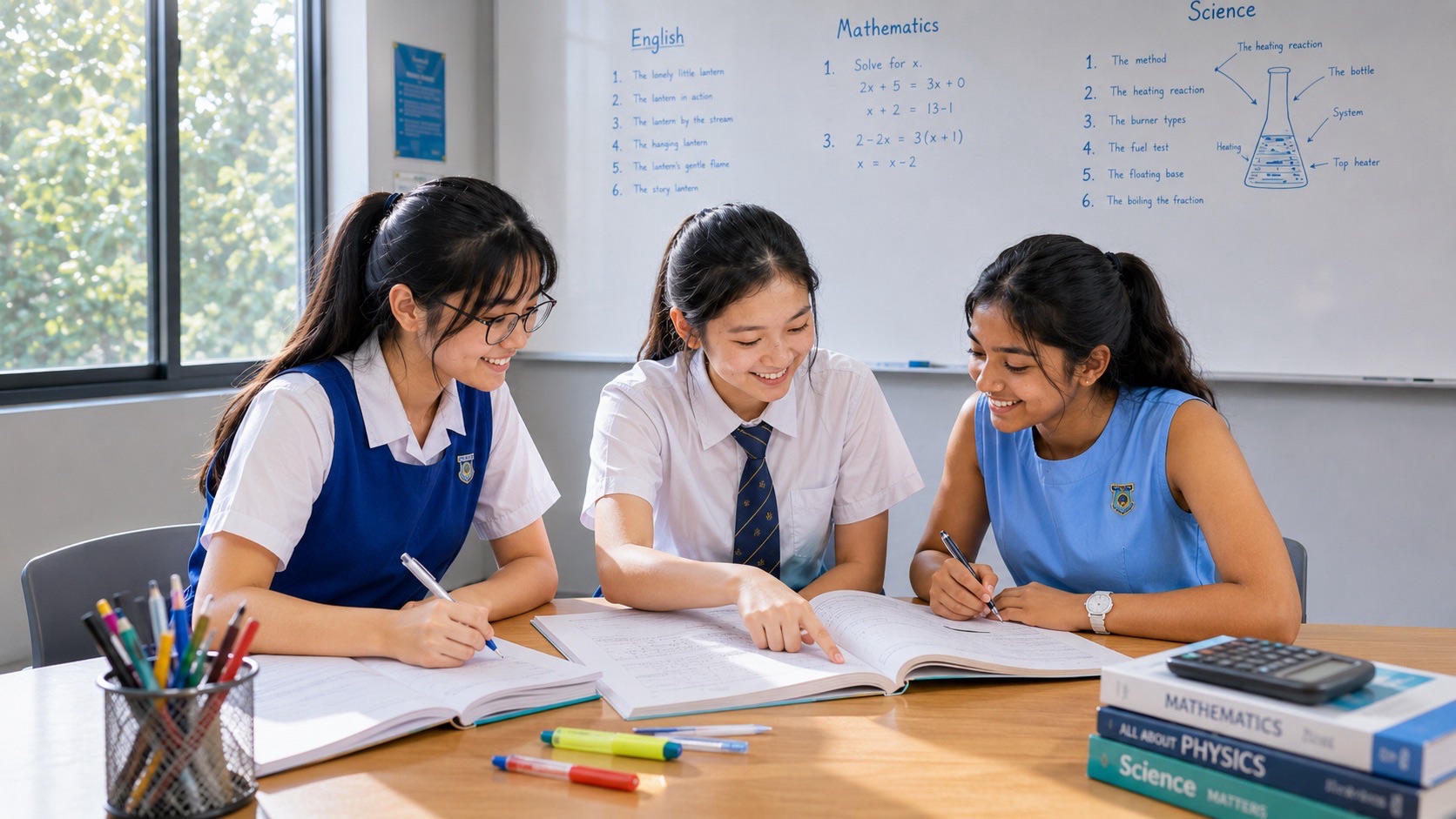
Secondary 3 G2 Additional Mathematics is not a reduced version of G3 A-Math. It is a deliberate mathematical bridge.
Under the 2027 Singapore-Cambridge Secondary Education Certificate, G2 Additional Mathematics is syllabus K232. Its official purpose is unusually clear: it is intended to prepare students adequately for G3 Additional Mathematics. That one sentence tells us how the subject should be understood, taught and learned.
G2 A-Math is not simply a collection of harder algebra questions. It is a transition system. It takes the mathematics a student already knows, increases the symbolic density, introduces new structures, strengthens mathematical reasoning, and builds the habits required for a later move into more advanced mathematics where appropriate.
For a Secondary 3 student, this makes the year especially important. Secondary 3 is usually the first sustained period in which Additional Mathematics becomes a separate mathematical world. The student must learn not only new content but a new way of operating.
The central question is therefore not:
How many A-Math chapters has the student completed?
The better question is:
What mathematical capability is being built in Secondary 3 G2 Additional Mathematics, and is it becoming strong enough to survive more advanced work?
This guide answers that question from first principles.
The Short Answer
Secondary 3 G2 Additional Mathematics works by turning ordinary mathematical competence into stronger symbolic, structural and problem-solving control.
The official K232 syllabus is organised into three major strands:
- Algebra
- Geometry and Trigonometry
- Calculus
But the real architecture sits underneath those headings. Students have to learn to:
- read mathematical structure accurately;
- choose useful representations;
- manipulate symbols without breaking equivalence;
- connect ideas across chapters;
- solve unfamiliar problems rather than only imitate examples;
- reason and communicate mathematically;
- check whether an answer actually satisfies the original conditions;
- develop enough fluency for later progression to G3 A-Math where appropriate.
That is why Secondary 3 is best treated as a build year, not a race to finish content.
Where G2 Additional Mathematics Sits in the SEC System
Singapore’s new secondary structure is easier to understand when three ideas are kept separate.
- Secondary 3 is a school stage.
- G1, G2 and G3 are subject levels under Full Subject-Based Banding.
- SEC is the common Singapore-Cambridge Secondary Education Certificate framework beginning for graduating cohorts from 2027.
Mathematics is offered at G1, G2 and G3. Additional Mathematics is offered at G2 and G3. There is no G1 Additional Mathematics syllabus in the 2027 SEC school-candidate list.
For G2 Additional Mathematics, the 2027 subject code is K232. The corresponding G2 Mathematics syllabus is K210. Knowledge of G2 Mathematics is assumed for G2 Additional Mathematics, which means the subjects are related but not interchangeable.
This matters enormously in diagnosis. A student struggling with G2 A-Math may not have an A-Math problem at all. The visible failure may be caused by an unstable Mathematics foundation: fractions, negative numbers, rearrangement, equations, graphs, coordinate ideas or trigonometric basics.
The first job is therefore to identify the dependency, not merely the latest chapter.
G2 A-Math Is a Bridge, Not a Ceiling
The most useful sentence in the K232 syllabus is its statement that G2 Additional Mathematics is intended to prepare students adequately for G3 Additional Mathematics.
This means the course has a forward-facing design. It must be rigorous enough to build genuine mathematical capability, but calibrated so students can establish that capability progressively.
A bridge works only if both ends connect.
The starting end is G2 Mathematics. The forward end is G3 Additional Mathematics. Secondary 3 is where the bridge begins carrying real load.
The student therefore needs more than short-term examination tricks. Any method that produces marks today but weakens future mathematical independence is a poor bridge.
What Changes When Additional Mathematics Begins
Students often describe the jump into A-Math with one word: “hard”. That word is emotionally accurate but mathematically vague.
The real changes are more specific.
Symbolic density increases
There are more symbols per line, more transformations per solution and more opportunities for a small sign or bracket error to propagate.
Methods become more connected
One question may involve several ideas. A student may need algebra before calculus, graph understanding before coordinate reasoning, or trigonometric manipulation before solving an equation.
Representation matters more
The form of an expression can make a problem easy or difficult. Factorised, expanded and completed-square forms may reveal different properties of the same quadratic.
Selection matters more
The student must decide which mathematical tool fits. Knowing a method is no longer enough.
Checking becomes more important
Longer solutions create longer error chains. The student must learn independent verification rather than relying on the final answer looking plausible.
These changes explain why Secondary 3 G2 A-Math can expose weaknesses that ordinary Mathematics previously allowed the student to hide.
The Core Operating Cycle: Read → Represent → Transform → Connect → Check
A useful model for G2 Additional Mathematics is a five-stage operating cycle.
Read
What mathematical objects are present? What is known? What must be found? Which conditions matter? What information can be ignored?
Represent
Can the information be rewritten as an equation, graph, factorisation, trigonometric relationship, derivative or integral?
Transform
Can the student legally change the form while preserving truth? This is where algebraic fluency matters.
Connect
Does the problem require another topic? What previous idea unlocks the next step?
Check
Does the result satisfy the original condition? Can it be substituted back? Does the graph support it? Is the sign sensible? Is the angle inside the required interval? Is the maximum actually a maximum?
Students who master only transformation can look strong during topical practice. Students who master the full cycle become much more resilient on unfamiliar questions.
Algebra Is the Infrastructure of G2 A-Math
If one part of Secondary 3 G2 A-Math deserves disproportionate attention, it is algebra.
Algebra is not merely the first strand. It is the working language used inside the other strands. Weak algebra damages coordinate geometry. It damages trigonometric equations. It damages differentiation and integration. It damages checking because the student cannot reliably substitute or simplify.
A strong Secondary 3 programme therefore builds algebra until routine manipulations consume relatively little attention. The student should be able to concentrate on the new idea rather than spending all available mental capacity on signs and fractions.
The K232 algebra strand includes important structures such as quadratic functions, equations and inequalities, surds, polynomials and partial fractions. Each topic is useful in its own right, but together they teach a deeper lesson: the form of mathematics can be changed strategically without changing the underlying truth.
Quadratics: Learning to See One Object in Several Forms
Quadratic functions are an ideal training ground for structural thinking.
The same quadratic may be written in expanded form, factorised form or completed-square form. Each representation reveals something different. Factorised form can expose roots. Completed-square form can expose a turning point. Expanded form may be convenient for manipulation or comparison.
This is where a student begins to understand a mature mathematical idea: there is no universally “best” form. There is a best form for the current job.
The discriminant adds another layer. Instead of solving a quadratic completely, the student can reason about the number and nature of its roots. This becomes powerful in intersection and tangency problems because a geometric condition can be converted into an algebraic condition.
That is Additional Mathematics doing what it does best: translating one kind of structure into another so a hidden condition becomes visible.
Surds: Why Exact Form Matters
Students are often conditioned to think that a decimal is more complete than an expression containing a square root. Surds correct that intuition.
An exact surd contains more information than an early rounded approximation. By learning to simplify surds, rationalise denominators and preserve exact form, students develop a habit that becomes increasingly important in higher mathematics.
The broader lesson is that approximation should be deliberate. Do not throw away mathematical structure simply because a calculator can produce a decimal.
Polynomials: Testing Hidden Structure
Polynomials teach students to infer structure without expanding everything blindly.
The factor and remainder ideas are powerful because they turn substitution into a structural test. A particular value can reveal whether a factor exists. Once one factor is identified, a higher-degree polynomial can often be reduced to something familiar.
This encourages a more efficient mathematical habit: test what the structure is telling you before performing large amounts of mechanical work.
Partial Fractions: Decompose Before You Solve
Partial fractions provide another lesson in representation. A complicated rational expression can sometimes be decomposed into simpler pieces whose structure is easier to understand and manipulate.
Students often assume that solving a harder-looking problem requires a more complicated method. Partial fractions teach the opposite possibility: sometimes the right move is to split the object into simpler parts.
This is useful mathematical thinking well beyond A-Math. Complex systems often become manageable when their components are separated cleanly.
Geometry and Trigonometry: From Triangles to Functions
Students entering Additional Mathematics may know trigonometry as a set of ratios used to find missing sides and angles. G2 A-Math expands that view.
Sine, cosine and tangent become functions whose values vary systematically with angle. Periodicity becomes important. Radians introduce another way to measure angle that fits naturally with higher mathematics. Identities show that two different-looking expressions can encode the same relationship.
This means trigonometry changes from a triangle tool into a larger mathematical language.
Trigonometric Identities: Preserve Truth While Changing Form
Identity work is one of the clearest tests of whether a student understands transformation.
When proving an identity, the student is not solving for an unknown in the ordinary sense. The student is transforming one valid expression into another equivalent expression.
The difficulty is strategic. Which side should be changed? Which identity is useful? Should the expression be factorised, expanded or rewritten using another function?
Students who rely on memorised procedures often find identity work frustrating because there is no single fixed route. Students who learn to inspect structure begin to see possible transformations.
This is exactly the kind of capability G2 Additional Mathematics is meant to cultivate.
Trigonometric Equations: One Equation Can Have More Than One Answer
Trigonometric equations force students to move beyond the expectation that solving produces one number.
Because trigonometric functions repeat, multiple values can satisfy the same equation within a specified interval. The student must therefore control both the algebra and the geometry of the function.
A common failure is finding one calculator value and stopping. The stronger student asks what other angles share the required trigonometric value and whether they lie within the requested range.
This is a good example of why verification is part of the mathematics, not an optional final step.
Coordinate Geometry: Algebra Becomes Shape
Coordinate geometry is where students see algebra and geometry operating as one system.
A straight line can be described by an equation. Gradient describes a geometric direction and an algebraic rate. Parallel and perpendicular relationships become conditions on gradients. Distances and midpoints connect coordinates to geometry.
This is an important intellectual step because it shows that mathematical branches are translations of one another. A geometric problem can be moved into algebra, solved there and interpreted back in geometric form.
Calculus: A New Language for Change
Calculus is often the part of A-Math students are most anxious about, largely because it looks like a new mathematical species.
But the conceptual beginning is simple.
Differentiation asks how a quantity is changing.
Integration asks how accumulated change can be reconstructed.
In school mathematics, differentiation is connected to the gradient of a tangent and to rates of change. It also helps identify stationary points and analyse maxima and minima. Integration reverses differentiation and leads to definite integrals and area under curves.
The key Secondary 3 insight is not memorising derivative rules. It is recognising that a function has behaviour, and calculus gives us a way to describe that behaviour precisely.
Why Calculus Still Depends on Algebra
Students sometimes think they are “bad at differentiation” when the derivative is actually correct and the error occurs during the algebra that follows.
A maximum-and-minimum question may require differentiation, but it also requires solving equations, substituting values, comparing results and interpreting the situation. Integration may require algebraic simplification before the integral is manageable.
This is why Additional Mathematics has to be taught as a dependency system. The chapter where the mistake appears is not always the chapter that needs repair.
Secondary 3 Is Not a Nationally Fixed Chapter Order
Parents often search for a single definitive list of “Secondary 3 G2 A-Math topics”. That can create confusion.
The K232 syllabus specifies the course content and assessment framework. Schools can sequence the teaching of that content differently across Secondary 3 and Secondary 4.
One school may introduce calculus earlier. Another may spend longer building algebra and trigonometry first. This means two Secondary 3 students can legitimately be at different points in the same national course.
A strong tuition programme therefore asks for the student’s school sequence, recent assessments and upcoming topics. It synchronises where useful, but it also protects the deeper dependency structure so the student does not simply chase next week’s worksheet.
What K232 Assessment Tells Us About Learning
The 2027 G2 Additional Mathematics assessment contains two written papers. Each is 1 hour 45 minutes and carries 70 marks, with equal weighting.
The official assessment objectives are especially useful because they reveal what the course values.
- AO1: Use of standard techniques — approximately 50%.
- AO2: Solve problems in a variety of contexts — approximately 40%.
- AO3: Reason and communicate mathematically — approximately 10%.
This means half the course is not simply “do the standard method”. Problem solving and reasoning occupy substantial assessment space.
AO2 includes interpreting information, translating between forms, connecting topics, formulating mathematical problems, selecting relevant information and interpreting results.
That is exactly why endlessly repeating near-identical questions can create an illusion of strength. The examination expects students to recognise and deploy mathematics when the structure is less obvious.
Technique Is Necessary but Not Sufficient
Standard techniques matter enormously. A student cannot reason effectively if every factorisation, rearrangement or differentiation rule requires conscious reconstruction.
Fluency frees cognitive capacity.
But fluency becomes dangerous when it turns into blind pattern matching. If a student sees a familiar visual cue and fires the usual method without checking the structure, speed can simply make the wrong route happen faster.
The goal is therefore fluent selection: the student knows methods well enough to execute them quickly, but understands structure well enough to choose the right one.
The Difference Between Knowing a Method and Owning It
A student can appear successful during a lesson for several different reasons.
- Recognition: the student understands the method when it is shown.
- Reproduction: the student can repeat the method on a similar question.
- Selection: the student chooses the method independently.
- Transfer: the student uses the same idea when the question looks different.
- Integration: the student combines the method with another topic under mixed conditions.
Secondary 3 G2 A-Math should steadily move students beyond reproduction.
A student who can complete ten similar questions after watching a worked example may still fail the examination if the method is not available without the visual cue.
Why Mixed Practice Is Essential
Topical practice is the right tool during initial learning. It isolates the new idea and allows enough repetition for the basic procedure to stabilise.
But topical practice has a hidden weakness: the student already knows what chapter is being tested.
Once a method is reasonably secure, practice should evolve:
- worked example;
- guided practice;
- independent topical practice;
- variation within the topic;
- mixed-topic retrieval;
- unfamiliar application;
- timed execution;
- delayed retest.
This progression forces the student to do the difficult cognitive work of identifying the structure before executing the method.
The First Wrong Line Is More Valuable Than the Final Wrong Answer
Long A-Math solutions often contain cascading errors. Once one early line is wrong, every later line can become wrong even if the later procedures are executed correctly.
That makes the first wrong line the most useful diagnostic object.
It tells us whether the failure came from:
- misreading the problem;
- choosing the wrong representation;
- selecting the wrong method;
- breaking an algebraic rule;
- losing a sign or bracket;
- using an identity incorrectly;
- misinterpreting a derivative or integral;
- using the calculator in the wrong state;
- rounding too early;
- failing to check an interval or condition.
Different failure mechanisms need different repairs. “Do more practice” is not a diagnosis.
Why “Careless Mistakes” Is Usually Too Vague
Students and parents often describe lost marks as careless mistakes. Sometimes that is true. More often, “careless” hides a repeatable mechanism.
- Signs are unstable when several negatives appear.
- Brackets are dropped during substitution.
- Working is compressed so heavily that the student cannot audit it.
- Fractions overload attention.
- The calculator is in the wrong angle mode.
- Exact values are replaced by rounded decimals too early.
- The student never checks whether all required roots or angles were found.
- The student reads the first sentence and starts calculating before understanding the task.
Once the mechanism is named, it can be trained. Until then, “be more careful” is rarely enough.
Mathematical Writing Is Part of the Control System
In Additional Mathematics, working is not decoration. It is externalised reasoning.
A clean solution allows the student to see whether each line follows from the last. It helps preserve essential working. It makes the first wrong line visible. It reduces copying errors and working-memory load.
The K232 syllabus explicitly values mathematical reasoning and communication. That is not separate from solving. A solution another person can follow is also a solution the student can inspect.
The Calculator Has a State
Approved calculators may be used in both K232 papers, but calculators introduce their own failure modes.
Degree and radian mode matter. Stored values matter. Brackets matter. Premature rounding matters. A calculator can execute exactly what was entered even when what was entered does not represent the intended mathematics.
Students therefore need a calculator protocol:
- check angle mode;
- use brackets deliberately;
- keep sufficient precision;
- estimate the expected magnitude;
- inspect whether the output makes sense;
- reset or clear stored states when necessary;
- never let calculator output replace mathematical interpretation.
The calculator is an instrument. Mathematical judgement remains the pilot.
Accuracy: Exact First, Approximate Deliberately
The syllabus includes numerical accuracy conventions. Unless otherwise stated, non-exact numerical answers are generally given to 3 significant figures, and angles in degrees to 1 decimal place.
The deeper habit is more important than the formatting rule: preserve enough information until the calculation is genuinely ready to be rounded.
Students who round intermediate steps aggressively can produce a final answer that drifts outside acceptable accuracy. Students who convert every exact form into decimals too early also lose structural information that may simplify later work.
Exactness and approximation are tools. Strong mathematics knows when to use each one.
What a Secondary 3 G2 A-Math Diagnostic Should Test
A score tells us how much went wrong. A diagnostic should tell us what kind of thing went wrong.
- Is the student definitely on the K232 G2 route?
- Which topics has the school taught so far?
- What is the student’s G2 Mathematics foundation like?
- Can the student manipulate fractions, signs and brackets reliably?
- Can the student move between algebraic forms deliberately?
- Can the student read graphs as mathematical relationships?
- Can the student choose methods without chapter labels?
- Can the student explain why a step is valid?
- Can the student identify the first wrong line after feedback?
- Can the student independently check an answer?
- Does performance survive mixed questions?
- Does performance collapse only when time pressure is introduced?
This gives the tutor a map instead of a vague instruction to “improve A-Math”.
A Good Secondary 3 G2 A-Math Lesson Removes Support Gradually
The best lesson is not the one in which the teacher performs the most impressive mathematics. It is the one in which the student becomes more capable of operating without the teacher.
- Locate. Identify the concept and its dependency.
- Explain. Make the underlying relationship visible.
- Model. Demonstrate a clean, auditable solution.
- Guide. Support only the part the student cannot yet carry.
- Release. Remove prompts.
- Vary. Change the surface form.
- Mix. Place the idea beside other topics.
- Verify. Require an independent check.
- Record. Track the error pattern.
- Retest. Return later without announcing the method.
This is how assisted performance becomes independent capability.
Secondary 3 Is the Build Year
Secondary 3 G2 A-Math should be used to build the machine before Secondary 4 asks the student to run it under greater compression.
By the end of the build year, the student should ideally have:
- stable algebraic manipulation;
- stronger symbolic reading;
- confidence changing representation;
- a reliable trigonometric foundation;
- a coherent understanding of the calculus introduced by the school sequence;
- method-selection habits;
- mixed-topic retrieval experience;
- clear mathematical working;
- an independent checking routine;
- a known list of remaining dependencies to repair.
If these are built, Secondary 4 can focus more effectively on synthesis, completion and examination reliability.
The G2 → G3 Bridge
Because K232 explicitly prepares students for G3 Additional Mathematics, it is useful to think about progression before the end of the course.
The student does not need to become a G3 student overnight. What matters is whether the underlying capabilities are becoming portable.
A strong bridge student increasingly shows:
- algebra that remains stable when questions get longer;
- less dependence on chapter labels;
- greater tolerance for unfamiliar forms;
- ability to combine two ideas in one problem;
- habitual checking;
- clear mathematical communication;
- curiosity about why methods work rather than only whether they produce marks.
These are better indicators of readiness than simply finishing advanced worksheets early.
What Changes If a Student Later Moves to G3 A-Math?
G3 Additional Mathematics is not merely the same course with harder numbers. It expands the content and raises the level of mathematical demand.
The G3 route includes additional structures such as binomial expansion and exponential and logarithmic functions, together with broader geometry and calculus demands. It assumes G3 Mathematics and is designed as preparation for A-Level H2 Mathematics.
The safest preparation for that possible move is therefore not premature acceleration. It is depth.
A student with excellent G2 foundations can add new structures. A student with fragile foundations simply carries old instability into a denser system.
When Should a Student Consider the G3 Bridge?
Subject-level progression is governed by school policies and the wider Full Subject-Based Banding framework, so families should work with the school when considering level changes.
From a mathematical perspective, useful evidence includes:
- consistent performance rather than one good test;
- strong underlying Mathematics foundations;
- stable algebra;
- independent method selection;
- ability to cope with mixed and unfamiliar questions;
- good retention across time;
- willingness to engage with abstraction rather than simply memorise;
- capacity to handle greater workload without sacrificing understanding.
The goal should not be to acquire a higher label. The goal should be to enter a higher-demand course with enough foundation to benefit from it.
What Parents Should Watch Beyond Marks
Marks are important, but they arrive after the underlying learning system has already been operating for some time.
Earlier indicators include:
- Does the student begin questions without waiting for a hint?
- Can the student explain why the first step is appropriate?
- Is the algebra becoming cleaner?
- Can the student return to a topic after a delay and still solve it?
- Can the student find the first wrong line in a failed solution?
- Does the student check answers independently?
- Can the student work through mixed questions without chapter headings?
- Does the student understand that K232 is a bridge towards G3 A-Math rather than simply another label?
These behaviours show whether the subject is becoming part of the student’s own mathematical capability.
A Five-Minute Parent Check
- Are you taking G2 Additional Mathematics K232?
- What topic is school teaching now?
- Show me one question you got wrong recently.
- Where was the first wrong line?
- What independent check could have caught it?
If the student can answer those questions clearly, the family already has a much better view of the learning system.
What G2 Additional Mathematics Builds Beyond School
The subject has an examination, but its deeper educational value is larger than the examination.
G2 Additional Mathematics trains students to:
- compress relationships into symbols;
- change representation strategically;
- preserve constraints while transforming a system;
- recognise hidden structure;
- reason about change;
- distinguish exact and approximate information;
- verify a result independently;
- communicate a logical chain another person can inspect;
- persist when the route is not immediately visible.
These habits recur in science, computing, engineering, finance, economics, data analysis and many technical forms of work.
How Bukit Timah Tutor Uses the K232 Architecture
At Bukit Timah Tutor, Secondary 3 G2 Additional Mathematics is treated as a bridge-building year.
We separate the student’s current school sequence from the deeper mathematical dependencies. We distinguish conceptual misunderstanding from algebraic execution. We distinguish knowing a method from selecting it independently. We distinguish ordinary speed problems from weak foundations.
The class is intentionally small because many A-Math failures can only be diagnosed by watching the working closely enough to find the first point where the mathematical system changes direction.
The goal is not to create dependence on a tutor. The goal is to increase the amount of mathematics the student can operate correctly without one.
Route Through the Bukit Timah Mathematics Estate
- How Secondary 3 Additional Mathematics Works | SEC G2 & G3
- How Secondary 3 Mathematics Works | SEC G1, G2 & G3
- How Secondary 3 G2 Mathematics Works | SEC K210
- How Additional Mathematics Works | Complete A-Math Learning System
- What Is G3 and G2 Additional Mathematics?
- Should I Take Additional Mathematics? G2 or G3 A-Math
- How Strong Must Algebra Be Before Secondary 3 A-Math?
- How Secondary 3 A-Math Prepares Students for Secondary 4
- Mathematics Examination Craft
- Singapore Mathematics Hub
Topic Rooms Already Available
The existing Secondary 3 Additional Mathematics library contains topic explainers that can be used as deeper rooms off this page. School sequence varies, so these links should be treated as topic resources rather than a claim that every school teaches each topic in the same Secondary 3 order.
- Quadratic Functions | Completing the Square
- Surds | Exact Irrational Numbers
- Polynomials | Factor and Remainder Theorem
- Partial Fractions
- Trigonometric Functions
- Trigonometric Identities & Equations
- Coordinate Geometry
- Differentiation
- Integration
- Definite Integrals & Area
Official Singapore References
- SEAB — 2027 SEC G2 Syllabuses for School Candidates
- SEAB — K232 G2 Additional Mathematics Syllabus 2027
- SEAB — 2027 SEC G3 Syllabuses for School Candidates
- SEAB — Singapore-Cambridge Secondary Education Certificate
Where This Series Goes Next
This article isolates the G2 route so the main Secondary 3 Additional Mathematics page does not have to carry every detail. The branch can now continue without cannibalising the control spine:
- How Secondary 3 G3 Additional Mathematics Works
- How the G2 → G3 Additional Mathematics Bridge Works
- How Algebra Works in Secondary 3 Additional Mathematics
- How Trigonometry Works in Secondary 3 Additional Mathematics
- How Calculus Works in Secondary 3 Additional Mathematics
- How Mixed-Topic Questions Work in Secondary 3 Additional Mathematics
- How Error Diagnosis Works in Secondary 3 Additional Mathematics
- How Retrieval and Revision Work in Secondary 3 Additional Mathematics
- How Secondary 3 G2 A-Math Builds the Secondary 4 Runway
Final Principle
Secondary 3 G2 Additional Mathematics works when the student learns to operate mathematics as a connected system rather than a shelf of isolated procedures.
K232 deliberately builds that system as a bridge. Algebra supplies the symbolic infrastructure. Geometry and trigonometry connect relationships across representations. Calculus introduces a language of change. Problem solving forces selection. Reasoning forces justification. Checking turns a solution from an act of hope into something the student can verify.
The student does not need to become a different kind of learner overnight.
The student needs to make the mathematical system more reliable, one dependency at a time.
Read the structure. Choose the representation. Transform legally. Connect the ideas. Check independently.
That is how G2 Additional Mathematics becomes a genuine bridge rather than simply another subject to survive.