
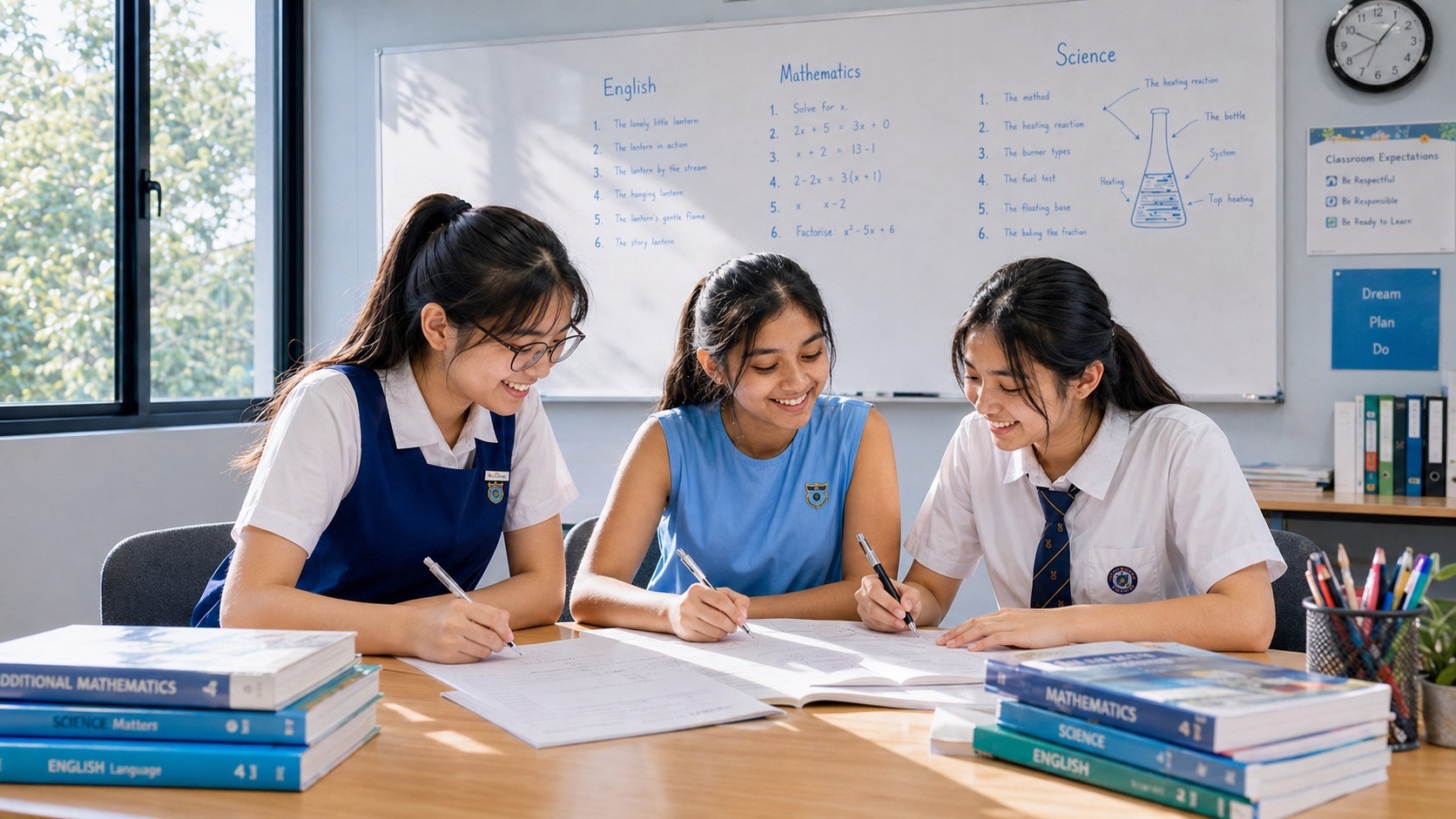
Secondary 3 Mathematics is where assessment stops being a report card and starts becoming a diagnostic instrument.
A mark still matters. It tells the student how much of a particular paper was converted into credit under a particular set of conditions. But by Secondary 3, the percentage alone is no longer enough to plan the next move.
Two students can both score 62% and be in completely different mathematical states.
One may understand the concepts but lose marks through slow working and weak checking. Another may execute routine questions well but fail whenever the chapter cue disappears. A third may have a strong method but unstable algebra. A fourth may be carrying several earlier gaps that only appear when topics combine.
This is why Secondary 3 assessment readiness has a distinct job:
Convert every test into evidence about what the student can operate independently, what still requires support, and what must be repaired before Secondary 4.
Under Singapore’s Full Subject-Based Banding framework, Mathematics is taken at G1, G2 or G3 subject level. From the 2027 graduating cohort, students sit the Singapore-Cambridge Secondary Education Certificate, or SEC, at the subject level they are taking. The 2027 Mathematics subject codes are K110 at G1, K210 at G2 and K310 at G3.
Secondary 3 does not yet mean every school assessment will reproduce the final SEC paper exactly. Schools may sequence syllabus content differently and design internal tests according to their own programme. The job of Secondary 3 is therefore to use school assessments as stepping stones toward the broader mathematical capabilities the final course will eventually require.
This Article Has One Specific Job
This page sits inside our How Secondary 3 Mathematics Works in Singapore | SEC G1, G2 & G3 series.
It does not duplicate the existing estate-wide pages on:
- How AO1, AO2 & AO3 Work in SEC Secondary Mathematics;
- How Paper 1 and Paper 2 Work in SEC Secondary Mathematics;
- How Calculator, Formula Sheet & Essential Working Work in SEC Secondary Mathematics.
Those pages explain the national assessment architecture.
This article answers the narrower developmental question:
How should a Secondary 3 student use school tests, common tests, weighted assessments, examinations and practice papers to become genuinely ready for the final Mathematics system?
The Short Answer
Assessment readiness works when the student learns to convert performance into diagnosis, diagnosis into repair, repair into retesting, and retesting into increasingly independent execution.
The cycle is:
Attempt → Mark → Locate → Classify → Repair → Retest → Mix → Time → Review
This is much more powerful than:
Attempt → See score → Feel good or bad → Move on.
A Score Is an Output, Not a Diagnosis
A percentage tells us how much credit was earned.
It does not automatically tell us why marks were lost.
Suppose two students both score 70%.
Student A loses most marks in two long questions because the initial method selection is wrong.
Student B loses one mark in fifteen different places because signs, units and copying are unstable.
The score is the same.
The repair is completely different.
Student A needs method-selection and mixed problem-solving work.
Student B needs execution discipline, working structure and verification habits.
This is why useful assessment analysis begins below the score.
The First Wrong Line Is More Useful Than the Final Wrong Answer
When a question goes wrong, the final answer may be many steps downstream from the actual failure.
Find the first line where the Mathematics stops being valid.
Then classify the failure.
- Reading: the student misunderstood the task.
- Representation: the situation was translated incorrectly into mathematics.
- Concept: the underlying relationship was not understood.
- Method selection: the student knew several tools but chose the wrong one.
- Algebra: the setup was correct but symbolic manipulation failed.
- Arithmetic: routine calculation failed.
- Geometry: a condition or theorem was misused.
- Statistics: a measure or graph was misread.
- Probability: the event structure was built incorrectly.
- Unit or precision: the numerical result was mishandled.
- Communication: the student did not present the required answer clearly enough.
- Verification: an implausible result was accepted without challenge.
- Time: the student could do the Mathematics but could not complete enough of it under the clock.
One wrong answer can therefore reveal a precise failure mechanism.
Assessment Readiness Has Three Layers
A Secondary 3 student can be ready at one layer and unready at another.
Layer 1: Mathematical readiness
Does the student understand the content and possess the required mathematical skills?
Layer 2: Selection readiness
Can the student recognise which Mathematics is needed when the chapter heading disappears?
Layer 3: examination readiness
Can the student perform the Mathematics accurately, clearly and efficiently under the conditions of an assessment?
These layers should not be collapsed.
A student may understand the chapter but fail the exam because selection and timing are weak.
Another student may be fast but conceptually fragile.
A third may score well on school topical tests but underperform on mixed examinations because the assessment conditions changed.
Secondary 3 School Tests Are Not Just Mini-SEC Papers
School assessments have their own local purpose.
A weighted assessment may focus on recently taught content. A common test may measure a broader portion of the school’s sequence. An end-of-year examination may integrate more topics. Different schools may emphasise different formats and question distributions.
This means the student should not assume:
- every Secondary 3 paper will look exactly like the final SEC paper;
- every school will test the same chapter in the same month;
- every strong school score guarantees full-course readiness;
- every weak school score means the student cannot succeed at the subject level.
School assessments are evidence points inside a longer trajectory.
The Assessment Ladder
A strong Secondary 3 programme gradually increases uncertainty and integration.
- Worked example: the method is visible.
- Guided question: the student fills part of the route.
- Topical practice: the chapter is known.
- Topical test: the chapter is known but time and accuracy matter.
- Mixed practice: the student must select the method.
- Mixed test: selection and execution are both assessed.
- Unfamiliar problem: transfer becomes necessary.
- Timed section: speed and triage enter.
- Full paper: topic switching, endurance and recovery matter.
- Delayed retest: the student proves the learning survived.
The student should not jump directly from classroom explanation to full-paper pressure and then conclude that low marks mean inability.
Assessment readiness is built progressively.
Topical Success Can Hide Selection Weakness
If a worksheet is titled “Simultaneous Equations”, the student has already been told which family of methods to use.
If the worksheet is titled “Trigonometry”, the method search space is reduced.
This is valuable during learning.
But an assessment often removes those cues.
Now the student must solve an additional problem:
What kind of Mathematics is hiding here?
This is why a student can get 90% on topical homework and 60% on a mixed paper without forgetting all the content.
The assessment is testing a different layer.
AO1, AO2 and AO3 Should Change How Students Review Errors
SEC Mathematics uses three broad assessment objectives across the subject levels: standard techniques, problem solving in varied contexts, and mathematical reasoning and communication. The exact weightings differ by level.
For Secondary 3 planning, the labels are useful because they prevent every error from being treated as the same kind of weakness.
AO1-type weakness
The student may not be fluent enough with standard mathematical techniques.
Typical repair: focused practice, cleaner procedures, calculator accuracy, algebraic fluency, unit control.
AO2-type weakness
The student may know the tools but fail to formulate or solve a problem in an unfamiliar or contextual setting.
Typical repair: mixed practice, representation changes, modelling, decomposition, method-selection work.
AO3-type weakness
The student may obtain results but struggle to justify, explain, compare or communicate the reasoning.
Typical repair: written reasoning, comparison questions, justification, complete conclusions, explicit checks.
The important point is not to relabel every school question mechanically.
The point is to recognise that assessment measures different mathematical behaviours.
Marks Are Attached to Mathematical Decisions
Students sometimes think marks belong only to final answers.
In mathematics assessment, credit can depend on intermediate mathematical decisions and essential working.
This is why a student should learn to make important steps visible:
- the equation being formed;
- the formula being used;
- the values substituted;
- the geometric relationship selected;
- the probability structure;
- the statistical comparison;
- the intermediate result needed for the next step.
Clear working is not only about neatness.
It makes the mathematical route visible.
Essential Working Is an Insurance Policy
The official SEC Mathematics syllabuses make clear that omission of essential working can result in loss of marks.
But there is a second reason to show working.
Working creates recoverability.
If the final answer is wrong but the route is visible, the student can locate the first wrong line.
If the working is compressed into mental jumps, the error may be impossible to reconstruct.
Good working therefore does three jobs:
- communicates method;
- reduces cognitive load;
- makes correction possible.
The Command Word Is Part of the Mathematics
Assessment questions often fail before calculation because the student answers a different question from the one asked.
Words such as find, calculate, determine, show, explain, state, compare, justify, estimate or hence signal different answer behaviours depending on context.
The student should ask:
- Am I being asked for a numerical result?
- Am I being asked to show why something is true?
- Am I being asked to compare two quantities?
- Am I being asked to explain the meaning of a result?
- Am I expected to use an earlier result?
- Is exact form required or is approximation appropriate?
Answer form is part of assessment readiness.
The Student Should Learn to Read the Marks
The number of marks attached to a question can provide useful information.
It does not reveal the exact marking scheme, but it can help the student judge whether the proposed solution is suspiciously short or unnecessarily complicated.
If a multi-mark question has been answered with one unexplained number, something may be missing.
If a two-mark question has consumed half a page of algebra, the route may be inefficient.
Marks therefore become another small source of structural feedback.
Time Is a Mathematical Resource
In an assessment, the student has finite time.
That means examination performance includes resource allocation.
The student must decide:
- when to continue;
- when to stop;
- when to leave a question temporarily;
- when partial working is worth recording;
- when a check is essential;
- when a long route should be replaced with a shorter one.
This is not separate from Mathematics.
It is the management of Mathematics under a constraint.
Do Not Train Time Pressure Too Early
A timer is useful only after the underlying mathematical process is reasonably stable.
If a student cannot solve an equation correctly without time pressure, adding a clock will not repair equality.
If a student cannot identify the correct theorem, faster guessing will not build selection.
The progression should be:
correct slowly → correct consistently → correct in mixed conditions → correct efficiently → correct under full assessment pressure
Question Triage Should Be Learned Deliberately
A full Mathematics paper is not only a sequence of questions.
It is a queue of competing demands on limited time and attention.
A student needs a triage policy.
A useful policy is:
- Start the question.
- Identify the likely route.
- If progress is occurring, continue.
- If the route collapses, record any valid partial working.
- Leave a visible marker and move on.
- Return after securing more accessible marks elsewhere.
The exact timing strategy can vary by student and paper.
The principle is stable: do not allow one question to consume the entire examination.
Recovery Is an Assessment Skill
Strong students do not always choose the perfect method immediately.
What distinguishes them is often recovery.
If a route fails, the student should know how to restart:
- return to the exact target;
- identify the last reliable line;
- mark what is definitely known;
- try a different representation;
- solve a simpler subproblem;
- estimate the expected result;
- switch method where appropriate.
Recovery should be practised before the real examination.
Checking Is Part of Assessment Readiness
Students often say they will check “if there is time”.
That treats checking as an optional final ritual.
A better system embeds checks throughout the paper.
- Check a sign after a difficult algebraic transformation.
- Check units before writing the final measurement answer.
- Check whether a probability lies between 0 and 1.
- Check whether a graph agrees with the algebra.
- Check whether a percentage result moves in the expected direction.
- Check whether a calculated length is geometrically possible.
These local checks are cheaper than discovering a chain of errors at the end.
A Good Check Must Be Independent
Repeating the same working from the top may reproduce the same mistake.
Stronger checks use another route:
- solve, then substitute;
- factorise, then expand;
- calculate exactly, then estimate;
- solve algebraically, then inspect graph behaviour;
- use one geometric relationship, then check against another;
- calculate directly, then use a complement where appropriate;
- calculate a statistic, then inspect whether the data pattern agrees.
Assessment readiness improves when the student becomes capable of disagreeing with their own first answer.
Calculator Fluency Is Different From Calculator Dependence
SEC Mathematics permits approved calculators according to the official scheme of assessment for the respective syllabus.
That makes calculator fluency important.
But the calculator should not decide the mathematics.
A controlled sequence is:
- decide what relationship is being calculated;
- estimate the expected scale;
- enter the expression carefully;
- retain enough precision during intermediate work;
- interpret the output;
- round according to the requirement;
- check whether the result is plausible.
Perfect calculator accuracy cannot rescue a wrongly modelled problem.
Formula Sheets Reduce Memory Load, Not Thinking Load
Where relevant formulae are provided, students sometimes assume formula memory is no longer important.
But a provided formula does not choose itself.
The student still has to know:
- what the symbols represent;
- when the formula applies;
- which values to substitute;
- whether rearrangement is required;
- which units are involved;
- whether the final result makes sense.
A formula sheet lowers recall burden.
It does not remove the need for mathematical selection.
Answer Form Is Part of the Mark
A mathematically correct quantity can still be incompletely communicated.
Students should check:
- Does the question require exact or approximate form?
- Is a unit required?
- Is the answer a length, area or volume?
- Does the question ask for a percentage?
- Is a comparison or explanation required?
- Does a real-world context require rounding up or down rather than ordinary nearest rounding?
The final answer is the interface between the mathematical reasoning and the examiner.
The Student Should Learn a Two-Pass Review
After a test or practice paper, review it twice.
Pass 1: mark recovery
Understand how the question should have been solved and correct the immediate Mathematics.
Pass 2: mechanism recovery
Ask why the error happened.
- Did I not know the concept?
- Did I know it but fail to recognise it?
- Did I select the wrong method?
- Did I lose the mark through execution?
- Did time pressure cause the failure?
- Did I fail to check?
The second pass is what changes future performance.
Correction Is Not Complete Until a Fresh Question Works
Students often copy the correct solution and feel the error has been repaired.
That proves the solution is visible.
It does not prove the capability is installed.
A complete repair cycle is:
- locate the first wrong line;
- identify the missing concept or habit;
- repair it;
- solve a similar question;
- solve a changed question;
- solve a mixed question;
- retest after a delay.
Only then do we have evidence that the repair survived.
The Error Log Should Record Mechanisms, Not Just Chapters
A weak error log says:
“Wrong: Trigonometry.”
A useful error log says:
“Selected cosine when the known and unknown sides required tangent; did not label opposite and adjacent before choosing.”
Or:
“Reverse percentage: used final value as 100% instead of recognising it as 80% of original.”
Or:
“Probability tree correct until second branch; forgot probability changed because there was no replacement.”
Mechanism-level records are reusable.
Assessment Readiness in Secondary 3 G1 Mathematics
At G1, assessment readiness should emphasise reliable use of mathematics in practical and mathematical contexts.
The student should increasingly be able to:
- read instructions accurately;
- identify relevant quantities;
- use number, ratio, percentage, rate and measurement reliably;
- interpret graphs and data;
- handle simple algebra in context;
- show essential working;
- use units correctly;
- check reasonableness;
- complete practical problem-solving tasks independently.
Assessment preparation should not become abstract difficulty for its own sake.
The target is dependable performance and usable mathematical judgement.
Assessment Readiness in Secondary 3 G2 Mathematics
At G2, the assessment system places greater demand on integration and method selection.
The student should increasingly be able to:
- execute standard techniques fluently;
- interpret longer questions;
- choose between several methods;
- connect algebra, graphs, geometry, statistics and probability;
- solve real-world problems;
- show structured working;
- manage longer multi-step questions;
- recover after a false start;
- check independently under time pressure.
The important transition is from “I know this chapter” to “I can identify and use this Mathematics when the chapter is hidden.”
Assessment Readiness in Secondary 3 G3 Mathematics
At G3, the assessment demand becomes denser.
The student must increasingly manage:
- greater abstraction;
- more complex algebraic infrastructure;
- multiple representations;
- longer reasoning chains;
- multi-topic integration;
- unfamiliar problem contexts;
- mathematical justification;
- time allocation across a demanding paper;
- verification without external prompting.
At this level, assessment readiness is not simply content completion.
It is the ability to keep the mathematical system stable while the conditions change.
A Four-Week Assessment-Readiness Cycle
One practical Secondary 3 cycle can run like this:
Week 1: diagnose
Use a recent school script and one short uncued diagnostic. Identify recurring first wrong lines.
Week 2: repair
Repair the highest-leverage dependency and practise it in both direct and contextual form.
Week 3: mix
Remove chapter labels. Mix the repaired skill with neighbouring topics. Require independent method selection.
Week 4: test
Use a timed section or school-aligned assessment. Compare the new error pattern with the original one.
The important question is not simply whether the score rose.
Ask whether the failure mechanism changed.
Improvement Can Appear Before the Score Improves
Suppose a student previously made ten conceptual errors and five execution errors.
After several weeks, the student makes two conceptual errors and ten small execution errors.
The score may not yet look dramatically better.
But the system has changed.
Conceptual instability has been converted into a smaller, more trainable execution problem.
This is why trend analysis should include error quality, not only error quantity.
A Falling Score Can Also Reveal Useful Progress
Sometimes the difficulty of practice increases deliberately.
A student may move from easy topical worksheets to mixed, unfamiliar and timed questions.
The raw percentage may fall even though the training quality has improved.
Assessment data must therefore be interpreted relative to task difficulty and cue level.
A 75% score on an unfamiliar mixed paper may demonstrate more mathematical control than 95% on highly repetitive topical work.
The Independence Test
One of the most useful Secondary 3 assessment questions is:
What can the student still do when the tutor, chapter heading, model answer and immediate memory of the lesson are gone?
This should be tested through:
- uncued questions;
- delayed retrieval;
- mixed-topic work;
- unfamiliar representations;
- independent checking.
That is a stronger measure of readiness than smooth performance during guided practice.
The Recovery Test
A second assessment question is:
What happens after the student becomes stuck?
Does the student reread, mark the target, change representation, estimate, try a simpler case or return to the last reliable line?
Or does all progress stop until someone supplies the next step?
Recovery is part of examination capability.
The Verification Test
A third assessment question is:
Can the student produce evidence that their own answer is probably correct?
This is a powerful marker of maturity.
The student who can substitute, estimate, compare representations, check units and challenge impossible results is less dependent on external marking.
The Retention Test
A fourth question is:
Can the student still do it next week?
Immediate success can be produced by short-term memory.
Delayed success is stronger evidence that the mathematical structure has become retrievable.
The Transfer Test
A fifth question is:
Can the student recognise the same Mathematics when the surface changes?
Change the letters.
Rotate the diagram.
Put the percentage inside a financial context.
Turn the equation into a graph.
Mix the probability question with a table.
If the method survives, the learning is becoming portable.
The End-of-Year Secondary 3 Assessment Question
At the end of Secondary 3, the most important question is not:
How many chapters have been completed?
It is:
What mathematical capabilities are now stable enough to carry into Secondary 4 without constant reconstruction?
We want evidence of:
- stable foundations;
- reasonable topic coverage according to school sequence;
- mixed-topic selection;
- working fluency;
- clear answer form;
- independent checking;
- timed-paper tolerance;
- ability to recover from a difficult question;
- retention across time.
That is the real handover into Secondary 4.
A Parent’s Assessment Dashboard
Parents do not need to reconstruct the marking scheme to monitor progress.
Track a small number of signals:
- Score trend: several assessments, not one.
- Error concentration: are mistakes random or clustered?
- First wrong line: what fails earliest?
- Independence: how much prompting is needed?
- Mixed performance: can methods be selected without chapter cues?
- Retention: can older topics still be used?
- Time: does accuracy collapse under pressure?
- Checking: does the student challenge implausible answers?
This dashboard is more informative than “Math improved” or “Math dropped”.
Five Questions a Parent Can Ask After a Mathematics Test
- Where was the first wrong line in your most expensive mistake?
- Was that a concept, selection or execution problem?
- Which mistake appeared more than once?
- What will you do differently on a fresh question?
- How will we know the repair worked next week?
These questions turn the assessment into a learning event rather than an emotional verdict.
A Tutor’s Post-Test Protocol
- Record the score.
- Identify the highest-mark questions lost.
- Locate first wrong lines.
- Classify each failure mechanism.
- Look for repeated dependencies.
- Select the highest-leverage repair.
- Teach the repair.
- Retest immediately on a fresh question.
- Retest later in mixed conditions.
- Compare the new failure pattern with the old one.
This keeps tuition diagnostic rather than merely repetitive.
How Bukit Timah Tutor Uses Assessment
At Bukit Timah Tutor, we treat Mathematics assessment as a measurement system for learning, not merely as a ranking event.
We separate:
- score from mechanism;
- concept weakness from execution weakness;
- recognition from selection;
- selection from transfer;
- school-sequence gaps from foundational gaps;
- Mathematics from Additional Mathematics;
- understanding problems from examination-conditioning problems.
Our mathematics classes are deliberately small, with a maximum of three students, because assessment evidence lives in the working: what the student reads, what they choose, where they hesitate, how they recover and whether they can verify the result.
The long-term target is:
The student should progressively become able to convert their own performance into useful information, repair the right weakness and return stronger to the next assessment.
The Secondary 3 Assessment Route
- Singapore Mathematics Hub
- How Secondary 3 Mathematics Works | SEC G1, G2 & G3
- How Full Subject-Based Banding Changes Secondary 3 Mathematics Planning
- How Problem-Solving Independence Changes in Secondary 3 Mathematics
- How AO1, AO2 & AO3 Work in SEC Secondary Mathematics
- How Paper 1 and Paper 2 Work in SEC Secondary Mathematics
- How Calculator, Formula Sheet & Essential Working Work in SEC Secondary Mathematics
- Secondary 3 Mathematics
- Secondary 4 Mathematics
Official Singapore References
For current national syllabus and assessment requirements, use the official Singapore Examinations and Assessment Board SEC syllabus pages:
School-specific Secondary 3 assessment structures, topic sequencing and weighting should always be confirmed with the student’s school.
Final Principle
A Mathematics test is not only a judgement on what happened.
Used properly, it is a map of what should happen next.
The score tells us how much credit was earned.
The first wrong line tells us where the system failed.
The error pattern tells us what to repair.
The fresh retest tells us whether the repair worked.
The mixed paper tells us whether the student can select the Mathematics.
The delayed retest tells us whether the learning stayed.
Attempt carefully. Mark accurately. Diagnose precisely. Repair selectively. Retest freshly. Mix deliberately. Time progressively. Verify independently.
That is how Secondary 3 assessment stops being something that merely happens to the student.
It becomes part of the system that prepares the student for Secondary 4 and the final SEC Mathematics course.