
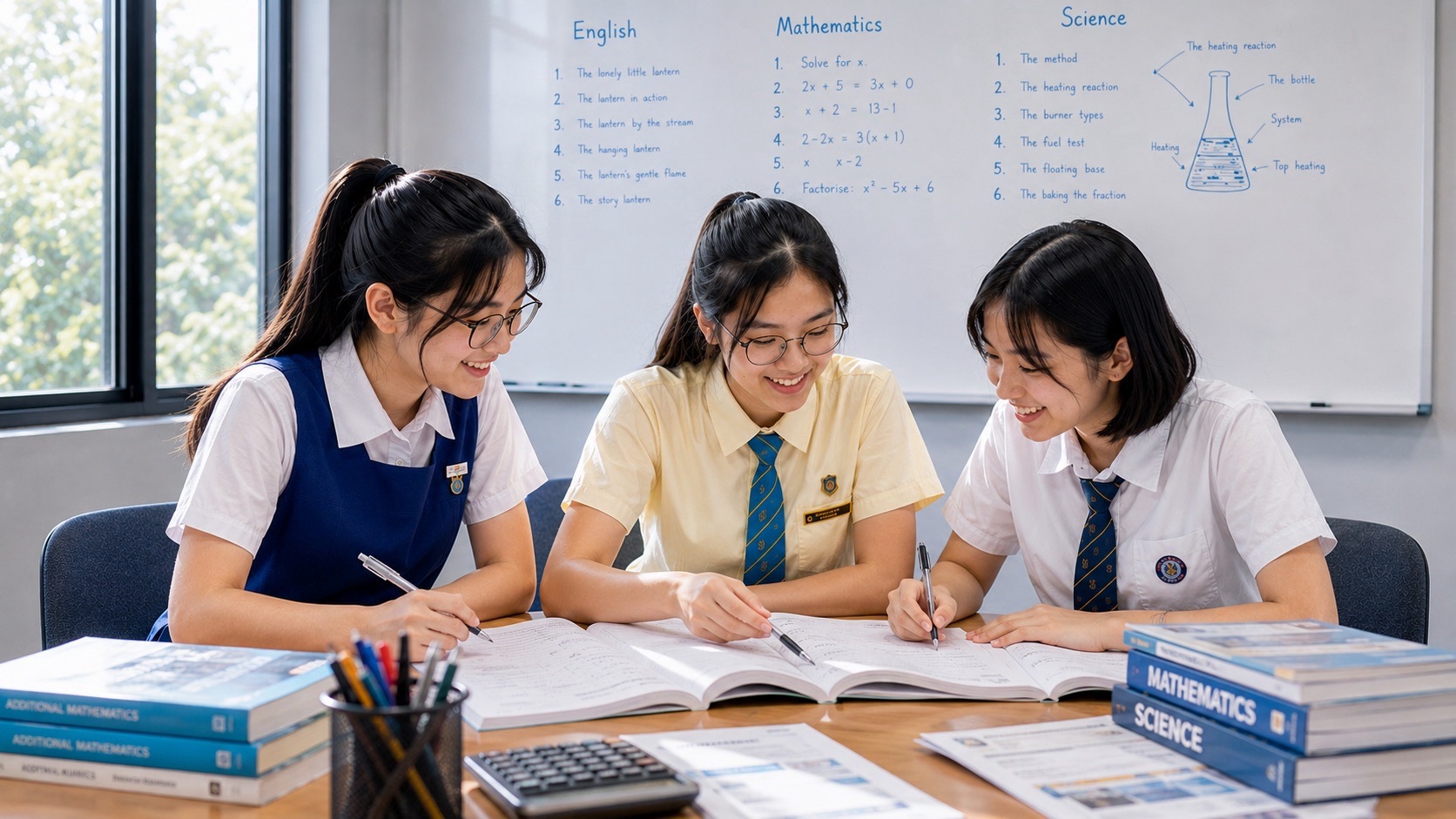
Secondary 3 Mathematics often becomes difficult before the student writes the first line.
The problem may begin in the reading.
A student can know the algebra, remember the formula and use the calculator correctly, yet still lose the question because one phrase was misread, one condition was ignored, one symbol was interpreted too quickly or one command word was answered with the wrong kind of response.
This is why mathematical language is not a decorative layer around the Mathematics.
It is part of the Mathematics.
Before a student can choose the right method, the student must first build the right problem.
At Secondary 3, that construction becomes more demanding. Questions become denser. More conditions are embedded in sentences. Diagrams carry information that must be separated from appearance. Statistical claims require interpretation. Probability language changes event structure. Algebraic notation becomes more compressed. Multi-part questions may depend on earlier results. A single word such as hence, exactly, at least, show or justify can change the required task.
Under Singapore’s Full Subject-Based Banding framework, Mathematics is taken at G1, G2 or G3 subject level. From the 2027 graduating cohort, the common national certification is the Singapore-Cambridge Secondary Education Certificate, or SEC. The 2027 Mathematics subject codes are K110 for G1, K210 for G2 and K310 for G3.
The content depth differs across the levels, but all three require the learner to read mathematical language accurately enough to know what problem is actually being solved.
This Article Has a Distinct Job
This page belongs to our How Secondary 3 Mathematics Works in Singapore | SEC G1, G2 & G3 series.
It does not duplicate the lower-secondary owner How Secondary 1 Mathematical Vocabulary & Task Language Work, which introduces the stage earlier in the curriculum.
It also does not duplicate How Problem-Solving Independence Changes in Secondary 3 Mathematics, which owns method selection, recovery and independent route choice.
This article owns the reading interface that comes before method selection:
- command words;
- conditions and qualifiers;
- symbols and notation;
- units and dimensions;
- diagram language;
- probability event language;
- statistical comparison language;
- linked-part language such as hence;
- translation from ordinary language into mathematical representation;
- how reading errors masquerade as Mathematics errors.
The Short Answer
Task reading works when the student converts the question into a controlled mathematical representation before calculating.
A useful sequence is:
Read → Mark → Translate → Classify → Constrain → Represent → Select → Execute → Return
Read
Read the full task before reacting to visible numbers.
Mark
Underline or annotate key conditions, units, command words, comparison phrases and restrictions.
Translate
Convert words into quantities, relationships, sets, equations, diagrams, tables or events.
Classify
What kind of mathematical structure has been created?
Constrain
What must be true? What is forbidden? What range, unit, condition or shape property limits the solution?
Represent
Build the mathematical form that makes the structure visible.
Select
Choose the method only after the problem has been constructed correctly.
Execute
Carry out the Mathematics.
Return
Return the answer to the language of the original question.
This sequence prevents a common error: doing correct Mathematics on the wrong problem.
Mathematical Reading Is Not Ordinary Reading
Ordinary reading often allows approximation.
A reader can understand the general meaning of a paragraph without inspecting every word.
Mathematical reading is less forgiving.
One small word can change the problem:
- at least is not the same as exactly;
- maximum is not the same as minimum;
- diameter is not the same as radius;
- perimeter is not the same as area;
- mean is not the same as median;
- independent is not the same as mutually exclusive;
- exact is not the same as correct to three significant figures.
The student therefore needs two reading modes:
- global read: understand the situation;
- precision read: inspect the mathematical conditions.
The Command Word Tells You What Kind of Answer to Produce
Students often focus on the topic noun and ignore the command verb.
But the verb is often the instruction.
Find
Produce the required mathematical quantity or result.
Calculate
Carry out numerical or symbolic work to obtain a value.
Determine
Use the information to establish the requested result. The method may not be prescribed.
Show that
The result is already supplied. The task is to produce a valid chain of reasoning that establishes it.
Explain
A numerical answer alone is usually incomplete. State why or what the result means.
Justify
Give mathematical evidence that supports the conclusion.
Compare
Discuss relevant similarities or differences using mathematical evidence.
Estimate
Produce an approximate value using a reasonable method.
Hence
Use the result or structure established earlier rather than restarting the problem from zero unless necessary.
These words are not merely exam vocabulary.
They specify the mathematical job.
“Show That” Questions Reverse the Usual Direction
In a normal question, the student does not know the answer and must produce it.
In a “show that” question, the target is known.
The task is proof of route, not discovery of destination.
This changes the student’s job.
- The final answer cannot be used as unexplained evidence.
- The intermediate steps matter.
- The student should preserve enough exactness to arrive at the stated result properly.
- The route must be logically defensible.
Students who treat “show that” as an ordinary calculator question often lose the real point of the task.
“Hence” Is a Handoff Word
The word hence signals dependency.
An earlier result has been produced for a reason.
The student should ask:
- What did the previous part establish?
- What new quantity can that result unlock?
- Can the earlier expression be substituted, transformed or interpreted here?
Ignoring the handoff can lead to unnecessary work or a method that misses the intended structure.
Qualifiers Are Mathematical Constraints
Qualifying phrases often define the valid solution space.
Examples include:
- positive integer;
- whole number;
- between 0 and 1;
- acute angle;
- nearest cent;
- nearest degree;
- three significant figures;
- exact value;
- not drawn to scale;
- without replacement;
- at least;
- at most;
- no more than;
- more than;
- minimum;
- maximum.
The student should treat these phrases as part of the equation, even when no algebraic symbol is present.
“At Least” and “At Most” Change the Event
Probability language is especially sensitive to qualifiers.
“Exactly two successes” is one event.
“At least two successes” includes two or more.
“At most two successes” includes zero, one or two.
A student who jumps directly to arithmetic before defining the event can calculate perfectly and still answer the wrong probability.
“Not Drawn to Scale” Is a Warning Against Visual Evidence
Geometry diagrams are useful representations.
They can also seduce the student into trusting appearance.
When a question states that a diagram is not drawn to scale, the student should actively separate:
- what is stated;
- what is marked;
- what can be logically derived;
- what merely looks true.
That distinction is covered more fully in How Geometry & Measurement Work in Secondary 3 Mathematics.
Symbols Are Words With Compressed Meaning
Mathematical notation is a language.
A symbol may encode a relationship that would take several words to express.
Examples include:
- = equality;
- ≈ approximation;
- <, > inequalities;
- ≤, ≥ inclusive bounds;
- ∠ angle;
- ∥ parallel;
- ⊥ perpendicular;
- π a mathematical constant;
- √ a root operation;
- function notation where relevant;
- set and interval notation where relevant to the syllabus.
Students should not read symbols only by name.
They should read them by mathematical consequence.
For example, “x ≥ 4” does not mean “x is 4”.
It describes a region of possible values.
Equals Does Not Mean “The Answer Comes Next”
The equality sign is frequently misread procedurally.
Some students experience it as “now calculate”.
Its deeper meaning is that two expressions represent the same value.
This matters when rearranging equations, checking identities or interpreting formulas.
A student who understands equality as balance is less likely to apply arbitrary “move it across” rules without preserving equivalence.
Variables Have Roles
A letter in Mathematics can represent different kinds of things.
- an unknown to solve for;
- a variable quantity;
- a constant parameter;
- a coordinate;
- a label;
- a formula input.
Students who treat every letter as “the answer” can misread formulas and graphs badly.
Before manipulating symbols, ask:
What role is this symbol playing in this problem?
The dedicated algebra owner is How Algebra Works in Secondary 3 Mathematics.
Units Are Part of the Sentence
Units tell the student what kind of quantity is being discussed.
They can reveal whether the current reasoning is dimensionally sensible.
A distance answer in square centimetres is suspicious.
An area answer in centimetres is incomplete.
A rate with incompatible units may reveal that the relationship has been set up wrongly.
Students should therefore annotate units during reading rather than adding them only at the end.
The Noun Tells You the Quantity
Many Mathematics errors are really quantity-identification errors.
Students should distinguish words such as:
- length;
- distance;
- perimeter;
- area;
- surface area;
- volume;
- gradient;
- speed;
- rate;
- probability;
- frequency;
- mean;
- median;
- percentage change.
The noun tells the student what kind of mathematical object the answer should be.
Pronouns Can Hide Mathematical Reference
Longer word problems sometimes use ordinary pronouns or referential phrases:
- this value;
- that amount;
- the remaining length;
- the corresponding side;
- the second group;
- the original price;
- the new rate.
Students should ask:
What exactly does this phrase refer to?
Misidentifying the referent can derail an otherwise correct method.
The Original Value and the Final Value Are Different Mathematical Roles
Percentage questions expose the importance of noun phrases.
“Original amount”, “new amount”, “increase”, “discounted price”, “remaining amount” and “percentage change” are not interchangeable.
Students should identify the reference base before calculating.
Otherwise the arithmetic may be correct but attached to the wrong quantity.
Words Such as “Of”, “Per” and “For Every” Carry Structure
Small words can signal mathematical relationships.
- of often indicates multiplication in percentage contexts;
- per often signals a rate;
- for every often signals ratio;
- difference often asks for subtraction or comparison;
- times as much signals multiplicative comparison;
- more than and less than can be order-sensitive in algebraic translation.
These are translation signals, not universal mechanical rules.
The student should use them to build a relationship, then check the relationship against the context.
Do Not Translate Word by Word
Mechanical word-by-word translation is dangerous.
Mathematical language should be translated by meaning.
For example, “five less than x” is not created safely by reading the words left to right and writing 5 − x.
The phrase means a quantity that is five below x.
The structure is x − 5.
The student should ask what relationship the sentence describes, not what operation each word superficially suggests.
The Translation Ladder
When a word problem feels dense, move through levels.
- Story: What is happening?
- Quantities: What can be measured or counted?
- Relationships: How do the quantities connect?
- Representation: Equation, table, graph, diagram, ratio or event?
- Target: Which quantity must be found or explained?
This reduces the pressure to translate the whole paragraph at once.
The Diagram Has Its Own Language
Geometric notation carries information:
- arrow marks for parallel lines;
- tick marks for equal lengths;
- right-angle boxes;
- angle labels;
- coordinate labels;
- centre and radius information;
- dimension labels on solids.
Students should read these marks with the same seriousness as words.
The geometry diagram is a sentence written spatially.
Tables Are Sentences Arranged in Rows and Columns
A data table compresses relationships.
Students should identify:
- what each row represents;
- what each column represents;
- the units;
- whether values are frequencies, measurements, percentages or categories;
- whether totals should satisfy a constraint.
Reading a table badly can produce a correct calculation using the wrong data.
Graphs Have Grammar
A graph has its own reading order.
- Read the title or context.
- Read both axes.
- Read units.
- Read scale intervals.
- Identify what one point, bar, region or line represents.
- Only then interpret trend, intersection, gradient, maximum or other structure.
Students who jump straight to the picture can miss a non-zero axis origin, unequal scale or changed unit.
Statistical Comparison Requires Comparison Language
When a question asks students to compare data sets, listing two statistics separately is often weaker than making a comparative statement.
A stronger structure is:
Group A has a higher typical value because …, while Group B is more consistent because …
The exact measures depend on the syllabus level and data.
But the language should connect statistic to meaning.
The dedicated owner is How Statistics & Probability Work in Secondary 3 Mathematics.
Probability Language Defines the Event
Before calculating probability, define the event in words.
For example:
- exactly one red;
- at least one red;
- no red;
- red then blue;
- red or blue;
- without replacement;
- given that another event has occurred where relevant.
These phrases create different outcome spaces.
The event should be understood before probabilities are multiplied or added.
Multi-Part Questions Have Dependency Language
Secondary 3 questions increasingly contain parts that interact.
Signals include:
- hence;
- using your answer;
- given that;
- from the graph;
- using the result in part (a);
- therefore.
These phrases tell the student that information is being handed from one stage to another.
A result is not always an endpoint.
Sometimes it is an interface.
Linked Parts Should Be Read Before Part (a) Is Solved
A useful habit is to glance at the whole multi-part question before starting.
This can reveal why an earlier quantity is being requested.
For example, part (a) may ask for an expression that part (b) will use.
Understanding the handoff can make the first part easier to organise.
Reading Errors Often Masquerade as Topic Errors
A student may appear weak in percentage because “original amount” was misidentified.
A student may appear weak in trigonometry because “angle of elevation” was misread.
A student may appear weak in statistics because “compare” was answered by listing calculations without interpretation.
A student may appear weak in probability because “at least one” was interpreted as “exactly one”.
This is why diagnosis should locate the first wrong line and the first wrong interpretation.
The diagnostic owner is How to Diagnose a Secondary 3 Mathematics Result.
The First Wrong Interpretation Method
When reviewing a wrong answer, inspect the interpretation before the algebra.
- What did the question ask?
- What did the student think it asked?
- Which word, symbol or diagram feature created the difference?
- What mathematical representation followed from that interpretation?
- Would the later Mathematics have been correct if the interpretation were correct?
This separates reading failure from execution failure.
The “What Does This Word Change?” Test
Take a question and remove one qualifier.
Ask the student what changes.
Examples:
- Remove “at least”.
- Change “exact value” to “3 significant figures”.
- Change “area” to “perimeter”.
- Change “without replacement” to “with replacement”.
- Change “show that” to “find”.
If the student cannot explain how the problem changes, the language has not yet been mathematically internalised.
The Paraphrase Test
Before solving a dense question, ask the student to rewrite it in simpler language without changing the Mathematics.
This is harder than it sounds.
The student must preserve:
- the quantities;
- the relationships;
- the conditions;
- the target.
A good paraphrase is evidence that the problem has been understood structurally.
The Symbol-to-Sentence Test
Students should also move in the opposite direction.
Given an equation, inequality, graph or probability notation, ask them to explain it in ordinary language.
This reveals whether the symbols carry meaning or are being manipulated mechanically.
The Sentence-to-Symbol Test
Then reverse the direction.
Give a sentence and ask for an equation, inequality, diagram, table or event structure.
This two-way translation is one of the strongest ways to build mathematical literacy.
Do Not Teach a Dictionary Without Context
Students do need mathematical vocabulary.
But memorising isolated definitions is weaker than using the word inside a decision.
For example, do not only define “median”.
Ask when median would be preferred over mean and what kind of distribution makes that choice useful.
Do not only define “parallel”.
Ask what geometric consequences become available when two lines are known to be parallel.
Vocabulary becomes powerful when it unlocks action.
Mathematical Language Should Be Stored in Notes as Decision Cues
The strongest language notes are not glossary pages alone.
They connect term to consequence.
- parallel: angle relationships may become available;
- similar: corresponding angles equal, corresponding lengths proportional;
- median: positional measure of centre;
- independent events: one event does not change the probability of the other under the model;
- exact value: preserve exact form rather than decimal approximation.
This note architecture connects to How Notes, Formula Memory & Reference Use Work in Secondary 3 Mathematics.
Mathematical Language in G1 Mathematics
At Secondary 3 G1, task language should remain strongly connected to practical use.
High-value language includes:
- percentage increase and decrease;
- rate and unit rate;
- scale;
- perimeter, area and volume;
- average and median;
- probability;
- estimate;
- compare;
- nearest unit;
- practical interpretation.
The goal is dependable quantitative reading in school and real-world contexts.
Mathematical Language in G2 Mathematics
At Secondary 3 G2, language becomes more integrated with algebraic and multi-step reasoning.
The student should increasingly manage:
- algebraic phrases and variables;
- graph language;
- geometric conditions;
- trigonometric instructions;
- data comparison;
- combined probability events;
- multi-part dependencies;
- explanation and justification language.
The main transition is from recognising terms to using them to select the correct mathematical structure.
Mathematical Language in G3 Mathematics
At Secondary 3 G3, notation and task language become more compressed and abstract.
The student should increasingly manage:
- dense symbolic relationships;
- multiple representations;
- stronger justification demands;
- exactness and approximation conditions;
- longer linked-part questions;
- more subtle method-selection cues;
- technical statistical and probability language;
- unfamiliar contexts where the topic is not named.
The objective is not simply a larger vocabulary.
It is faster, more reliable construction of the mathematical problem hidden inside the language.
When Mathematics and Additional Mathematics Are Both Taken
Students taking Additional Mathematics encounter overlapping symbols and increasingly dense mathematical language.
The risk is false transfer.
A symbol or phrase may appear familiar while the required task belongs to a different subject structure.
Students should therefore keep subject boundaries clear:
- Which subject owns this question?
- What is the target?
- Which methods are expected or appropriate here?
- Is an A-Math method genuinely helpful or merely more complicated?
The interface owner is How Mathematics & Additional Mathematics Interact at Secondary 3.
A Reading Routine Before Calculation
Before touching the calculator, use this short routine:
- Circle the command word.
- Underline the target quantity.
- Box important conditions.
- Mark units.
- Annotate the diagram or table.
- Write one sentence describing the relationship.
- Only then choose the method.
This may take ten seconds.
It can save several minutes of wrong working.
The Ten-Second Problem Statement
Before solving a difficult question, the student should be able to state:
I know ____. I need ____. The relationship seems to be ____. The main condition is ____.
If the blanks cannot be filled, calculation is probably premature.
The Read–Represent–Solve Discipline
Some students go directly from reading to calculation.
Secondary 3 increasingly benefits from an intermediate representation stage.
Read → Represent → Solve
The representation may be:
- an equation;
- a labelled diagram;
- a table;
- a graph;
- a ratio;
- a tree diagram;
- a list of known and unknown quantities.
The representation acts as a buffer between language and calculation.
The Wrong-Question Check
At the end of a solution, reread the original command.
Ask:
- Did I answer the quantity requested?
- Did I use the correct unit?
- Did I follow the rounding instruction?
- Did I explain if explanation was requested?
- Did I compare if comparison was requested?
- Did I justify if justification was requested?
This catches a surprising number of avoidable errors.
The Confidence-in-Reading Mark
Students can mark their confidence before solving:
- High: I know exactly what this question is asking.
- Medium: I understand most of it but one phrase is uncertain.
- Low: I am not sure what mathematical structure the wording describes.
A low-confidence reading should trigger clarification before extensive working begins.
The Error Log Should Include Language Errors
Do not record every wrong answer as a topic error.
Record reading mechanisms specifically:
- misread “at least” as “exactly”;
- used diameter as radius;
- answered perimeter instead of area;
- ignored “not drawn to scale”;
- missed “hence” dependency;
- rounded when exact value was required;
- listed statistics without actually comparing them.
These notes become future warning signals.
The Weekly Language Drill
One short weekly drill can train task reading without adding much workload.
- Take three short Mathematics questions.
- Do not solve them yet.
- Identify command words.
- Mark conditions.
- State the target quantity.
- Choose a representation.
- Name the likely method family.
- Then solve only one of the three.
This isolates the reading and selection layer from routine execution.
The Parent Does Not Need to Teach the Method
Parents can help by checking interpretation rather than giving solutions.
Ask:
- What exactly is the question asking?
- Which word changes the task?
- What are the units?
- What condition cannot be ignored?
- What would the answer need to look like?
These questions support mathematical reading without replacing method selection.
Five Questions a Parent Can Ask
- What is the command word?
- What is the target quantity?
- Which condition matters most?
- What mathematical representation fits the wording?
- How will you check that you answered the question actually asked?
A Tutor’s Task-Language Checklist
- Can the student paraphrase the question?
- Can the student identify the command word?
- Can the student identify qualifiers?
- Can the student distinguish the target from the given information?
- Can the student translate between words and symbols?
- Can the student read diagram notation?
- Can the student read tables and graph scales?
- Can the student distinguish similar technical terms?
- Can the student return the final answer to the wording of the question?
If a student can calculate but repeatedly fails this checklist, the next intervention should not simply be more worksheets.
The Three-Student Small-Group Advantage
In a small group, task-reading differences become visible.
One student may read quickly but miss qualifiers.
Another may understand the wording but struggle to translate it into algebra.
A third may build the correct representation but choose the wrong method.
These states look similar if only the final answer is inspected.
They require different teaching.
The value of the small group is that the tutor can hear the student’s interpretation before the working hides it.
What Secondary 3 Should Hand to Secondary 4
By the end of Secondary 3, mathematical reading should be increasingly automatic.
- The student identifies command words.
- The student marks important conditions.
- The student respects units.
- The student translates words into representations.
- The student reads symbols by meaning.
- The student reads diagrams by evidence.
- The student recognises linked-part dependencies.
- The student returns the answer to the exact task.
This reduces the number of Secondary 4 errors that are wrongly blamed on “carelessness”.
The wider handover is covered in How Secondary 3 Mathematics Prepares a Student for Secondary 4.
How Bukit Timah Tutor Uses Mathematical Language
At Bukit Timah Tutor, mathematical language is diagnosed as part of the solution system.
We separate:
- reading failure from concept failure;
- translation failure from algebra failure;
- symbol misunderstanding from procedure weakness;
- command-word failure from answer-form failure;
- diagram interpretation from geometric calculation;
- probability event definition from probability arithmetic.
Our mathematics classes are deliberately small, with a maximum of three students, because the first useful evidence often appears before the calculation: what the student thinks the question means.
The long-term target is:
The student should increasingly be able to convert dense mathematical language into a clean mathematical object before choosing a method.
The Secondary 3 Mathematical-Language Route
- Singapore Mathematics Hub
- How Secondary 3 Mathematics Works | SEC G1, G2 & G3
- How Notes, Formula Memory & Reference Use Work in Secondary 3 Mathematics
- How Worked Examples & Example Fading Work in Secondary 3 Mathematics
- How Problem-Solving Independence Changes in Secondary 3 Mathematics
- How to Diagnose a Secondary 3 Mathematics Result
- Secondary 3 Mathematics
Official Singapore References
For current national syllabus boundaries and subject codes, use the official Singapore Examinations and Assessment Board SEC syllabus pages:
- 2027 SEC G1 syllabuses — Mathematics K110
- 2027 SEC G2 syllabuses — Mathematics K210
- 2027 SEC G3 syllabuses — Mathematics K310
School-specific wording conventions, internal assessment formats and topic sequencing should always be read alongside the national syllabus.
Final Principle
Mathematics begins before calculation.
The student first has to decide what the words, symbols, units, diagrams and conditions mean together.
A formula cannot rescue a problem that has been misread.
A calculator cannot rescue the wrong event.
Perfect algebra cannot rescue the wrong target quantity.
Read the command. Mark the condition. Name the quantity. Respect the unit. Translate the relationship. Build the representation. Then choose the Mathematics.
That is how mathematical language and task reading should work in Secondary 3 Mathematics.