
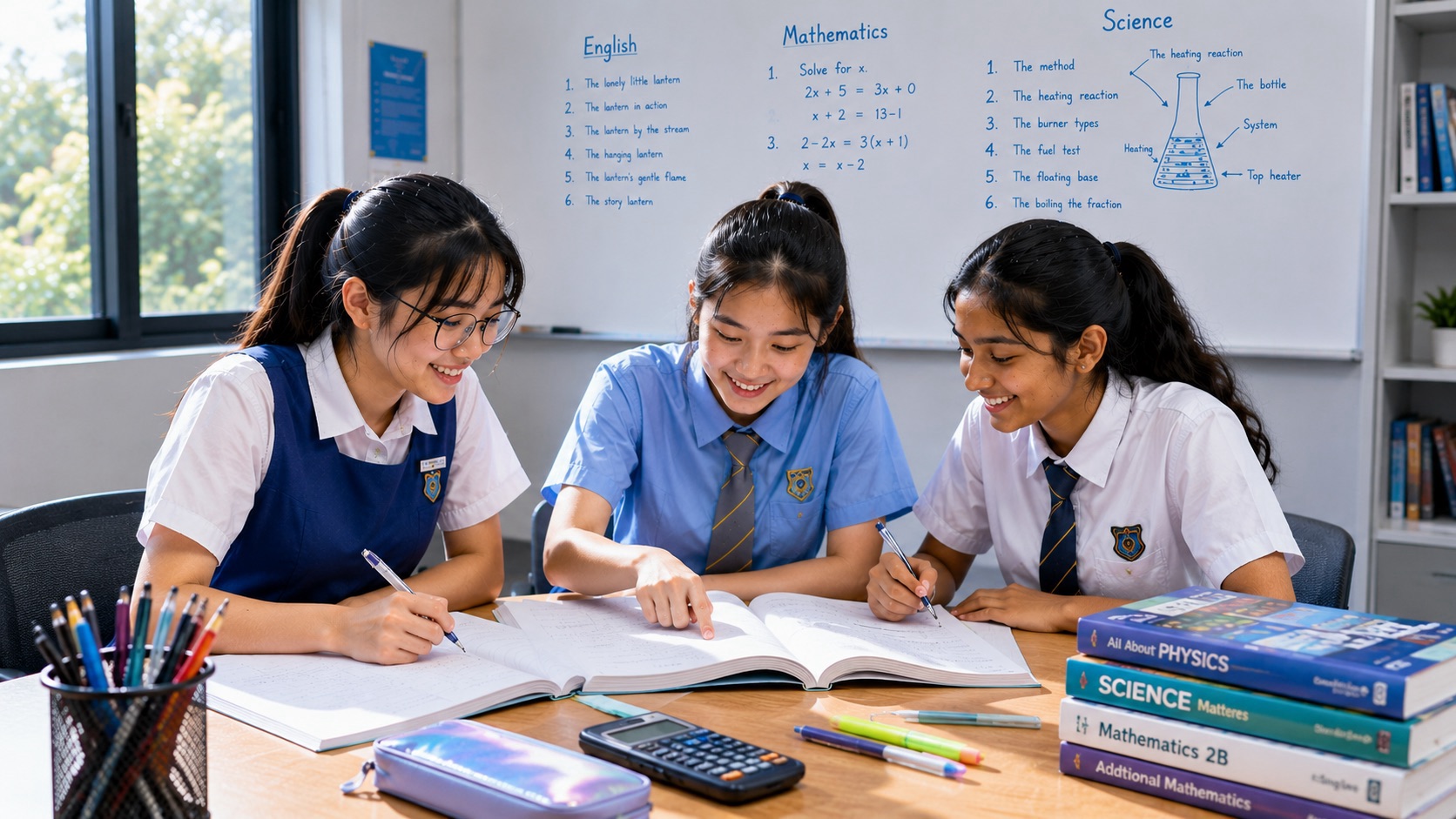
Secondary 3 Mathematics is not only about learning harder content. It is also about learning how to become independent from the worked example.
Worked examples are powerful because they make invisible mathematical decisions visible.
A good example shows more than the answer. It shows how the problem was read, what was represented, which relationship was selected, how the algebra was organised, where the calculator entered, what was checked and why the final answer is believable.
But worked examples have a built-in danger.
If the student remains too close to them for too long, the example can become a crutch.
The student may be able to follow a solution beautifully and still be unable to start the next question alone.
This is why Secondary 3 needs a deliberate transition:
see the route → explain the route → complete part of the route → choose the route → run the route independently
That transition is what example fading is for.
Under Singapore’s Full Subject-Based Banding framework, Mathematics is taken at G1, G2 or G3 subject level. From the 2027 graduating cohort, the common national certification is the Singapore-Cambridge Secondary Education Certificate, or SEC. The 2027 Mathematics subject codes are K110 for G1, K210 for G2 and K310 for G3.
The breadth and depth differ across the levels, but all three benefit from the same instructional principle:
Support should be strong enough to reveal the Mathematics, then fade fast enough to reveal the learner.
This Article Has a Distinct Job
This page belongs to our How Secondary 3 Mathematics Works in Singapore | SEC G1, G2 & G3 series.
It does not duplicate How Homework & Independent Practice Change in Secondary 3 Mathematics, which owns the independent-practice system.
It does not duplicate How Problem-Solving Independence Changes in Secondary 3 Mathematics, which owns method selection, transfer and recovery.
This page owns the instructional bridge between the two:
- how to use worked examples without creating dependence;
- how to ask students to self-explain the example;
- how to pair examples with problems;
- how to remove steps gradually;
- how to know when to stop modelling;
- how to move from imitation to independent route selection.
The Short Answer
A worked example should reduce unnecessary search while a student is learning a new structure. Example fading should then return the search responsibility to the student in controlled stages.
The learning sequence is:
Model → Explain → Complete → Vary → Select → Transfer
Each stage removes one form of help.
Why Worked Examples Matter More at Secondary 3
Secondary 3 problems are more connected than many lower-secondary exercises.
A question can require the student to manage several layers at once:
- interpret the question;
- identify the representation;
- retrieve the relevant mathematics;
- choose a method;
- carry out algebra;
- use a calculator where appropriate;
- track units or conditions;
- check the result;
- communicate the answer.
For a novice learning a new structure, asking them to discover every step from scratch can overload the learning process.
A worked example reduces that burden.
It lets the student inspect the architecture before being asked to operate it independently.
A Good Worked Example Is Not a Model Answer
A model answer is usually optimised for completeness and correctness.
A good worked example is optimised for learning.
That means it should reveal the important decisions.
- What was noticed first?
- What information was ignored?
- Why was this representation chosen?
- Why is this theorem or formula legal here?
- Why was the equation arranged in this form?
- What could have gone wrong?
- How was the answer checked?
A perfect solution that hides all of these decisions may be less useful for learning than a slightly longer solution that exposes them.
The Worked-Example Engine
A useful operating sequence is:
Read → Predict → Observe → Explain → Cover → Rebuild → Vary → Apply
Read
Read the problem before looking at the solution.
Predict
Ask what method or representation might be useful.
Observe
Study the worked route.
Explain
Explain why each important step is valid.
Cover
Hide part or all of the solution.
Rebuild
Reconstruct the route from memory and reasoning.
Vary
Change the numbers, orientation, wording or required quantity.
Apply
Solve a fresh uncued problem.
The example has done its job only when the student can leave it.
The Student Should Predict Before Looking
If the student opens a worked example and immediately reads the full solution, the thinking begins too late.
Before viewing the working, ask:
- What type of structure is this?
- What is known?
- What is required?
- What method families might apply?
- What answer form should I expect?
Even an incorrect prediction is useful because it gives the student something to compare against the worked route.
Self-Explanation Is the Difference Between Seeing and Learning
Students often read a worked example and experience an illusion of understanding because each step looks sensible after it has been shown.
Self-explanation interrupts that illusion.
After each major step, ask:
- Why was this step taken?
- What rule makes it valid?
- What would happen if this condition were absent?
- Could another method work?
- How do we know the answer is still plausible?
The student does not need to narrate every arithmetic operation.
The important explanations are the decision points.
Example–Problem Pairs
One of the most useful structures is:
worked example → similar problem → worked example → similar problem
This is especially useful when the learner is still building a new method.
The first example reveals the route.
The paired problem requires immediate reconstruction.
The pairing reduces the distance between explanation and independent use.
But the problem should not be a perfect copy.
Change something meaningful:
- the numbers;
- the unknown;
- the order of information;
- the diagram orientation;
- the wording;
- the required final quantity.
The student should have to transfer the route, not trace it.
What Example Fading Means
Example fading means gradually removing parts of the worked solution so the learner completes more of the reasoning.
A simple fading sequence is:
- Full example: every important step shown.
- Missing final step: student completes the conclusion.
- Missing middle step: student bridges part of the route.
- Skeleton solution: only major prompts remain.
- Method cue only: student runs the solution.
- No cue: student must identify and execute the method independently.
The support fades while the mathematical demand remains controlled.
Fade the Decision, Not Only the Arithmetic
A weak fading sequence removes only calculations.
For example, the method is fully identified and the student merely fills in numbers.
That trains execution but not independence.
A stronger fading sequence removes decision support:
- first remove the final calculation;
- then remove the substitution;
- then remove the equation setup;
- then remove the method label;
- finally remove the representation cue.
The learner gradually inherits the route-selection work.
The Wrong Way to Fade
Fading too quickly can create unnecessary failure.
Fading too slowly can create dependence.
The wrong sequence is:
teacher does everything → teacher does everything → teacher does everything → full examination question
The gap is too large.
A controlled fade creates smaller transfers of responsibility.
The Tutor Should Watch for Productive Struggle
When a step is faded, some hesitation is useful.
The student has to retrieve the relationship and reconstruct the route.
But struggle becomes unproductive when the learner has no viable entry point.
A useful distinction is:
- productive struggle: the student is choosing among plausible routes;
- unproductive struggle: the student lacks the prerequisite needed to enter the problem.
If the prerequisite is missing, return to the foundation rather than waiting longer.
The Hint Ladder and Example Fading Are the Same Family of Tool
Both control the amount of support.
A hint ladder might move through:
- What is the target?
- What is definitely known?
- What representation could help?
- Which method families are possible?
- Which specific relationship connects the known and unknown quantities?
- Only then: the first procedural step.
The tutor should use the smallest hint that restarts the learner.
Then fade again.
Worked Examples Should Make Errors Visible Too
Students often see only perfect mathematical routes.
That can create the false impression that good mathematics means never choosing a weak route.
Occasionally, a useful example is a deliberately flawed solution.
Ask the student to locate the first wrong line.
Examples include:
- a sign error after expansion;
- a reverse-percentage base error;
- mismatched corresponding sides in similar figures;
- a wrong trigonometric ratio;
- a probability tree that ignores no replacement;
- a statistical comparison that discusses mean but ignores spread.
Error examples train diagnosis and verification rather than imitation alone.
Compare Two Solutions, Not Just One
Some problems admit more than one valid route.
Comparing routes helps students understand efficiency and representation.
Ask:
- Which route is shorter?
- Which route is easier to check?
- Which route uses less fragile algebra?
- Which route generalises better?
- Which route communicates the reasoning more clearly?
This develops judgement rather than formula obedience.
Worked Examples in Algebra
Algebra examples should reveal invariants.
For equations, show why equality is preserved.
For factorisation, show the relationship between expanded and factorised forms.
For substitution, show how the variable role is identified before values enter.
For formula rearrangement, show the target variable and the inverse operations controlling the sequence.
Then fade the support:
- remove one transformation;
- remove the stated inverse operation;
- remove the target-isolation cue;
- mix with a geometry or rate problem.
The dedicated owner remains How Algebra Works in Secondary 3 Mathematics.
Worked Examples in Geometry & Measurement
Geometry examples should reveal how evidence is extracted from the diagram.
Do not show only the calculations.
Show:
- what was given;
- what was marked;
- which relationship became available;
- which hidden triangle or subfigure mattered;
- why the theorem was valid;
- what unit was expected;
- how plausibility was checked.
Then fade the annotations until the student marks the diagram independently.
The dedicated owner remains How Geometry & Measurement Work in Secondary 3 Mathematics.
Worked Examples in Statistics & Probability
Statistics examples should reveal why a representation or measure was selected.
Probability examples should reveal the event structure before the arithmetic.
Useful example prompts include:
- Why is median more useful here?
- Why does spread matter in this comparison?
- Why is this histogram different from a bar chart?
- Why do these branch probabilities change?
- Why are these events multiplied rather than added?
- How can the final probability be checked?
Then remove the representation cue and require the student to build it.
The dedicated owner remains How Statistics & Probability Work in Secondary 3 Mathematics.
Worked Examples Should Eventually Become Mixed
Early examples are usually topic-specific.
Later examples should model method selection in mixed conditions.
For example, present three short problems and ask the student to identify which structure belongs to:
- simultaneous equations;
- proportion;
- trigonometry;
- statistics;
- probability;
- graph interpretation.
Then reveal one worked selection process.
The worked example has moved from “how to calculate” to “how to choose”.
The Example Should Shrink as the Student Grows
This is one of the easiest rules to remember.
At the beginning:
- show more steps;
- name more decisions;
- annotate more heavily;
- check more explicitly.
Later:
- show fewer steps;
- remove method labels;
- reduce annotations;
- require the student to generate the check.
If the example never shrinks, the learner may never grow into the space it occupies.
The Example-Fading Ladder
A practical ladder is:
- Observe: full worked example.
- Explain: student explains major steps.
- Complete: student fills missing final steps.
- Bridge: student fills missing middle steps.
- Plan: student is given only the target and some structure.
- Select: no method cue is provided.
- Transfer: surface changes and topic may be mixed.
- Retrieve: problem returns after delay.
The student should not remain permanently at any one rung.
How to Know When to Fade
Fade when the student can explain the current step rather than merely repeat it.
Useful signals include:
- the student predicts the next step accurately;
- the student explains why the step is valid;
- the student can complete a near problem independently;
- the student notices common errors;
- the student can check the answer.
If these signals are present, reduce support.
How to Know When to Restore Support
Support should return when the student is failing for the wrong reason.
For example:
- the prerequisite is missing;
- working memory is overloaded by too many new elements;
- the representation itself is unfamiliar;
- the student is guessing rather than reasoning;
- the error pattern is multiplying without learning.
Restore just enough support to make the structure visible again.
Then fade once more.
The Worked-Example Trap: Copying
Copying creates a completed page without proving understanding.
To prevent copying:
- require prediction before viewing;
- cover the solution after study;
- ask for self-explanation;
- change one feature in the paired problem;
- require a fresh problem immediately;
- retest later without the example visible.
The example should be inspected, not traced.
The Worked-Example Trap: Pattern Matching
Students can memorise the appearance of an example instead of the underlying relationship.
To test this, change:
- orientation;
- labels;
- order of information;
- numerical scale;
- context;
- required output.
If performance collapses, the student may own the template rather than the Mathematics.
The Worked-Example Trap: Too Many Examples
Five beautifully explained examples in a row can still be too much teacher activity.
The learner needs to produce mathematics.
A useful rhythm is:
example → student problem → reflection → variation
Do not allow explanation to crowd out retrieval.
The Worked-Example Trap: Too Little Explanation
A short solution is not always a clear solution.
Experts can compress many decisions because the structure is already internalised.
Novices may need those decisions unpacked.
For example, an expert may write:
Let x be the original amount.
A novice may need to hear why the original amount is the useful unknown and why the final amount is not 100% in a reverse-percentage problem.
Good examples expose expert compression before eventually teaching the student to compress too.
Worked Examples Should Train Checking
A solution that ends at the answer teaches students that producing an answer is the final mathematical act.
Include checks inside the example.
- Substitute the solution.
- Estimate the magnitude.
- Check the unit.
- Compare graph and algebra.
- Test geometric plausibility.
- Check probability bounds.
- Compare statistical conclusion with the display.
Then fade the checking prompt until the student initiates it.
Worked Examples Should Train Recovery
Not every example should begin with the perfect route.
Occasionally model recovery.
For instance:
“This route is becoming more complicated than expected. Let us stop, return to the target and try another representation.”
This teaches an important lesson:
Changing route is not failure. It is part of problem solving.
Worked Examples in G1 Mathematics
At Secondary 3 G1, worked examples should emphasise clear, practical mathematical use.
Useful examples include:
- percentage and rate in everyday contexts;
- simple algebraic representation;
- measurement and unit conversion;
- graph and table interpretation;
- probability of simple events;
- financial or practical calculations.
The fade should move from strong contextual annotation toward independent interpretation.
The target is dependable use, not unnecessary abstraction.
Worked Examples in G2 Mathematics
At Secondary 3 G2, worked examples should increasingly reveal connections across topics.
Useful examples include:
- algebra inside geometry;
- graphs connected to equations;
- ratio connected to scale;
- trigonometry connected to measurement;
- statistics connected to interpretation;
- probability represented through organised outcome spaces.
The fade should move from method-labelled examples toward mixed method selection.
Worked Examples in G3 Mathematics
At Secondary 3 G3, worked examples should increasingly model abstraction, efficiency and reasoning.
Useful examples should make visible:
- why one representation is chosen over another;
- how long algebraic chains are organised;
- how multiple methods are compared;
- how unfamiliar problems are decomposed;
- how conclusions are justified;
- how independent checks are selected.
The fade should eventually remove not only steps but the method cue itself.
When Mathematics and Additional Mathematics Are Both Taken
Worked examples can help manage the Mathematics–Additional Mathematics interface.
Use shared examples to stabilise common infrastructure such as algebra, graphs and trigonometric foundations.
Then separate the subject-specific extension.
For example:
- Mathematics example: solve and interpret a quadratic relationship in the Mathematics context;
- A-Math example: extend the symbolic or functional reasoning according to K232 or K341;
- comparison: identify what is shared and what belongs only to A-Math.
This helps students transfer without collapsing the subjects into one.
Follow the interface owner at How Mathematics & Additional Mathematics Interact at Secondary 3.
The Parent Should Not Become the Worked Example
Parents naturally want to help when the student is stuck.
But giving the full route too quickly can recreate dependence.
Use questions instead:
- What are you trying to find?
- What do you know for certain?
- What example from class is this closest to?
- What was different in that example?
- What first step can you justify?
The goal is to trigger retrieval, not deliver the route.
Five Questions a Parent Can Ask
- Can you explain why this example uses that method?
- What step could be removed next?
- What would change if the numbers or diagram changed?
- Can you solve a similar question without looking?
- How would you check the answer yourself?
A Tutor’s Worked-Example Checklist
- Does the example reveal the important decisions?
- Does the student predict before viewing?
- Does the student self-explain the major steps?
- Is there an immediate paired problem?
- Has at least one feature been varied?
- Is support being faded?
- Is the method cue eventually removed?
- Is checking included?
- Is there a delayed retest?
- Is the learner producing more Mathematics than the tutor?
If the final answer to the last question is no, the modelling phase has probably lasted too long.
The Three-Student Small-Group Advantage
Example fading is easier to manage when the tutor can see each learner’s state.
One student may still need the full example.
Another may need only a method cue.
A third may be ready for a fully uncued transfer problem.
In a small group, support can be faded at different speeds without turning the whole lesson into three separate lectures.
The tutor can give one common example, then vary the level of completion required from each student.
That is where visibility becomes instructional precision.
The Example Should Become a Memory, Not a Dependency
A good worked example should leave behind:
- a recognition signal;
- a method structure;
- a common error warning;
- a checking routine;
- a connection to related problems.
It should not leave behind the belief:
I can only do this if I can see one just like it.
The Secondary 3 Worked-Example Route
- Singapore Mathematics Hub
- How Secondary 3 Mathematics Works | SEC G1, G2 & G3
- How Homework & Independent Practice Change in Secondary 3 Mathematics
- How Problem-Solving Independence Changes in Secondary 3 Mathematics
- How to Diagnose a Secondary 3 Mathematics Result
- How to Practise Maths Effectively
- How Secondary 3 Mathematics Prepares a Student for Secondary 4
- Secondary 3 Mathematics
Official Singapore References
For current national syllabus boundaries and subject codes, use the official Singapore Examinations and Assessment Board SEC syllabus pages:
- 2027 SEC G1 syllabuses — Mathematics K110
- 2027 SEC G2 syllabuses — Mathematics K210
- 2027 SEC G3 syllabuses — Mathematics K310
School-specific sequencing across Secondary 3 and Secondary 4 should always be checked alongside the national syllabus.
Final Principle
A worked example is useful when it makes the Mathematics visible.
It becomes harmful when it makes the student invisible.
Secondary 3 should therefore use examples as temporary scaffolds.
Show the route. Explain the decisions. Pair the example with a problem. Remove a step. Remove another. Remove the method label. Change the surface. Ask for a check. Return later without the example.
The destination is not a student who recognises every model answer.
The destination is a student who can build the route when the model answer is gone.