
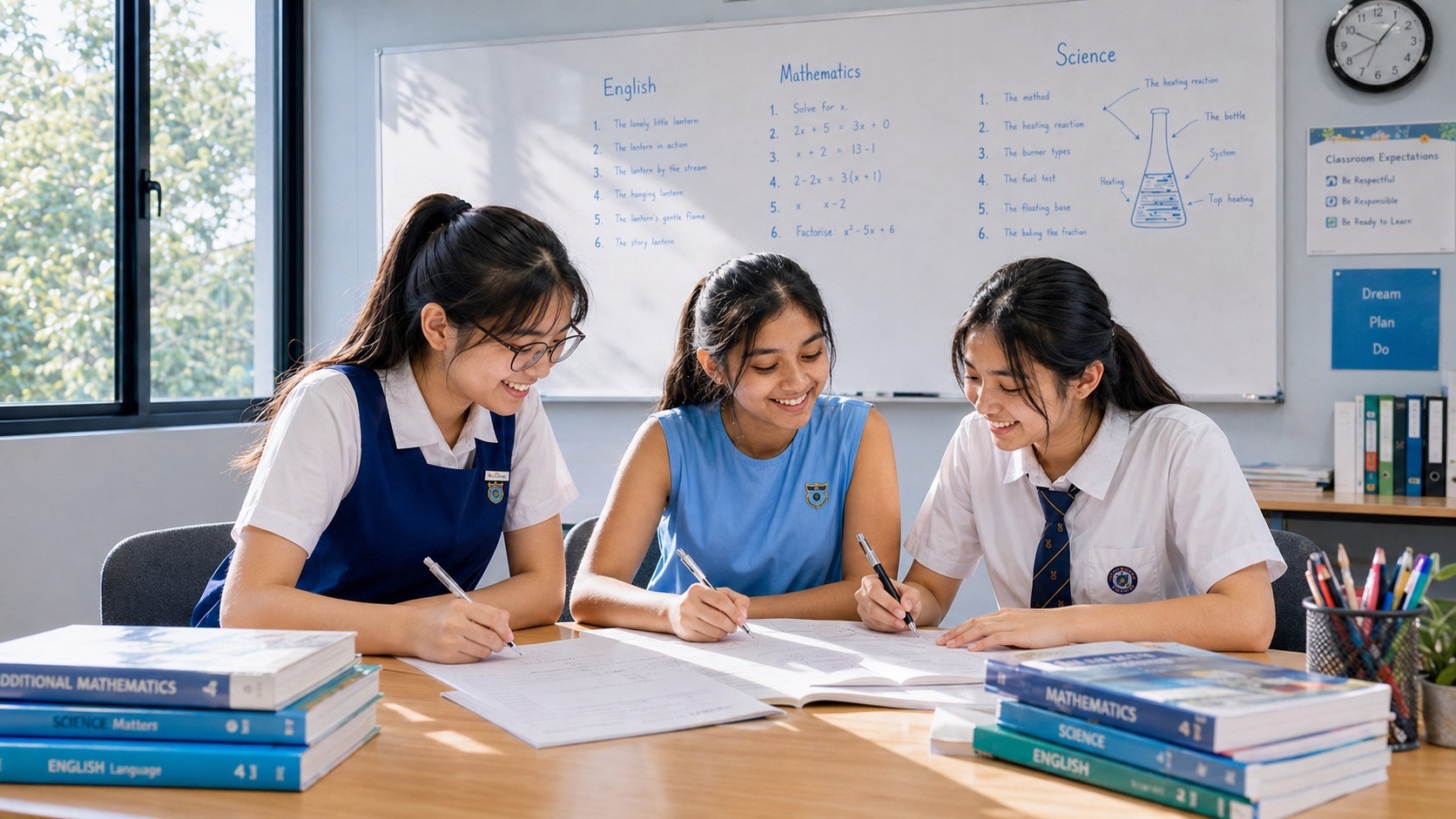
Secondary 3 Mathematics homework should stop behaving like a pile of questions and start behaving like a training system.
At earlier stages, homework often has a simple purpose: practise the method taught in class until the procedure becomes familiar.
That still matters at Secondary 3.
But it is no longer enough.
By Secondary 3, the student must increasingly learn to retrieve older Mathematics, choose methods without chapter labels, connect topics, detect when a route is failing, correct mistakes independently and return to the same idea after a delay.
This changes the role of homework.
The question is no longer simply:
How many questions did the student complete?
The better question is:
What mathematical capability did the practice strengthen, and can the student still operate it without support later?
That is the shift from homework as completion to homework as deliberate independent practice.
Under Singapore’s Full Subject-Based Banding framework, Mathematics is taken at G1, G2 or G3 subject level. From the 2027 graduating cohort, students sit the Singapore-Cambridge Secondary Education Certificate, or SEC, at the subject level taken. The 2027 Mathematics codes are K110 for G1, K210 for G2 and K310 for G3.
The exact content and depth differ across the three levels.
But the practice principle is shared:
Secondary 3 homework should progressively remove support until the student can carry more of the Mathematics alone.
This Article Has a Distinct Job
This page belongs to our How Secondary 3 Mathematics Works in Singapore | SEC G1, G2 & G3 series.
It does not duplicate the estate-wide owner How to Practise Maths Effectively, which covers deliberate practice across Secondary Mathematics generally.
It also does not duplicate the SEC Mathematics Revision System, which owns retrieval, spacing, interleaving and examination revision across G1, G2 and G3.
This page owns the stage-specific question:
What should homework and independent practice do differently in Secondary 3 so the student is ready for Secondary 4?
The Short Answer
Secondary 3 homework should evolve through four states:
- Learn: practise the new method while the topic is clear.
- Stabilise: vary the surface so the procedure becomes reliable.
- Mix: remove the chapter cue so the student must select the method.
- Retrieve: return after a delay so the Mathematics has to be recalled rather than copied from recent memory.
If homework stays permanently in State 1, the student may become excellent at recognising familiar worksheets and still struggle on mixed papers.
Homework Has Five Different Jobs
One reason homework becomes inefficient is that every question is treated as if it serves the same purpose.
It does not.
1. Acquisition
The student is learning a new relationship or procedure.
2. Fluency
The student already understands the method and needs routine execution to become cheaper and more reliable.
3. Selection
The student has several tools and must decide which one belongs to the problem.
4. Transfer
The student must recognise the same structure when wording, representation or context changes.
5. Retention
The student must retrieve older Mathematics after the recent lesson has disappeared from working memory.
A strong practice system deliberately uses all five.
The Homework Engine
A useful Secondary 3 practice cycle is:
Understand → Attempt → Check → Diagnose → Correct → Vary → Mix → Delay → Retrieve
This is different from:
Attempt → look at answer → copy correction → finish worksheet.
The difference is that the first cycle generates future independence.
The First Rule: Do Not Practise What Is Not Yet Understood
Repetition strengthens whatever process is being repeated.
If the student is using an invalid method, more questions can strengthen the invalid method.
Before assigning high volume, establish:
- what the quantities mean;
- why the method works;
- what conditions make it valid;
- what the answer should roughly look like;
- how the result can be checked.
Then practise.
The Second Rule: Volume Should Follow Error Type
Not every weakness needs fifty questions.
If the student understands equation balance but is slow, repeated practice may help.
If the student does not understand why an equation transformation is valid, fifty questions may simply produce fifty fragile imitations.
If the student chooses the wrong method in mixed questions, more same-topic practice may make the selection problem worse because the topic cue remains visible.
Practice volume should therefore follow the mechanism.
The Third Rule: Stop Repeating Once the Skill Is Stable
Over-practice has an opportunity cost.
If the student can already solve ten nearly identical questions accurately, the eleventh may add less value than one varied question that changes the representation.
A useful release rule is:
- three clean direct questions;
- one varied question;
- one mixed question;
- one delayed question later.
If the skill survives these stages, move on and monitor.
Topical Homework Is Necessary but Dangerous
Topical homework is excellent during acquisition.
The danger appears when every question remains topical forever.
A page titled “Quadratic Equations” tells the student which family of methods to search.
A page titled “Similarity” tells the student to look for scale relationships.
A page titled “Tree Diagrams” tells the student how to represent the probability.
Those clues are helpful when learning.
They become a hidden crutch when never removed.
Mixed Practice Is Where Method Selection Begins
Once a topic is stable, place it beside unrelated Mathematics.
Now the student must decide:
- Is this algebra or proportion?
- Is this Pythagoras or trigonometry?
- Is this mean, median or another comparison?
- Is this direct probability or easier through a complement?
- Is this a graph-reading question or an equation-solving question?
The chapter heading is gone.
That missing hint is the training.
Contrast Practice Is More Powerful Than More Repetition
Students often fail not because they know no methods, but because two nearby methods look too similar.
Contrast practice places the alternatives beside one another.
For example:
- one Pythagoras question beside one trigonometry question;
- one direct-percentage question beside one reverse-percentage question;
- one linear graph question beside one quadratic graph question;
- one probability question requiring addition beside one requiring multiplication;
- one data set where mean is useful beside one where median is more robust.
The student is forced to learn the boundary between methods.
Variation Reveals Whether the Student Owns the Structure
Change one feature after the student gets a question right.
- Change the numbers.
- Change the unknown.
- Reverse the question.
- Rotate the diagram.
- Change the variable letters.
- Change the graph scale.
- Add a real-world context.
- Remove one obvious cue.
If the student can still solve it, the method is becoming structural rather than visual.
Delayed Practice Separates Learning From Recent Memory
Immediately after a lesson, the method is still active in working memory.
That makes immediate homework useful for stabilisation but weak as a test of long-term retrieval.
Return later.
Do not announce the topic.
If the student can retrieve the method after several days, the knowledge is becoming more durable.
Homework Should Include Old Mathematics
Secondary 3 students often have a recency problem.
The current chapter receives attention.
The previous chapter disappears.
By the end of the year, the student has “covered” many topics but can retrieve only the most recent ones.
A strong homework set therefore contains a small amount of old Mathematics.
The purpose is not to revise the entire syllabus every night.
It is to prevent access from decaying completely.
The 60–25–15 Practice Split
One useful starting template is:
- 60% current learning: the chapter being taught now;
- 25% mixed older work: retrieval and method selection;
- 15% repair: targeted work on the student’s current weak link.
This is not a fixed national rule.
It is a planning model.
The proportions should move depending on school sequence, assessment timing and learner state.
The Repair Block Should Be Small and Precise
When a student has a recurring weakness, the repair block should not become another giant worksheet.
Use a bounded sequence:
- one clean explanation;
- two guided questions;
- three independent questions;
- one varied question;
- one later mixed retest.
If the student still fails, the diagnosis may be wrong or the prerequisite may sit earlier.
Do not simply double the volume automatically.
The Error Log Should Sit Beside the Homework
Homework without error logging can become repetitive noise.
Record only meaningful recurring failures.
A useful entry is specific:
Reverse percentage — treated final amount as 100% instead of recognising it as 80% of original.
Or:
Similarity — paired sides by visual position instead of correspondence.
Or:
Probability — tree structure correct but second-stage probabilities unchanged despite no replacement.
The error log should change future homework.
Independent Practice Should Include Independent Checking
If every homework answer is checked only by the teacher, the student can become dependent on external verification.
Secondary 3 should train self-checking.
- Substitute solved equations.
- Expand a factorised expression.
- Estimate before trusting a calculator.
- Compare graph behaviour with algebra.
- Check units and dimensions.
- Check geometric plausibility.
- Check that probability lies between 0 and 1.
- Check whether a statistical conclusion matches the display.
Homework should increasingly require the student to produce evidence that the answer is credible.
Answer Keys Can Help or Destroy the Practice
An answer key is useful when it shortens the feedback loop.
It becomes harmful when the student checks after every small step or copies the route before attempting the question independently.
A better protocol is:
- attempt the question fully;
- mark confidence level;
- check the final answer;
- if wrong, locate the first wrong line before reading the solution;
- use the worked answer only after attempting diagnosis;
- close the solution;
- solve a fresh related question.
The key rule is:
The answer key should accelerate correction, not replace thinking.
Copying a Correction Is Not Practice
A copied solution may look perfect while teaching very little.
After correction, the student should be able to answer:
- What was my first wrong decision?
- Why was it wrong?
- What signal should have triggered the correct method?
- How would I check this next time?
Then solve a fresh question.
Without that fresh retest, the correction may remain visual rather than operational.
The Confidence Mark
Before checking an answer, ask the student to mark confidence:
- High: I know why this method is valid.
- Medium: I think this is right but I am not fully sure.
- Low: I am guessing or following a weak memory.
This creates useful metacognitive information.
A high-confidence wrong answer may reveal a misconception.
A low-confidence correct answer may reveal fragile knowledge that needs reinforcement.
The Stop-and-Explain Rule
After several routine questions, pause and ask the student to explain:
- what the method is doing;
- when it applies;
- when it does not apply;
- what common error to avoid;
- how to check the result.
This prevents procedural fluency from drifting away from understanding.
Homework Should Sometimes Begin With a Cold Question
Do not always begin with the current chapter.
Start occasionally with one older question chosen without warning.
This reveals whether the knowledge is still accessible.
If the student cannot even identify the method, the topic may need retrieval work.
If the student identifies the method but executes slowly, fluency may be the issue.
If the student executes cleanly, the topic can remain on maintenance rather than full revision.
One Good Mixed Set Can Be More Valuable Than Three Topical Sets
Mixed sets train switching.
Switching forces the student to reset before each question.
The student must ask:
- What is this question asking?
- What topic is hidden here?
- Which representation is useful?
- Which method should I choose?
- What previous assumptions must I drop?
This is closer to the mental work of an assessment.
But Do Not Mix Too Early
Interleaving weak skills before they are understood can create confusion.
The order matters:
understand → stabilise → vary → mix
Mixing is a selection tool, not a substitute for initial teaching.
Timed Homework Has a Specific Job
Timed practice should not dominate Secondary 3 homework.
It should be used when:
- the underlying Mathematics is already reasonably stable;
- the student needs fluency conditioning;
- the student is learning paper pacing;
- the student performs well untimed but collapses under time pressure.
Timed work should not be used to hide conceptual weakness.
The sequence remains:
correct → consistent → mixed → timed
The 20-Minute Independent Block
One useful Secondary 3 routine is a short bounded block in which the student works without help.
For example:
- 2 current-topic questions;
- 2 older mixed questions;
- 1 repair question;
- 1 self-check requirement.
The point is not the exact number of questions.
The point is to create a bounded period in which the student has to operate the Mathematics without live assistance.
What the Student Should Do When Stuck
Independent practice becomes ineffective if every difficult question immediately turns into help-seeking.
Use a restart protocol:
- Restate the target.
- Mark what is definitely known.
- Identify the topic candidates.
- Change representation.
- Solve a smaller subproblem.
- Estimate the expected answer.
- Try one route for a bounded number of steps.
- If the route fails, record where it failed before seeking help.
Help should enter after the student has generated evidence about the stuck state.
The Hint Ladder
When help is necessary, use the smallest hint that can restart the student.
- “What are you trying to find?”
- “What information is definitely given?”
- “What topic might this connect to?”
- “What representation could help?”
- “Which two methods are you considering?”
- “Look at this specific relationship.”
- Only then give the first step.
The hint ladder preserves more student ownership than immediately supplying the method.
Homework Should Produce Questions for the Next Lesson
Independent practice is not successful only when everything is correct.
It is also successful when it reveals a precise question.
For example:
- “I can solve the equation, but I do not know when to form it.”
- “I keep mixing the corresponding sides in similarity.”
- “I can calculate standard deviation but do not know how to compare the groups.”
- “I know sine and cosine but cannot decide which one to use.”
Those are useful learning signals.
The Homework Review Should Be Faster Than the Homework
Do not spend the entire next lesson redoing every question.
Review by exception.
Prioritise:
- high-confidence wrong answers;
- repeated mechanisms;
- questions abandoned without a route;
- questions solved correctly through an inefficient or fragile method;
- errors with high downstream reach.
This keeps lesson time diagnostic rather than administrative.
How Independent Practice Changes in G1 Mathematics
At Secondary 3 G1, homework should prioritise dependable mathematical use.
Useful practice includes:
- number and percentage fluency;
- ratio and rate in practical contexts;
- simple algebraic representation;
- measurement and unit control;
- graph and data interpretation;
- simple probability structures;
- checking reasonableness;
- explaining what the result means.
The objective is not excessive abstraction.
The objective is reliable independent use.
How Independent Practice Changes in G2 Mathematics
At Secondary 3 G2, homework should gradually increase integration.
Useful practice includes:
- algebra fluency;
- graph–equation connections;
- geometry and trigonometric selection;
- statistics comparison;
- probability representation;
- multi-step contextual problems;
- mixed-topic method selection;
- independent checking.
The student should increasingly practise identifying the structure before calculating.
How Independent Practice Changes in G3 Mathematics
At Secondary 3 G3, homework should carry greater abstraction and switching demand.
Useful practice includes:
- high-reliability algebra;
- representation switching;
- longer reasoning chains;
- multi-topic combinations;
- unfamiliar problem forms;
- mathematical justification;
- mixed retrieval;
- timed sections after stability;
- independent verification.
The objective is to make the student less dependent on immediate topic context.
When Mathematics and Additional Mathematics Are Both Taken
Homework becomes more complicated when the student also takes Additional Mathematics.
The danger is that A-Math absorbs the entire independent-practice budget because it feels harder.
A better structure protects:
- shared algebraic infrastructure;
- Mathematics-only statistics and probability;
- Mathematics measurement and modelling;
- A-Math-specific symbolic work;
- mixed retrieval from both subjects.
Follow the interface owner at How Mathematics & Additional Mathematics Interact at Secondary 3.
The Parent’s Role Is Not to Become the Marker
Parents can support independent practice without teaching every method.
Useful questions include:
- What was the hardest question?
- Where did you get stuck?
- What did you try before checking the answer?
- Which mistake repeated?
- What will you retest tomorrow or next week?
This keeps attention on learning process rather than surveillance.
Five Questions a Parent Can Ask
- Which question did you have to choose the method for yourself?
- Which older topic appeared today?
- What error did you correct rather than merely copy?
- How did you check one answer independently?
- What will you retest after a delay?
The Tutor’s Homework Design Checklist
- What capability is this set training?
- Is the topic still in acquisition or ready for mixing?
- Does the set include unnecessary repetition?
- Is there at least one varied question?
- Is there at least one old retrieval question?
- Is there one targeted repair question?
- Does the student have a way to check independently?
- Will one item return later after a delay?
- Can the work be reviewed by mechanism rather than question count?
Homework should be designed, not merely assigned.
The Three-Student Small-Group Advantage
In a small group, independent work can be observed closely without turning every question into direct tutoring.
The tutor can see:
- which student starts immediately;
- which student waits for a cue;
- which student chooses the wrong method;
- which student checks independently;
- which student repeats an old error;
- which student has become genuinely self-operating.
The value is not simply fewer students.
It is visibility into the learning process.
What a Strong Week of Secondary 3 Homework Looks Like
A strong week does not need endless pages.
It might contain:
- one current-topic fluency set;
- one short mixed set;
- one contrast pair;
- one targeted repair block;
- one cold retrieval question from an older topic;
- one independent-check requirement;
- one delayed retest.
This gives the student several different kinds of mathematical work instead of one kind repeated many times.
What Weak Homework Design Looks Like
Weak design often has one of these patterns:
- twenty nearly identical questions after the skill is already stable;
- no older-topic retrieval;
- no mixed questions;
- corrections copied but never retested;
- answers checked too early;
- timed practice before understanding;
- every difficult question immediately solved by the tutor;
- no distinction between concept weakness and fluency weakness.
High volume can hide low design quality.
When the Student Says “I Have Too Much Homework”
Do not respond only by counting pages.
Ask what is consuming time.
- Is routine algebra too slow?
- Is the student stuck because a prerequisite is missing?
- Is the student over-checking every line?
- Is homework duplicated across school and tuition?
- Is A-Math cannibalising Mathematics study time?
- Is the student rewriting perfect solutions unnecessarily?
Homework load is partly a quantity problem and partly an efficiency diagnostic.
When the Student Finishes Homework Very Quickly
Fast completion can mean excellent fluency.
It can also mean the work is too cued.
Test this by:
- removing the chapter heading;
- mixing topics;
- changing the representation;
- asking for explanation;
- returning after a delay.
If performance stays strong, the fluency is genuine.
If it collapses, the original homework was measuring recognition more than ownership.
When the Student Needs Help on Every Question
This indicates that the practice level may be too high, the prerequisite may be missing or the learner may be dependent on live cues.
Do not simply increase explanation.
Reduce the problem to a level where the student can complete part of the route independently.
Then fade support gradually.
When the Student Does Homework but Marks Do Not Improve
This usually means the practice is not targeting the failure mechanism.
Possible causes include:
- too much topical repetition;
- insufficient mixed selection;
- corrections without fresh retesting;
- no delayed retrieval;
- wrong diagnosis;
- too much help during practice;
- time pressure never trained;
- poor verification habits.
More homework is not automatically the answer.
Better homework design may be.
The Secondary 3 Practice Audit
Once a month, audit the practice system.
- Which topics are still only topical?
- Which topics have moved into mixed practice?
- Which topics have survived delayed retrieval?
- Which errors are recurring?
- Which skills are over-practised?
- Which skills are under-maintained?
- Which answers are still dependent on teacher confirmation?
- Which topics collapse under time pressure?
The audit prevents practice from becoming automatic routine.
What Secondary 3 Should Hand to Secondary 4
By the end of Secondary 3, independent practice should have built several habits.
- The student can start without waiting for a tutor.
- The student can identify the likely method family.
- The student can work without chapter labels.
- The student can correct an error rather than copy a correction.
- The student can retrieve older Mathematics.
- The student can check answers independently.
- The student can tolerate some uncertainty before asking for help.
- The student can return to a repaired weakness later and still perform.
That is a stronger handover than simply finishing a large stack of worksheets.
How Bukit Timah Tutor Uses Independent Practice
At Bukit Timah Tutor, homework is not assigned only by chapter.
We separate:
- acquisition from fluency;
- fluency from selection;
- selection from transfer;
- current school work from older retrieval;
- shared infrastructure repair from topic-specific repair;
- independent practice from tutor-assisted practice.
Our mathematics classes are deliberately small, with a maximum of three students, because the useful information is not only whether the homework is correct.
It is how the student worked:
- where help was needed;
- where the wrong method was selected;
- where the same error repeated;
- where checking happened independently;
- where the student was able to recover without rescue.
The long-term target is:
Independent practice should progressively reduce the amount of Mathematics that depends on the tutor being present.
The Secondary 3 Independent-Practice Route
- Singapore Mathematics Hub
- How Secondary 3 Mathematics Works | SEC G1, G2 & G3
- How Problem-Solving Independence Changes in Secondary 3 Mathematics
- How to Diagnose a Secondary 3 Mathematics Result
- How to Practise Maths Effectively
- How SEC Mathematics Revision Works
- How Secondary 3 Mathematics Prepares a Student for Secondary 4
- Secondary 3 Mathematics
Official Singapore References
For the current national syllabus boundaries and subject codes, use the official Singapore Examinations and Assessment Board SEC syllabus pages:
- 2027 SEC G1 syllabuses — Mathematics K110
- 2027 SEC G2 syllabuses — Mathematics K210
- 2027 SEC G3 syllabuses — Mathematics K310
School-specific homework, topic sequencing and assessment arrangements should always be read alongside the national syllabus.
Final Principle
Secondary 3 homework is useful when it changes what the student can do without help.
The worksheet is not the product.
The completed page is not the product.
The product is the capability that remains after the page is gone.
Learn the method. Stabilise it. Vary it. Mix it. Check it. Retrieve it later. Correct the mechanism, not just the answer. Reduce the hint. Increase the ownership.
That is how homework and independent practice should change in Secondary 3 Mathematics.