
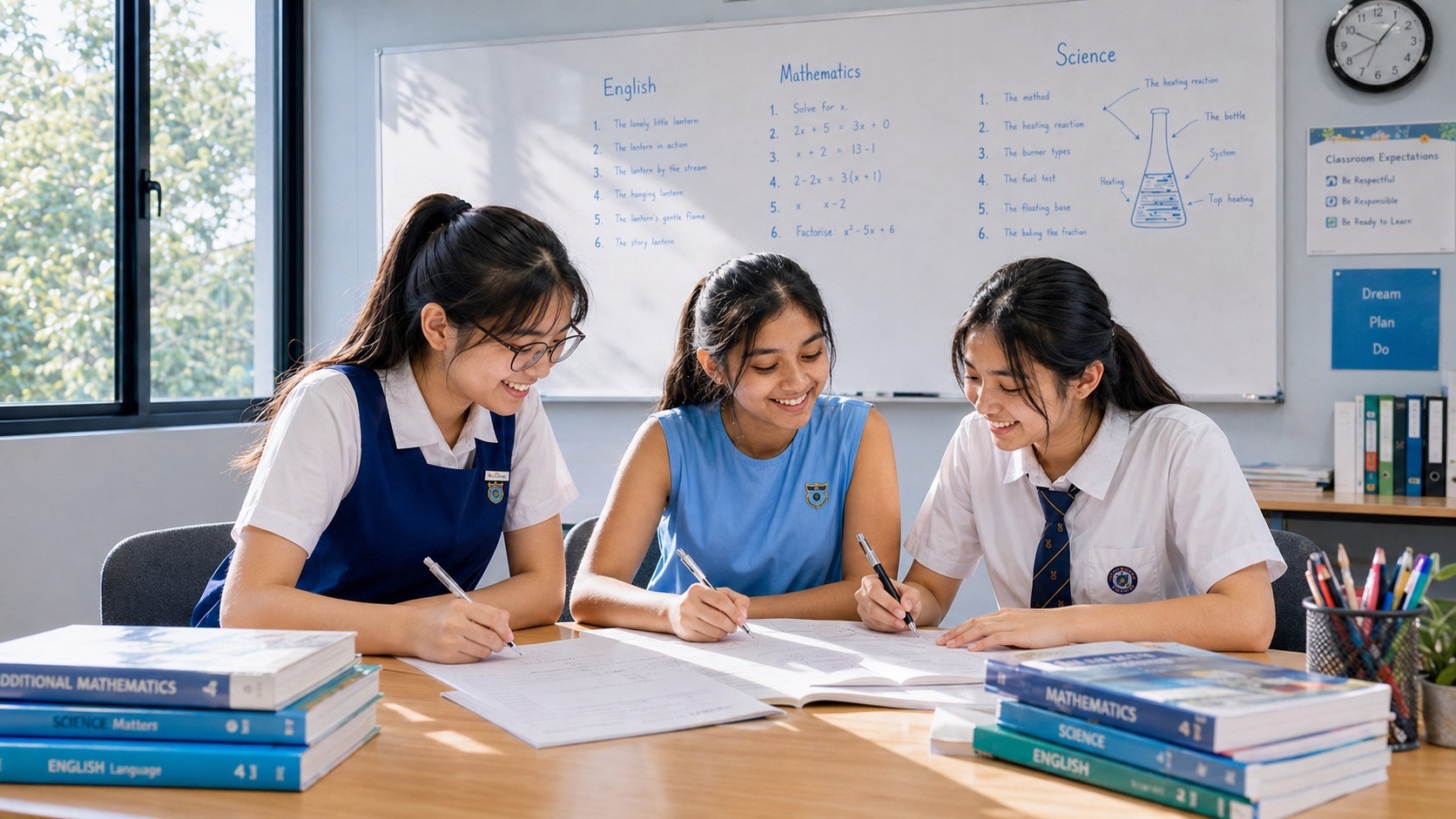
Secondary 3 Mathematics notes should stop being a record of what the teacher wrote and start becoming a retrieval system for what the student must be able to do.
That is a much bigger change than it first appears.
Many students enter Secondary 3 with notebooks full of definitions, formulas, copied examples and highlighted pages. The material may be neat. It may even be complete.
But when the assessment begins, the notebook is usually gone.
The student must still decide what Mathematics is present, which relationship applies, what a formula means, what conditions make it valid, how to execute it, and how to check the result.
This is why note-taking, formula memory and reference use have to change at Secondary 3.
The purpose of a Mathematics note is not to preserve the page. It is to make the Mathematics easier to retrieve, reconstruct and use when the page is no longer visible.
Under Singapore’s Full Subject-Based Banding framework, Mathematics is taken at G1, G2 or G3 subject level. From the 2027 graduating cohort, the common national certification is the Singapore-Cambridge Secondary Education Certificate, or SEC. The 2027 Mathematics subject codes are K110 for G1, K210 for G2 and K310 for G3.
The level of abstraction and breadth differ across the three routes, but all three benefit from the same principle:
Keep only the information that helps the learner recognise, select, execute, check and explain the Mathematics.
This Article Has a Distinct Job
This page belongs to our How Secondary 3 Mathematics Works in Singapore | SEC G1, G2 & G3 series.
It does not duplicate the general SEC owner How Calculator, Formula Sheet & Essential Working Work in SEC Secondary Mathematics, which explains the national examination tools and working expectations.
It does not duplicate How SEC Mathematics Revision Works, which owns retrieval, spacing, interleaving and revision architecture across the full SEC Mathematics system.
This page owns the Secondary 3 learning layer:
- what a useful Mathematics note should contain;
- what should be remembered and what should be reconstructed;
- how formulas should be stored with meaning and conditions;
- how worked examples should be compressed into reusable patterns;
- how error notes should change future work;
- how reference materials should support learning without becoming a dependency;
- how notes should prepare the student for Secondary 4.
The Short Answer
A good Secondary 3 Mathematics note should answer five questions quickly.
- What structure is this?
- When does it apply?
- What is the smallest reliable procedure?
- What error should I watch for?
- How can I check the result?
Everything else is secondary.
A page of notes that answers those five questions can be more useful than five pages of copied working.
Mathematics Notes Are Compression
The lesson contains more information than the learner should carry permanently.
A good note compresses the lesson while preserving the structure needed to reconstruct it.
This is similar to compressing a large file without destroying the information needed to rebuild it.
For Mathematics, the compression should preserve:
- meaning;
- conditions;
- method choice;
- critical steps;
- common errors;
- checking routes;
- connections to neighbouring ideas.
If the note preserves only the final formula, too much structure may have been lost.
If the note preserves every word from the lesson, too little compression has occurred.
A Formula Is Compressed Mathematics
Students often treat a formula as a line to memorise.
A formula is more useful when treated as compressed structure.
For every formula or relationship, the student should know:
- what each symbol means;
- what quantity the formula produces;
- what conditions make the formula valid;
- what units are expected;
- what happens when one input increases or decreases;
- how to check whether the result is plausible.
A formula remembered without these conditions is fragile.
The Formula Card
One useful note structure is a compact formula card.
Instead of writing only the formula, include six fields:
- Name: what relationship is this?
- Meaning: what does it describe?
- Conditions: when may it be used?
- Variables: what does each symbol represent?
- Trap: what mistake appears most often?
- Check: what independent test can challenge the result?
This turns formula memory into operational memory.
Do Not Memorise What Can Be Reconstructed Reliably
Some mathematical knowledge should be recalled directly because it is used frequently and cheaply.
Other knowledge can be reconstructed from deeper relationships.
For example, a student who understands dimensional scaling can reconstruct why an area scale factor behaves differently from a length scale factor.
A student who understands equation balance does not need a large list of disconnected “move this across and change the sign” rules.
A student who understands the complement relationship in probability can derive the probability of the opposite event from the total of 1.
Reconstruction reduces memory load because several surface rules collapse into one deeper structure.
But Do Not Reconstruct Everything During the Examination
Understanding does not eliminate the need for fluency.
If a relationship is used constantly, reconstructing it from first principles every time can be slow.
The useful sequence is:
understand deeply → reconstruct successfully → practise → retrieve directly when speed matters
Memory and understanding are not enemies.
Understanding tells the student what the memory means.
Fluent memory makes that understanding available quickly.
The Seven Types of Useful Secondary 3 Mathematics Notes
1. Concept note
Explains the central mathematical relationship in plain language.
2. Decision note
Explains how to recognise when a method applies.
3. Formula note
Stores a relationship together with its variables, conditions, units and check.
4. Example note
Preserves one clean example that demonstrates the structure rather than every possible variation.
5. Error note
Records a recurring failure mechanism and how to detect it earlier next time.
6. Check note
Stores independent verification methods for common answer types.
7. Retrieval note
Contains a prompt or question that forces the student to reconstruct the idea without rereading the explanation first.
A good notebook contains several of these types rather than hundreds of undifferentiated pages.
Decision Notes Are Especially Valuable at Secondary 3
The biggest change at Secondary 3 is that students increasingly need to choose methods rather than merely execute named methods.
Decision notes should therefore capture recognition signals.
Examples:
- Pythagoras: right-angled triangle; side relationship; no angle information needed if two sides are known.
- Trigonometry: right-triangle relationship involving an angle and side ratios where appropriate.
- Reverse percentage: final value represents a percentage of the original rather than 100%.
- Simultaneous equations: two unknown quantities linked by two independent relationships.
- Probability complement: direct event is cumbersome but the opposite event is simpler.
The note should help the student answer:
What should make me think of this method?
Error Notes Should Be Mechanism Notes
A weak error note says:
Trigonometry — wrong.
A useful error note says:
Selected cosine before labelling sides relative to the given angle. New rule: label O, A and H before choosing the ratio.
Another useful note:
Reverse percentage — treated $72 as 100% instead of 80% of the original. New cue: ask “what percentage does this visible value represent?” before calculating.
Error notes should change future behaviour.
The Check Note
Students often know how to solve but not how to verify.
A check note should map answer type to verification method.
- Equation: substitute the solution.
- Factorisation: expand.
- Graph: compare intercepts, gradient or overall behaviour with the equation.
- Geometry: test angle sums, length bounds or an alternate relationship.
- Measurement: check units and approximate magnitude.
- Probability: confirm the result lies between 0 and 1 and that complete outcome probabilities total appropriately.
- Statistics: compare the numerical summary with the visible data pattern.
Checking becomes easier when it is stored as part of the topic rather than added as a vague instruction at the end.
The Retrieval Note Is Not a Summary
A summary is something to read.
A retrieval note is something to answer.
Examples:
- When does Pythagoras apply?
- What is the difference between mean and median?
- What tells you that a reverse-percentage structure is present?
- How does a length scale factor affect area?
- What must be true before two probabilities can be multiplied in a simple sequential model?
The answer should be hidden initially.
The purpose is to force reconstruction.
One Clean Example Is Better Than Ten Copied Examples
Students often copy many worked solutions because more pages feel safer.
But the notes become difficult to navigate and the underlying pattern remains hidden.
Keep one example when it captures the structure cleanly.
Annotate only the high-value decisions:
- why the method was selected;
- where students usually make mistakes;
- which line is structurally important;
- how the result is checked.
Then practise the variations separately.
The worked-example owner is How Worked Examples & Example Fading Work in Secondary 3 Mathematics.
The Open-Book Illusion
Students can feel fluent when the notes are open because recognition is easy.
The formula is visible.
The example is visible.
The chapter title is visible.
Every visible cue reduces the retrieval burden.
This is useful during learning.
It becomes dangerous when the student mistakes recognition for ownership.
A simple test is:
- study the note;
- close it;
- reconstruct the central relationship;
- solve one fresh question;
- check the note only after attempting.
If the student cannot proceed once the page closes, the note has not yet become knowledge.
Reference Use Should Fade
Reference material is useful during acquisition.
But the student should gradually need it less.
A useful progression is:
- full notes open;
- formula card only;
- decision cue only;
- no reference during the question;
- reference used only during post-question checking;
- delayed uncued retrieval.
This mirrors example fading.
The support should disappear as the learner becomes more capable.
A Provided Formula Does Not Select Itself
When a formula is provided in an approved reference or examination context, the student still has substantial work to do.
- recognise that the formula is relevant;
- identify the variables;
- choose the correct values;
- rearrange where necessary;
- preserve units;
- interpret the output;
- check plausibility.
A formula sheet reduces memory burden.
It does not remove method selection.
That broader examination-tools layer is covered in How Calculator, Formula Sheet & Essential Working Work in SEC Secondary Mathematics.
The One-Page Topic Map
After a topic becomes reasonably stable, compress it onto one page.
Use five zones:
- Core idea: one short statement.
- Recognition cues: what should trigger this topic?
- Methods: the smallest reliable procedures.
- Traps: recurring mistakes.
- Checks: independent verification routes.
The purpose is not decoration.
The purpose is fast reactivation.
A Mathematics Notebook Should Have Navigation
A large notebook becomes less useful when the student cannot find anything quickly.
Use a simple index organised by mathematical job rather than only school date.
- Number & proportion
- Algebra
- Graphs & relationships
- Geometry & measurement
- Statistics
- Probability
- Problem solving
- Error log
- Checks
This helps the notebook remain useful after the school has moved on from the chapter.
Do Not Rewrite the Textbook
Copying long explanations can feel productive because the page fills quickly.
But copying requires less retrieval and less decision-making than reconstruction.
A better process is:
- read the explanation;
- close or cover it;
- write the idea in your own compact mathematical language;
- reopen and check for missing conditions;
- add one example and one check.
The note becomes a reconstruction rather than a transcription.
Do Not Decorate Before the Structure Is Clear
Colour, boxes and highlighting can support navigation.
They should not replace thinking.
A beautiful page that does not state when the formula applies is still a weak Mathematics note.
Use visual emphasis only for information with a real job:
- condition;
- decision cue;
- common trap;
- verification step;
- connection to another topic.
The Memory Test
After producing a note, test whether it can leave the page.
Ask the student to close the notebook and answer:
- What is the central relationship?
- When does it apply?
- What is one common trap?
- What is one check?
- What neighbouring topic does it connect to?
If the student cannot answer, the note has not yet become retrievable knowledge.
The Blank-Page Test
One of the strongest revision tools is a blank page.
Write the topic name at the top and reconstruct as much as possible from memory:
- definitions;
- relationships;
- formulas;
- conditions;
- method choices;
- common errors;
- checks.
Then compare with the note.
The missing items reveal what still needs retrieval work.
The Formula-from-Meaning Test
For selected relationships, ask whether the student can rebuild the formula from meaning.
This should not replace fluent recall of frequently used formulas.
It tests whether the symbols still connect to the mathematical idea.
If the student can recite the formula but cannot explain what changing one variable does to another, memory may be disconnected from understanding.
Formula Memory in Algebra
Algebra is less about memorising many formulas than maintaining structural rules.
High-value notes include:
- equivalence and equality;
- inverse operations;
- expansion–factorisation relationships;
- substitution discipline;
- formula rearrangement;
- graph–equation connections;
- common sign and bracket traps.
The dedicated owner is How Algebra Works in Secondary 3 Mathematics.
Formula Memory in Geometry & Measurement
Geometry notes should attach formulas to conditions and diagrams.
Do not store a trigonometric relationship without a labelled triangle.
Do not store a mensuration formula without identifying the dimensions it requires and the units it produces.
Do not store similarity as a naked ratio without corresponding-side logic.
The dedicated owner is How Geometry & Measurement Work in Secondary 3 Mathematics.
Notes for Statistics & Probability
Statistics and Probability need fewer formula-only notes and more interpretation notes.
Useful prompts include:
- What does this measure tell me?
- What information does it hide?
- When is median more useful than mean?
- What does spread add to a comparison?
- What must the sample space contain?
- Are the outcomes equally likely?
- Are events mutually exclusive or independent where relevant?
- How can the final probability be checked?
The dedicated owner is How Statistics & Probability Work in Secondary 3 Mathematics.
G1 Notes Should Protect Practical Meaning
At Secondary 3 G1, notes should prioritise clear, dependable mathematical use.
Keep:
- practical definitions;
- percentage and rate relationships;
- simple algebra cues;
- measurement formulas with units;
- graph-reading reminders;
- probability meaning;
- real-world interpretation checks.
The notes should make practical Mathematics easier to retrieve, not add unnecessary abstraction.
G2 Notes Should Protect Connections
At Secondary 3 G2, notes should increasingly expose how topics connect.
Useful links include:
- algebra ↔ graphs;
- ratio ↔ scale;
- algebra ↔ geometry;
- trigonometry ↔ measurement;
- statistics ↔ interpretation;
- probability ↔ fractions and organised counting.
The note should help the student move between topics rather than store each chapter in isolation.
G3 Notes Should Protect Structure Under Abstraction
At Secondary 3 G3, notes should increasingly compress long mathematical structures.
The most useful notes often record:
- decision boundaries between similar methods;
- representation changes;
- long algebraic dependency chains;
- reasoning conditions;
- efficient checks;
- connections to unfamiliar applications.
The notebook should become a map of structure rather than an archive of pages.
When Mathematics and Additional Mathematics Are Both Taken
Students taking Additional Mathematics need a clean boundary between shared infrastructure and subject-specific material.
Use one shared section for:
- sign control;
- fractions;
- factorisation;
- equation balance;
- substitution;
- graph interpretation;
- calculator habits;
- verification routines.
Then keep separate subject sections for Mathematics-owned and A-Math-owned structures.
This avoids learning the same basic algebra twice while still preserving syllabus ownership.
Follow the interface owner at How Mathematics & Additional Mathematics Interact at Secondary 3.
The Weekly Note Maintenance Cycle
Notes should be maintained, not rewritten constantly.
- After the lesson: compress the main idea and one example.
- After homework: add one meaningful error note if needed.
- After a mixed set: add one method-selection cue.
- After a test: update the recurring-error section.
- At week end: close the notes and run a short retrieval test.
This keeps the notebook alive without turning revision into endless note production.
The Monthly Compression Cycle
Once a month, compress further.
Ask:
- Which pages are now redundant?
- Which formulas are fluent enough to move to maintenance?
- Which decision cues still matter?
- Which error notes are still recurring?
- Which old topics are becoming hard to retrieve?
- Which notes should become retrieval prompts rather than explanations?
The notebook should become more compressed as understanding becomes richer.
The Exam-Preparation Transition
As the student approaches larger mixed assessments, the role of notes should change.
Early in learning, notes explain.
Later, notes cue retrieval.
Near examination conditions, notes should increasingly be used before and after practice rather than during it.
A useful progression is:
- learn with notes open;
- practise with a small reference card;
- attempt mixed work closed-book;
- use notes only for diagnosis afterward;
- retest without notes.
This is how reference use becomes independence.
A Parent Does Not Need to Inspect Every Formula
Parents can still tell whether the note system is healthy.
Ask the student to close the notebook and explain one topic.
Then ask:
- When does this method apply?
- What is one common mistake?
- How do you check the answer?
- Can you solve one question without reopening the notes?
If the student can do this, the notes are probably serving learning rather than merely recording it.
Five Questions a Parent Can Ask
- What is the one idea this page is helping you remember?
- When would you know to use this formula?
- What mistake does this note help you avoid?
- Can you close the book and reconstruct it?
- What question will test whether you really remember it?
A Tutor’s Note-System Checklist
- Does the note state the core structure?
- Does it include method-recognition cues?
- Are formulas attached to conditions?
- Is one clean example enough?
- Are recurring errors recorded by mechanism?
- Does every major topic include a checking route?
- Can the note be converted into retrieval prompts?
- Is reference dependence decreasing over time?
- Can the student solve a fresh question after closing the notes?
If the answer to the last question is no, the note system has not yet completed its job.
What Secondary 3 Should Hand to Secondary 4
By the end of Secondary 3, the student should not need to carry an enormous archive mentally.
The student should carry a compressed mathematical map:
- core relationships;
- method-selection cues;
- essential formulas and conditions;
- recurring error warnings;
- independent checking routines;
- connections between topics;
- retrieval prompts for maintenance.
Secondary 4 can then use notes as a fast reactivation system rather than a replacement for forgotten learning.
The wider handover is covered in How Secondary 3 Mathematics Prepares a Student for Secondary 4.
How Bukit Timah Tutor Uses Notes and References
At Bukit Timah Tutor, notes are treated as temporary support structures and retrieval tools rather than as the learning outcome itself.
We separate:
- recording from understanding;
- recognition from retrieval;
- formula recall from method selection;
- example storage from example dependence;
- error correction from error prevention;
- reference use from independent performance.
Our mathematics classes are deliberately small, with a maximum of three students, because it becomes possible to see exactly when the student is using a note productively and when the note is doing the thinking for the student.
The long-term target is:
The notes should become smaller as the student’s internal mathematical map becomes larger.
The Secondary 3 Notes & Formula-Memory Route
- Singapore Mathematics Hub
- How Secondary 3 Mathematics Works | SEC G1, G2 & G3
- How Worked Examples & Example Fading Work in Secondary 3 Mathematics
- How Homework & Independent Practice Change in Secondary 3 Mathematics
- How Calculator, Formula Sheet & Essential Working Work in SEC Secondary Mathematics
- How SEC Mathematics Revision Works
- How to Diagnose a Secondary 3 Mathematics Result
- Secondary 3 Mathematics
Official Singapore References
For current national syllabus boundaries and subject codes, use the official Singapore Examinations and Assessment Board SEC syllabus pages:
- 2027 SEC G1 syllabuses — Mathematics K110
- 2027 SEC G2 syllabuses — Mathematics K210
- 2027 SEC G3 syllabuses — Mathematics K310
School-specific note systems, formula expectations and topic sequencing should always be read alongside the student’s current school programme.
Final Principle
A Mathematics note is successful when the student can stop looking at it.
A formula is successful when the student understands the relationship it compresses.
A reference is successful when it accelerates learning without replacing method selection.
Compress the concept. Store the conditions. Record the decision cue. Keep one clean example. Name the recurring trap. Attach a check. Close the notes. Reconstruct the Mathematics. Solve fresh.
That is how notes, formula memory and reference use should work in Secondary 3 Mathematics.