
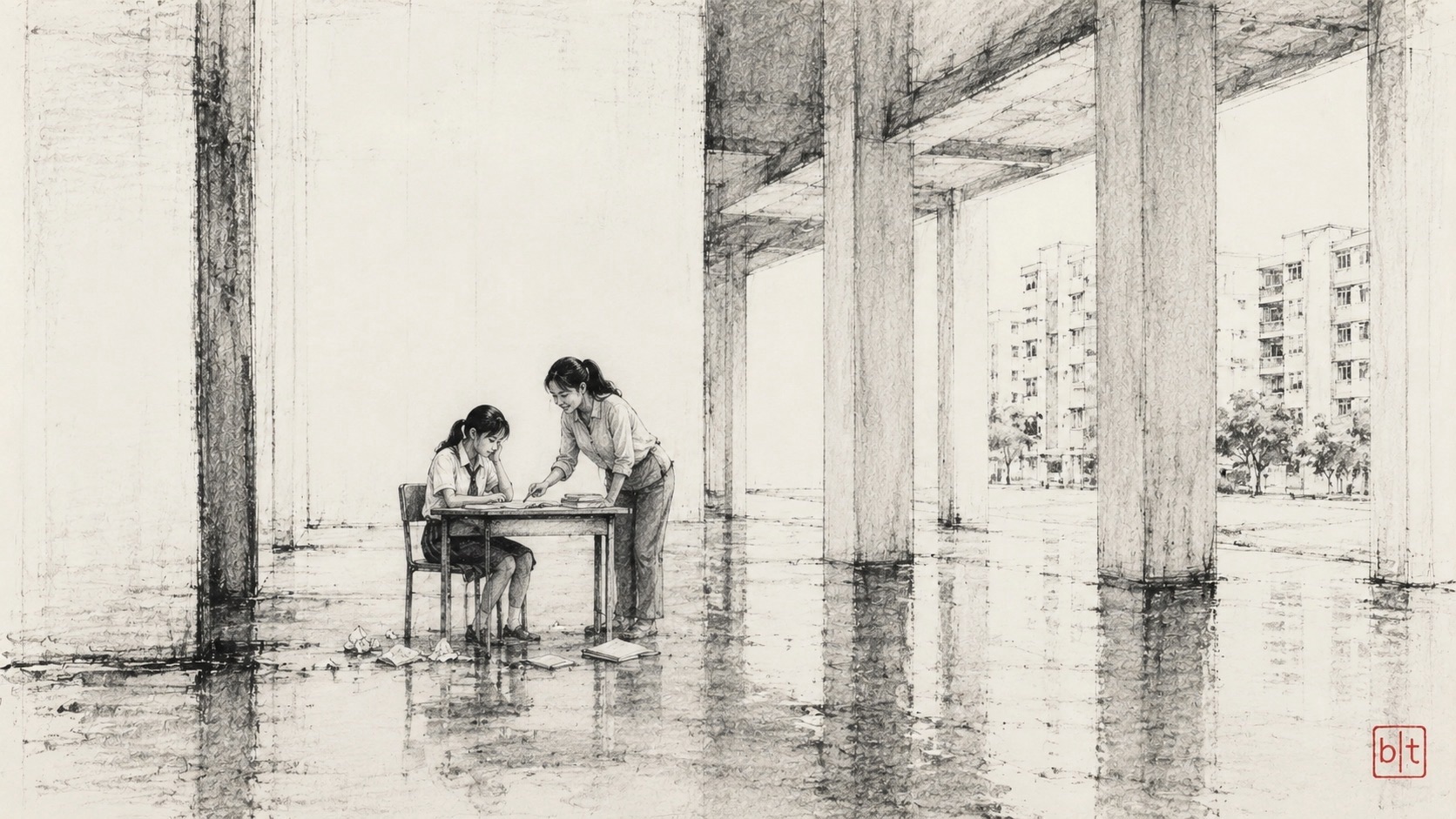
A good Additional Mathematics tuition lesson should not be judged only by how many questions the student completes.
A student can finish an impressive stack of work and still remain dependent on examples, uncertain about the concepts and unable to perform independently during an assessment.
Nor should a lesson be judged only by how smoothly it appears to run.
A class with no pauses, no mistakes and no visible struggle may look efficient. But it may also mean the tutor is doing too much of the thinking.
The more useful question is:
What has changed in the student by the end of the lesson?
A strong Secondary 3 A-Math lesson should help the student become clearer, more accurate and more independent.
The student should leave with:
- a better understanding of the Mathematics;
- a clearer sense of where the difficulty lies;
- one or more corrected error patterns;
- stronger control over the current school topic;
- a precise next step;
- less dependence on the tutor than before.
This is especially important in Secondary 3.
Additional Mathematics is cumulative. A lesson should not simply help the student survive the worksheet in front of them. It should build the thinking, algebraic control and correction habits that will continue into Secondary 4.
A Good Lesson Begins Before the Teaching Starts
The tutor should not begin every lesson by opening a random assessment book.
The first few minutes should establish the student’s present position.
This may include checking:
- what school taught that week;
- which homework questions were difficult;
- whether a weighted assessment has been returned;
- what errors appeared;
- whether the previous repair remained stable;
- what assessment is coming next;
- whether the student can still retrieve earlier work.
This gives the lesson direction.
Without it, tuition may become a separate academic universe that does not connect to school, previous corrections or future assessments.
A useful opening question is not simply:
“What chapter are you doing?”
It is:
“What is happening in your Mathematics now?”
The answer may reveal that the real issue is not the chapter itself.
The student may understand the concept but be unable to carry the algebra.
The student may complete school homework but rely heavily on examples.
The student may have corrected last week’s mistake, only for it to return under time pressure.
The lesson should respond to that evidence.
The Lesson Should Have a Clear Job
Every tuition lesson should have a defined purpose.
That purpose may be to:
- teach a new concept;
- repair an earlier gap;
- stabilise the current school chapter;
- convert guided understanding into independent work;
- revisit an old topic;
- analyse an assessment;
- reduce repeated errors;
- prepare for an upcoming weighted assessment;
- stretch a stronger student through variation.
A lesson can do more than one of these.
But it should not feel like a collection of unrelated activities.
By the end, both tutor and student should be able to answer:
- What did we work on?
- Why did it matter?
- What became more stable?
- What still needs attention?
- What should the student do before the next lesson?
This is how tuition becomes a learning system rather than a weekly academic event.
A Good Lesson Connects School, Foundation and Future
Secondary 3 A-Math tuition needs to operate across three time positions.
The present
What is the school teaching now?
The past
Which earlier skill is helping or interfering?
The future
What will the student need for the next chapter, assessment or Secondary 4?
A lesson may begin with the current topic but discover that a past foundation must be repaired.
For example, the student may be studying differentiation but repeatedly fail while solving the derivative equation.
The visible topic is differentiation.
The earlier weakness is factorisation or quadratic solving.
The future need is to handle stationary-point questions independently and under time pressure.
A strong lesson connects all three.
It does not abandon the current chapter to spend weeks on isolated revision.
Nor does it ignore the foundation and continue adding new work on top of instability.
The Tutor Should Inspect the Student’s Working
The final answer is useful.
The working is more informative.
A student may obtain an incorrect answer because:
- the concept is misunderstood;
- the wrong method was chosen;
- the method was correct but the algebra failed;
- a value was copied incorrectly;
- a condition was overlooked;
- one solution was omitted;
- the calculator was used poorly;
- the student ran out of time.
These conditions can produce the same score.
They require different teaching.
A good tutor should therefore look for:
- the first wrong line;
- the student’s intended method;
- the point where certainty disappears;
- whether the mistake has appeared before;
- whether the student can explain the decision;
- whether the correction survives the next question.
This is one of the central advantages of a small class.
The tutor can see enough of each student’s process to correct precisely.
The Bukit Timah Additional Mathematics Tuition in 3-Pax Small Groups structure is designed around this close reading of individual working.
The Tutor Should Not Explain Too Much Too Early
Clear explanation is important.
But constant explanation can become another form of dependence.
If the tutor begins every question by:
- identifying the chapter;
- selecting the formula;
- setting up the first line;
- correcting every hesitation;
- confirming every decision;
the student may feel successful without learning to operate independently.
A good lesson should use explanation where explanation is needed.
Then it should transfer the decision-making back to the student.
The sequence may look like this:
Demonstrate
The tutor models a new concept or method clearly.
Reconstruct together
The student helps rebuild the logic.
Attempt with prompts
The student solves a related question with selective guidance.
Attempt independently
The tutor steps back and observes.
Explain afterwards
The student describes why the method worked.
The purpose of explanation is not to keep the tutor at the centre of every solution.
It is to give the student enough structure to begin thinking independently.
Productive Silence Matters
A good lesson may contain moments of silence.
The student is reading.
The student is retrieving.
The student is deciding how to begin.
The student is checking whether a possible route is valid.
This can feel uncomfortable, especially when tuition time is precious.
However, if the tutor fills every pause immediately, the student never practises crossing uncertainty alone.
Silence is productive when the student has enough knowledge to think.
It is not productive when the child is completely lost and has no relevant foundation.
The tutor must distinguish between:
- a student who is thinking;
- a student who is waiting;
- a student who does not know;
- a student who is afraid to attempt.
Good teaching responds differently to each.
The Tutor Should Use a Prompt Ladder
Prompts should not all provide the same level of help.
A useful prompt ladder moves from more support to less.
Full direction
“Substitute this expression into the second equation.”
Focused question
“Which expression can be substituted?”
Structural cue
“Can you reduce the number of unknowns?”
Reflective question
“What do you know, and what are you trying to find?”
Silent observation
The student must generate the next step.
The tutor should use the least support that allows productive progress.
Over time, the student should require fewer and broader prompts.
That is one visible sign that tuition is working.
The Student Should Speak About the Mathematics
A-Math should not be a silent exercise in copying symbols.
Students should sometimes explain:
- what the question is asking;
- why a method applies;
- what a formula represents;
- where an error occurred;
- why a solution should be rejected;
- how the answer can be checked;
- what changed between two related questions.
Explanation makes hidden understanding visible.
A student may write a correct answer through imitation but struggle to explain why the route works.
That does not mean every lesson should become a long oral examination.
Short, precise explanations are enough.
The purpose is to confirm that the student is controlling the method rather than merely reproducing its appearance.
A Good Lesson Includes Direct Practice
Students still need repetition.
Once a concept is understood, direct practice helps stabilise the core method.
The student may need several similar questions to become more reliable in:
- expansion;
- factorisation;
- substitution;
- rearrangement;
- differentiation;
- integration;
- graph interpretation;
- trigonometric solving.
Direct practice is especially useful when the skill is new.
It reduces hesitation and gives the tutor repeated opportunities to inspect execution.
However, direct practice should not become the entire lesson.
If every question looks the same, the student may become fluent without learning to recognise the method independently.
A Good Lesson Includes Variation
After direct practice, the presentation should begin changing.
Variation may involve:
- different values;
- a rearranged equation;
- a changed unknown;
- a new representation;
- altered wording;
- an additional condition;
- a connection to another topic.
The student should learn to see what remains mathematically constant beneath the changing surface.
For example, a quadratic relationship may appear as:
- an equation;
- a graph;
- an intersection problem;
- a discriminant condition;
- a coordinate question;
- part of a differentiation problem.
A strong student recognises the underlying structure.
A good lesson gradually develops that recognition.
A Good Lesson Includes Mixed Questions
Students should not always know which chapter they are practising.
Topical worksheets are useful during early learning.
Mixed questions are necessary for assessment readiness.
In mixed work, the student must decide:
- which concept is relevant;
- what should be retrieved;
- how the given information should be organised;
- whether more than one chapter is involved.
This is a separate skill.
A student may be able to complete every question on a labelled worksheet but become uncertain when the labels are removed.
A good tuition lesson should therefore move from:
“Here is a quadratic question.”
towards:
“What Mathematics do you see here?”
A Good Lesson Uses Errors Properly
Mistakes should not be removed from the page too quickly.
The tutor should preserve enough of the original working to inspect it.
A useful correction sequence is:
- Find the last valid line.
- Identify the first invalid line.
- Ask what the student intended.
- Classify the error.
- State the correct principle.
- Restart from the last valid line.
- Complete the solution independently.
- Test the same issue in another question.
This is stronger than simply replacing the wrong answer.
The student learns how to read personal work.
Over time, the child should become better at detecting errors before the tutor points them out.
A Good Lesson Does Not Call Everything “Careless”
The word “careless” is too broad to guide correction.
A student may lose marks because of:
- weak sign control;
- missing brackets;
- poor notation;
- premature rounding;
- omitted solutions;
- inaccurate copying;
- weak checking;
- conceptual confusion;
- time pressure.
These are different.
The tutor should help the student identify a specific prevention action.
For example:
- place every negative substituted value in brackets;
- write each factor on a separate line;
- keep exact values until the final answer;
- reread the required interval before solving trigonometric equations;
- substitute stationary values into the original function.
Specific actions are more useful than general reminders.
A Good Lesson Revisits Previous Learning
A-Math should not be taught as a sequence of sealed chapters.
A student may understand a topic during one week and be unable to retrieve it a month later.
A good lesson should include some cumulative review.
This may be brief:
- one question from last week;
- one older retrieval question;
- one recurring-error question;
- one mixed question connecting topics.
The purpose is to keep learning accessible.
Without retrieval, students repeatedly restart before every examination.
With retrieval, older knowledge becomes easier to activate.
A Good Lesson Adjusts Difficulty Carefully
The work should not be so easy that the student never has to think.
It should not be so difficult that every question requires rescue.
The best level is one where:
- the student can make a genuine start;
- the question reveals the next weakness;
- the tutor can provide selective support;
- the student still completes meaningful reasoning;
- the difficulty increases as control improves.
This balance changes from student to student.
A strong student may need unfamiliar combinations and elegant solution comparison.
A struggling student may need shorter questions that isolate one unstable process.
The class should not force every learner through identical work at identical speed.
A Good Lesson Should Build Algebraic Reliability
Even when the topic is new, the tutor should watch the algebra carrying it.
A student may understand the concept but lose marks through:
- factorisation;
- rearrangement;
- signs;
- fractions;
- substitution;
- equation solving.
A good lesson does not dismiss these as unrelated lower-level mistakes.
It identifies whether the same algebraic weakness is appearing across several topics.
Then the tutor repairs it through relevant questions.
For example:
- factorisation through quadratics and calculus;
- indices through logarithms;
- rearrangement through linear law;
- substitution through functions;
- sign control throughout.
This keeps foundation repair connected to current A-Math learning.
A Good Lesson Should Include Independent Work
Some part of the lesson should show what the student can do without active help.
This may be:
- one full question;
- a short mixed set;
- a delayed retrieval task;
- a timed section;
- a correction completed without reference.
The tutor may still observe closely.
But the student should not receive constant intervention.
Independent work reveals:
- whether the method can be retrieved;
- whether the question is recognised;
- whether the algebra remains stable;
- whether checking happens naturally;
- whether prompt dependency remains.
Without independent work, tuition may create supported success that disappears outside the classroom.
A Good Lesson Should End With Consolidation
The final minutes should not feel like the abrupt end of a worksheet.
The lesson should close by identifying what changed.
The student may be asked:
- What did you learn?
- Which error did you repair?
- What can you now do independently?
- Which point is still unstable?
- What should you review before the next lesson?
- What school chapter is coming next?
This helps the student organise the lesson mentally.
A short exit task may also be useful.
For example:
- one retrieval question;
- one explanation;
- one corrected error;
- one first-step decision.
The tutor then knows whether the central lesson objective has held.
What Should Homework From Tuition Look Like?
Tuition homework should have a purpose.
It may be used to:
- stabilise the lesson method;
- retrieve earlier learning;
- test independence;
- revisit a correction;
- prepare for the next school chapter;
- build assessment readiness.
It should not simply be more volume.
A useful homework set may include:
- two direct questions;
- two controlled variations;
- one mixed question;
- one corrected-error question;
- one older retrieval question.
The exact amount depends on the student’s school workload and present need.
Homework that is too large may be rushed, copied or avoided.
A smaller set completed independently and corrected properly can be more valuable.
What a Good Lesson Looks Like for a Struggling Student
A struggling student may need a lesson with this shape:
1. Current-school check
Clarify what school is teaching and where the student is disconnected.
2. Foundation test
Identify the earlier algebraic skill interfering.
3. Short explanation
Teach or rebuild the key concept.
4. Guided attempt
Support the student through one related question.
5. Prompt withdrawal
Reduce help across the next questions.
6. Error repair
Correct one recurring pattern precisely.
7. Independent question
Test whether the learning holds.
8. Small homework plan
Protect consistency without overload.
The lesson should leave the student feeling that the subject has become smaller and more manageable.
What a Good Lesson Looks Like for an Average Student
An average student may understand the basics but need greater reliability.
The lesson may focus on:
- improving independent starts;
- reducing repeated algebraic errors;
- moving from topical to mixed questions;
- strengthening retrieval;
- building clearer checking;
- preparing for school assessments.
The tutor should not reteach everything from the beginning.
The student needs selective correction and increasing variation.
The objective is to move from inconsistent performance towards dependable control.
What a Good Lesson Looks Like for a Strong Student
A strong student needs more than faster syllabus coverage.
The lesson may include:
- unfamiliar question structures;
- comparison of solution methods;
- greater algebraic elegance;
- proof and justification;
- connected-topic problems;
- harder transfer;
- tighter examination precision;
- reduction of small mark losses.
The tutor should still inspect working.
Strong students can lose marks through over-compression, omitted conditions, weak checking or excessive confidence.
The work should stretch mathematical judgement, not merely increase the number of chapters completed.
The Role of the Small Group
A small group can provide several advantages when it is managed properly.
Students can:
- hear another student’s explanation;
- compare different solution routes;
- notice mistakes they may also make;
- practise explaining Mathematics;
- work independently while the tutor supports another learner;
- experience a calm level of accountability.
However, a small group should not become a miniature lecture class.
Each student’s working still needs to be visible.
The tutor should know:
- who understands;
- who is following;
- who is waiting;
- who is copying;
- who needs a different level of challenge.
A maximum of three students allows the lesson to retain both individual correction and useful shared learning.
What Parents Should Be Able to See Over Time
Parents may not observe the tuition lesson directly.
They can still look for changes outside it.
A good programme should gradually produce:
- easier homework starts;
- fewer repeated mistakes;
- clearer working;
- more specific questions;
- less dependence on notes;
- stronger retrieval of older topics;
- improved mixed-question performance;
- calmer preparation for assessments;
- more consistent school results.
The tutor should also be able to explain the current priority.
Not every lesson needs a long report.
But the direction should be clear.
Parents should not feel that the child is simply attending and hoping.
Warning Signs of Weak Tuition
A tuition programme may need review when:
- every lesson consists of worksheet completion;
- the tutor supplies most first steps;
- the student cannot explain what was learned;
- old mistakes keep returning unchanged;
- school topics and tuition topics are disconnected;
- corrections are copied but never revisited;
- no mixed practice is used;
- the student becomes more dependent;
- homework volume rises while understanding remains weak;
- the tutor cannot identify the student’s main difficulty.
A busy class is not automatically an effective class.
The question remains:
What is changing in the learner?
How Long Should a Good Lesson Be?
There is no perfect duration for every student.
A useful lesson must be long enough to:
- review;
- teach;
- practise;
- correct;
- test independence;
- consolidate.
But longer does not always mean better.
A student who is exhausted may complete the final part of a long lesson with very little meaningful learning.
The quality of attention matters.
A well-structured lesson should have rhythm:
- explanation;
- attempt;
- feedback;
- independent work;
- review.
This is more important than filling every minute with continuous instruction.
Should Every Lesson Include Timed Work?
No.
Timed practice is important, especially before assessments.
But it should be introduced when the relevant Mathematics is sufficiently stable.
A student still learning a new concept may need time to organise the method accurately.
A student preparing for a weighted assessment may need controlled timing.
The tutor should know which stage the learner is in.
Trying to make an unstable method fast often increases error.
The better order is:
Understand → Stabilise → Mix → Time
Should the Tutor Always Follow the School Sequence?
The school sequence matters because the student must remain connected to class learning.
However, the tutor may need to move briefly backwards or sideways.
For example:
- revisit factorisation before a quadratic chapter;
- strengthen indices before logarithms;
- repair rearrangement during linear law;
- revisit graphs before calculus applications.
The tutor should not follow the school sequence blindly.
Nor should tuition disappear into an unrelated syllabus.
The best path supports the current chapter while repairing the dependencies beneath it.
Should Tuition Stay Ahead of School?
Being slightly ahead can be useful.
The student gains familiarity and enters the school lesson with less friction.
But being far ahead is not automatically valuable.
The risks include:
- shallow learning;
- forgetting;
- overconfidence;
- boredom during school;
- insufficient practice;
- little time for correction.
The aim should not be to finish first.
It should be to understand, retain and apply.
A student who is one chapter ahead with secure control may be in a better position than one who has “completed” half the syllabus without retrieval or transfer.
Frequently Asked Questions
How can I tell whether an A-Math tuition lesson is effective?
Look for increasing independence, fewer repeated mistakes, stronger retrieval and clearer working—not only worksheet volume.
Should the tutor reteach the school lesson?
Sometimes.
If the school explanation was not understood, reteaching may be necessary. But the tutor should also identify why the learning did not hold and move the student towards independent use.
Is it good if my child says tuition is easy?
Not always.
It may mean the work is well explained, but it may also mean the questions are too familiar or the tutor is helping too much.
Should my child make mistakes during tuition?
Yes.
Mistakes are useful when they reveal the next repair point and are corrected properly. A lesson with no mistakes may not be challenging enough.
How much help should a tutor give?
Enough to keep the student thinking productively, but not so much that the tutor owns the solution. Support should reduce over time.
Should tuition homework be difficult?
It should match the purpose. Some questions should stabilise the method; others should test variation, retrieval or mixed recognition.
Is small-group tuition suitable for a weak student?
It can be, when the class is small enough for close correction and the student can participate meaningfully. Very broad or specialised needs may require a different format.
Should parents receive lesson updates?
The tutor should be able to communicate the student’s present priority and progress. The level of detail can vary, but the direction should not be mysterious.
Should every lesson cover many topics?
Not necessarily.
A focused lesson that repairs one influential weakness may be more valuable than superficial coverage of several chapters.
How should a strong A-Math student be taught?
Through greater variation, connected problems, precision, method comparison and deeper transfer—not merely faster completion of the syllabus.
The Best Lesson Changes Who Is Carrying the Mathematics
At the beginning of tuition, the tutor may need to carry more of the structure.
The tutor explains.
The tutor models.
The tutor prompts.
The tutor catches the first error.
Over time, that responsibility should move.
The student begins.
The student chooses.
The student checks.
The student explains.
The student corrects.
The tutor remains important, but the role changes.
The tutor no longer carries every solution.
The tutor observes, challenges, refines and extends the solution the student is increasingly able to produce.
That is one of the clearest signs of a good Additional Mathematics lesson.
Secondary 3 Additional Mathematics Tuition in Bukit Timah
At Bukit Timah Tutor, Secondary 3 Additional Mathematics tuition is conducted in maximum three-student classes near Sixth Avenue.
Each lesson is built around the student’s present learning position.
We look at:
- the current school chapter;
- recent assessments;
- recurring mistakes;
- algebraic foundations;
- level of independence;
- upcoming assessment demands;
- what must become more stable before Secondary 4.
The purpose is not simply to complete more A-Math questions.
It is to help students understand the subject, preserve the working, correct intelligently and become less dependent over time.
Some students need repair.
Some need stability.
Some need stronger transfer.
Some need greater precision at distinction level.
A good lesson should know the difference.
Continue with:
Secondary Math Tuition | Sec 3 Additional Mathematics Tutor
Secondary 3 Additional Mathematics Tuition Bukit Timah
Bukit Timah Additional Mathematics Tuition | 3-Pax Small Groups
Additional Math Tutor | Excellent Secondary A-Math Tuition
Speak With Bukit Timah Tutor
It is helpful to share:
- the student’s recent results;
- the current school chapter;
- questions the student cannot begin;
- repeated mistakes;
- the date of the next assessment;
- whether the present goal is repair, stability or distinction-level performance.
We can then identify what the lesson needs to do first.
Less noise. More structure. Better results.