
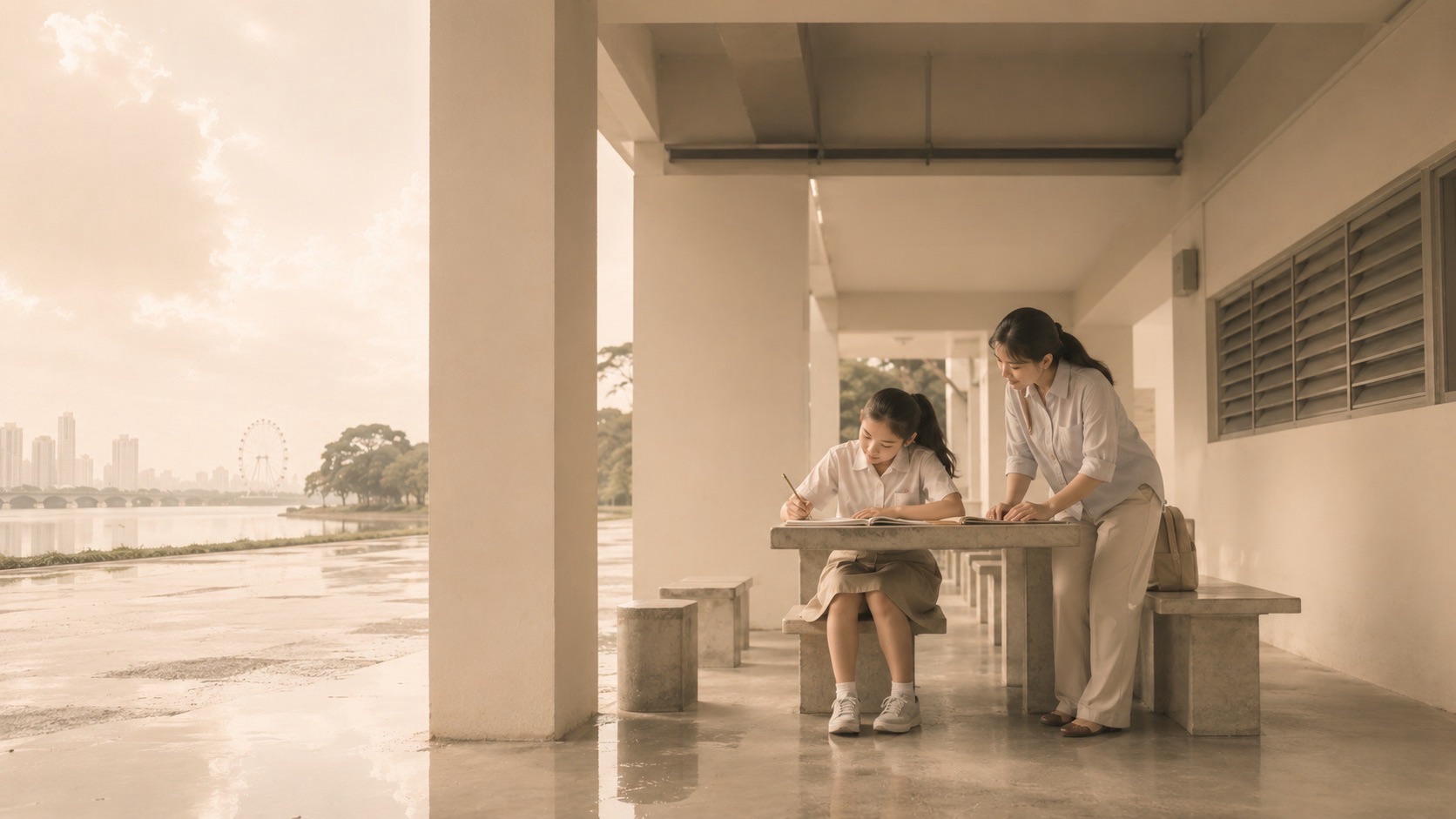
Full Subject-Based Banding changes more than the names used in secondary school.
It changes how parents should understand a child’s academic position.
Under the former system, students were generally placed in the Express, Normal (Academic) or Normal (Technical) stream. That stream became the broad description of the student’s secondary education.
Under Full Subject-Based Banding, the student is no longer defined by one stream.
A child may take Mathematics at G3, English at G2, Science at G3 and Mother Tongue Language at another suitable level. The student’s education becomes a subject-by-subject profile rather than a single academic label.
This creates greater flexibility. It can also create greater complexity.
Parents now need to understand not only which secondary school their child enters, but also:
- the student’s Posting Group;
- the level at which each subject is taken;
- whether that level remains appropriate;
- what is required to move to a more demanding level;
- and which post-secondary pathways the complete subject combination keeps open.
The central question is no longer simply:
Which stream is my child in?
It becomes:
What is my child’s present subject profile, and where can it lead?
What Is Full Subject-Based Banding?
Full Subject-Based Banding, commonly known as Full SBB, has been fully implemented in Singapore’s secondary schools since 2024.
It removes the former Express, Normal (Academic) and Normal (Technical) streams. Students enter secondary school through Posting Groups and may study individual subjects at different levels according to their strengths, learning needs and readiness.
The three subject levels are:
- G1
- G2
- G3
The letter G stands for General.
Broadly, G1, G2 and G3 represent increasing levels of academic demand. However, they should be attached to the subject, not used as permanent labels for the child.
It is more accurate to say:
My child takes G2 Mathematics.
It is less accurate to say:
My child is a G2 student.
The second statement quietly recreates the stream labels that Full SBB was intended to move beyond.
MOE describes Full SBB as a system in which students learn in mixed form classes, study a common curriculum in several subjects and take other subjects at levels suited to their strengths and learning needs.
Full SBB at a Glance
| Earlier Secondary School Structure | Full Subject-Based Banding |
|---|---|
| Express, Normal (Academic) and Normal (Technical) streams | No separate Express, N(A) or N(T) streams |
| One stream broadly determined most subject levels | Different subjects may be taken at G1, G2 or G3 |
| Stream often became the student’s academic identity | Subject level should remain attached to the individual subject |
| Form classes were generally organised by stream | Students learn in mixed form classes |
| N-Level and O-Level examinations | Singapore-Cambridge Secondary Education Certificate from 2027 |
| Parents mainly watched the overall stream | Parents must understand the child’s complete subject profile |
The most important shift is simple:
Full SBB moves the focus from sorting whole students to organising the level of individual subjects.
That is a more precise way to educate a child—but only when parents, students and educators read the profile carefully.
Posting Groups and Subject Levels Are Not the Same Thing
One of the most common sources of confusion is the difference between a Posting Group and a subject level.
Posting Groups
Posting Groups 1, 2 and 3 are used during Secondary 1 posting.
They provide a broad entry point into secondary school and an indicative starting level for most subjects.
Subject Levels
G1, G2 and G3 describe the level at which an individual subject is studied.
A student entering through Posting Group 2 may, for example, be offered particular subjects at G3 where the student has demonstrated the relevant strength. Subject levels may also be reviewed as the student progresses, subject to the school’s criteria, available subject combinations, timetable and assessment of readiness.
Posting Group therefore answers:
How did the student enter the secondary school?
Subject level answers:
At what level is this particular subject being studied?
These two answers may be aligned at the beginning of Secondary 1, but they do not have to remain identical throughout the student’s secondary education.
Parents preparing for this transition may find it useful to read What Happens After PSLE?, which explains how Posting Groups, Mathematics levels, the secondary years and the eventual SEC qualification connect.
G1, G2 and G3 Should Not Be Reduced to “Easy, Medium and Hard”
It is tempting to explain G1, G2 and G3 as three simple difficulty settings.
That description is too thin.
The levels can differ in:
- curriculum breadth;
- depth of concepts;
- degree of abstraction;
- expected pace;
- complexity of application;
- independence required;
- examination demand;
- and the post-secondary routes for which they prepare the student.
A student may be highly capable in one domain and need more support in another.
For example, a child may:
- read and write confidently at G3 English;
- require G2 Mathematics while rebuilding numerical and algebraic foundations;
- perform strongly at G3 Science;
- and take Mother Tongue Language at another suitable level.
That is not a contradiction.
It is the system working subject by subject.
The level should describe the present learning route, not the child’s worth, potential or intelligence.
Full SBB Makes Secondary Education More Flexible—but Less Automatic
The former stream structure was easier to describe.
Once a student entered a stream, much of the academic route was already organised.
Full SBB creates more possible combinations. That means a child’s route can become more responsive, but it also means fewer decisions should be made automatically.
Parents now need to distinguish between three questions.
1. What can my child manage now?
This concerns the student’s present foundations, pace, confidence and ability to work independently.
2. What can my child become ready for?
A student may not yet be ready for a higher level but may have a realistic route towards it after the correct foundations are repaired.
3. Which future pathways should remain available?
A subject decision should consider the student’s current wellbeing and performance, but it should also consider later JC, Millennia Institute, polytechnic, ITE and subject-combination requirements.
The best decision is rarely:
Always choose the highest level.
Nor is it:
Choose the easier level so the child will score better.
The better question is:
Which level gives this student the strongest real foundation while preserving the pathways that genuinely matter?
The Quiet Importance of Subject-Level Movement
Full SBB makes movement between subject levels possible at appropriate points, but parents should understand what this flexibility means.
It does not mean that subject levels will change automatically.
A school may consider factors such as:
- the student’s results;
- demonstrated understanding;
- learning habits;
- ability to manage the higher curriculum;
- teacher observations;
- subject prerequisites;
- timetable feasibility;
- and the school’s own review process.
Moving upwards should therefore involve more than obtaining one encouraging mark.
A student who moves from G2 to G3 Mathematics may encounter:
- a faster curriculum;
- more abstract algebra;
- longer chains of reasoning;
- more unfamiliar applications;
- and greater expectations of independent problem-solving.
The student must be ready not only to enter the higher level, but to continue learning successfully after entering it.
Similarly, moving to a more suitable level should not be treated as failure.
Sometimes a student performs better when excessive cognitive load is reduced, foundational gaps are repaired and confidence is rebuilt. Once the learning system becomes stable, later progression may become more realistic.
A well-chosen route does not close a child down.
It gives the child somewhere firm from which to move.
Full SBB Changes What Parents Should Look for in Tuition
Under Full SBB, matching tuition only by school year is no longer enough.
Two Secondary 2 students may be studying Mathematics at different levels.
Even two students taking G3 Mathematics may need completely different teaching.
One may have fallen behind because fractions and negative numbers were never secure.
Another may understand the concepts but lose marks through slow algebraic manipulation.
A third may already be scoring distinctions and need greater depth, unfamiliar questions and preparation for Additional Mathematics.
They share the same subject label.
They do not share the same learning requirement.
This is why good tuition should quietly route students in different directions.
For a student who is struggling
The immediate aim may be to:
- stop the academic fall;
- locate the earliest weak link;
- rebuild missing foundations;
- reconnect the student to the present school topic;
- restore independent working;
- and prepare for a suitable subject-level review where appropriate.
For a student who is already secure
The aim may be to:
- deepen conceptual understanding;
- improve transfer between topics;
- introduce less familiar problems;
- refine examination performance;
- prepare for Additional Mathematics;
- and preserve more demanding future subject choices.
The first student needs a better corridor back into learning.
The second needs a wider corridor towards future possibilities.
Both students may need tuition, but not for the same reason.
This distinction is explored further in The 3 Modes of Progressive Mathematics Tuition: recovery after a fall, conversion from average to distinction, and positioning from distinction towards greater readiness.
Why Mathematics Makes the Full SBB Change Especially Visible
Full SBB affects the entire secondary school experience, but Mathematics reveals its logic particularly clearly.
Mathematics is cumulative.
A weakness that begins in one area can travel into many later chapters.
For example:
- weak fraction operations can reappear in algebraic fractions;
- poor control of negative numbers can disrupt equations and coordinate geometry;
- weak ratio understanding can affect rates, similarity and scale;
- uncertain algebraic manipulation can affect graphs, functions and Additional Mathematics;
- and poor translation from words into mathematical expressions can weaken many application questions.
The student may appear to have difficulty with the latest chapter.
The actual problem may have started several years earlier.
This means that a Mathematics level should not be judged only from one overall mark. The student’s working should be examined to determine:
- where the first important error appears;
- whether the concept is understood;
- whether the method can be retrieved independently;
- whether the student can recognise the method when the question changes;
- and whether performance remains stable under time pressure.
A mark is useful evidence.
It is not a complete diagnosis.
How Full SBB Changes the Secondary 1 Mathematics Year
Secondary 1 is no longer simply the first year of a fixed stream.
It is the beginning of a subject-level route.
Students must adapt to:
- a new school environment;
- several subject teachers;
- faster academic sequencing;
- more independent homework;
- formal algebra;
- new examination expectations;
- and, for many students, a different Mathematics level from that taken by some classmates.
This makes the Primary 6 to Secondary 1 transition especially important.
A child who performed reasonably well in primary school may still struggle when Mathematics becomes more symbolic. Primary Mathematics often permits students to reason with numbers, diagrams and familiar problem types. Secondary Mathematics increasingly requires students to control variables, expressions, equations and general relationships.
Early problems with algebra should not be dismissed as a temporary adjustment if they continue across several topics.
They may signal that the student needs:
- a clearer introduction to algebraic language;
- stronger number foundations;
- more careful explanation;
- slower initial modelling;
- or practice that moves gradually from guided to independent work.
Parents can read more about this transition in Secondary 1 Mathematics Tuition in Bukit Timah.
How Full SBB Changes the Secondary 2 Decision Year
Secondary 2 is often the point at which the student’s longer upper-secondary route becomes clearer.
By this stage, schools and families may be considering:
- the student’s appropriate Mathematics level;
- readiness for upper-secondary subjects;
- possible Additional Mathematics choices;
- the sustainability of the child’s complete workload;
- and future post-secondary intentions.
Secondary 2 results should therefore be read for more than promotion.
They should reveal whether the student has the foundation required for what comes next.
A student may be passing Mathematics while remaining dependent on:
- memorised examples;
- teacher prompts;
- repetitive question patterns;
- or last-minute revision.
That student may not yet be ready for the heavier abstraction of upper-secondary Mathematics or Additional Mathematics.
Another student may be scoring well but completing only familiar work. That student may need greater variation and depth before selecting a more demanding route.
The purpose of Secondary 2 Mathematics tuition should therefore be to clarify readiness—not merely to produce one more set of marks.
How Full SBB Changes Secondary 3
Secondary 3 is where subject-level decisions begin carrying more visible consequences.
The student may encounter:
- a more demanding Mathematics syllabus;
- Additional Mathematics at G2 or G3, where offered;
- separate sciences;
- heavier content across several subjects;
- longer questions;
- and less time to repair lower-secondary weaknesses.
This is why the same tuition programme should not be used indiscriminately for every Secondary 3 student.
A student taking Mathematics without Additional Mathematics has a different workload from a student taking both subjects.
A student beginning G2 Additional Mathematics has a different starting point and progression purpose from a student beginning G3 Additional Mathematics.
A student struggling with both Mathematics and Additional Mathematics may not have two unrelated problems. Both difficulties may originate from the same algebraic foundation.
Useful support should separate the subjects, identify their shared dependencies and decide what must be repaired first.
Read more about the upper-secondary pivot in Secondary 3 Mathematics Tuition in Bukit Timah.
Parents considering the Additional Mathematics route may also find these guides useful:
- Should My Child Take G2 or G3 Additional Mathematics?
- What Is the Difference Between G2 and G3 Additional Mathematics?
- Secondary 3 Additional Mathematics Tuition in Bukit Timah
How Full SBB Changes Secondary 4 and the SEC Year
From the 2027 graduating cohort, students will sit for the Singapore-Cambridge Secondary Education Certificate, or SEC, at their respective G1, G2 and G3 subject levels.
The SEC replaces the former N-Level and O-Level examinations. Students will receive one certificate reflecting the subjects and levels taken.
MOE has stated that the SEC will continue to be jointly examined and awarded by SEAB, MOE and Cambridge International Education. English Language and Mother Tongue Language written papers are scheduled in September, with written papers for other subjects in October and November. Results will be released in January of the following year.
For Secondary 4 students, this means preparation must be based on the actual subject profile.
The family should know:
- which subjects are taken at G1, G2 or G3;
- which subjects can be used for the intended post-secondary route;
- which grades are presently secure;
- where the greatest risk lies;
- and how revision time should be allocated across the full combination.
A student with a mixed profile should not receive a generic examination plan.
The student needs a plan that respects the demand, importance and present condition of each subject.
For Mathematics, the final year should move progressively through:
- diagnosis of remaining gaps;
- targeted foundation repair;
- topic retrieval;
- mixed-topic application;
- timed practice;
- paper strategy;
- error correction;
- and stable independent execution.
More detail is available in Secondary 4 Mathematics Tuition in Bukit Timah.
Full SBB Does Not Make Every Pathway Identical
One certificate does not mean that every subject combination produces the same post-secondary options.
The level and combination of subjects still matter.
From the 2028 intake, students may use one G2 subject in the ELR2B2 computation for admission to Polytechnic Year 1, while the remaining four subjects must continue to be taken at G3. MOE has also announced a new Post-Secondary Admissions Exercise from 2028, allowing students to apply for different post-secondary pathways at the same time after receiving their SEC results.
This is an important development.
It makes the system more porous, but it does not remove prerequisites.
A student interested in a particular JC subject combination, polytechnic diploma or other post-secondary course should still work backwards from the relevant requirements.
Parents should ask:
- Which subjects must be taken at G3?
- Which G2 subjects may be used?
- Are there minimum grades for English or Mathematics?
- Does the desired course require Additional Mathematics or a particular Science?
- Is the child merely eligible to apply, or genuinely prepared to manage the next curriculum?
Eligibility opens a door.
Readiness determines what happens after the child enters.
Two Mistakes Parents Should Avoid Under Full SBB
Mistake 1: Treating the highest available level as automatically best
A higher level may preserve more routes, but only when the student can build a dependable foundation within it.
A child who is continuously overwhelmed may:
- stop understanding new lessons;
- become dependent on copied methods;
- avoid practice;
- lose confidence;
- and carry unfinished knowledge into the next chapter.
Remaining at the highest possible level is not useful if the student cannot learn there effectively.
The correct aim is not maximum difficulty.
It is maximum sustainable development.
Mistake 2: Lowering the level without investigating the cause
A poor result does not always mean that the subject level is unsuitable.
The problem may be:
- one missing foundation;
- weak examination timing;
- a recent transition;
- ineffective revision;
- an unfamiliar school paper;
- poor retrieval;
- or several preventable execution errors.
Before changing direction, parents should understand what produced the result.
Sometimes a relatively small repair restores the student’s ability to manage the present level.
Sometimes the evidence shows that a different route would be healthier and more productive.
Both decisions can be intelligent.
The important part is that the decision follows diagnosis rather than fear.
When Might a Child Need Tuition Under Full SBB?
Tuition may be useful when it solves a specific learning problem that school lessons and independent study have not yet resolved.
The student is falling behind the school sequence
Each new chapter arrives before the previous one is stable.
The child needs help reconnecting earlier knowledge to present lessons.
The student can follow examples but cannot begin alone
Recognition is being mistaken for independent understanding.
The child needs practice selecting and executing methods without visible prompts.
The marks are inconsistent
The child performs well on familiar work but loses control when questions are mixed, reworded or placed under time pressure.
A change in subject level is being considered
The student needs an honest assessment of whether the foundation, pace and independence required for the next level are present.
Additional Mathematics is approaching
The child may need stronger algebraic fluency before upper-secondary abstraction places greater pressure on weak foundations.
The child is already strong but insufficiently challenged
A distinction student may need fewer routine repetitions and more work involving variation, explanation, transfer and unfamiliar problems.
These are different reasons for tuition.
Each should change what the tutor actually does.
The broader principles are explained in Why Have Mathematics Tuition?.
What Good Full SBB-Aware Tuition Should Do
1. Identify the student’s actual subject level
The teaching must match the G1, G2 or G3 curriculum being taken.
2. Diagnose before adding workload
The tutor should inspect the child’s written work and identify where understanding or execution first begins to fail.
3. Separate present performance from future potential
A weak result may describe the student’s present condition without defining the eventual ceiling.
4. Repair foundations while staying connected to school
Foundation work should not become months of isolated revision. Each repair should be linked back to the current school topic.
5. Adjust the teaching route as the student changes
A recovering student may later become stable. A stable student may later need distinction training. A distinction student may eventually need preparation for more demanding future work.
6. Build independence
The tutor should gradually become less necessary inside each question.
Students should increasingly be able to:
- recognise the mathematical structure;
- choose a method;
- organise their working;
- detect an error;
- and recover without waiting for approval after every line.
7. Preserve the right future corridors
The tutor should understand whether the immediate priority is recovery, stable performance, movement between levels, Additional Mathematics, SEC preparation or readiness for a later quantitative route.
That is where a small-group setting becomes valuable.
In a maximum three-student class, students can study related material while the tutor remains close enough to see differences in reasoning, pace, error patterns and readiness. Read more about why Bukit Timah Tutor uses small-group tuition.
Questions Parents Can Ask the School
Full SBB gives families more information to understand. These questions can make school discussions more useful:
- At which level is my child taking each subject?
- Is this the default level from the Posting Group or a subject-specific arrangement?
- What evidence shows that the present level is suitable?
- At which points does the school review subject levels?
- What criteria are used when considering a move?
- What additional content must be covered if the student moves upwards?
- Which upper-secondary subjects can the student take from the present combination?
- How might this profile affect the post-secondary routes being considered?
- Is the present difficulty conceptual, procedural, behavioural or examination-related?
- What can be strengthened at home without creating unnecessary overload?
The aim is not to pressure the school into moving the child to a different level.
It is to understand the route clearly enough to make a calm decision.
Questions Parents Can Ask a Tutor
Before choosing tuition, parents may ask:
- Does the tutor understand the student’s G1, G2 or G3 syllabus?
- Will the tutor inspect actual schoolwork and assessment papers?
- How will foundational gaps be identified?
- How will repair work be connected to current school topics?
- How will the programme differ for a falling, average or distinction student?
- How will progress be measured beyond worksheet completion?
- Can the tutor explain whether the child is becoming more independent?
- How will the tutor prepare the student for a possible higher level without rushing?
- How will stronger students be stretched without merely being given more routine work?
- How does the tutor consider Additional Mathematics and later pathways?
Good tuition should produce a clearer answer than:
We will give the child more practice.
Practice matters.
Its value depends on whether the right student is practising the right work at the right time.
Frequently Asked Questions About Full Subject-Based Banding
Does Full SBB mean there are no differences in academic demand?
No.
G1, G2 and G3 remain different subject levels with different levels of curriculum and assessment demand. Full SBB changes how those levels are combined around the student.
Is Posting Group the same as subject level?
No.
Posting Group is used for entry into secondary school. G1, G2 and G3 refer to the level of individual subjects.
Can a student take subjects at different levels?
Yes.
A student’s profile may contain a mixture of G1, G2 and G3 subjects, depending on strengths, learning needs, school offerings and eligibility.
Can students move from G2 to G3?
Movement may be possible at suitable review points, but it is not automatic. Schools consider readiness, performance, curriculum coverage, timetable feasibility and their own criteria.
Is moving to G2 a failure?
No.
A suitable level can give the student enough space to build understanding, confidence and independent performance. The decision should be based on evidence and future planning rather than stigma.
Should every capable student take the highest possible level?
Not automatically.
Capability, capacity, complete workload, interest and future pathway all matter. A level is useful only when the child can learn sustainably within it.
What replaces the N-Level and O-Level examinations?
From the 2027 graduating cohort, students will sit for the Singapore-Cambridge Secondary Education Certificate at their respective G1, G2 and G3 subject levels.
Does Full SBB make tuition more necessary?
Not for every student.
However, it makes precise tuition more important when support is needed. The tutor must understand the child’s subject level, present condition and future route rather than teaching every student in the same way.
The Deeper Change: One Child, Several Possible Routes
The deepest change introduced by Full Subject-Based Banding is not administrative.
It is a change in how we see the student.
A child can be:
- strong in one subject;
- developing in another;
- recovering in a third;
- and ready for greater challenge elsewhere.
These conditions can change over time.
The child should not be frozen inside the description created by one examination, one Posting Group or one difficult year.
At the same time, flexibility should not become drift.
A route must still be built deliberately.
For a struggling student, the right support may quietly lead back through a more manageable corridor:
secure the foundation, restore participation, stabilise performance and prepare for the next realistic step.
For a stronger student, the right support may open the corridor wider:
deepen understanding, develop unfamiliar problem-solving, prepare for Additional Mathematics and preserve demanding future choices.
One child may need less pressure before more progress becomes possible.
Another may need greater depth before a good result becomes genuine readiness.
The purpose of tuition is not to force every student towards the same door.
It is to understand where the student stands, identify which door matters next and build enough capability for the child to walk through it with confidence.
Full SBB Mathematics Tuition in Bukit Timah
Bukit Timah Tutor provides small-group Mathematics and Additional Mathematics tuition for students who need to catch up, keep up or move ahead.
Classes are kept to a maximum of three students so that teaching can remain close to each learner’s:
- subject level;
- school sequence;
- written working;
- error pattern;
- foundation;
- examination performance;
- and intended future route.
A student who has fallen needs secure ground.
A student who is passing needs dependable control.
A student who is already strong needs depth and a wider horizon.
Less noise. More structure. Better results.