
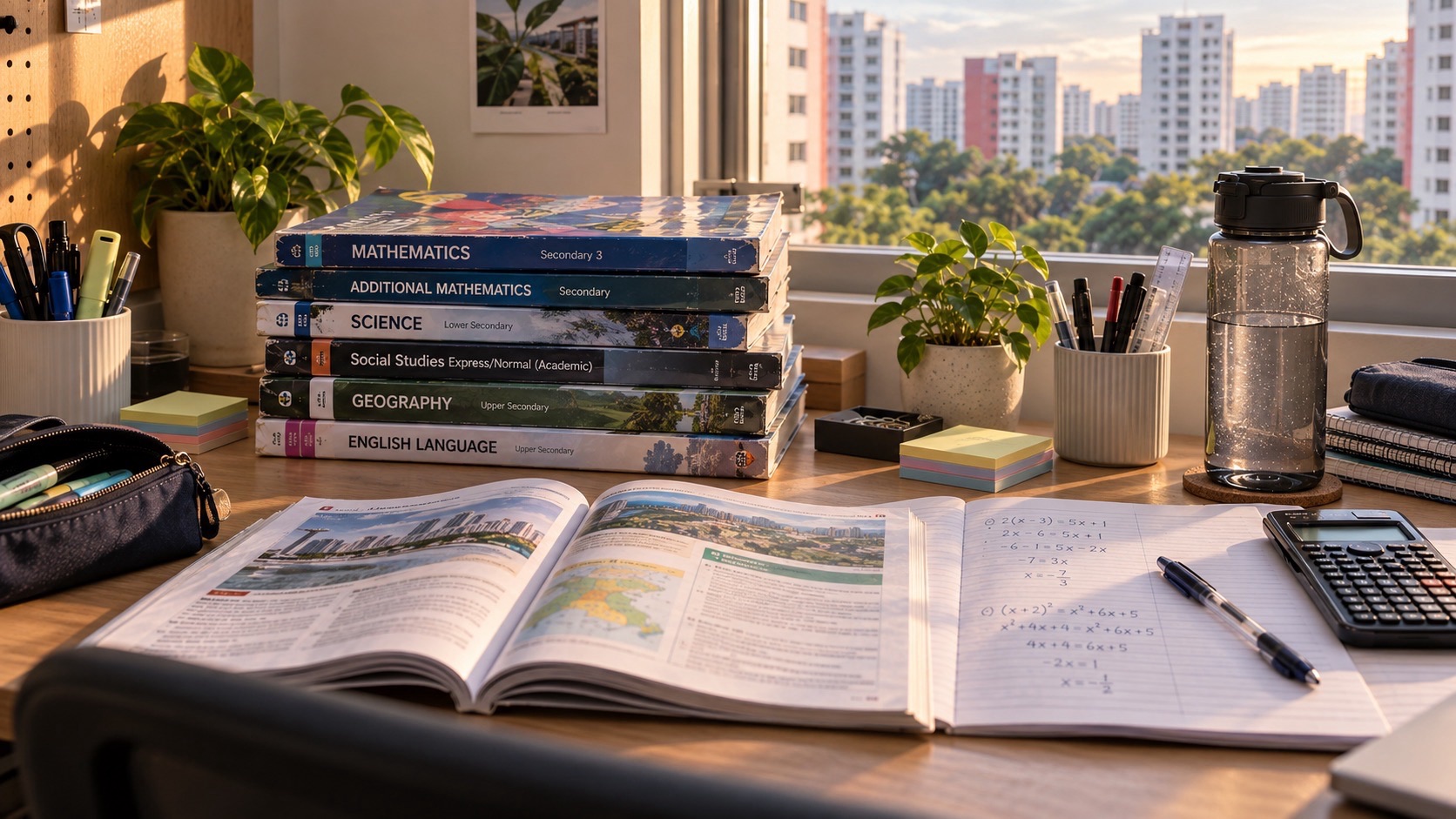
Singapore Math money guide for families and teachers outside Singapore. What Primary 1 to Primary 3 students learn about money, how Singapore teaches dollars and cents, and how to practise money at home.
Money is the first place many children see Mathematics working in daily life.
It is also where many children first write a decimal point.
In Singapore Mathematics, money is a Primary 1 to Primary 3 topic. Students count amounts in cents and dollars, read and write money in decimal notation, compare and convert amounts, and then add and subtract money.
Money does not appear as a topic in Primary 4. It returns in Primary 5, when percentage is applied to discount, GST and annual interest.
This guide is useful for families and teachers who want to:
- understand what Singapore expects from Primary 1 to Primary 3;
- teach money at home in a clear sequence;
- prepare a child who is moving into a Singapore school; or
- support a student using Singapore Math materials in another country.
Quick facts
Level: Primary 1 to Primary 3
Strand: Number and Algebra
Official source: MOE Primary Mathematics Syllabus, the 2021 syllabus first examined at PSLE in 2026
Comes after: Addition and Subtraction and Whole Numbers and Place Value
Leads to: Decimals and Discount, GST and Interest
What Money Means in Singapore Mathematics
Singapore uses dollars and cents. 100 cents make 1 dollar.
An amount such as $4.35 means 4 dollars and 35 cents. The digits after the decimal point are the cents, and there are always two of them.
So 5 cents is written $0.05, and 4 dollars 5 cents is written $4.05.
Money gives children a meaningful reason to group in hundreds, to exchange smaller units for larger ones and to calculate carefully. It is the same place value thinking they use with whole numbers, now applied to a real context.
Where Money Sits in the Singapore Syllabus
In the current primary syllabus, money is taught from Primary 1 to Primary 3.
At Primary 1, students learn:
- counting amounts of money in cents up to $1; and
- counting amounts of money in dollars up to $100.
At Primary 2, students learn:
- counting amounts of money in dollars and cents;
- reading and writing money in decimal notation;
- comparing two or three amounts of money; and
- converting money in decimal notation to cents only, and back.
At Primary 3, students learn:
- adding and subtracting money in decimal notation.
| Level | What students do with money |
|---|---|
| Primary 1 | Count cents up to $1 and dollars up to $100 |
| Primary 2 | Count dollars and cents, decimal notation, compare amounts, convert between decimal notation and cents |
| Primary 3 | Add and subtract money in decimal notation |
| Primary 5 | Percentage applied to discount, GST and annual interest |
No Money topic appears in the Primary 4 content. Formal decimals are introduced in Primary 4 instead, and money is a natural example for them.
How Singapore Teaches Money
1. Count coins by value, not by number
At Primary 1, children count cents up to $1. Start with coins of one value, then mix them, counting on from the largest value.
2. Exchange smaller units for larger ones
100 cents make $1. Number bonds to 100, such as 65 + 35, help a child see how much more makes a dollar. The Singapore Math Number Bonds guide explains the idea.
3. Count dollars separately
At Primary 1, children also count notes and dollars up to $100, using tens and ones.
4. Write money in decimal notation
At Primary 2, $2.35 is read as “2 dollars 35 cents”. The point separates dollars from cents.
5. Compare and convert
Compare dollars first, then cents. Convert by place value: $4.05 is 405 cents, and 230 cents is $2.30.
6. Add and subtract
At Primary 3, students add and subtract money in decimal notation. Some add dollars and cents separately and then regroup; others line up the decimal points in columns.
The order matters. A child who writes decimal notation before understanding 100 cents in a dollar often writes $3.5 for three dollars five cents.
Worked Examples
Finding change (Primary 3)
Question: Ravi buys a book for $6.75 and a pen for $1.80. He pays with a $10 note. How much change does he receive?
Step 1. Total cost = $6.75 + $1.80.
Step 2. 75 cents + 80 cents = 155 cents = $1.55, so the total is $6 + $1 + $1.55 = $8.55.
Step 3. Change = $10.00 − $8.55 = $1.45.
Check: $8.55 + $1.45 = $10.00.
Counting on also works for change: from $8.55, add 45 cents to reach $9, then $1 to reach $10. The change is $1.45.
Converting money (Primary 2)
Question: Write 305 cents in dollars. Then write $7.08 in cents.
Step 1. 305 cents = 300 cents + 5 cents = $3 and 5 cents.
Step 2. In decimal notation, that is $3.05.
Step 3. $7.08 = 7 dollars and 8 cents = 700 cents + 8 cents = 708 cents.
Check: The cents always fill two places after the point: $3.05, not $3.5, and 708 cents, not 78 cents.
Common Mistakes
- Writing one digit for cents. A child writes $3.5 for 3 dollars 5 cents. Fix: cents always take two places, so it is $3.05.
- Mixing two units in one answer. A child writes “$2.50 cents”. Fix: write either $2.50 or 250 cents, never both.
- Counting coins, not value. A child counts five coins as “5” whatever their values. Fix: say the running total aloud as each coin is added.
- Misaligning amounts. In $12 + $3.50, the 3 is placed under the 2. Fix: write $12 as $12.00 and line up the decimal points.
- Regrouping errors across zero. $10.00 − $8.55 comes out as $2.55. Fix: count on from $8.55 to $10.00 as a check.
Teaching Money Outside Singapore
Money skills transfer well, but the context matters. A few points are worth knowing.
- Currency. Singapore questions use Singapore dollars and cents. If your local currency also has 100 smaller units in each main unit, the methods transfer directly.
- Real coins. Practise with your own coins and notes. The skill being taught is counting by value and exchanging, not recognising particular coins.
- Timing. In Singapore’s current syllabus, money is taught from Primary 1 to Primary 3. Decide by readiness rather than age. The Singapore Math Grade Levels guide explains why direct conversions are unreliable.
- Link to decimals. Money decimal notation comes before formal decimals. When your child reaches Primary 4 decimals, use money as a familiar example.
- Mental and written methods. The primary syllabus does not introduce calculators for this work, and PSLE Paper 1 does not allow them, so careful written and mental methods matter from the start.
How to Practise Money at Home
A short, regular routine works better than one long weekend session.
- Count a small handful of coins and say the running total aloud.
- Make $1 in two different ways using coins.
- Read three prices aloud in dollars and cents, then write each one in cents.
- Compare two prices and say which is more, and by how much.
- Add two prices from a receipt and work out the change from a note.
- Once a week, let the child pay for something small and check the change.
Ten to fifteen minutes is enough when the work is focused.
Try These
- Write 4 dollars 7 cents in decimal notation.
- Which is more, $5.60 or 548 cents?
- Find $3.65 + $2.80.
- Find $20 − $13.45.
Answers
- $4.07. The cents take two places after the point.
- $5.60. 548 cents is $5.48, and $5.60 is more by 12 cents.
- $6.45. 65 cents + 80 cents = 145 cents = $1.45, and $3 + $2 + $1.45 = $6.45.
- $6.55. Count on from $13.45: 55 cents makes $14, then $6 makes $20.
What Comes Next
Money connects to several later topics.
- In Primary 4, Decimals extends place value to tenths, hundredths and thousandths.
- In Primary 5, Discount, GST and Interest applies percentage to money.
- In Primary 5, Rate uses prices per unit, such as dollars per kilogram.
A child who is confident with dollars and cents usually finds decimals far less strange.
Frequently Asked Questions
When do Singapore students learn money?
From Primary 1 to Primary 3. Primary 1 counts cents and dollars, Primary 2 uses decimal notation, and Primary 3 adds and subtracts money.
Do Primary 4 students learn money?
Money does not appear as a topic in the Primary 4 content. Money contexts return in Primary 5, when percentage is applied to discount, GST and annual interest.
Why must cents always have two digits?
Because the cents show how many hundredths of a dollar there are. $3.05 is 3 dollars and 5 hundredths of a dollar, while $3.5 would mean 3 dollars and 50 cents.
Does my child need to use Singapore currency?
No. Use your own currency for real practice. If your child uses Singapore materials, explain that $ there means Singapore dollars.
Should my child add dollars and cents separately or use columns?
Either is fine at first. Columns with lined-up decimal points prepare well for Primary 4 decimals.
Is money the same as decimals?
Money uses decimal notation with exactly two places. Decimals in general can have more places, so formal decimals are taught separately in Primary 4.
Helpful Reading
- Singapore Mathematics | International Edition: Addition and Subtraction
- Singapore Mathematics | International Edition: Decimals
- Singapore Mathematics | International Edition: Time and the 24-Hour Clock
- Primary Mathematics: Time, Money and Schedules | Worked Learning Guide
- Singapore Math Number Bonds
- How Primary Mathematics Foundations Are Built
- MOE Primary Mathematics Syllabus
Money in Singapore Mathematics
Count by value.
100 cents make a dollar.
Two places for cents, always.
Line up the points.
Taught this way, money stops being a list of coin names.
It becomes place value that children can hold in their hands.
That habit carries a student from Primary 1 into decimals, rate and percentage.
Ask Bukit Timah Tutor
Bukit Timah Tutor teaches Mathematics in small groups of three students in Singapore.
If your child is learning Singapore Mathematics at home, in an international school or in a Singapore school, and you are unsure where to begin with this topic, send us a short message with the student’s level and one example of the work.
Bukit Timah Tutor
8 Fourth Avenue, Singapore 268674
Near Sixth Avenue MRT
Three-student Mathematics tutorials
By appointment
Properly taught kids shine a bright light into the future.
Singapore Mathematics | International Edition is a Bukit Timah Tutor guide series for families and teachers outside Singapore. It is not a textbook and is not affiliated with MOE, SEAB or any publisher. Syllabus details were checked against MOE and SEAB documents in October 2026. Always confirm current requirements with your school.
← Previous: Singapore Mathematics | International Edition: Average
Next: Singapore Mathematics | International Edition: Length, Mass and Volume →
All 100 topics in the International Edition