
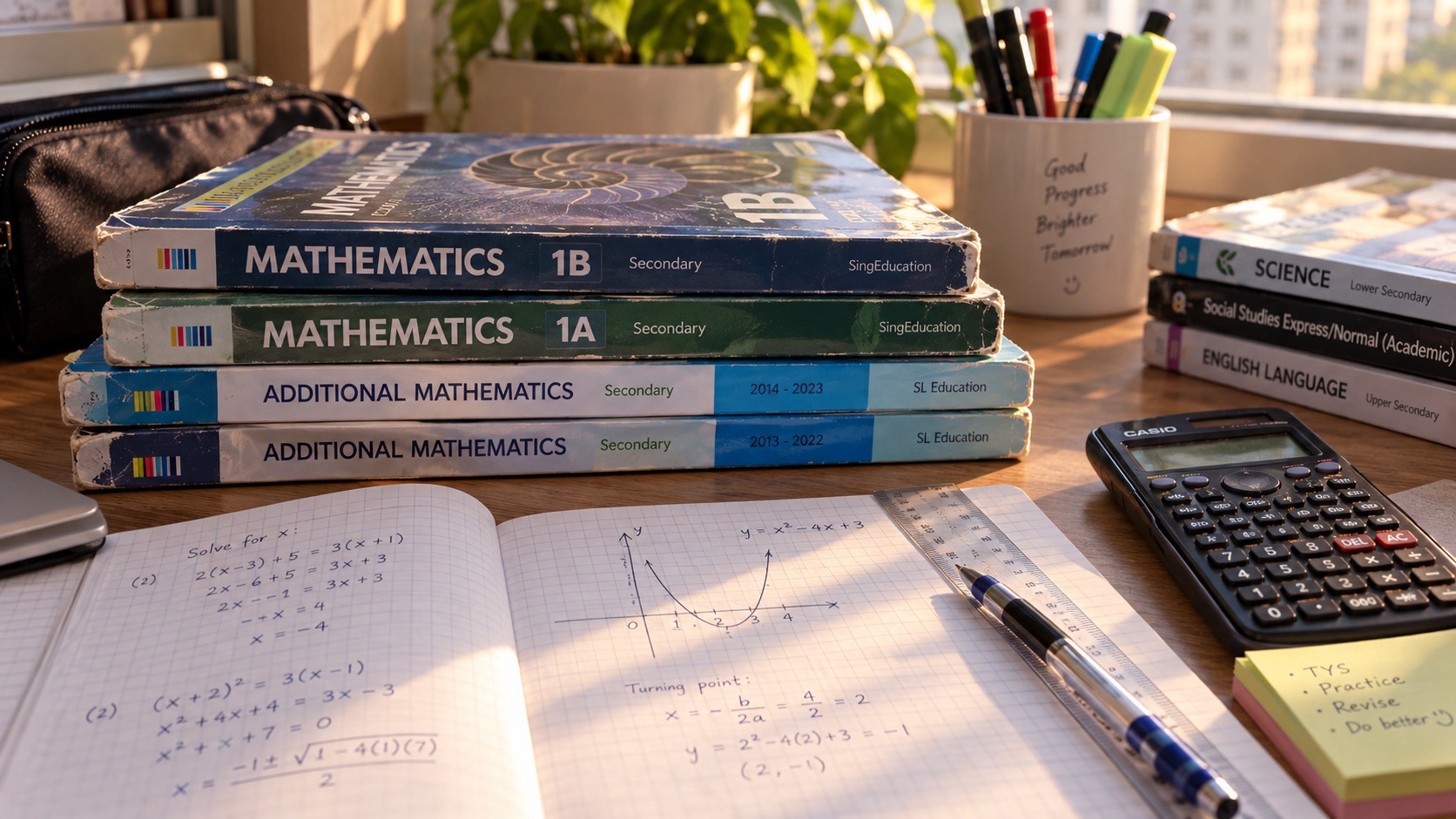
Singapore Math matrices guide for families and teachers outside Singapore. What G3 students learn about matrices in Secondary 3 or 4, how Singapore teaches them, and how to practise them at home.
A matrix is a rectangular array of numbers arranged in rows and columns.
In Singapore’s secondary syllabus, a matrix is first of all a way to organise information.
In Singapore Mathematics, matrices are a Secondary 3 or 4 topic in G3 Mathematics. Students display data in a matrix, interpret a given matrix, multiply a matrix by a scalar, and calculate the sum and product of two matrices where these are defined.
The topic is short, but it trains careful reading of rows, columns and order.
This guide is useful for families and teachers who want to:
- understand what Singapore expects in Secondary 3 or 4;
- teach matrices at home in a clear sequence;
- prepare a student who is moving into a Singapore secondary school; or
- support a student using Singapore Math materials in another country.
Quick facts
Level: Secondary 3 or 4 (G3 Mathematics only)
Strand: Number and Algebra (N9 Matrices)
Official source: SEAB G3 Mathematics syllabus K310 (2027 SEC; O-Level 4052 in 2026), with year placement from MOE’s 2020 secondary Mathematics syllabus
Comes after: Sets and Venn Diagrams and Statistical Diagrams
Leads to: Personal and Household Finance and Vectors
What Matrices Mean in Singapore Mathematics
A matrix with 2 rows and 3 columns has order 2 × 3. Rows come first, then columns.
Each entry has a meaning given by its row label and its column label. A matrix of sales might have days as rows and items as columns.
Two matrices of the same order are added by adding the entries in matching positions. A scalar, which is a single number, multiplies every entry.
Matrix multiplication combines each row of the first matrix with each column of the second. It is defined only when the number of columns in the first matrix equals the number of rows in the second.
In context, a product often answers a practical question, such as “what were the takings on each day?”
Where Matrices Sit in the Singapore Syllabus
Matrices are sub-strand N9 of the SEAB G3 Mathematics syllabus. MOE places them in Secondary 3 or 4.
The syllabus lists:
- “display of information in the form of a matrix of any order”;
- “interpreting the data in a given matrix”;
- “product of a scalar quantity and a matrix”; and
- “problems involving the calculation of the sum and product (where appropriate) of two matrices”.
MOE’s teaching syllabus words the last item as “problems involving addition, subtraction and multiplication of matrices”.
The wording is identical in the 2026 O-Level syllabus (4052) and the 2027 SEC syllabus (K310). K310 also has a Mathematical Notation section that includes matrix notation.
Matrices are G3 only. They are not in the content of G2 Mathematics (K210).
| Matrix work | What students do |
|---|---|
| Display | Turn a table of information into a matrix of the right order |
| Interpret | Explain what a given entry, row or column means |
| Scalar product | Multiply every entry by the same number |
| Sum and difference | Add or subtract matrices of the same order |
| Product | Multiply two matrices when the orders allow it, and explain the result |
The four listed items do not mention determinants or inverse matrices.
How Singapore Teaches Matrices
1. Start with a table
A table of data becomes a matrix when the numbers are kept in their rows and columns and the labels are remembered.
2. State the order
Students say the order aloud before any calculation: “This is a 2 × 3 matrix: 2 rows, 3 columns.”
3. Add, subtract and multiply by a scalar
These are entry-by-entry operations. Students check that the orders match before adding or subtracting.
4. Check whether a product exists
Write the two orders side by side, such as (2 × 3)(3 × 1). The inner numbers must match. The outer numbers give the order of the answer, here 2 × 1.
5. Multiply row by column
Each entry of the product comes from one row of the first matrix and one column of the second: multiply in pairs, then add.
6. Interpret the answer
Students say what each entry of the result means in the context, with units.
Worked Examples
The table shows the number of pens, files and notebooks a shop sold on two days.
| Day | Pens | Files | Notebooks |
|---|---|---|---|
| Monday | 4 | 2 | 5 |
| Tuesday | 3 | 6 | 1 |
Using a matrix product to find takings
Question: Pens cost $1.20, files cost $3.50 and notebooks cost $2.00. Use matrices to find the takings on each day.
Step 1. Write the sales as a 2 × 3 matrix Q, with rows (4, 2, 5) and (3, 6, 1).
Step 2. Write the prices as a 3 × 1 column matrix P, with entries 1.20, 3.50 and 2.00.
Step 3. Q has 3 columns and P has 3 rows, so QP exists. Its order is 2 × 1.
Step 4. Monday: 4 × 1.20 + 2 × 3.50 + 5 × 2.00 = 4.80 + 7.00 + 10.00 = 21.80.
Step 5. Tuesday: 3 × 1.20 + 6 × 3.50 + 1 × 2.00 = 3.60 + 21.00 + 2.00 = 26.60.
Step 6. QP is the column matrix with entries 21.80 and 26.60. The takings were $21.80 on Monday and $26.60 on Tuesday.
Check: Over both days the shop sold 7 pens, 8 files and 6 notebooks, worth 8.40 + 28.00 + 12.00 = $48.40. Also $21.80 + $26.60 = $48.40.
A scalar multiple and a sum
Question: A is the 2 × 2 matrix with rows (2, −1) and (0, 3). B is the 2 × 2 matrix with rows (1, 4) and (5, −2). Find 2A + B.
Step 1. 2A has rows (4, −2) and (0, 6).
Step 2. Add entry by entry: rows (4 + 1, −2 + 4) and (0 + 5, 6 + (−2)).
Step 3. 2A + B has rows (5, 2) and (5, 4).
Check: Both matrices have order 2 × 2, so the sum is defined, and the answer is also 2 × 2.
Common Mistakes
- Reversing the order. A 3 × 2 matrix has 3 rows and 2 columns, not the other way round. Fix: always say “rows, then columns”.
- Multiplying entry by entry. That is not matrix multiplication. Fix: combine a row of the first matrix with a column of the second.
- Assuming AB = BA. In general they are different, and one may not even exist. In the example above, PQ is (3 × 1)(2 × 3), which is not defined. Fix: check the orders for each product separately.
- Adding matrices of different orders. Fix: compare orders before adding or subtracting.
- Losing the meaning. A correct product is of little use if the student cannot say what it means. Fix: label the rows and columns in pencil and keep the labels through the working.
- Applying a scalar to one entry only. Fix: a scalar multiplies every entry.
Teaching Matrices Outside Singapore
Matrix notation is broadly international, but the scope of school matrix work varies.
- Brackets. Some books put matrices in round brackets and others in square brackets. Both mean the same thing.
- Scope. If your course covers determinants, inverses or matrices as transformations, that goes beyond the four Singapore G3 items quoted above. Transformations are not a topic in the current Singapore secondary syllabus.
- Timing and level. Matrices are a Secondary 3 or 4 topic and G3 only. Decide by readiness rather than age. The Singapore Math Grade Levels guide explains why direct conversions are unreliable.
- Prerequisites. Students need accurate arithmetic with negative numbers and decimals, and confidence reading tables.
- Working. An approved calculator may be used in both G3 Mathematics papers. SEAB also notes that “omission of essential working will result in loss of marks”, so students should show the row-by-column working.
How to Practise Matrices at Home
- Turn a real table, such as a weekly shopping list with quantities, into a matrix and state its order.
- Write a matching price matrix and decide whether the product exists before calculating.
- Work one product by hand each session, then check it on a calculator.
- Practise one scalar multiple and one sum or difference.
- For every answer, write one sentence saying what each entry means.
- Once a week, try a product in both orders and explain why one fails or why the results differ.
Short, accurate sessions build the habit of checking orders first.
Try These
- State the order of a matrix with 3 rows and 4 columns.
- A is a 2 × 3 matrix and B is a 3 × 2 matrix. Is AB defined? If so, state its order. Is BA defined?
- Find 3M, where M is the 2 × 2 matrix with rows (1, 2) and (3, 4).
- Find the product of the 1 × 2 matrix (2, 5) and the 2 × 1 column matrix with entries 3 and 4.
Answers
- 3 × 4, because rows are stated first.
- Yes, AB is defined and has order 2 × 2. BA is also defined, with order 3 × 3. The two products are different.
- 3M has rows (3, 6) and (9, 12). Every entry is multiplied by 3.
- The 1 × 1 matrix (26), because 2 × 3 + 5 × 4 = 6 + 20 = 26.
What Comes Next
Matrices are a compact topic, but their habits spread.
- Personal and Household Finance often involves tables of quantities and prices, which is exactly what a matrix product organises.
- Vectors, another G3-only topic in Secondary 3 or 4, uses column notation and scalar multiplication.
- Mathematical Modelling asks students to represent a real situation mathematically, and a matrix is one way to do that.
A student who checks orders and interprets entries usually handles these later topics with more care.
Frequently Asked Questions
When do Singapore students learn matrices?
In Secondary 3 or 4, as part of G3 Mathematics.
Are matrices in G2 Mathematics?
No. Matrices are not in the G2 Mathematics content (K210).
Do students learn determinants and inverse matrices?
They are not among the four matrix items in the G3 Mathematics syllabus, which cover displaying and interpreting data, scalar multiples, and sums and products.
Are matrices used for transformations here?
No. Transformations are not a topic in the current Singapore secondary syllabus. Matrices in G3 Mathematics are about organising and combining information.
What does “where appropriate” mean for products?
A product of two matrices exists only when the number of columns in the first equals the number of rows in the second. Students must check this first.
Can my child use a calculator for matrices?
An approved calculator may be used in both papers. Working should still be shown, because omitted essential working loses marks.
Helpful Reading
- Singapore Mathematics | International Edition: Sets and Venn Diagrams
- Singapore Mathematics | International Edition: Vectors
- Singapore Mathematics | International Edition: Personal and Household Finance
- Secondary Mathematics: Matrices, Data, Scalar Operations and Matrix Multiplication
- Why Mathematics Accuracy Falls on Longer Multi-Step Questions
- How to Make Sense of the SEC G3 Mathematics Syllabus
- SEAB G3 Mathematics Syllabus K310
- MOE Secondary Mathematics Syllabuses
Matrices in Singapore Mathematics
Rows first, then columns.
Check the orders before you calculate.
Row by column, then add.
Say what each entry means.
Taught this way, a matrix is not a puzzle of brackets.
It is a tidy way to hold information and combine it.
That habit of order and meaning serves a student well beyond this topic.
Ask Bukit Timah Tutor
Bukit Timah Tutor teaches Mathematics in small groups of three students in Singapore.
If your child is learning Singapore Mathematics at home, in an international school or in a Singapore school, and you are unsure where to begin with this topic, send us a short message with the student’s level and one example of the work.
Bukit Timah Tutor
8 Fourth Avenue, Singapore 268674
Near Sixth Avenue MRT
Three-student Mathematics tutorials
By appointment
Properly taught kids shine a bright light into the future.
Singapore Mathematics | International Edition is a Bukit Timah Tutor guide series for families and teachers outside Singapore. It is not a textbook and is not affiliated with MOE, SEAB or any publisher. Syllabus details were checked against MOE and SEAB documents in October 2026. Always confirm current requirements with your school.
← Previous: Singapore Mathematics | International Edition: Sets and Venn Diagrams
Next: Singapore Mathematics | International Edition: Personal and Household Finance →
All 100 topics in the International Edition