
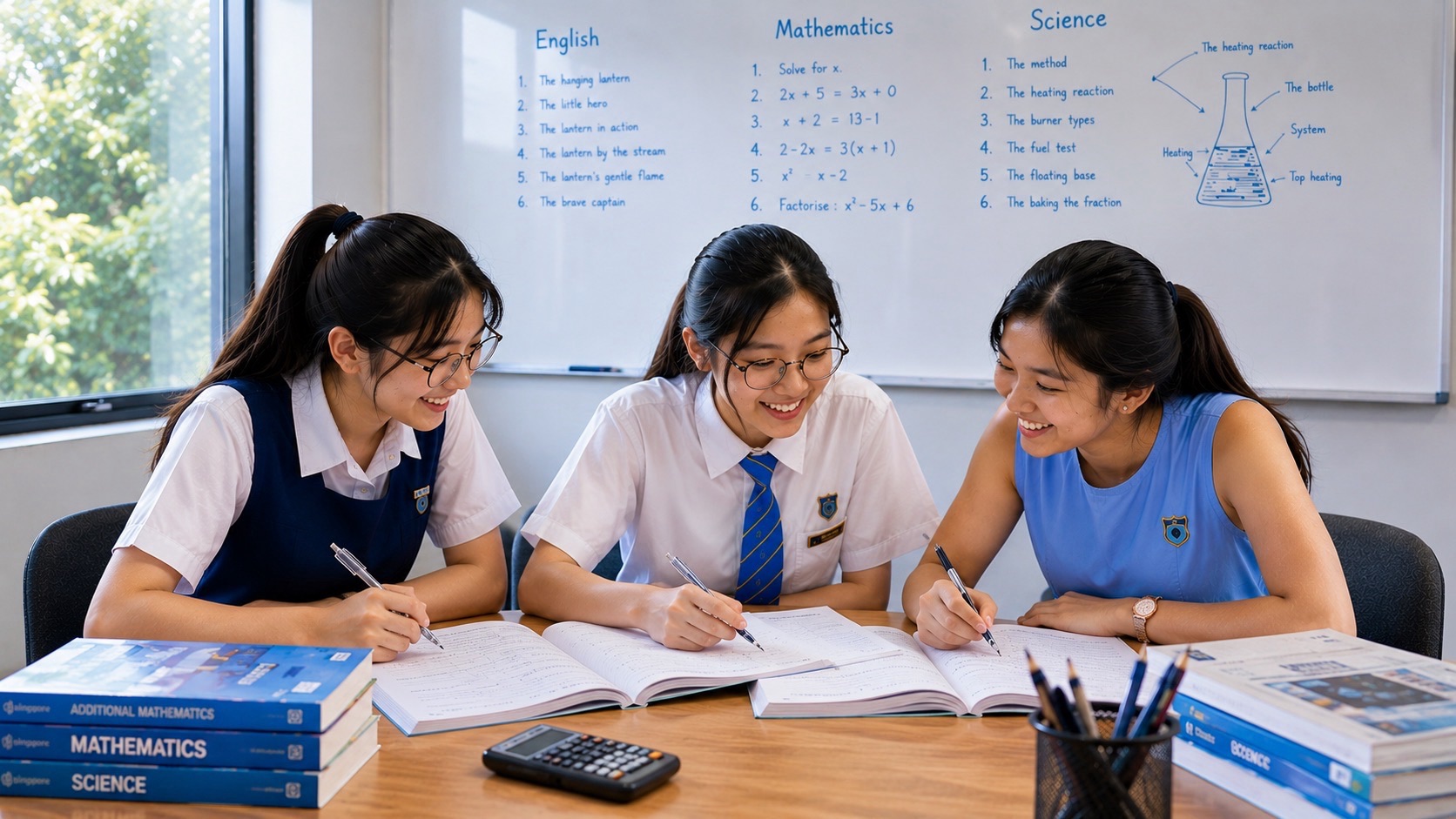
Revision in Secondary 3 Additional Mathematics is not the act of looking at mathematics again. It is the act of making mathematics available again when the page, teacher, example and chapter heading are gone.
This distinction changes everything.
A student can spend hours rereading notes, highlighting formulas and watching worked solutions while becoming more familiar with the material but not necessarily more able to retrieve it independently. Familiarity feels like learning because the page looks easier each time. The examination asks for something else.
It asks whether the student can recognise the structure, retrieve the method, execute it, connect it to other topics and verify the answer without the original support.
Under the 2027 Singapore-Cambridge Secondary Education Certificate, Additional Mathematics is offered at G2 K232 and G3 K341. Both routes require more than routine technique. Students must solve problems, connect representations, reason and communicate mathematically. Effective revision therefore has to build retrieval, not merely recognition.
If you can only do the mathematics while looking at the mathematics, the revision is not finished.
That is the central principle of this guide.
The Short Answer
Retrieval and revision work by repeatedly asking the student to reconstruct mathematical knowledge from memory under gradually changing conditions.
A strong revision cycle looks like this:
Learn → Retrieve → Check → Repair → Delay → Mix → Retest → Perform.
- Learn: understand the concept and method.
- Retrieve: attempt it without looking at the worked example.
- Check: compare the solution with the mathematical standard.
- Repair: fix the first weak link.
- Delay: leave enough time for memory to become less supported.
- Mix: remove chapter labels and combine topics.
- Retest: use a fresh question.
- Perform: use the knowledge under timed and unfamiliar conditions.
Revision becomes useful when it moves the student from assisted recognition to independent retrieval.
Recognition Is Not Retrieval
This is the most important distinction in revision.
Recognition means the mathematics looks familiar when the student sees it.
Retrieval means the student can reconstruct the relevant mathematics without seeing the answer first.
Recognition feels easier because the external page is supplying cues. Retrieval is harder because the student has to generate the route internally.
That is why rereading can create false confidence.
A formula may look obvious in the notes and still fail to appear in the examination. A worked identity may make complete sense while the student is reading and still remain inaccessible when a different trigonometric expression appears two weeks later.
Revision must therefore include repeated moments in which the notes are closed.
The Retrieval Gap: “I Knew This Yesterday”
Students often experience a frustrating pattern.
They complete a chapter confidently. A week later, the same idea feels partly missing. By the time a mixed paper appears, the student may remember the topic name but not the method.
This does not automatically mean the original learning failed. It means the memory has not yet been strengthened through enough retrieval.
The first successful lesson creates a path. Repeated retrieval makes that path easier to find later.
Secondary 3 A-Math needs this especially because later topics depend on earlier ones. Algebra learned in one month may become necessary inside calculus several months later. Trigonometric identities may reappear inside equations, graphs or calculus. Quadratic structure may reappear after substitution in an apparently unrelated problem.
If knowledge cannot be retrieved after delay, the dependency chain becomes fragile.
Revision Should Follow the Dependency Graph, Not the Textbook Order
Textbooks are organised for teaching. Revision should be organised for performance.
That means the best revision order may not be Chapter 1, Chapter 2, Chapter 3.
Instead, ask which skills support the largest number of later tasks.
- algebraic fractions support many later manipulations;
- factorisation supports quadratics, polynomials, trigonometric equations and calculus;
- graph interpretation supports functions, trigonometry and calculus;
- exact-value control supports trigonometry and symbolic work;
- equation solving supports nearly every strand;
- checking habits support every topic.
A revision plan that strengthens high-dependency skills can improve several topics at once.
This is more efficient than treating every chapter as equally isolated.
Spaced Retrieval: Let Memory Become Slightly Difficult
Immediate repetition feels fluent because the method is still active in working memory.
That fluency is useful during initial practice, but it does not prove long-term availability.
Spaced retrieval introduces delay.
A topic learned today is revisited after enough time has passed that some effort is required to reconstruct the method.
The effort is the point.
A useful pattern might be:
- same day: short independent practice;
- 2–3 days later: quick retrieval set;
- one week later: fresh questions with changed form;
- two to three weeks later: mixed retrieval;
- one month later: delayed diagnostic retest.
The exact spacing can vary with the student and topic. The important idea is that revision should occur after some forgetting has begun, not only while everything still feels recent.
Do Not Confuse Difficulty With Failure
Retrieval feels harder than rereading.
That can make students believe they are getting worse.
But productive difficulty can be useful. If the student has to reconstruct the relationship, decide which method applies and rebuild part of the solution, the memory is being used in a way closer to examination conditions.
The revision should not be so hard that every attempt collapses. But it should not be so supported that the student merely recognises the answer.
The correct level of difficulty is one at which the learner can retrieve enough to struggle productively, then receive precise feedback.
Closed-Book First, Open-Book Second
A simple revision rule can improve the quality of practice dramatically:
Attempt from memory before reopening the notes.
This changes notes from a crutch into a checking tool.
A useful sequence is:
- read the question;
- write what you remember;
- attempt the first method independently;
- mark exactly where recall breaks;
- consult the notes only for the missing piece;
- close them again;
- restart or continue independently;
- use a fresh question to prove the repair.
This makes every revision attempt diagnostic.
Formula Recall Should Be Connected to Meaning
Additional Mathematics contains formulas, identities and standard transformations, but isolated memorisation is fragile.
Students remember more reliably when the formula is connected to a job.
- completed-square form reveals turning-point structure;
- the discriminant reveals the nature of quadratic roots;
- trigonometric identities allow equivalent forms to be exchanged;
- differentiation rules produce a rate-of-change function;
- integration rules reconstruct accumulated or prior structure;
- gradient relationships connect coordinate geometry and line direction.
The revision question should therefore not only be “Can you state the formula?”
It should also be:
What problem does this formula solve, and what structure should make you think of it?
Worked Examples Should Fade
Worked examples are excellent teaching tools. They show how a clean mathematical chain is constructed.
But they can become harmful if they never disappear.
A useful progression is:
- full worked example;
- worked example with one missing step;
- worked example with several missing steps;
- question with only the first line given;
- independent question with no scaffold;
- changed-form question;
- mixed-topic question;
- timed question.
The support should fade as ownership grows.
If the example remains permanently visible, the student may become excellent at following but weak at initiating.
Interleaving: Mix Related Topics Before the Examination Does
Interleaving means mixing different types of problems instead of completing a long block of one identical method.
This is valuable because it forces method selection.
For example, a revision set may include:
- a quadratic condition;
- a trigonometric equation;
- a derivative problem;
- a coordinate geometry question;
- a partial-fractions question;
- a mixed problem combining two of them.
The student must identify the structure each time.
Interleaving should not replace all blocked practice. Early learning still benefits from topical repetition. The key is timing: once individual methods are reasonably stable, revision should increasingly require selection.
Mixed Retrieval Is Different From Random Difficulty
Good mixed revision is designed, not random.
The question set should have a purpose.
Possible purposes include:
- testing whether quadratics are recognised outside a quadratic chapter;
- checking whether algebra remains stable inside calculus;
- testing degree-radian control after several weeks away from trigonometry;
- checking whether exact values are preserved across different topics;
- testing whether the student can switch from differentiation to coordinate geometry;
- checking whether an old error pattern returns under time pressure.
Revision becomes much more powerful when every mixed set is designed to answer a diagnostic question.
Error-Led Revision Is More Efficient Than Equal Revision
Not every topic deserves the same revision time.
A student may be highly reliable in surds and repeatedly unstable in trigonometric equations. Giving both topics equal time is administratively neat but mathematically inefficient.
Error-led revision allocates effort according to evidence.
- frequent errors receive more attention;
- high-dependency errors receive priority;
- errors that propagate across topics receive urgent repair;
- stable topics are maintained with shorter retrieval doses;
- rare one-off slips are monitored without dominating the revision plan.
This is why an error ledger is so useful. It converts revision from guesswork into targeted maintenance.
The Error Ledger Becomes the Revision Map
An error ledger should record more than “wrong question”.
Useful fields include:
- topic;
- first wrong decision;
- first wrong line;
- error family;
- underlying dependency;
- repair action;
- date of immediate retest;
- date of delayed retest;
- whether the error returned in mixed practice;
- whether it returned under time pressure.
Over time, the ledger tells the student what should appear in revision more often.
The goal is not to create a permanent museum of mistakes. It is to retire errors after repeated evidence that the repair holds.
A Revision Topic Can Be Retired—Temporarily
Revision resources are limited. Students cannot practise everything every day.
Once a topic has survived several successful retrievals across delay and changed form, it can move to a lower-frequency maintenance schedule.
This creates three practical states:
- Repair: currently unstable; needs focused work.
- Maintain: broadly stable; needs periodic retrieval.
- Stress-test: stable in ordinary conditions; needs mixed, unfamiliar or timed testing.
This is more intelligent than cycling through chapters simply because the calendar says so.
Revision Should Move From Recall to Selection
Early revision asks:
Can you remember how to do this?
Later revision must ask:
Can you recognise when to do this?
This is the transition from retrieval to method selection.
A student may remember the quadratic formula perfectly and still fail if the quadratic appears after a substitution in a trigonometric problem and is not recognised.
Revision therefore has to remove labels progressively.
Revision Should Move From Selection to Transfer
Once a student can identify the correct method in familiar forms, revision should change the surface.
Transfer questions may alter:
- coefficients;
- notation;
- diagram orientation;
- wording;
- context;
- order of information;
- which topic appears first;
- whether a result must be reused later.
The underlying mathematics remains recognisable only if the student has learned the structure rather than memorised the appearance.
Revision Should Move From Transfer to Performance
Examinations add time limits, uncertainty and topic switching.
Revision should therefore eventually include those conditions.
- timed mixed sets;
- unfamiliar questions;
- longer multi-part questions;
- questions with “hence” dependencies;
- practice that includes leaving and returning;
- whole-paper sections;
- full-paper simulations later in the cycle.
Performance practice should come after the underlying methods are reasonably stable. Timing fragile mathematics too early can simply automate error.
The 24-Hour Rule: Retest the Lesson Before It Becomes a Memory
A practical Secondary 3 habit is to revisit the core lesson shortly after it was learned.
Within roughly a day, the student can attempt one or two fresh questions without looking at the original worked example.
This is not a full revision session. It is a quick ownership check.
If the student cannot begin without reopening the notes, the method has not yet become independently retrievable.
That is useful information while the lesson is still recent enough to repair efficiently.
The One-Week Rule: Change the Surface
A week later, revision should not simply repeat the same worksheet.
Change the surface.
- use different coefficients;
- reverse the direction of the question;
- move from equation to graph;
- hide the method inside another topic;
- remove the chapter title;
- ask for explanation rather than only calculation.
If the method survives the change, the student is learning the structure rather than the template.
The One-Month Rule: Mix and Stress-Test
After a longer delay, the best question is no longer “Can you still do this chapter?”
It is:
Can you still recognise and use this mathematics when it appears beside other mathematics?
This is where mixed sets become valuable.
A one-month stress test can combine old and new material, include one unfamiliar form and require at least one independent check.
This provides much stronger evidence of durable learning than immediate repetition.
Revision Cards Should Ask Questions, Not Store Answers
Students sometimes create beautiful summary cards that become miniature textbooks.
Those cards may be useful for reference, but they are weak retrieval tools if the answer is always visible.
A stronger card asks:
- What does the discriminant tell you?
- When is completed-square form useful?
- What must be checked after solving a trigonometric equation?
- Why does an indefinite integral require a constant?
- How can you distinguish signed integral from geometric area?
- What makes a tangent problem become a coordinate-geometry problem?
The answer should be hidden until the student attempts retrieval.
Blank-Page Retrieval Is a Powerful Diagnostic
One of the simplest revision techniques requires almost no resources.
Take a blank page and write everything you can reconstruct about one topic before opening any notes.
For example, for trigonometric equations:
- what identities are relevant?
- how are degrees and radians handled?
- what does the principal value mean?
- how are other solutions found?
- what interval checks are required?
- what common errors occur?
Then compare the page with the correct reference.
The missing pieces are the revision targets.
This is much more diagnostic than copying the notes again.
Revision Should Include Explanation
Students can sometimes execute procedures they do not understand.
A short explanation check can expose this immediately.
Ask:
- Why is this transformation legal?
- Why does this method fit this question?
- Why can there be more than one trigonometric answer?
- Why does the derivative become zero at a stationary point?
- Why can a definite integral be negative?
- Why is this earlier result useful in the next part?
Explanation converts revision from procedure rehearsal into conceptual reconstruction.
Revision Should Include Verification
A student who only practises getting answers can become dependent on external marking.
Revision should repeatedly ask the student to generate a check.
- solve an equation, then substitute;
- find roots, then inspect the factorised form;
- find trigonometric solutions, then test the interval;
- integrate, then differentiate the result;
- find a stationary point, then inspect graph behaviour;
- use an estimate to check numerical magnitude.
This builds self-correction into the revision routine.
Revision Should Include the First Wrong Line
When a revision question is wrong, do not immediately read the full solution.
First locate the first wrong decision or first wrong line.
Then classify it:
- reading;
- representation;
- method selection;
- algebra;
- trigonometric cycle;
- calculus meaning;
- domain or interval;
- exactness;
- calculator state;
- communication;
- retrieval;
- time pressure.
This prevents revision from becoming endless repetition of whole questions when only one small dependency needs repair.
Do Not Revise Only What Feels Comfortable
Students naturally prefer topics that produce quick success.
This can distort revision.
A student may spend thirty minutes on familiar algebra because it feels productive and avoid the trigonometric interval problem that actually needs repair.
A balanced revision plan should include:
- maintenance of strong topics;
- focused repair of weak topics;
- retrieval of older topics;
- mixed questions;
- one deliberately uncomfortable area.
Revision should follow evidence, not mood.
Do Not Revise Only What Feels Difficult
The opposite mistake also occurs.
A student can spend all revision time repairing weak topics while allowing strong topics to decay.
Strong knowledge still needs maintenance.
A simple solution is to use three buckets:
- Repair: high-frequency weaknesses.
- Maintain: stable content requiring periodic retrieval.
- Stress-test: stable content tested under mixed, unfamiliar or timed conditions.
This keeps the whole mathematical system alive.
A Practical Weekly Revision Architecture
A Secondary 3 student does not need an enormous daily revision system. A smaller repeatable structure is often more sustainable.
Session A: Current learning
Practise the school’s current topic until the main method is understood and reasonably fluent.
Session B: Delayed retrieval
Retrieve an older topic without notes. Use only a few high-quality questions.
Session C: Error repair
Select recurring errors from the ledger. Repair the underlying mechanism and use fresh retests.
Session D: Mixed retrieval
Combine several topics with no chapter labels. Require method selection and checking.
Session E: Short timed set
Add time pressure only after the relevant methods are stable enough that speed testing is meaningful.
The exact number of sessions can vary. The important point is that revision should contain more than current homework.
A Practical 30-Minute Revision Session
When time is limited, a compact session can still be useful.
- 5 minutes: blank-page retrieval of formulas, concepts or decision rules.
- 10 minutes: two fresh questions from an older topic.
- 10 minutes: one mixed question requiring method selection.
- 5 minutes: error classification and one independent check.
The session is short, but every component asks the student to produce mathematics rather than merely look at it.
When to Use Past-Year and Examination-Style Questions
Examination-style questions are valuable, but timing matters.
If the student has not learned enough of the course, whole papers may create noise because too many questions are inaccessible for syllabus-sequence reasons rather than learning weakness.
Earlier in Secondary 3, use selected examination-style questions that match the content already taught and test transfer.
Later, as the syllabus coverage grows, revision can expand towards longer mixed sections and eventually whole-paper performance.
Past-year work should not be consumed merely as a finite stockpile of questions. Each question should produce information about recognition, execution, timing and checking.
Do Not Burn Through Good Questions Without Learning From Them
A student can complete a large number of good questions and gain surprisingly little if each one is marked, corrected and forgotten.
A high-value question should leave evidence.
- What structure did it test?
- Which method was chosen?
- Where was the first wrong decision?
- Where was the first wrong line?
- What dependency failed?
- What independent check was available?
- What fresh question should retest the repair?
The question is then doing more than awarding a mark. It is improving the student’s model of their own mathematics.
What G2 K232 Revision Should Build
G2 Additional Mathematics is designed as a bridge towards G3 Additional Mathematics. Revision should therefore build portability.
A strong G2 revision system should progressively develop:
- stable algebraic retrieval;
- recognition of quadratic and polynomial structure;
- trigonometric function and interval control;
- calculus meaning and procedure;
- cross-topic method selection;
- independent checking;
- delayed retention;
- self-diagnosis after errors.
The bridge is strong when the student can still use the mathematics after the immediate chapter context has disappeared.
What G3 K341 Revision Should Build
G3 Additional Mathematics operates at greater density and places heavier emphasis on problem solving, reasoning and communication.
Revision must therefore maintain a wider connected system.
- quadratics and inequalities;
- surds, polynomials and partial fractions;
- binomial expansion;
- exponential and logarithmic functions;
- trigonometric functions, identities and equations;
- coordinate geometry and proof;
- differentiation and integration;
- kinematics;
- mixed-topic recognition;
- mathematical reasoning and communication.
Because the system is larger, revision quality matters more than raw question quantity.
Why Retrieval Builds the G2 → G3 Bridge
A student is better prepared for a higher mathematical load when current knowledge remains available after delay and under changed conditions.
Retrieval practice gives evidence of exactly that.
A student who can still factorise, recognise quadratic structure, solve trigonometric equations and interpret derivatives after several weeks is carrying a stronger bridge than a student who has merely seen more advanced content recently.
Progression should therefore be supported by durable foundations, not only acceleration.
Why Revision Builds the Secondary 4 Runway
Secondary 4 is not the ideal year to discover that Secondary 3 knowledge disappeared as soon as each chapter ended.
By the end of Secondary 3, the revision system should already be keeping older material alive.
A strong Secondary 3 exit includes:
- a working error ledger;
- regular delayed retrieval;
- mixed-topic practice;
- maintenance of strong topics;
- focused repair of weak dependencies;
- independent checking;
- some timed mixed work;
- evidence that older topics remain retrievable.
Then Secondary 4 can increase examination intensity without rebuilding the entire course from memory.
Revision Should Become More Examination-Like Over Time
Early revision can remain close to the original learning environment.
Later revision should progressively resemble the conditions under which the knowledge must eventually perform.
- fewer labels;
- longer delays;
- more mixed questions;
- more unfamiliar forms;
- more linked parts;
- more time pressure;
- more independent checking;
- less teacher prompting.
This is how revision becomes performance training rather than memory maintenance alone.
What Parents Can Watch Without Teaching A-Math
A parent does not need to solve logarithmic equations or integrate functions to see whether revision quality is improving.
- Does the student revise with the notes closed at least part of the time?
- Can the student still do older topics after several weeks?
- Does revision include mixed questions rather than only chapter worksheets?
- Are recurring mistakes recorded and retested?
- Can the student explain why a method is used?
- Can the student check an answer independently?
- Is the student spending more time on evidence-based weak areas rather than comfortable topics?
- Can the student return to a failed question later and solve a fresh version?
These behaviours show whether revision is building durable mathematical availability.
A Five-Minute Parent Revision Check
- What old topic did you retrieve this week?
- Which mistake are you actively trying to retire?
- What mixed question did you do without a chapter label?
- What topic did you revisit after a delay?
- How did you check one answer independently?
Those questions reveal whether revision is active or merely familiar.
How Bukit Timah Tutor Treats Retrieval and Revision
At Bukit Timah Tutor, revision is treated as a retrieval system.
We do not want a student who can only reproduce yesterday’s lesson while the example is still fresh. We want the mathematics to remain available after time has passed, after the question has changed form and after another topic has appeared beside it.
That means using:
- delayed retesting;
- mixed retrieval;
- error-led revision;
- hint fading;
- fresh transfer questions;
- independent verification;
- timed stress-testing only when the underlying mathematics is stable.
The small-group format helps because the revision plan can respond to the actual error pattern of each student instead of assigning identical repetition to everyone.
The goal is not to make revision feel busy.
The goal is to make mathematics retrievable.
Route Through the Secondary 3 A-Math Spine
- How Secondary 3 Additional Mathematics Works | SEC G2 & G3
- How Secondary 3 G2 Additional Mathematics Works | SEC K232
- How Secondary 3 G3 Additional Mathematics Works | SEC K341
- How the G2 → G3 Additional Mathematics Bridge Works
- How Algebra Works in Secondary 3 Additional Mathematics
- How Trigonometry Works in Secondary 3 Additional Mathematics
- How Calculus Works in Secondary 3 Additional Mathematics
- How Mixed-Topic Questions Work in Secondary 3 Additional Mathematics
- How Error Diagnosis Works in Secondary 3 Additional Mathematics
- How Secondary 4 Additional Mathematics Revision Works
- How Mathematical Practice Works
- How to Learn Mathematics | Practise Until You Can Recognise the Method
- Singapore Mathematics Hub
Official Singapore References
- SEAB — 2027 SEC G2 Syllabuses for School Candidates
- SEAB — 2027 SEC G3 Syllabuses for School Candidates
- SEAB — Singapore-Cambridge Secondary Education Certificate
Where the Series Goes Next
With the control page, G2 route, G3 route, bridge, algebra, trigonometry, calculus, mixed-topic work, error diagnosis and retrieval system established, the Secondary 3 Additional Mathematics branch can now move into the final transition layers:
- How Secondary 3 A-Math Builds the Secondary 4 Runway
- How G3 A-Math Builds the H2 Mathematics Runway
Final Principle
Retrieval and revision work in Secondary 3 Additional Mathematics when the student stops treating revision as repeated exposure and begins treating it as repeated reconstruction.
Rereading creates familiarity. Retrieval creates availability. Delay tests durability. Mixing tests selection. Transfer tests structure. Timed practice tests performance. Error diagnosis tells the student what to repair next.
The strongest revision system therefore does not ask only whether the student has seen the mathematics recently.
It asks whether the student can still find the mathematics when the original support is gone.
Learn. Retrieve. Check. Repair. Delay. Mix. Retest. Perform.
That is how Secondary 3 revision becomes a foundation for Secondary 4 rather than a temporary memory of last week’s lesson.