
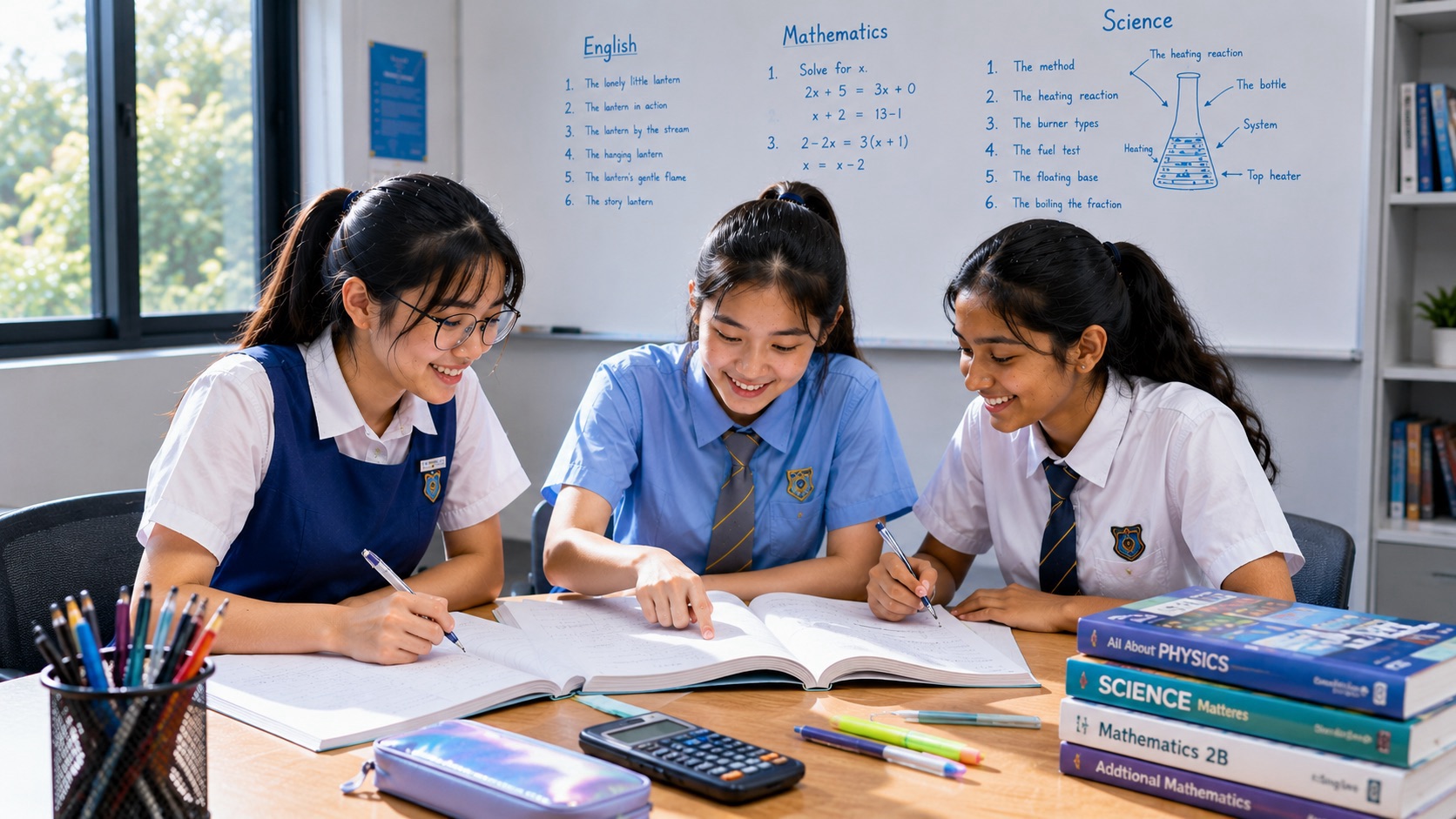
The move from G2 Additional Mathematics to G3 Additional Mathematics is not a jump from one unrelated subject into another. It is a bridge from one mathematical system into a denser version of that system.
Under the 2027 Singapore-Cambridge Secondary Education Certificate, G2 Additional Mathematics is syllabus K232 and G3 Additional Mathematics is syllabus K341. The official purpose of K232 is especially important: it is intended to prepare students adequately for G3 Additional Mathematics. K341 then points further forward, preparing students for more advanced mathematical study, including A-Level H2 Mathematics.
This gives us a clear architecture:
G2 Mathematics → G2 Additional Mathematics K232 → G3 Additional Mathematics K341 → advanced post-secondary mathematics.
The bridge works when the student carries forward what already works, repairs what is still fragile, and expands capacity before the mathematical load increases.
The bridge fails when a higher subject label is treated as the goal while the underlying mathematical system remains unstable.
The Short Answer
The G2 → G3 Additional Mathematics bridge works by preserving a common mathematical core while increasing breadth, abstraction, integration, reasoning demand and examination load.
A student moving towards G3 A-Math does not need to discard G2 A-Math. The opposite is true. The student needs to own the G2 foundations so thoroughly that new G3 structures can be added without destabilising the whole system.
The transition therefore has five jobs:
- Preserve the algebraic, trigonometric and calculus structures already learned.
- Stabilise weaknesses that would become expensive under higher load.
- Expand into additional G3 content and deeper representations.
- Integrate chapters so methods can be selected without prompts.
- Verify that the student can operate independently before increasing difficulty.
This is a capability transition, not merely a syllabus transition.
Start With the Correct SEC Map
The first step is to identify exactly what the two subject routes are.
- G2 Additional Mathematics: SEC K232.
- G3 Additional Mathematics: SEC K341.
There is no G1 Additional Mathematics syllabus in the 2027 SEC school-candidate list. G1 belongs to the wider Mathematics structure, while the Additional Mathematics branch itself begins at G2.
K232 assumes knowledge of G2 Mathematics. K341 assumes knowledge of G3 Mathematics. That means the bridge is not only between two A-Math courses. It also depends on the student’s underlying Mathematics level.
A student may therefore need two kinds of upgrading at once:
- stronger Additional Mathematics capability;
- stronger underlying Mathematics capability.
If the second is ignored, the first may never become stable.
A Bridge Is Not a Shortcut
The most common misunderstanding is to treat progression as acceleration.
If a student is doing well in G2 A-Math, it can be tempting to respond by immediately giving harder G3 worksheets. Sometimes that is appropriate. Often it is premature.
A bridge is not built by making the far side visible. It is built by making the structure underneath strong enough to carry load.
For mathematics, that means asking whether the student can still perform when:
- the chapter name disappears;
- two topics meet;
- coefficients become less friendly;
- the representation changes;
- the question is unfamiliar;
- the working becomes longer;
- time pressure increases;
- the teacher is no longer present.
If performance collapses under these changes, the student may need greater depth before greater breadth.
What Transfers Directly From G2 to G3
The bridge works because much of the mathematical architecture is shared.
Both G2 and G3 Additional Mathematics are organised around the broad strands of Algebra, Geometry and Trigonometry, and Calculus. That common structure means the student is not starting from zero when moving upward.
Important transferable capabilities include:
- quadratic functions and equations;
- algebraic manipulation;
- surds;
- polynomial structure;
- partial fractions;
- coordinate relationships;
- trigonometric functions, identities and equations within the relevant course scope;
- differentiation;
- integration;
- maxima and minima;
- rates of change;
- area and accumulated change;
- problem interpretation;
- mathematical communication;
- independent checking.
The names of topics matter less than the operating habits underneath them. If the student knows how to preserve equivalence, change representation, connect chapters and check an answer, those capabilities travel well.
The Most Important Transfer Is Algebra
Algebra is the largest piece of transferable infrastructure because it appears inside nearly every part of Additional Mathematics.
A student moving towards G3 should be increasingly reliable with:
- fractions;
- negative signs;
- brackets;
- expansion and factorisation;
- rearrangement;
- substitution;
- quadratic manipulation;
- exact forms;
- equation solving;
- inequalities;
- interpreting algebraic form.
The key phrase is increasingly reliable. A student does not need perfection before every new step. But the foundational operations should be stable enough that they do not consume all available attention.
This is because G3 adds more structure on top of the same algebraic engine. If that engine is already overloaded, the additional content becomes much harder than it needs to be.
Why Algebraic Fluency Matters More as the Load Rises
Working memory is limited. A student cannot consciously attend to every small manipulation and simultaneously reason about a difficult new concept.
This is why fluency matters. Routine algebra should become sufficiently automatic that attention can be used for structure, method selection and interpretation.
But fluency is not the same as speed.
A student who moves quickly but breaks equivalence is not fluent. A fluent student can move efficiently and preserve validity.
The bridge therefore needs two forms of algebraic strength:
- procedural fluency — the student can carry out standard operations reliably;
- structural fluency — the student can see which form is useful and why.
G3 increasingly rewards both.
What Expands in G3
The G3 course extends the Additional Mathematics system beyond the G2 bridge.
Among the important additional or expanded G3 demands are structures such as:
- binomial expansion;
- exponential and logarithmic functions;
- broader trigonometric manipulation and function work;
- plane geometry proof;
- additional coordinate-geometry and graphical transformation demands;
- broader differentiation and integration applications;
- straight-line motion through displacement, velocity and acceleration.
The important point is not the length of the list. It is what the list does to cognitive load.
Each new topic is built on earlier mathematical language. That means the bridge must reduce the amount of instability the student carries forward.
Binomial Expansion: Generalisation Raises the Abstraction Level
Binomial expansion shows one of the ways G3 becomes more abstract.
Instead of multiplying repeated factors directly, the student learns a general pattern that predicts terms and coefficients. A repeated process is compressed into a rule.
This is a step upward in abstraction because the student must be comfortable with a formula representing an entire family of expansions.
A student whose algebra is already stable can focus on the pattern. A student who is still fighting signs and indices may experience the same chapter as much harder.
Exponential and Logarithmic Functions: A New Function Family Enters the System
Exponential and logarithmic functions introduce a major new relationship: repeated multiplicative growth and its inverse.
The student must connect equations, functions, graphs and logarithmic laws. The topic therefore tests whether the bridge has built enough function thinking.
A useful reading is:
A logarithm answers the question: what power produces this value?
Students who understand inverse relationships can integrate the topic into their existing mathematical system. Students who memorise logarithmic rules without that relationship often experience the chapter as a disconnected collection of formulas.
Trigonometry: From Competence to Greater Structural Control
The G2 course already builds substantial trigonometric capability. The G3 route asks the student to operate a denser trigonometric system.
The bridge should therefore ensure that the student does not only remember identities but understands what identities do.
A strong bridge student can:
- move between trigonometric forms deliberately;
- respect interval conditions;
- recognise periodicity;
- work accurately in degrees or radians when required;
- find all valid solutions rather than the first calculator answer;
- use identities as transformation tools;
- connect trigonometry with graphs and calculus.
These habits allow the later G3 trigonometric work to attach to an existing system rather than starting from scratch.
Proof Changes the Nature of the Question
Plane geometry proof is important because it changes the objective from finding a number to constructing a justified argument.
The student must track what is given, what is known from established geometry, what can be inferred and what still has to be established.
This is not completely new. Good G2 A-Math already develops mathematical reasoning and communication. But proof raises the precision of that reasoning.
The bridge therefore benefits from asking students to explain why earlier algebraic and trigonometric steps are valid rather than accepting unexplained procedure.
Reasoning built early transfers into proof later.
Calculus: The Same Language Becomes Broader
Both G2 and G3 Additional Mathematics include calculus. This makes calculus one of the strongest bridge areas because the central concepts transfer directly.
The derivative still describes local change. Integration still reverses differentiation and measures accumulation within the relevant context. Maxima, minima, gradients, rates of change and area remain connected ideas.
What changes is the breadth of functions and applications the student must handle.
This means the bridge should make the conceptual meaning of calculus secure before more formulas are added.
A student who understands that differentiation describes change can learn new derivative rules more coherently. A student who sees differentiation only as “lower the power and multiply” may struggle when the function family changes.
Kinematics: Calculus Becomes Motion
G3 uses calculus to connect displacement, velocity and acceleration in straight-line motion.
The mathematical ideas are already present in the bridge:
- a function describes a changing quantity;
- a derivative describes how that quantity changes;
- integration can reconstruct a quantity from its rate of change.
Kinematics gives those ideas a physical interpretation.
This is a useful example of why conceptual understanding scales better than memorisation. If the student understands the relationship between a quantity and its rate, the new application has somewhere to attach.
The Assessment Load Changes Too
The bridge is not only about content. The assessment architecture becomes more demanding.
For the 2027 SEC:
- K232 G2 Additional Mathematics: two papers of 1 hour 45 minutes, 70 marks each, equally weighted.
- K341 G3 Additional Mathematics: two papers of 2 hours 15 minutes, 90 marks each, equally weighted.
The assessment-objective balance also changes.
- K232: approximately 50% standard techniques, 40% problem solving, 10% reasoning and communication.
- K341: approximately 35% standard techniques, 50% problem solving, 15% reasoning and communication.
This is a critical signal.
As the student moves into G3, the proportion of the paper associated with routine technique decreases, while problem solving and reasoning occupy more of the assessment.
The bridge must therefore build more than speed. It must build selection, connection, interpretation and explanation.
Why a Strong G2 Score Is Not the Whole Readiness Test
A high score is useful evidence, but it does not tell us how the score was produced.
Two students can both score well while possessing very different levels of readiness.
Student A may rely heavily on familiar question forms, teacher cues and recent topical drilling.
Student B may recognise methods independently, retain topics across time, cope with mixed questions and check errors without prompting.
The same score can therefore hide different mathematical systems.
A readiness decision should examine how performance behaves when support is removed and conditions change.
The Six-Part Bridge Readiness Test
A useful transition check examines six dimensions.
1. Foundation
Is the underlying Mathematics sufficiently stable? Can the student handle algebra, graphs, geometry and trigonometric foundations without recurring basic breakdown?
2. Fluency
Are routine A-Math procedures reliable enough that the student has attention left for harder reasoning?
3. Selection
Can the student identify an appropriate method when the chapter is not announced?
4. Transfer
Can the student use a familiar idea when the surface form changes?
5. Integration
Can the student combine more than one topic in the same solution?
6. Verification
Can the student check the result independently and identify the first wrong line after an error?
A student strong across these dimensions is carrying a bridge, not merely a collection of marks.
The First Wrong Line Is a Bridge Sensor
When difficulty rises, the location of the first wrong line becomes especially valuable.
If the first wrong line repeatedly occurs in basic algebra, the bridge needs foundation repair.
If the first wrong line occurs before any calculation because the student chooses the wrong method, the bridge needs selection practice.
If the mathematics is correct until the final interpretation, the bridge needs meaning and communication.
If errors appear only under time pressure, the bridge may need fluency and examination conditioning rather than conceptual reteaching.
This is why diagnostic precision is more useful than simply increasing worksheet quantity.
Mixed Practice Is Where the Bridge Is Tested
Topical practice builds technique. Mixed practice tests whether the technique is available when needed.
This distinction becomes increasingly important when moving towards G3 because problem solving receives greater assessment weight.
A bridge programme should therefore evolve through stages:
- learn one method;
- practise it topically;
- vary the question form;
- mix it with neighbouring topics;
- remove chapter labels;
- introduce unfamiliar applications;
- add time constraints;
- retest after delay.
If the method survives these changes, it is becoming portable.
Retention Matters More Than Acceleration
A student can appear advanced because they have already seen a G3 chapter. That is not the same as being ready for G3.
Readiness is better demonstrated when previously learned mathematics remains available after time has passed.
A bridge should therefore use delayed retrieval:
- return to algebra after trigonometry;
- return to quadratics after calculus begins;
- return to exact values after several weeks;
- place an older topic inside a new mixed problem.
The question is not “has the student seen this?”
The question is “can the student still use this when it is no longer recent?”
Mathematical Writing Must Scale With the Load
As solutions become longer, poor working becomes more expensive.
A student moving towards G3 needs working that can carry a larger logical chain without collapsing.
This does not mean writing every obvious arithmetic step. It means preserving the steps that matter to the logic:
- define substitutions clearly;
- show transformations cleanly;
- preserve brackets;
- state conditions and intervals;
- separate exact and approximate values;
- make reasoning auditable;
- show essential working required by the examination.
Good mathematical writing is a load-bearing part of the bridge.
Calculator Discipline Must Also Scale
Both G2 and G3 Additional Mathematics permit approved calculators in both papers, but denser mathematics creates more opportunities for calculator-state errors.
The bridge should establish routines before higher load arrives:
- check degree or radian mode;
- enter nested brackets carefully;
- preserve sufficient precision;
- avoid unnecessary early rounding;
- estimate expected magnitude;
- check whether all valid solutions have been found;
- treat calculator output as evidence, not truth.
The more advanced the mathematics becomes, the more important it is that tools remain under the student’s control.
A Higher Level Should Not Be Used as a Badge
Full Subject-Based Banding is designed around subjects, not broad labels for the whole learner. A level change should therefore be treated as an educational decision, not a status symbol.
Moving towards G3 makes sense when the higher mathematical demand is likely to produce productive learning.
It makes less sense when the student would spend most of their cognitive energy surviving basic manipulation while losing the opportunity to understand the new ideas.
The correct question is not:
Can we get the student into G3?
It is:
Can the student benefit from the G3 mathematical environment?
That is a much more useful standard.
What Evidence Supports a Strong Bridge
Schools govern subject-level placement and progression, so families should always work with the school’s actual policies and evidence requirements.
From a mathematical-learning perspective, useful evidence includes:
- consistent performance across more than one assessment;
- stable underlying Mathematics foundations;
- strong algebraic fluency;
- retention across time;
- independent method selection;
- successful mixed-topic work;
- ability to explain reasoning;
- ability to identify and repair errors;
- tolerance for unfamiliar questions;
- sustainable workload and study habits.
No single indicator is perfect. The strongest decision uses several pieces of evidence together.
A Practical Twelve-Week Bridge Model
A bridge does not need to be a separate national programme to be structured intelligently. A tutor or student can use a staged preparation cycle.
Weeks 1–2: Diagnose
Identify the student’s G2 Mathematics and G2 A-Math dependency weaknesses. Use recent scripts, mixed questions and delayed retrieval rather than only a fresh topical worksheet.
Weeks 3–4: Repair algebra
Stabilise the algebraic operations that appear across the subject: fractions, signs, factorisation, rearrangement, equation solving and exact forms.
Weeks 5–6: Build representation control
Move between expanded, factorised and completed-square forms; equations and graphs; trigonometric forms; derivative and function interpretations.
Weeks 7–8: Mix
Remove chapter labels. Combine algebra with trigonometry, graphs with equations, and calculus with earlier function ideas.
Weeks 9–10: Extend
Introduce selected higher-demand structures only after the bridge foundations are stable. The purpose is to test capacity for abstraction, not to rush through the entire G3 syllabus.
Weeks 11–12: Verify
Use mixed, unfamiliar and timed work. Retest older topics. Check whether the student can identify errors independently. Evaluate whether increased difficulty remains productive.
The exact calendar can vary. The architecture is what matters: diagnose → repair → mix → extend → verify.
Why Secondary 3 Is the Best Time to Build the Bridge
Secondary 3 has one major advantage over Secondary 4: there is still runway.
In Secondary 4, examination completion and performance pressure become more urgent. Repair is still possible, but every major foundational weakness competes with revision, school assessments, prelims and the SEC examination timeline.
Secondary 3 therefore offers the better environment for:
- deep algebra repair;
- slower conceptual explanation;
- building mixed-topic habits;
- developing checking protocols;
- testing possible higher-level readiness;
- learning how the student personally fails and recovers.
The bridge is strongest when built before the final-year compression arrives.
What Happens If the Student Is Not Yet Ready?
Not being ready for a higher mathematical load at one moment is not a permanent verdict.
It is diagnostic information.
If the bridge test reveals unstable foundations, the correct response is to repair them deliberately.
Possible repair targets include:
- algebraic manipulation;
- graph interpretation;
- trigonometric foundations;
- exact forms and numerical accuracy;
- method selection;
- retention;
- mathematical writing;
- time-pressure stability.
Once repaired, the bridge can be tested again with fresh evidence.
This is a healthier model than treating progression as a one-time judgement about innate ability.
What Parents Can Ask Without Teaching A-Math
A parent does not need to remember logarithmic laws or differentiation rules to understand whether the bridge is developing.
- Which route are you taking now: G2 K232 or G3 K341?
- Which old topic still causes the most trouble?
- Show me one mixed question you solved without a hint.
- Where was the first wrong line in your last difficult question?
- What check could have caught it?
- Can you still solve something from two months ago?
Those questions reveal the state of the learning system without turning the parent into the mathematics teacher.
How Bukit Timah Tutor Treats the Bridge
At Bukit Timah Tutor, the G2 → G3 Additional Mathematics bridge is treated as a capability transition rather than a label transition.
We look for what already transfers, what remains fragile and what additional load the student can productively carry.
That means separating:
- content exposure from content ownership;
- topical success from mixed-question success;
- speed from fluency;
- mistakes from their underlying mechanism;
- higher-level ambition from higher-level readiness;
- temporary support from independent mathematical capability.
The small-group format helps because the bridge is often visible inside working. We can see whether a student is recognising structure, merely imitating a recent example, or using a method for a reason.
The desired outcome is simple: when the mathematical environment becomes denser, the student’s system should continue to function.
Route Through the Secondary 3 A-Math Spine
- How Secondary 3 Additional Mathematics Works | SEC G2 & G3
- How Secondary 3 G2 Additional Mathematics Works | SEC K232
- How Secondary 3 G3 Additional Mathematics Works | SEC K341
- How Secondary 3 G2 Mathematics Works | SEC K210
- How Secondary 3 G3 Mathematics Works | SEC K310
- What Is G3 and G2 Additional Mathematics? Differences and Pathways
- Should I Take Additional Mathematics? G2 or G3 A-Math
- How Strong Must Algebra Be Before Secondary 3 A-Math?
- Mathematics Examination Craft
- Singapore Mathematics Hub
Official Singapore References
- SEAB — 2027 SEC G2 Syllabuses for School Candidates
- SEAB — 2027 SEC G3 Syllabuses for School Candidates
- SEAB — Singapore-Cambridge Secondary Education Certificate
Where the Series Goes Next
With the G2 route, G3 route and bridge now separated, the Secondary 3 Additional Mathematics branch can move into the mechanisms that cut across both levels:
- How Algebra Works in Secondary 3 Additional Mathematics
- How Trigonometry Works in Secondary 3 Additional Mathematics
- How Calculus Works in Secondary 3 Additional Mathematics
- How Mixed-Topic Questions Work in Secondary 3 Additional Mathematics
- How Error Diagnosis Works in Secondary 3 Additional Mathematics
- How Retrieval and Revision Work in Secondary 3 Additional Mathematics
- How Secondary 3 A-Math Builds the Secondary 4 Runway
- How G3 A-Math Builds the H2 Mathematics Runway
Final Principle
The G2 → G3 Additional Mathematics bridge works when progression is built on transferable capability rather than exposure alone.
K232 is deliberately positioned as preparation for G3 Additional Mathematics. K341 then expands the system and points towards advanced mathematics. The route therefore has continuity by design.
The student crosses the bridge by making algebra more stable, representation more flexible, method selection more independent, reasoning more explicit and checking more reliable.
A higher level should not require the student to abandon everything already built.
It should allow the student to carry a stronger mathematical machine into a more demanding environment.
Preserve what works. Repair what fails. Expand deliberately. Integrate the system. Verify before increasing load.
That is how the G2 → G3 Additional Mathematics bridge should work.