
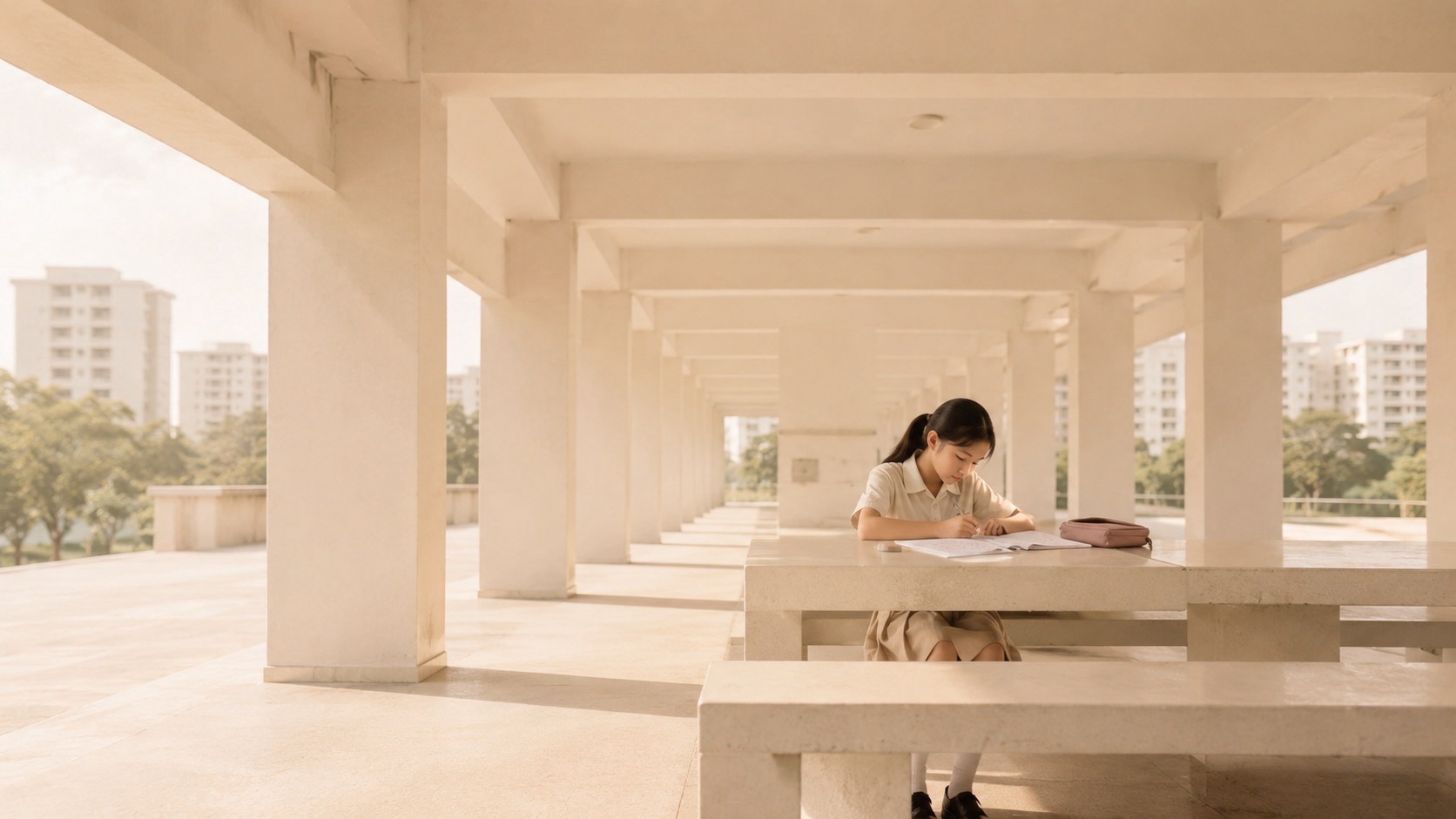
For many Singapore parents, the education pathway once appeared relatively straightforward:
Primary school → PSLE → Express, Normal (Academic) or Normal (Technical) → O-Levels or N-Levels → post-secondary education.
That familiar map has changed.
Students entering secondary school under Full Subject-Based Banding are no longer placed into the traditional Express, Normal (Academic) or Normal (Technical) streams. Instead, they enter through a Posting Group, take individual subjects at G1, G2 or G3, and eventually receive the new Singapore-Cambridge Secondary Education Certificate, commonly known as the SEC.
The new system offers greater flexibility, but it can initially feel more complicated.
The most useful way to understand it is this:
A Posting Group is the entrance into secondary school. G1, G2 and G3 describe the level of individual subjects. The SEC records the final combination of subjects and levels taken by the student.
A child is no longer expected to travel through secondary school inside one fixed academic lane.
Different subjects may develop at different speeds.
A student may need a gentler route in one subject, a more demanding route in another, and a change of level later when readiness improves. The responsibility for parents, schools and tutors is therefore not simply to push the child towards the highest possible level.
It is to keep the right pathways open.
The Singapore Education Pathway at a Glance
The broad pathway now looks like this:
Primary School
↓
Primary School Leaving Examination — PSLE
↓
Secondary 1 Posting through Posting Group 1, 2 or 3
↓
Individual subjects offered at G1, G2 or G3
↓
Subject levels reviewed as the student progresses
↓
Singapore-Cambridge Secondary Education Certificate — SEC
↓
Junior College, Millennia Institute, Polytechnic, ITE or other suitable pathways
The Integrated Programme remains a separate six-year route leading towards qualifications such as the GCE A-Level, International Baccalaureate Diploma or NUS High School Diploma.
For most students in mainstream secondary schools, however, PSLE, Full SBB, subject levels and the SEC now form one connected system.
What Does the PSLE Decide?
The Primary School Leaving Examination remains an important transition point.
A student’s PSLE Score is calculated by adding the Achievement Levels obtained across four subjects. The total ranges from 4 to 32, with 4 being the best possible score.
The PSLE Score affects:
- the secondary schools available during Secondary 1 posting;
- the student’s eligible Posting Group or Posting Groups;
- and the indicative level at which most subjects may begin.
However, the PSLE does not permanently determine the level of every subject throughout secondary school.
This distinction matters.
A student’s overall PSLE Score may place the child in Posting Group 2, while the child’s stronger Mathematics performance may support taking Mathematics at a more demanding level. Another student may enter through Posting Group 3 but later require additional support in one subject while remaining strong in the others.
The PSLE therefore creates a starting position.
It does not write the entire educational future.
Parents preparing a child for the transition can read more about our approach to PSLE Mathematics tuition in Bukit Timahand the important change from PSLE Mathematics to Secondary 1 Mathematics.
What Are Posting Groups?
From the 2024 Secondary 1 cohort, the old Express, Normal (Academic) and Normal (Technical) streams were removed for students entering secondary school under Full Subject-Based Banding.
Students are instead posted through:
- Posting Group 1
- Posting Group 2
- Posting Group 3
Posting Groups are used for two main purposes:
- placing students into secondary schools; and
- guiding the initial level at which most subjects are taken.
They should not be treated as permanent descriptions of a child’s ability.
MOE’s indicative posting ranges are:
| PSLE Score | Posting Group eligibility | Indicative starting level for most subjects |
|---|---|---|
| 4–20 | Posting Group 3 | G3 |
| 21–22 | Posting Group 2 or 3 | G2 or G3 |
| 23–24 | Posting Group 2 | G2 |
| 25 | Posting Group 1 or 2 | G1 or G2 |
| 26–30, with the required English and Mathematics results | Posting Group 1 | G1 |
Parents should follow the options stated in their child’s official Secondary 1 Eligibility Letter, particularly where more than one Posting Group is available.
A useful way to remember the distinction is:
The Posting Group helps the student enter the school. The subject level determines the academic demand of each subject.
For a more detailed Mathematics-focused explanation, read Posting Groups and Full SBB G1, G2 and G3 Mathematics.
Posting Group Is Not the Same as Subject Level
This is where many parents become confused.
A student in Posting Group 2 is not necessarily required to take every subject at G2.
Likewise, a student in Posting Group 3 should not be understood as permanently fixed at G3 for every subject regardless of later performance.
Under Full Subject-Based Banding, students can take different subjects at different levels according to their strengths, performance and readiness.
For example, a student might eventually take:
- English at G3;
- Mathematics at G3;
- Science at G2;
- Mother Tongue at G2;
- and another subject at G1 or G2.
Another student may begin most subjects at G2 but take Mathematics at G3 because Mathematics is a clear strength.
Students eligible for Posting Groups 1 and 2 may also be allowed to take English Language, Mother Tongue Languages, Mathematics or Science at a more demanding level from Secondary 1, based on their performance in the corresponding PSLE subject and the applicable school arrangements.
This is the central idea behind Full SBB:
The subject is levelled—not the whole child.
What Do G1, G2 and G3 Mean?
G1, G2 and G3 represent different levels of academic demand within a subject.
They differ in areas such as:
- curriculum breadth;
- conceptual depth;
- pace;
- abstraction;
- problem complexity;
- assessment expectations;
- and the independence expected from the student.
At the SEC examination level, the grading structures for G1, G2 and G3 correspond to the grading structures previously used for N(T), N(A) and O-Level subjects respectively. However, the new system should not be interpreted as merely renaming the old streams.
The important difference is that subject levels can now be combined within one student’s programme.
G1
G1 generally provides a more foundational treatment of the subject.
The emphasis is placed on essential knowledge, practical understanding, functional application and building sufficient confidence for continued learning.
G2
G2 provides an intermediate level of academic demand.
Students are expected to manage greater abstraction, more complex application and a broader range of questions than at G1.
G3
G3 is the most academically demanding of the three subject levels.
It generally requires:
- wider curriculum coverage;
- deeper conceptual understanding;
- stronger transfer between topics;
- greater algebraic or linguistic control;
- more independent problem-solving;
- and the ability to handle unfamiliar questions.
The difference is not simply that G3 students receive more homework.
The thinking itself becomes more demanding.
G1, G2 and G3 Are Not Measures of a Child’s Worth
Parents should be careful with the language used at home.
“G3 child,” “G2 child” or “G1 child” can easily become identity labels.
That is not the purpose of Full SBB.
A student may be highly capable in Mathematics but need a different pace in Mother Tongue. Another may be a strong writer whose mathematical foundations require more time. A third may develop later and move to a more demanding subject level after becoming more secure.
Children do not develop evenly across every domain.
Subject levels are intended to recognise this.
A more constructive question is not:
“Why isn’t my child at the highest level?”
It is:
“At which level can my child learn successfully now, and what would need to improve for the next pathway to become realistic?”
That question protects both ambition and wellbeing.
Can Students Move Between G1, G2 and G3?
Full SBB is designed to provide greater flexibility as students progress through secondary school.
Subject levels may be reviewed according to factors such as:
- school assessment performance;
- understanding of prerequisite knowledge;
- consistency;
- learning habits;
- ability to cope with the pace;
- and readiness for a more demanding curriculum.
Movement should not be treated as an automatic reward or punishment.
Moving to a more demanding level is helpful only when the student has the foundations and learning capacity to cope with it.
Moving to a less demanding level may sometimes give a struggling student space to rebuild—but it should not be used too quickly when a repairable weakness is the true problem.
This is where diagnosis becomes important.
A student performing poorly in Mathematics may have:
- weak number foundations;
- incomplete fraction and ratio understanding;
- difficulty reading word problems;
- fragile algebra;
- poor retrieval;
- slow working;
- examination anxiety;
- or a mismatch between understanding and written execution.
The same mark can come from very different causes.
The correct route depends on the cause.
Why Secondary 1 Matters Under Full SBB
Secondary 1 is more than a change of school.
It is the point where students begin learning inside a more flexible but more demanding system.
In Mathematics, the transition is especially significant.
Primary Mathematics relies heavily on:
- arithmetic;
- visual models;
- ratios;
- fractions;
- percentages;
- and structured problem-solving methods.
Secondary Mathematics gradually moves towards:
- algebraic representation;
- symbolic manipulation;
- equations;
- inequalities;
- graphs;
- formal geometry;
- and abstract relationships.
Students who were successful in primary school through memorised procedures may suddenly find that their usual methods are no longer sufficient.
Others may possess strong reasoning but lack the accuracy and organisation required for secondary-school working.
Our Secondary 1 Mathematics programme focuses on making this transition deliberately. The aim is not merely to finish the first chapters quickly. It is to help the student acquire the mathematical language needed for the years ahead.
A stable Secondary 1 student should gradually learn to:
- convert words into mathematical relationships;
- use letters as variables rather than decorations;
- write valid working;
- distinguish a method from a remembered example;
- and begin questions without waiting to be shown every step.
These abilities influence whether G2 or G3 Mathematics remains manageable later.
Why Secondary 2 Is a Major Pathway Year
Secondary 2 is often underestimated.
Parents may see it as the middle year between the Secondary 1 transition and the Secondary 3 subject combination.
In reality, Secondary 2 is where several important decisions begin taking shape.
By this stage:
- algebra becomes more central;
- mathematical weaknesses become harder to hide;
- subject-level suitability becomes clearer;
- upper-secondary subject combinations approach;
- and eligibility for subjects such as Additional Mathematics may become relevant.
A student who reaches the end of Secondary 2 with unstable algebra may struggle when upper-secondary Mathematics introduces more demanding work involving quadratics, functions, coordinate geometry, trigonometry and formal applications.
This does not mean every child must be accelerated.
It means weaknesses should be corrected while there is still enough runway.
Our Secondary 2 Mathematics programme treats the year as the point where students acquire the algebraic language needed for upper-secondary study.
For a weaker student, the priority may be to reconnect missing foundations to current schoolwork.
For a secure student, the priority may be speed, accuracy and transfer.
For a strong student, Secondary 2 may become preparation for a wider upper-secondary Mathematics route.
Secondary 3: When the Pathway Becomes More Visible
Secondary 3 is where the consequences of earlier foundations become easier to see.
Students encounter a heavier and more specialised curriculum. Depending on their school and subject combination, they may take subjects such as:
- G2 or G3 Mathematics;
- Additional Mathematics;
- Chemistry, Physics or Biology;
- Combined Science;
- Pure Humanities;
- Combined Humanities;
- and various applied or elective subjects.
Mathematics also changes character.
At this stage, students must increasingly connect topics rather than treat every chapter as separate.
A question may require the student to combine:
- algebra;
- graphs;
- geometry;
- trigonometry;
- and interpretation.
Students who previously relied on copying familiar procedures may begin to fall behind.
Our Secondary 3 Mathematics programme is designed around this upper-secondary shift.
Students beginning Additional Mathematics can also read about Secondary 3 Additional Mathematics tuition.
A-Math is not simply ordinary Mathematics with larger numbers.
It requires a more connected mathematical system involving:
- algebraic fluency;
- functions;
- logarithms;
- trigonometry;
- coordinate geometry;
- differentiation;
- integration;
- and precise symbolic reasoning.
The student must not only qualify to enter the subject.
The student must become capable of remaining inside it.
Secondary 4: Converting Knowledge into SEC Results
By Secondary 4, the purpose of tuition changes again.
The student may understand most of the syllabus but still lose marks through:
- incomplete working;
- slow retrieval;
- careless algebra;
- weak time allocation;
- poor question selection;
- inability to identify mixed-topic structures;
- or panic when a familiar idea appears in an unfamiliar form.
At this stage, learning cannot remain chapter-by-chapter.
The student must be able to retrieve knowledge from across the syllabus and use it under examination conditions.
Our Secondary 4 Mathematics programme therefore places greater attention on:
- syllabus integration;
- mixed-topic recognition;
- timed performance;
- answer presentation;
- error analysis;
- paper strategy;
- and stability under pressure.
The final year should not be spent endlessly adding new worksheets.
It should be used to identify what is still preventing the student’s knowledge from becoming a dependable examination result.
What Is the Singapore-Cambridge Secondary Education Certificate?
From the 2027 graduating cohort, the GCE N(T)-Level, N(A)-Level and O-Level examinations will be combined and renamed as the Singapore-Cambridge Secondary Education Certificate, or SEC.
Students will sit for each subject at the subject level they have been studying—G1, G2 or G3.
They will receive one certificate showing:
- the subjects taken;
- the level of each subject;
- and the grade obtained for each subject.
The SEC continues to be jointly examined and awarded by SEAB, MOE and Cambridge International Education. SEAB has stated that the overall examination standards will not be lowered and that the qualification will continue to be recognised locally and internationally.
This means a student may receive an SEC containing a mixed profile such as:
- G3 English Language;
- G3 Mathematics;
- G2 Science;
- G2 Mother Tongue;
- and other subjects at the appropriate levels.
The certificate presents the student’s actual subject combination rather than compressing the entire learner into one stream.
How Will SEC Subjects Be Graded?
The three subject levels use different grading structures:
| Subject level | Grade structure |
|---|---|
| G1 | A, B, C, D, E |
| G2 | 1, 2, 3, 4, 5, 6 |
| G3 | A1, A2, B3, B4, C5, C6, D7, E8, 9 |
Where aggregate calculations require subjects at different levels to be compared, official grade-mapping arrangements are used.
Students will receive their SEC results in January of the following year. English Language and Mother Tongue written examinations are scheduled in September, while most other written examinations will take place from October to November.
For parents, the deeper point is not the appearance of the certificate.
It is that decisions made during Secondary 1, 2 and 3 can affect the combination of subjects and levels eventually presented for post-secondary admission.
What Happens After the SEC?
Students may progress towards:
- Junior College;
- Millennia Institute;
- Polytechnic;
- ITE Higher Nitec programmes;
- specialised institutions;
- arts pathways;
- or other education and training routes.
From 2028, students receiving their SEC results will use a new Post-Secondary Admissions Exercise, or PSE, to apply for pathways including Junior Colleges, Millennia Institute, Polytechnics and ITE.
The exercise will bring applications for these pathways together at the point when SEC results are released. Existing early-admission routes such as DSA-JC, Poly-EAE and ITE-EAE will continue.
Admission will still depend on the requirements of the institution or course.
A mixed G1, G2 and G3 profile does not automatically close every pathway, nor does taking all subjects at G3 automatically guarantee entry into a preferred course.
What matters is the combination of:
- subject levels;
- grades;
- prerequisite subjects;
- aggregate calculations;
- course requirements;
- aptitude;
- and the student’s choices.
Parents should therefore think beyond the question:
“Is my child in G2 or G3?”
The more useful question is:
“Which future options require this subject, at this level, with this degree of performance?”
The Real Purpose of Full SBB: Better-Fitting Routes
Full SBB gives schools and families more ways to respond to uneven strengths.
However, flexibility alone does not guarantee progress.
A pathway becomes useful only when the student has the knowledge and habits required to move through it.
Consider three students.
Student A: Struggling in G3 Mathematics
The child may not immediately need to leave G3.
The real problem may be one missing foundation—perhaps fractions, algebraic signs, expansion or equation solving.
A precise repair may allow the student to reconnect with current schoolwork.
Student B: Comfortable in G2 Mathematics
The child may be performing steadily but could be ready for more demanding work.
The next step is not simply to place the child in G3 immediately. The tutor should first test whether the student can cope with the additional pace, abstraction and independence.
Student C: Already Strong in G3 Mathematics
The child does not need endless repetition of standard questions.
That student may need:
- unfamiliar problems;
- method comparison;
- deeper explanations;
- stronger mathematical communication;
- advanced transfer;
- and preparation for Additional Mathematics or later quantitative study.
These three students should not receive identical tuition simply because they are the same age.
The Tutor’s Role Is to Protect the Right Corridor
A useful tutor does more than teach the next worksheet.
The tutor must determine what kind of route belongs to the student now.
For a child who is falling behind, the tutor may need to create a shorter route back to understanding.
That means identifying the earliest important weakness, repairing it without sending the student unnecessarily far backwards, and reconnecting the repair to present schoolwork.
For a child who is coping but inconsistent, tuition should strengthen accuracy, retrieval, timing and examination execution.
For a child who is already strong, tuition should widen the route.
That may include:
- more difficult applications;
- unfamiliar question structures;
- alternative methods;
- proof and explanation;
- advanced problem-solving;
- and preparation for future academic demands.
This is the thinking behind our three modes of progressive Mathematics tuition.
The same class topic can be shared, while the purpose of the work differs.
One student may be rebuilding.
Another may be converting knowledge into stable marks.
A third may be positioning for a more demanding future pathway.
Why Small-Group Tuition Matters Under Full SBB
Full SBB makes individual observation more important.
Two students taking the same subject at the same level may still have very different needs.
One may understand concepts but work too slowly.
Another may be quick but careless.
A third may perform well on familiar exercises but freeze when a question changes form.
These differences are difficult to see when tuition is organised mainly around delivering the same worksheet to a large class.
In a carefully managed three-student tutorial, the tutor can observe:
- how each student begins;
- where the working breaks down;
- whether the student understands or imitates;
- which errors keep returning;
- how much prompting is required;
- and whether the student is ready for greater challenge.
Our explanation of why small-group tuition works at Bukit Timah Tutor describes how a shared lesson can remain socially useful while still allowing individual correction and extension.
The purpose is not to make every child move at exactly the same speed.
It is to keep every child moving in the correct direction.
What Parents Should Watch at Each Stage
Primary 5
Primary 5 is the beginning of the longer PSLE runway.
Watch for:
- weak fractions, ratios or percentages;
- difficulty explaining working;
- excessive dependence on model answers;
- poor retention between topics;
- and avoidance of multi-step problems.
The aim is to correct foundations before Primary 6 becomes dominated by examination preparation.
Primary 6
Primary 6 should balance PSLE performance with Secondary 1 readiness.
A student may obtain a respectable PSLE result but still enter secondary school with fragile algebraic readiness, poor organisation or weak independent learning habits.
After the PSLE, preparation should gradually shift from primary-school methods towards the demands of secondary learning.
Secondary 1
Watch whether the student can:
- follow the faster school pace;
- understand algebra;
- begin homework independently;
- maintain organised working;
- and recover after making mistakes.
The first sign of difficulty is often not a failed examination.
It may be growing dependence on copied solutions.
Secondary 2
This is the year to assess upper-secondary readiness.
Watch for:
- unstable algebra;
- weak graph interpretation;
- repeated sign errors;
- inability to connect topics;
- and uncertainty about future subject combinations.
Do not wait until Additional Mathematics or upper-secondary G3 Mathematics has already become overwhelming.
Secondary 3
Observe whether the student can handle the increased volume and abstraction.
A student may need to repair an earlier weakness while remaining connected to current school chapters.
Strong students may need greater depth rather than more repetition.
Secondary 4
The focus should turn towards SEC performance.
Watch for:
- incomplete papers;
- inconsistent grades;
- careless losses;
- slow retrieval;
- panic under timed conditions;
- and the inability to recognise familiar concepts inside mixed questions.
At this stage, every intervention should have a clear examination purpose.
When Does a Child Need Tuition?
Tuition may be useful when the child:
- no longer understands current school lessons;
- repeatedly loses marks from the same weakness;
- cannot begin work independently;
- needs excessive parental supervision;
- has moved to a more demanding subject level;
- is preparing for Additional Mathematics;
- understands concepts but cannot convert them into results;
- is performing well but no longer being stretched;
- or needs structured preparation for the SEC.
The right time is not always when marks have already collapsed.
Sometimes tuition is most useful just before an important transition:
- Primary 6 to Secondary 1;
- Secondary 1 to algebra-heavy Secondary 2;
- Secondary 2 to upper-secondary subject combinations;
- Secondary 3 into Additional Mathematics;
- or Secondary 4 into the SEC examination period.
A timely adjustment is usually calmer than an emergency repair.
Frequently Asked Questions About PSLE, Full SBB, G1, G2, G3 and SEC
Is Posting Group 3 the same as the old Express stream?
Not exactly.
Posting Group 3 is used for secondary-school placement and to guide the indicative level of most subjects at the beginning of Secondary 1. Students may later take different subjects at different levels.
The old streams treated the student’s course more broadly. Full SBB is more subject-specific.
Can a Posting Group 2 student take G3 Mathematics?
Yes, this may be possible.
Students can offer certain subjects at a more demanding level based on subject performance, eligibility, school assessment and readiness.
The precise arrangement should be discussed with the school.
Can a Posting Group 3 student take a subject at G2?
Yes.
A student’s subject combination can include different subject levels. The appropriate decision depends on the child’s needs and the school’s assessment.
Can students move from G2 to G3 later?
Subject levels may be reviewed as students progress.
Movement should be based on evidence that the student can manage the greater pace, depth and independence expected at the more demanding level.
Does taking a G2 subject mean that Polytechnic is impossible?
No.
Post-secondary eligibility depends on the complete combination of subject levels, grades, prerequisites and course requirements.
Parents should check the official admission requirements that apply to their child’s graduating cohort and intended course.
Does the SEC replace both O-Levels and N-Levels?
Yes.
From the 2027 graduating cohort, the previous N(T), N(A) and O-Level examinations are combined under the Singapore-Cambridge SEC. Students sit for individual subjects at G1, G2 or G3.
Will students receive several certificates?
Students will receive one SEC certificate reflecting the subjects and levels taken.
Is the SEC easier than the O-Levels?
SEAB has stated that there is no reduction in the overall examination standards. G3 subjects retain the assessment standards associated with the corresponding O-Level subjects.
Must every strong Mathematics student take Additional Mathematics?
No.
Additional Mathematics should be chosen when it supports the student’s strengths, future direction and ability to cope with the subject.
Qualifying for A-Math is not the same as being prepared for A-Math.
Should parents always push for the highest subject level?
The goal should be the highest level at which the student can learn meaningfully and progress sustainably.
A level that is too easy may restrict development.
A level that is too demanding without adequate foundations may produce chronic stress, dependence and falling confidence.
Good pathway planning balances present readiness with future opportunity.
A Better Way to Think About Singapore’s Education Pathways
The new system is easier to understand when parents stop imagining one ladder.
It is closer to a network of connected routes.
The PSLE provides an entrance point.
The Posting Group supports school placement.
G1, G2 and G3 allow subject-level differentiation.
School performance may create opportunities to adjust the route.
The SEC records the final combination.
Post-secondary admissions then examine whether that combination fits the next destination.
The purpose of tuition within this system is not to force every student into the same corridor.
It is to make sure the corridor fits.
For a weaker student, that may mean repairing the precise foundation that allows progress to resume.
For a capable but inconsistent student, it may mean turning understanding into dependable performance.
For a strong student, it may mean widening the route towards deeper Mathematics, Additional Mathematics and more demanding future study.
At Bukit Timah Tutor, our three-student Mathematics tutorials are structured around the student’s present position and next educational requirement.
We support students across:
- PSLE Mathematics;
- Secondary 1 Mathematics;
- Secondary 2 Mathematics;
- Secondary 3 Mathematics;
- Secondary 4 Mathematics;
- and Additional Mathematics.
Less noise.
More structure.
A clearer route forward.