
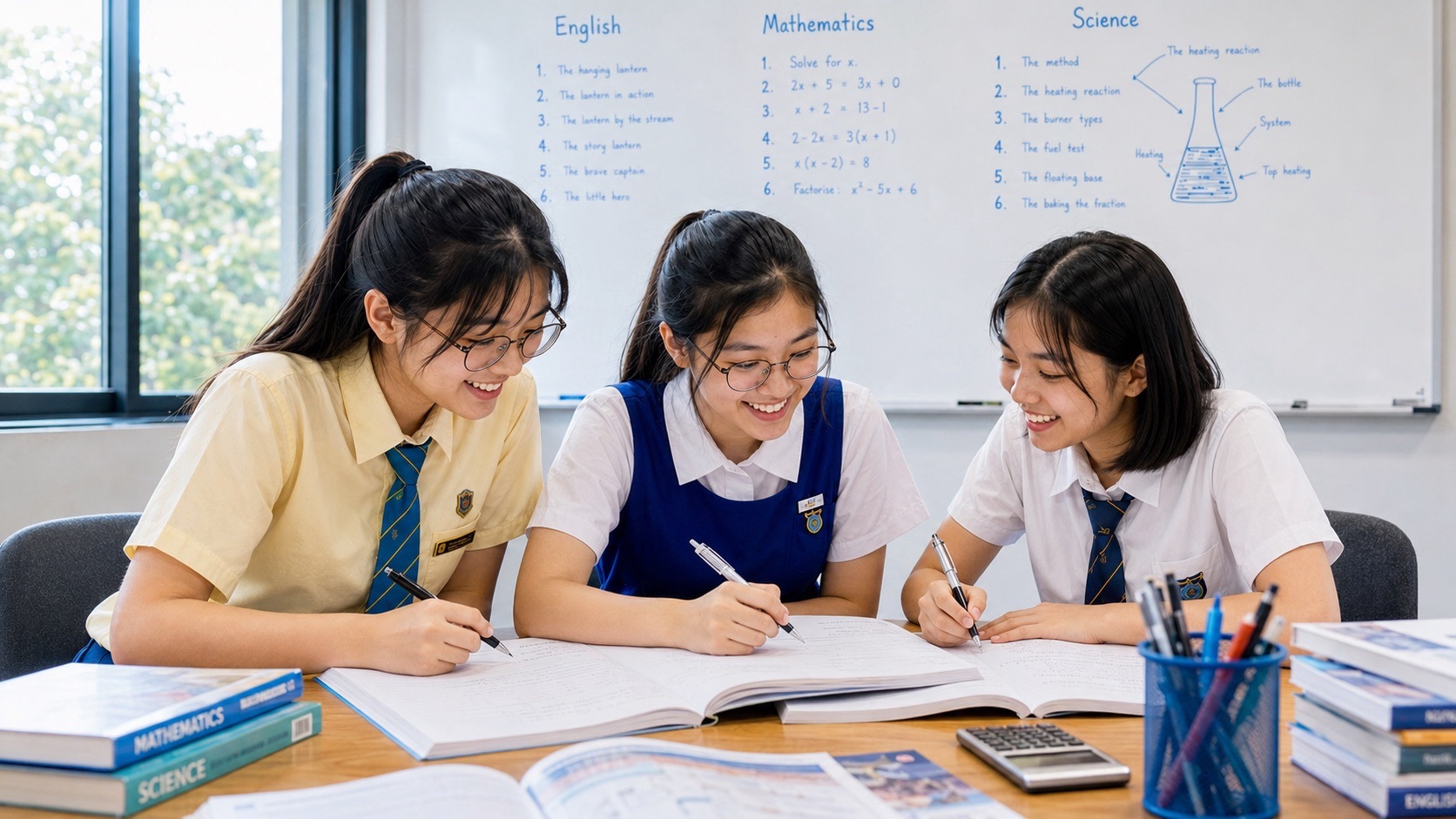
A good Mathematics lesson should leave something behind after the lesson itself has disappeared.
The explanation may have felt clear. The worked example may have made sense. The learner may have completed several questions correctly while the tutor was present. Those are useful signs, but they are not yet the strongest evidence that learning has held.
The stronger question is:
What remains when the explanation, hint, worked example, chapter label and tutor are no longer carrying the route?
This page is BTT’s human-facing evidence layer. It does not replace the existing technical owner Transfer and Retention Validation | Does the Repair Survive?, the BTT Mathematical Lab, How Mathematical Practice Works, How Mathematical Transfer Works, or How Independent Mathematics Works. Those remain current owners.
This page asks the simpler reader-facing question: what evidence should a learner, parent or tutor expect to see after a lesson if the Mathematics has really started to become the learner’s own?
A lesson can feel successful before learning is secure
Immediate success is often the easiest kind of success to produce.
The relevant method is still active in memory. The worksheet usually announces the topic. The worked example may still be visible. The tutor knows exactly where the learner is likely to hesitate. The learner may receive confirmation after each important step.
Under these conditions, correct work can be genuine progress—but it can also be partly supported by the environment.
That is why BTT separates:
- lesson success — the learner can work while the learning episode is still active;
- independent success — the learner can reattempt without the original support;
- retained success — the Mathematics is still available after time;
- transfer success — the Mathematics survives a changed surface;
- performance success — the capability survives examination conditions;
- self-correcting success — the learner can detect and repair some of their own errors;
- independence success — the learner can carry more of the route with less external help.
A strong lesson should eventually leave evidence across more than one of these layers.
Evidence 01 — The learner can reattempt without the original explanation
The first evidence is simple: remove the explanation and ask the learner to try again.
Not the exact same line-by-line copy. A fresh question should require the learner to reconstruct the important relationship.
For example:
- after learning how to identify the percentage base, give a new percentage problem with a different unknown;
- after learning algebraic balance, give an equation whose surface form is slightly different;
- after learning gradient from two points, ask for the relationship from a graph or table;
- after a trigonometric worked example, change the diagram orientation and unknown.
The important question is not whether the learner remembers every sentence of the teaching. It is whether enough mathematical structure remains to restart the route.
If the learner immediately asks for the same worked example again, the lesson may have produced recognition without yet producing retrieval.
Evidence 02 — The learner can explain the relationship, not only repeat the steps
Procedures are important. Mathematics becomes more durable when the learner knows what the procedure is preserving or representing.
Ask questions such as:
- Why is this operation valid here?
- What quantity does this number represent?
- What must remain equal?
- Why is this the correct base?
- What does the gradient mean in this situation?
- What restriction must remain true?
- Why would this method fail in a slightly different problem?
A learner does not need polished mathematical prose. What matters is whether they can point to the governing relation rather than only narrate remembered movements.
This is a stronger signal because relationships are more transferable than surface sequences.
Evidence 03 — The Mathematics survives a delay
Immediate success can be carried by short-term memory. Delay removes some of that support.
The learner should therefore meet the Mathematics again after time has passed.
The exact interval depends on the learner, stage and examination horizon, but the logic is constant:
If learning matters later, it must sometimes be tested later.
A useful sequence might be:
- reattempt later in the same lesson;
- return during the next study session;
- retrieve again after several days;
- meet the idea inside mixed revision later.
If the learner succeeds only while the lesson remains fresh, the learning may need more retrieval and spacing.
The deeper practice owner is How Mathematical Practice Works | From Repetition to Reliable Performance.
Evidence 04 — The learner can survive a changed question
A lesson has left stronger evidence when the Mathematics survives the disappearance of the original template.
Change one or more of these:
- the numbers;
- the unknown;
- the wording;
- the representation;
- the context;
- the order of information;
- the presence of irrelevant information;
- or the competing methods nearby.
The question should not become harder merely for the sake of being harder. It should change enough to reveal whether the learner recognises the underlying mathematical structure.
For example, a learner who has understood proportionality should increasingly recognise it across ratio, scale, rate, similarity, percentage and related contexts. A learner who understands a linear relationship should increasingly connect equation, graph, table and rate of change.
The transfer owner is How Mathematical Transfer Works | When Learning Survives a Changed Question.
Evidence 05 — The learner can choose the method when the chapter label disappears
A worksheet heading quietly supplies information. If it says “Simultaneous Equations”, the learner has already been told one of the most important decisions.
Mixed work removes that cue.
Now the learner must decide:
- What kind of structure is present?
- Which representation is useful?
- Which method is justified?
- Which familiar method is tempting but wrong?
This is often where apparent mastery changes. Accuracy can fall temporarily because the test is now measuring recognition and selection as well as execution.
That fall can be useful evidence. It tells the tutor what the blocked worksheet was hiding.
Evidence 06 — The learner can detect something is wrong
A good Mathematics lesson should gradually strengthen the learner’s internal error detector.
The learner may notice:
- a sign is inconsistent with the previous line;
- a probability is impossible;
- a length or area is unreasonable;
- a graph contradicts the algebra;
- the units do not match;
- a substitution does not satisfy the original equation;
- or an answer is implausibly large or small.
The learner does not need to avoid every mistake. A stronger sign of learning is that some mistakes become detectable before another person points them out.
This is one reason How Mathematical Feedback Works aims to move parts of the feedback loop into the learner’s own judgement.
Evidence 07 — The learner can recover from a wrong turn
Mathematical learning has held more strongly when the learner can recover after error.
A useful recovery sequence is:
- identify the last line that is still trusted;
- locate the first questionable decision;
- classify the break;
- repair only what is needed;
- re-run the affected part;
- verify the final result.
This matters because future Mathematics will not always proceed smoothly. Independence depends partly on the learner’s ability to repair their own route.
The validation-oriented owner is the BTT Mathematical Lab | Observe, Probe, Repair, Validate, Release.
Evidence 08 — The learner can perform under examination conditions
A learner may know the Mathematics and still fail to convert it into marks.
Examinations add:
- time pressure;
- mixed-topic selection;
- command words;
- answer-form requirements;
- calculator discipline;
- paper sequencing;
- working-memory pressure;
- and the need to recover after a difficult question.
When a lesson or repair has truly strengthened the learner, some of that capability should eventually survive these conditions too.
If the Mathematics works untimed but not in the paper, the next job may be examination craft rather than reteaching.
The owner is Mathematics Examination Craft | Converting Knowledge Into Marks.
Evidence 09 — The learner needs less help than before
This is one of the clearest signs that a lesson has left something durable.
Support may reduce in several ways:
- the learner starts without waiting for a cue;
- the worked example can be removed;
- the tutor no longer has to confirm every line;
- the learner can use a smaller hint;
- the parent no longer needs to check every answer immediately;
- AI can move from explaining to checking;
- the learner can finish a larger portion independently.
The key question is:
What can the learner now do without the support that used to be necessary?
The independence owner is How Independent Mathematics Works | When the Learner Can Carry the Route.
A lesson should leave different evidence at different stages
The evidence grows with the learner.
| Stage | Useful evidence after teaching |
|---|---|
| Primary | Learner can represent the problem, explain what numbers mean, choose the operation, check reasonableness and solve a changed story |
| PSLE | Learner can recognise relationships in non-routine questions, sustain several steps, recover from errors and convert knowledge into a bounded paper |
| Secondary | Learner can move between representations, select methods in mixed work, preserve algebraic equivalence and retrieve prerequisites |
| Additional Mathematics | Learner can use algebra as infrastructure, recognise functions and structures, handle restrictions and select among multiple methods |
| JC | Learner can sustain abstraction, choose mathematical objects strategically, interpret results, verify longer chains and recover from failed approaches |
Use The Mathematics Journey | Primary to JC and Beyond for the wider stage-to-stage progression.
One lesson, three learners, three evidence trails
In a three-student lesson, all three learners may study the same broad topic but leave different evidence.
Suppose the topic is simultaneous equations.
| Learner | Lesson evidence | Next useful move |
|---|---|---|
| A | Can solve only while the worked example is visible | Retrieval with reduced support |
| B | Can solve familiar equations independently but cannot recognise a word problem that requires simultaneous equations | Transfer and representation |
| C | Can recognise, solve and verify independently | Mixed or timed performance; possibly stretch |
The same lesson has therefore produced three different states. A small group becomes valuable when the tutor can see those differences and assign different next actions without fragmenting the whole class.
What parents can ask after a lesson
Parents do not need to ask, “Did you understand everything?”
More useful questions are:
- Can you show me one thing you can now do without the example?
- Can you explain what the main relationship was?
- What kind of question would test whether you really know it?
- What mistake are you now better at spotting?
- What part would you still need help with?
- When will you see this Mathematics again?
This shifts the conversation from “Was tuition good today?” toward “What evidence did the lesson leave?”
The broader parent route is Parents’ Guide to Mathematics | What Should I Do Next?.
What tutors can ask before declaring the lesson complete
A lesson can end when time runs out. Learning should not be declared complete merely because the clock does.
A tutor can ask:
- Can the learner now restart without me?
- Can the learner explain the governing relationship?
- Can I remove one layer of scaffolding?
- What delayed retrieval should happen next?
- What changed question will test transfer?
- What prediction should this repair make downstream?
- What evidence would cause me to reopen the diagnosis?
These questions turn the end of a lesson into the beginning of a validation sequence.
What the learner should gradually learn to ask
The strongest outcome is when the learner begins to run the evidence test internally.
- Can I do this without looking?
- Can I explain why the method works?
- Can I solve it if the question looks different?
- Can I recognise when this method does not apply?
- Will I still know this later?
- Can I check my own answer?
- What do I still need help with?
This is where lesson evidence starts becoming mathematical independence.
The evidence ladder
| Evidence level | What the learner can do | Strength of claim |
|---|---|---|
| 1. Follow | Understand while the explanation is happening | Useful first signal |
| 2. Reattempt | Repeat the relationship without the original explanation | Independent retrieval beginning |
| 3. Delay | Retrieve after time | Retention evidence |
| 4. Change | Use the Mathematics in a changed question | Transfer evidence |
| 5. Mix | Select the method among alternatives | Recognition evidence |
| 6. Perform | Use the capability under examination conditions | Performance evidence |
| 7. Self-correct | Detect and repair errors | Metacognitive control |
| 8. Fade | Succeed with less external support | Independence evidence |
No single Mathematics lesson needs to prove all eight levels immediately. The ladder shows how confidence in the learning claim becomes stronger over time.
When evidence does not appear
If the learner understood the lesson but the evidence disappears later, do not automatically repeat the whole lesson.
Ask which layer failed:
| Failure | Possible next owner |
|---|---|
| Cannot reattempt without the example | Mathematics HELP Runtime or practice |
| Can reattempt now, forgets later | Practice / retrieval / spacing |
| Can do familiar form, fails changed form | Mathematical Transfer |
| Changed form works, mixed set fails | Interleaving and method-selection practice |
| Untimed work works, paper fails | Mathematics Examination Craft |
| Same repair keeps failing downstream | BTT Mathematical Lab / diagnosis |
| Success collapses when help reduces | Independent Mathematics |
If the predicted evidence does not appear, the evidence has not failed the learner. It has improved the diagnosis.
The technical owner remains separate
This page deliberately stays reader-facing.
BTT already has a deeper validation layer in Transfer and Retention Validation | Does the Repair Survive? and the wider Mathematics Evidence and Validation Harness.
Those pages own the technical validation framework. This page owns the simpler public question: what should a learner, parent or tutor be able to observe after teaching if the learning claim is becoming stronger?
Where this page routes next
| Need | BTT owner |
|---|---|
| I need to know what kind of state the learner is in. | Find My Mathematics State |
| I need the right amount of support. | Mathematics HELP Runtime |
| I need to build retrieval and durability. | How Mathematical Practice Works |
| I need to test a changed question. | How Mathematical Transfer Works |
| I need to turn an error into the next useful action. | How Mathematical Feedback Works |
| I need to validate whether a repair survived. | Transfer and Retention Validation |
| I need to test the diagnosis-to-repair path. | BTT Mathematical Lab |
| I need performance under examination conditions. | Mathematics Examination Craft |
| I need to know whether support can reduce. | How Independent Mathematics Works |
| I need the complete learner route. | BTT Mathematics Runtime |
What should remain after help is gone?
Not the tutor’s wording.
Not the exact worksheet order.
Not permanent dependence on the worked example.
What should remain is mathematical capability:
- a relationship that can be reconstructed;
- a representation that can be chosen;
- a method that can be selected;
- a result that can be checked;
- a mistake that can increasingly be detected;
- a changed problem that can still be recognised;
- knowledge that remains available after time;
- and a learner who can carry more of the next route than before.
A good Mathematics lesson does not prove itself by how much happened during the lesson. It proves itself by what still works after the lesson is no longer there to help.
BTT lesson-evidence principle: teach clearly, remove support deliberately, ask the learner to reattempt, return after delay, change the question, test method selection, watch for self-correction, verify examination performance when relevant, and measure progress partly by how much useful Mathematics remains when external help is gone.