
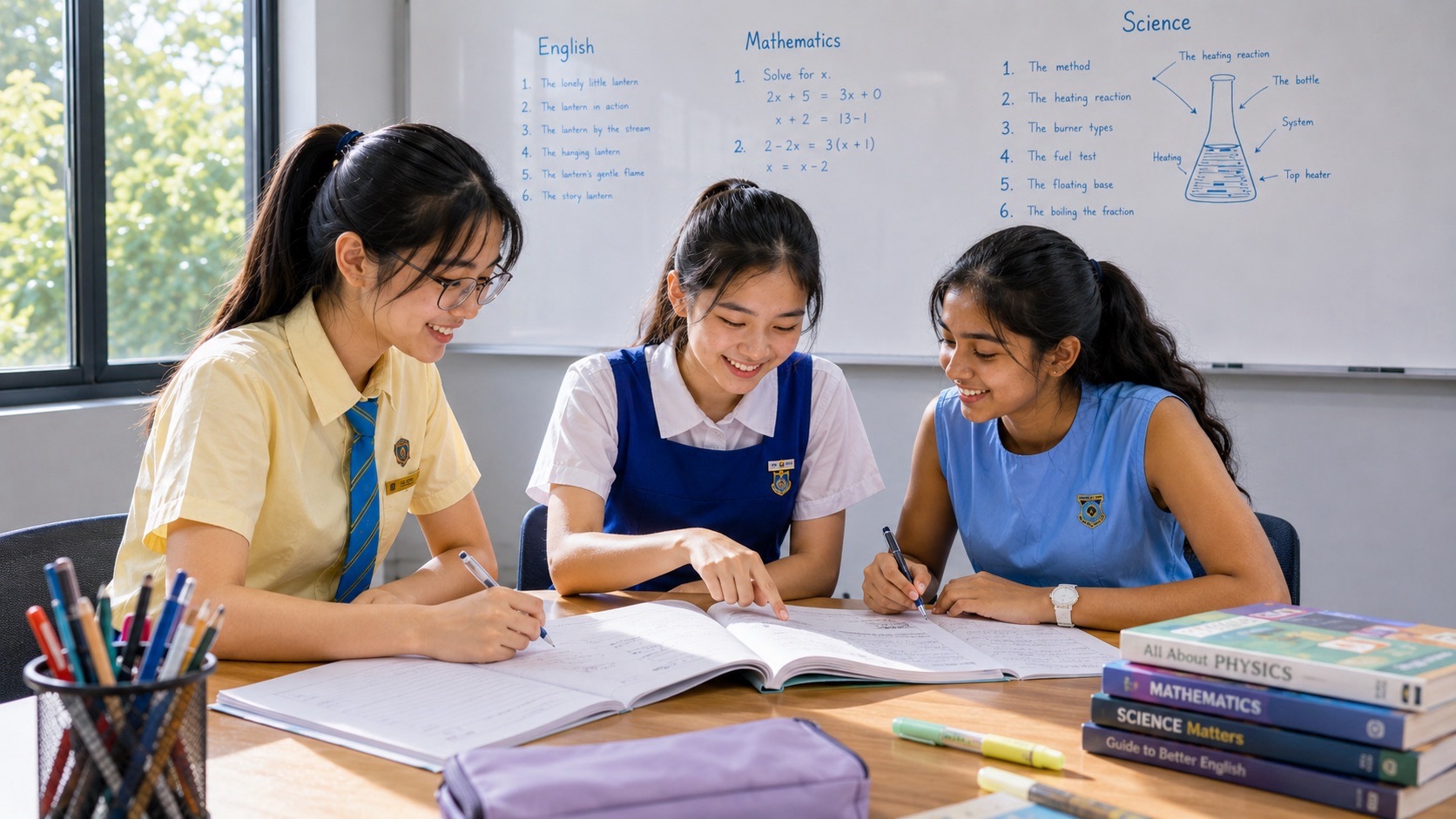
Secondary 1 Mathematics homework works when it transfers control from the teacher to the student.
The purpose of independent practice is not to prove that a worksheet was completed. It is to reveal what the learner can retrieve, represent, solve, check and repair when the teacher is no longer standing beside the page.
This matters especially in Secondary 1 because Mathematics is becoming more symbolic and more connected. A student who succeeds only while the worked example, chapter label or teacher prompt remains visible may appear fluent in class and become unstable at home or in assessment.
Homework is useful when it measures and builds independence — not when it hides dependence behind completed pages.
The Simple Answer
Strong Secondary 1 independent practice should contain several kinds of work:
- fluency — stabilise basic operations;
- retrieval — bring older learning back from memory;
- representation — translate among words, symbols, tables, graphs and diagrams;
- route selection — choose a method without a chapter cue;
- error repair — revisit wrong work from a blank page;
- transfer — solve the same structure in a changed context;
- checking — verify the result independently.
The mix should reflect the learner’s current subject-level demand in G1, G2 or G3 while preserving the same overall goal: increasing mathematical ownership.
Homework Is Not the Same Thing as More Teaching
If a student cannot yet understand the concept with support, assigning many independent questions on that concept can automate confusion.
Independent practice should generally begin after the learner has enough initial understanding to attempt the task meaningfully.
The sequence is usually stronger when it moves from:
- teacher explanation;
- worked example;
- guided attempt;
- partially supported attempt;
- independent attempt;
- mixed and delayed retrieval.
Homework belongs mostly in the later part of that sequence.
The First Question Is: What Is This Practice For?
Different homework tasks serve different purposes.
- A short arithmetic set may build fluency.
- A blank-page recall task may test retrieval.
- A mixed worksheet may train route selection.
- An error-analysis task may repair a misconception.
- A word problem may test representation and modelling.
- A graph interpretation task may test translation.
- A timed set may test pacing after accuracy is stable.
When the purpose is unclear, homework easily becomes volume without information.
Completion Is a Weak Measure of Learning
A student can complete every assigned question while depending on notes, answer keys, online solutions, family help or repeated teacher examples.
The page looks complete. The capability may still be externally supported.
Better evidence includes:
- how many questions were solved before help was needed;
- which cue unlocked the problem;
- whether the student could explain the method;
- whether the same idea remained available the next day;
- whether the learner could solve a changed version;
- whether errors were detected independently.
This shifts attention from page completion to installed capacity.
The Hint Ladder Should Be Visible
Independent practice does not require a student to remain stuck forever.
A useful support ladder can move from the least revealing hint to the most revealing:
- Reread the target.
- Identify the known quantities.
- Name the mathematical topic family.
- Choose a representation.
- Recall a similar example.
- Look at one strategic hint.
- Study the worked solution only if necessary.
The student should record how far down the ladder was required. That becomes diagnostic information.
Do Not Let the Worked Example Become a Permanent Crutch
Worked examples are valuable for initial learning because they make the method visible.
But independent practice should eventually remove them. Otherwise the student can become excellent at recognition while weak at reconstruction.
A useful fade is:
- full example visible;
- partial example;
- method name only;
- no method cue;
- mixed set with competing methods.
Each stage transfers more decision-making to the learner.
Homework Should Include Old Mathematics
If homework contains only the current chapter, old knowledge is allowed to decay.
Secondary 1 is cumulative. Earlier content should return in small doses because later topics depend on it.
A practical set might contain:
- most questions from the current topic;
- a few questions from recent topics;
- one or two older retrieval questions;
- one mixed problem where the method is not announced.
The exact ratio can vary. The principle is that old Mathematics should remain alive.
See How Secondary 1 Mathematics Revision, Retrieval & Interleaving Work.
Mixed Practice Should Arrive After Basic Stability
A learner who is still struggling to solve a basic equation does not benefit from immediately mixing that equation with five other topic families.
The stronger progression is:
- understand the new structure;
- stabilise basic execution;
- contrast nearby forms;
- mix with other topics;
- return after a delay;
- change the context.
Difficulty should be layered, not dumped.
One Good Question Can Be More Valuable Than Ten Repetitions
After a student solves a question correctly, changing one feature can reveal whether the structure was actually understood.
- Change the number.
- Reverse the unknown.
- Change the context.
- Remove the diagram.
- Ask for an explanation.
- Ask for a second method.
- Insert irrelevant information.
This variation tests whether the student learned the mathematical object or only the exact example.
See I Sometimes Change One Number After the Student Gets the Question Right.
Error Correction Is Part of Homework
Wrong questions should not simply receive a red cross and disappear.
A strong repair cycle is:
- find the first wrong step;
- classify the error;
- understand the correction;
- close the solution;
- redo from a blank page;
- solve a changed question;
- schedule a delayed retest.
This turns homework feedback into future performance.
See How Secondary 1 Mathematics Error Analysis & Diagnostics Work.
An Answer Key Can Help or Harm
Answer keys provide useful feedback, but timing matters.
If the student checks every line immediately, productive retrieval may never occur. If the student waits too long, the same misconception may be repeated across an entire set.
A useful routine is to solve a small batch independently, check, diagnose, repair, then continue.
The answer should be treated as feedback, not as a substitute for the route.
Copying a Solution Is Not Correction
A copied solution can look perfect while leaving the learner unable to reproduce it later.
The real test comes after the solution is hidden. Can the student reconstruct the route from a blank page and explain why each important step belongs?
Homework Volume Has Diminishing Returns
More practice can help when the student is rehearsing a valid method at an appropriate level.
More volume helps less when:
- the concept is misunderstood;
- fatigue is increasing errors;
- every question is nearly identical;
- the learner is copying rather than retrieving;
- the difficulty is far above current readiness;
- feedback arrives too late to change behaviour.
Quality practice has a purpose, an appropriate challenge and a feedback loop.
Time on Homework Is Not the Same as Learning
A student may spend two hours on a worksheet because prerequisite skills are unstable, distractions are frequent, hints are being searched for repeatedly, or every calculation is being checked excessively.
Long duration can therefore be a diagnostic signal rather than evidence of diligence.
The useful question is: what is consuming the time?
Independent Practice Should Train Starting
Many students can continue a solution after a teacher supplies the first step.
Homework should reveal whether the learner can start without that cue.
Useful prompts before calculating are:
- What is the target?
- What kind of mathematical object is this?
- What representation would help?
- Which relationship controls the problem?
- What could I find first?
This turns “I don’t know how to start” into a structured problem-solving routine.
See My Child Can Start a Mathematics Question but Gets Stuck Halfway.
Independent Practice Should Train Stopping
Persistence matters, but unlimited struggle is not automatically productive.
A student should learn when to stop, mark the uncertainty and seek targeted help rather than spending forty minutes repeating the same invalid route.
This is metacognitive control: recognise that progress has stalled, identify the blockage and request the smallest useful hint.
The Homework Log Can Record Independence
A simple record can make hidden dependence visible.
- ✓ solved independently;
- H1 solved after a small hint;
- H2 solved after a method cue;
- W required worked solution;
- R scheduled for redo.
This is more informative than a binary completed/not-completed mark because it tracks the level of external support required.
G1 Homework: Reliability Without Overload
At G1, independent practice should favour clear instructions, manageable set size, strong prerequisite support and frequent feedback.
The goal is to build confidence through dependable capability, not through excessive simplification or excessive volume.
G2 Homework: Route Selection and Connection
At G2, homework can increasingly mix topics, remove method cues and connect algebra, proportion, geometry, graphs and data.
The important question becomes whether the student can identify what kind of Mathematics belongs before executing it.
G3 Homework: Transfer and Compression
At G3, routine practice can often become more selective once fluency is secure. More value can come from mixed, unfamiliar and explanatory tasks that expose template dependence.
Independent work should test whether the learner can reconstruct the route rather than merely imitate one.
A Balanced Secondary 1 Homework Architecture
A useful homework set can be designed as a sequence:
- Warm retrieval: one or two older prerequisite questions.
- Current fluency: enough similar questions to stabilise the new method.
- Contrast: a nearby question requiring a different route.
- Representation: translate between forms.
- Application: one longer problem.
- Check: verify one answer using another method.
- Reflection: record the hardest point and any support used.
This produces more information than a long unstructured sheet.
What Parents Should Watch
- Does homework require the notes to remain open throughout?
- Does the student know how to start?
- Are the same errors recurring?
- Is the work taking much longer than expected?
- Can wrong questions be redone from a blank page?
- Are older topics still retrievable?
- Does the learner know when a hint was needed?
- Can the method survive a changed question?
These signals are more useful than asking only whether the homework is finished.
The Independent-Practice Cycle
- Attempt without unnecessary help.
- Mark where support becomes necessary.
- Use the smallest effective hint.
- Complete the problem.
- Check the answer.
- Diagnose errors.
- Redo from a blank page.
- Vary the question.
- Return after a delay.
This is how homework becomes a handover mechanism rather than a compliance task.
Where This Article Sits
This guide owns the Secondary 1 homework-and-independent-practice mechanism inside How Secondary 1 Mathematics Works | SEC G1, G2 & G3. It is distinct from the broader site material on homework behaviour and general study routines.
- How Secondary 1 Mathematics Revision, Retrieval & Interleaving Work
- How Secondary 1 Mathematics Error Analysis & Diagnostics Work
- How Secondary 1 Problem Solving & Mathematical Modelling Works
- How the Secondary 1 to Secondary 2 Mathematics Transition Works
Final Answer
Secondary 1 Mathematics homework and independent practice work when they gradually transfer representation, route selection, checking and error repair from the teacher to the learner.
The point is not that the page was finished.
The point is that the student can increasingly operate the Mathematics alone.