
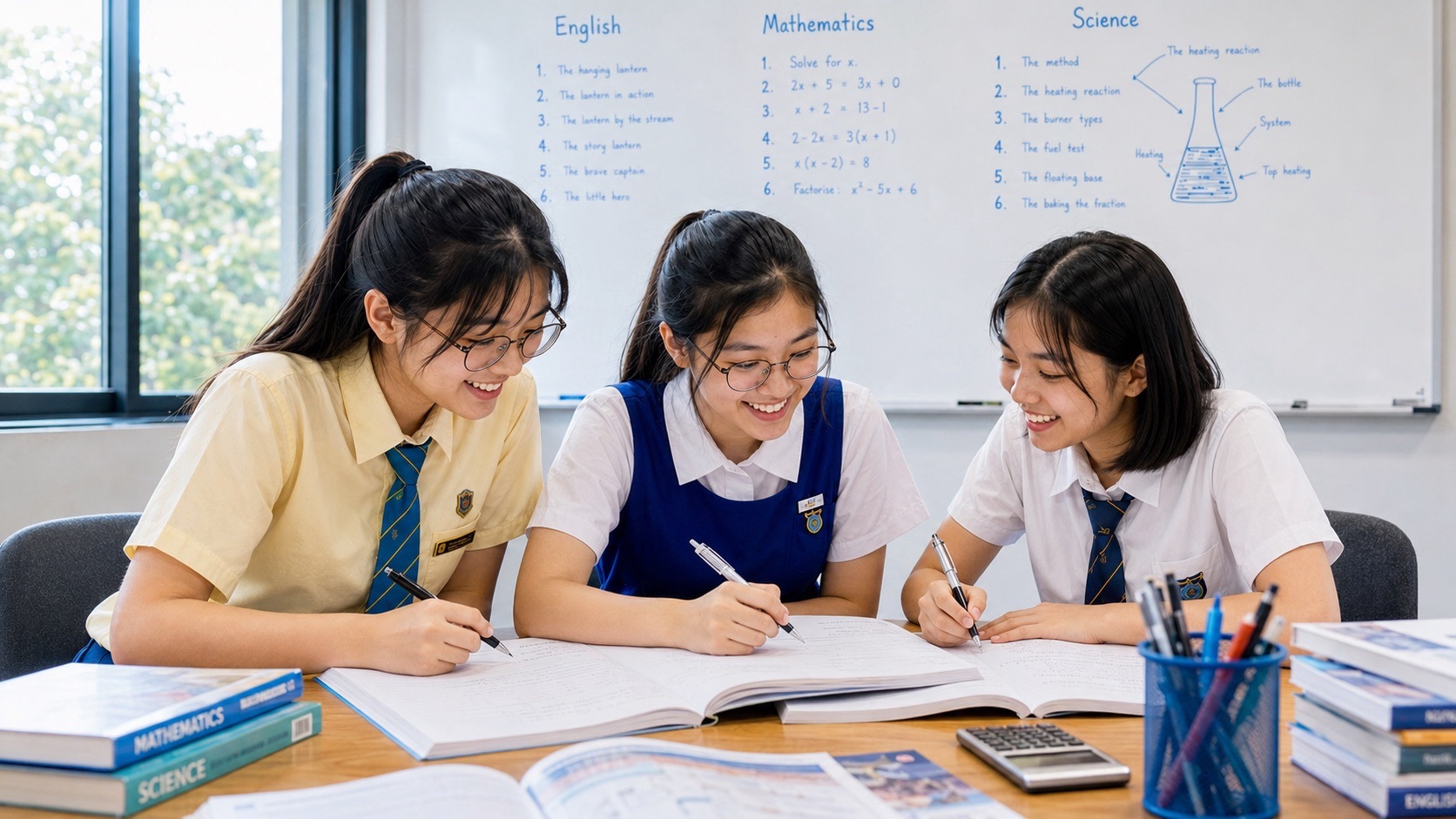
Secondary 1 Mathematics revision works when study changes what the student can retrieve and use later — not merely what feels familiar while the notes are open.
This distinction becomes critical in Secondary 1 because the curriculum starts accumulating. Signed numbers are needed inside algebra. Fractions reappear in ratio, probability and later expressions. Algebra enters geometry and graphs. Data uses percentage. Earlier learning becomes infrastructure for later learning.
A revision system therefore has to do more than refresh memory before a test. It must keep old Mathematics available while new Mathematics is being built.
The test of revision is not “Did this look familiar?” It is “Could I reconstruct and use it when the cue disappeared?”
The Simple Answer
Strong Secondary 1 Mathematics revision uses four complementary systems:
- retrieval — produce knowledge from memory before looking;
- spacing — return to knowledge after time has passed;
- interleaving — mix nearby topics so the learner must choose the route;
- transfer — vary the surface so the student learns the mathematical structure rather than one template.
These systems should sit on top of sound initial teaching. Revision cannot permanently compensate for a concept that was never understood.
Rereading Feels Easier Than Retrieval
When a student rereads notes or watches a worked example, the information is present on the page. Recognition is easy.
Retrieval is different. The learner closes the source and tries to produce the method, definition, property or representation from memory.
This feels harder because it is harder. That effort is useful evidence: it reveals what is actually available without support.
Worked Examples Are Scaffolds, Not Permanent Furniture
Worked examples are powerful when students are first learning a procedure or structure. They reduce unnecessary search and make the reasoning visible.
But if every practice question remains beside a nearly identical worked example, the student may never learn independent reconstruction.
A useful fade is:
- study a complete worked example;
- complete a partially worked example;
- solve a similar question without the example;
- solve the same structure after a delay;
- solve it inside a mixed set;
- solve it in a changed context.
This moves support gradually from the page into the learner.
Spacing: Forgetting a Little Can Make Retrieval More Useful
Twenty similar questions completed in one evening can create excellent immediate performance. That does not guarantee the method will be available two weeks later.
Spacing deliberately allows time between encounters.
A simple Secondary 1 rhythm might revisit a topic:
- later in the same week;
- the following week;
- several weeks later;
- inside a mixed revision set before assessment.
The exact interval can vary. The principle is that old learning should have to return from memory, not remain continuously visible.
See How Spaced Practice Works for Mathematics.
Interleaving: Remove the Invisible Chapter Label
Blocked practice is organised by method. Ten ratio questions follow each other. Ten algebra questions follow each other.
This is efficient for early fluency because the student does not need to keep deciding which method applies.
Interleaving changes the task. Ratio, algebra, percentage, geometry and graphs are mixed. The learner must first identify the mathematical structure before solving.
This trains route selection.
See How Interleaving Works for Mathematics.
Do Not Interleave Before the Basic Method Exists
Mixed practice is not a substitute for initial learning.
If a student still cannot solve a basic linear equation, mixing equations with ratio and geometry will mainly add confusion.
A productive sequence is:
- understand;
- practise the basic form;
- stabilise execution;
- contrast with nearby forms;
- interleave;
- space and retrieve;
- transfer to unfamiliar contexts.
Difficulty should be added after the underlying representation is stable enough to carry it.
Retrieval Should Cover More Than Formulas
Students often build revision around formula recall. Secondary 1 requires a wider retrieval set.
- definitions;
- properties;
- symbol meanings;
- representations;
- procedures;
- common error checks;
- route-selection cues;
- reasons why a method is valid.
A student who remembers a formula but cannot identify when it belongs has incomplete retrieval.
Retrieval Can Be Very Short
Not every retrieval session needs to be a full worksheet.
Useful low-cost prompts include:
- write three angle facts from memory;
- explain what the equal sign means;
- convert 3/8 to a decimal and percentage;
- sketch the axes and locate (-2, 4);
- state one way to check a solved equation;
- write a verbal rule for an algebraic expression;
- name one situation where mean may be misleading.
Short retrieval can be distributed throughout the week and does not require heavy homework volume.
Mixed Practice Builds Discrimination
Many errors occur because students know several methods but cannot distinguish when each one applies.
Good mixed practice uses deliberately confusable neighbours:
- percentage increase versus percentage of a quantity;
- perimeter versus area;
- mean versus median;
- translation versus reflection;
- negative sign versus subtraction;
- additive comparison versus multiplicative comparison.
The student should be asked not only to solve, but to explain which feature determined the route.
Error Correction Should Include a Blank-Page Redo
Reading a teacher’s correction can create recognition without ownership.
A stronger correction sequence is:
- locate the first wrong step;
- classify the error;
- study the correction;
- close the correction;
- redo the question from a blank page;
- solve one changed question of the same structure;
- return after a delay.
See How Secondary 1 Mathematics Error Analysis & Diagnostics Work.
An Error Log Needs a Return Date
An error log that only records past mistakes can become a museum.
To become a learning system, it should schedule retrieval.
For each important error, record:
- the error category;
- the repaired rule or idea;
- one transfer question;
- a date to retest;
- whether the error returned.
This connects diagnosis to durable learning.
Transfer Practice Changes the Surface
If all percentage questions involve shopping, the student may learn a shopping template. If all equations are presented in identical symbolic forms, the learner may never recognise algebra inside geometry or word problems.
Transfer practice preserves the mathematical structure while changing context, representation or wording.
The student then has to answer a deeper question: what stayed mathematically the same?
Revision Should Rotate Between Resolution Levels
Not every session should operate at the same scale.
A balanced system rotates among:
- micro fluency — short arithmetic or algebraic execution;
- concept recall — definitions and explanations;
- representation — words, symbols, tables, graphs and diagrams;
- mixed route selection — choose the method;
- long-form problem solving — multi-step integration;
- error repair — targeted remediation.
This reduces the risk that revision becomes either endless drill or endless difficult problems with no fluency base.
Revision Before an Assessment Should Not Start From Zero
If old topics have been spaced and retrieved throughout the term, pre-assessment revision becomes consolidation rather than emergency reconstruction.
A useful final revision phase can then focus on:
- high-frequency errors;
- mixed-topic route selection;
- timed fluency where needed;
- longer unfamiliar questions;
- checking routines;
- sleep and pacing rather than last-minute volume.
The ideal revision system makes the final week less dramatic because memory has already been maintained.
Timed Practice Has a Specific Job
Timed practice can reveal pacing, fluency and decision speed. It is useful after the mathematics is sufficiently stable.
Using time pressure too early can force students to compress unstable working and strengthen bad habits.
A useful progression is:
- untimed understanding;
- accurate independent execution;
- mixed route selection;
- moderate time constraints;
- full pacing practice.
Speed should be built on top of a correct system.
The Calculator Should Not Become a Revision Crutch
Calculator practice is important where calculators are permitted and useful. But students should retain estimation, sign prediction and number sense.
A good revision set occasionally asks the learner to predict the approximate result before using the calculator. This keeps the machine inside the mathematical reasoning system rather than replacing it.
Revision Should Include Explanation
Students can sometimes perform a method while holding a weak conceptual model.
Short explanation prompts expose this:
- Why can these terms be combined?
- Why does this percentage use the original quantity as its base?
- Why are these angles equal?
- Why can this probability not exceed 1?
- Why does this graph scale matter?
Explanation strengthens retrieval of the relationship, not only the procedure.
G1 Revision: Stability, Small Steps and Frequent Return
G1 revision should protect the learner from overload while steadily increasing independence.
Useful features include short retrieval sets, visible representation links, frequent prerequisite return, clear worked-example fading and mixed sets with a manageable number of competing routes.
The goal is not simply more repetition. It is reliable access.
G2 Revision: Discrimination and Connection
G2 revision should increasingly mix topics, compare nearby methods and require students to identify the structure before solving.
Representation switching, algebra inside geometry, percentages inside data and rate problems in unfamiliar contexts become useful transfer tasks.
G3 Revision: Compression Without Template Dependence
G3 students often need less routine repetition and more deliberate variation once fluency is secure.
Revision should challenge the learner to reconstruct methods, combine topics, justify transformations and solve unfamiliar forms without relying on visual similarity to worked examples.
A Weekly Secondary 1 Revision Architecture
A practical week can contain several small layers rather than one enormous weekend session:
- Day 1: current-topic fluency plus one old-topic retrieval question;
- Day 2: short representation or explanation prompt;
- Day 3: mixed set from two or three topics;
- Day 4: error-log repair and blank-page redo;
- Day 5: one longer unfamiliar application;
- Weekend: cumulative retrieval and targeted practice from diagnostic evidence.
The exact days can change. The important architecture is current learning + old retrieval + mixed discrimination + error repair + transfer.
What Parents Should Watch
- Does revision happen only immediately before tests?
- Can the student solve without opening notes first?
- Are old topics returning throughout the term?
- Does practice remain chapter-blocked forever?
- Are wrong questions redone from a blank page?
- Can the student explain why a method applies?
- Can knowledge survive a changed context?
- Does the student know which error patterns recur?
The objective is not maximal study time. It is better memory architecture.
The Revision Cycle
- Learn the new idea accurately.
- Practise until the basic form is stable.
- Retrieve without the example.
- Space the next encounter.
- Interleave with nearby topics.
- Transfer to a new surface form.
- Diagnose errors.
- Repair the weakest mechanism.
- Return again after delay.
This is how revision becomes part of learning rather than a separate emergency phase.
SEC G1, G2 and G3 Context
The Singapore-Cambridge Secondary Education Certificate structure offers Mathematics at G1, G2 and G3 subject levels, with 2027 school-candidate codes K110, K210 and K310. Secondary 1 revision should be calibrated to the learner’s subject-level demand while retaining the same core memory principles: accurate initial learning, retrieval, spacing, discrimination, transfer and repair.
Official references: SEAB Secondary Education Certificate, SEC G1 syllabuses, SEC G2 syllabuses and SEC G3 syllabuses.
Where This Article Sits
This guide owns the revision-retrieval-interleaving mechanism inside How Secondary 1 Mathematics Works | SEC G1, G2 & G3.
- How Secondary 1 Mathematics Error Analysis & Diagnostics Work
- How Secondary 1 Mathematics Assessment & Question Design Work
- How the Secondary 1 to Secondary 2 Mathematics Transition Works
Final Answer
Secondary 1 Mathematics revision works when knowledge is repeatedly reconstructed, spaced, mixed, transferred and repaired until the learner can retrieve it without the original cues.
Good revision is not a second copy of teaching.
It is the system that keeps Mathematics available after teaching has moved on.