
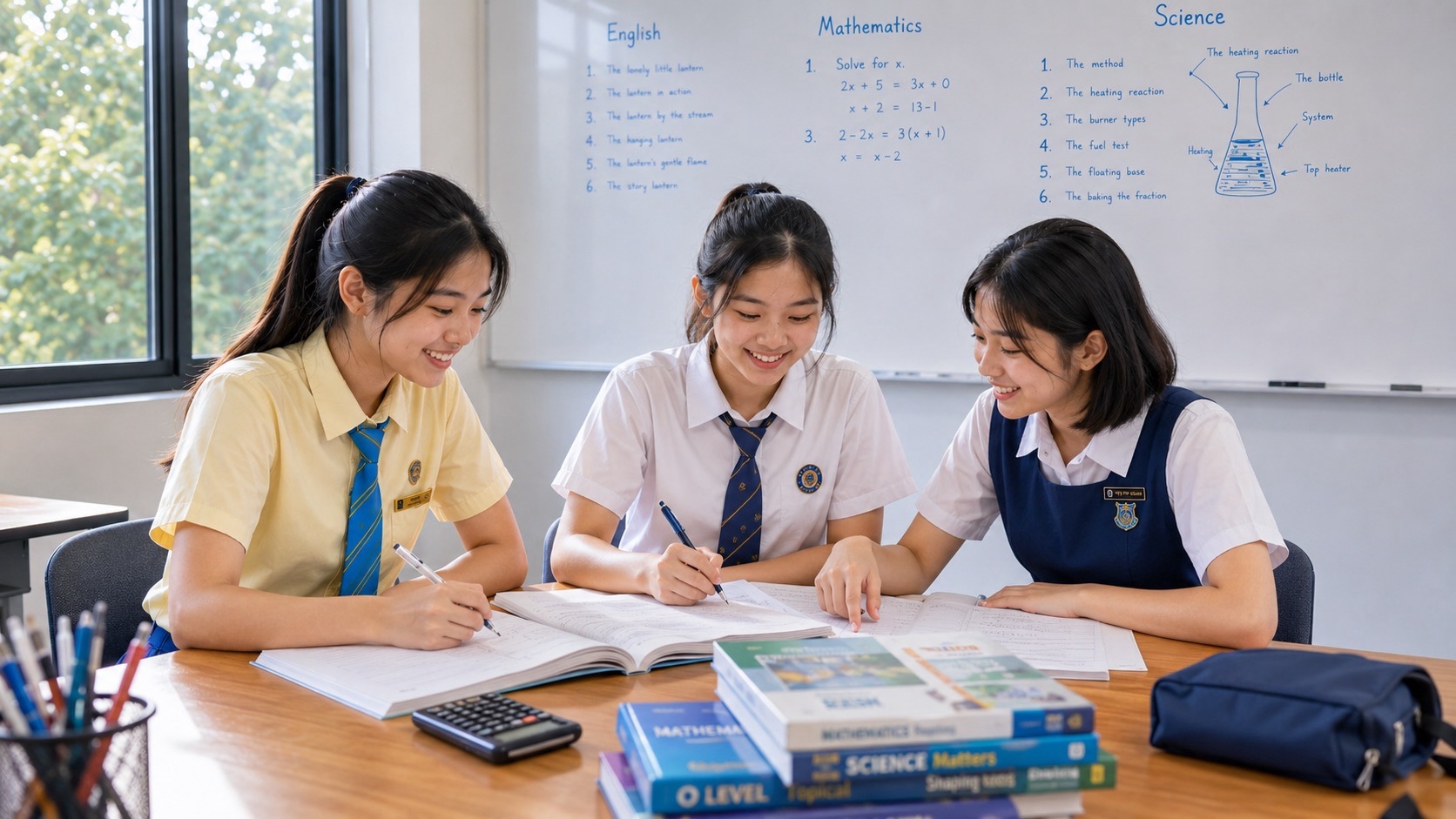
Secondary 3 G1 Mathematics is not mathematics made smaller. It is mathematics made usable.
The student is still expected to reason, represent, calculate, communicate and solve problems. What changes is the calibration. G1 Mathematics is built around fundamental mathematical knowledge, strong practical application and the ability to use mathematics confidently in real situations. At Secondary 3, that purpose becomes especially important because the subject is no longer only building basic numeracy. It is preparing the student to operate an increasingly connected mathematical system before the final secondary-school year.
Under Singapore’s Full Subject-Based Banding framework, G1 is a subject level. It is not a description of the whole student. A learner may take different subjects at different levels. From the 2027 graduating cohort, the common national certification is the Singapore-Cambridge Secondary Education Certificate, or SEC. For Mathematics, the 2027 G1 subject code is K110.
This guide asks a more useful question than “What chapters are in G1 Mathematics?”
What mathematical capability should a Secondary 3 G1 student be building, and how does the subject actually work as a learning system?
That is the question we will answer.
Start With the Correct Route
The first mistake in planning Secondary 3 Mathematics is assuming that the school year tells us everything. It does not.
Secondary 3 tells us the student’s stage in school. G1 tells us the level of Mathematics being taken. SEC tells us the certification framework that graduating students enter from 2027.
These three pieces need to be kept separate because they answer three different questions:
- Stage: Where is the student in secondary school?
- Subject level: What level of mathematical demand is the student working at?
- Certification: What national examination framework will record the subject and level?
A good Secondary 3 programme therefore begins by identifying the exact route rather than teaching from a generic “Sec 3 Math” label.
This article sits under our main guide, How Secondary 3 Mathematics Works in Singapore | SEC G1, G2 & G3.
What G1 Mathematics Is Trying to Build
G1 Mathematics has a clear educational purpose. It is designed to build mathematical knowledge and skills that can be used in life, other subjects and post-secondary vocational learning. It also develops problem solving, reasoning, communication and confidence.
That purpose matters because it changes how the subject should be taught.
If the goal were only to produce answers, the fastest route would be to train a student to imitate procedures. But a procedure without interpretation is fragile. Change the wording, change the units or put the same idea inside a household bill, a map, a graph or a measurement problem and the student may no longer recognise what to do.
So the deeper target is not “remember more steps”. It is:
- understand what a quantity represents;
- identify the relationship between quantities;
- select an appropriate mathematical method;
- carry out the calculation accurately;
- interpret the result in context;
- check whether the result is reasonable;
- communicate enough working for another person to follow it.
That is real mathematical capability.
The G1 Mathematics Engine
At Bukit Timah Tutor, we find it useful to think of G1 Mathematics as an operating sequence:
Read → Organise → Represent → Choose → Calculate → Check → Interpret
Read
What is the situation? What information has been given? What unit is being used? What exactly is the question asking for?
Organise
Which information matters? Can the student separate the known quantities from the unknown quantity? Is there extra information that should not be used?
Represent
Would a ratio, equation, table, graph, diagram, percentage or measurement relationship make the problem clearer?
Choose
Which mathematical operation or method matches the relationship?
Calculate
Can the student execute the method accurately and show enough working to preserve the logic?
Check
Does the answer have the correct sign, unit and scale? Is it plausible? Can it be checked by estimation, substitution or an inverse operation?
Interpret
What does the answer actually mean in the situation?
A student who consistently runs this sequence is already doing much more than arithmetic.
Why Secondary 3 Is a Critical Year for G1 Mathematics
Secondary 3 is the point where earlier mathematical ideas begin carrying more weight at the same time.
A percentage problem may now contain a financial context. A ratio may sit inside a map or scale problem. Algebra may be required to describe a real relationship. Geometry may involve several facts in one diagram. Statistics may require interpretation rather than simply reading a value.
The difficulty is therefore not always that a new concept is individually hard. The difficulty is that several familiar skills must now cooperate.
This is why Secondary 3 often reveals weaknesses that were previously hidden.
The Three Mathematical Worlds
The official G1 Mathematics syllabus is organised around three broad strands: Number and Algebra, Geometry and Measurement, and Statistics and Probability. The final SEC assessment also tests standard techniques, problem solving in context, and mathematical reasoning and communication. For 2027, two 1 hour 30 minute papers each carry 50% of the assessment; an approved calculator may be used in both papers. The exact official syllabus and examination details should always be checked directly with SEAB because national requirements can be updated.
Those three content strands are not three separate universes. They overlap constantly.
Number and Algebra: controlling quantity
Number is the foundation because almost every real problem contains quantity. But Secondary 3 G1 Mathematics asks the student to do more than calculate. The student must understand how quantities compare, change, scale and relate.
That is why ideas such as ratio, proportion, percentage, rate, speed, approximation, formulae, graphs and equations belong to one larger story: how one quantity is connected to another.
A student who sees these as isolated chapters has to remember many separate tricks. A student who sees the common structure has fewer things to remember because the relationships begin to make sense.
Geometry and Measurement: controlling space
Geometry gives structure to shape, direction and position. Measurement turns that structure into usable quantities such as length, area, volume and angle.
The important habit is to distinguish between what a diagram looks like and what the mathematics actually guarantees.
A drawing may look symmetrical without being stated as symmetrical. Two lines may appear parallel without being marked or logically established as parallel. A length may look longer without being drawn to scale.
Secondary 3 is a good time to teach this discipline explicitly because it is a transferable mathematical habit: evidence before assumption.
Statistics and Probability: controlling uncertainty
Data is everywhere in adult life: prices, waiting times, transport, health information, survey results, sales, sports, public statistics and household spending.
Statistics teaches the student how to organise and interpret information. Probability introduces disciplined thinking about chance. The key is not merely calculating a mean or probability. It is understanding what the result tells us and what it does not.
Averages can hide variation. Graph scales can influence perception. A probability describes likelihood, not certainty. A small sample can support weaker conclusions than a large and well-designed sample.
These are mathematical ideas with direct relevance beyond school.
Number Sense Still Matters at Secondary 3
Students sometimes assume that once a calculator is allowed, number sense becomes less important. The opposite is true.
The calculator can calculate. It cannot decide whether the entered calculation makes sense.
If a student expects an answer around 50 but obtains 5,000, number sense is the alarm system. If a percentage increase produces a smaller value, number sense notices the contradiction. If a room area is reported in cubic metres, unit sense detects the mismatch.
Strong G1 Mathematics therefore keeps estimation alive.
- What should the answer roughly be?
- Should it be larger or smaller than the starting value?
- Should it be positive?
- What unit should appear?
- Is the result realistic in the situation?
These questions are simple. They prevent many expensive errors.
Ratio Is More Than a Chapter
Ratio appears in recipes, maps, scale drawings, mixtures, rates, similarity, exchange relationships and many everyday comparisons.
Students often learn ratio procedurally: add the parts, divide the total, multiply by the required part. That works for one question shape. It does not automatically produce proportional reasoning.
A stronger student asks:
- What two quantities are being compared?
- Are the units compatible?
- Is the relationship direct or inverse?
- If one quantity doubles, what should happen to the other?
- Am I scaling a length, an area or a volume?
That final question is particularly important. Scale is one of the first places where students discover that not every quantity grows in the same way.
Percentage Is a Relationship, Not a Button
Percentage is one of the most practical ideas in school Mathematics because it appears in discounts, price changes, interest, tax, bills, data and everyday comparisons.
But percentage becomes confusing when students treat “%” as a signal to press a memorised calculator sequence.
The central idea is simpler:
A percentage tells us a quantity relative to a reference whole.
So the first question should always be: percentage of what?
That one habit helps with percentage increase, decrease, reverse percentage and comparison questions because it forces the student to identify the base quantity before calculating.
Rate and Speed: Learning to Read Units as Mathematics
Compound units carry meaning.
Kilometres per hour means kilometres for each hour. Dollars per kilogram means dollars for each kilogram. Litres per minute means litres for each minute.
When students learn to read the unit aloud, the formula often becomes easier to reconstruct.
This is an important G1 habit because it reduces dependence on memorised triangles and formula tricks. The unit itself becomes part of the reasoning.
Algebra: The Language Layer
G1 Mathematics includes algebra because algebra allows a relationship to be expressed generally.
The difficult transition for many students is that letters stop meaning “the answer I have not found yet”. A letter may represent a changing quantity, a fixed but unknown quantity, part of a formula or a general pattern.
Once that distinction becomes clear, algebra becomes much less mysterious.
Consider the statement:
Total cost = fixed fee + cost per unit × number of units
This is already algebraic thinking before any letters are introduced. Letters simply compress the relationship.
A student who understands the relationship can rebuild the formula. A student who memorises symbols without meaning is easily lost when the letters change.
Expressions, Formulae and Equations Are Different Objects
One source of confusion in Secondary Mathematics is treating every line containing letters as the same kind of thing.
They are not.
- An expression represents a mathematical quantity.
- A formula describes a relationship between quantities.
- An equation states that two expressions have equal value.
That distinction changes the action.
We simplify expressions. We substitute into formulae. We rearrange formulae. We solve equations.
When the student knows what object is in front of them, the correct operation becomes easier to choose.
Equations Work by Preserving Balance
Many students are taught to “move a term across and change the sign”. That shortcut can work, but it hides the reason.
An equation is a balance. If the same valid operation is performed on both sides, equality is preserved.
This deeper model matters because it survives unfamiliar questions. It also makes checking natural: substitute the proposed solution back into the original equation and see whether the equality is true.
That is a powerful pattern for G1 learners:
solve → substitute → verify
Graphs Are Relationships Made Visible
A graph is not merely a picture to be drawn neatly.
It is a representation of how two quantities are related.
That idea allows students to interpret:
- where a relationship begins;
- whether one quantity increases as the other increases;
- how steeply it changes;
- where a maximum or minimum occurs;
- where two relationships meet;
- what particular coordinates mean in context.
Secondary 3 students should learn to connect table, equation and graph rather than treating them as separate exercises.
If the equation changes, what should happen to the graph? If the graph is steep, what does that say about the relationship? If two graphs cross, what does the intersection mean?
These are richer questions than “plot the points”.
Geometry Works Through Constraints
Geometry becomes easier when students stop searching the diagram for a familiar-looking shape and start reading the conditions.
Parallel lines impose angle relationships. Similar shapes impose proportional relationships. A right-angled triangle permits certain tools. Symmetry restricts where points and lines can be. A circle imposes its own measurement relationships.
The diagram is therefore a system of constraints.
A good habit is to annotate only what has been established. This prevents the eye from inventing facts that the question never gave.
Pythagoras and Trigonometry: Choosing the Right Relationship
Right-angled triangle problems are a good example of why method selection matters.
The student first has to identify the triangle and the information available. Pythagoras links three side lengths. Trigonometric ratios connect an acute angle to side ratios.
If the student memorises formulas without reading the structure, the question feels like a guessing exercise. If the student asks what is known and what is required, the choice becomes more systematic.
This is a recurring Secondary 3 lesson: method selection comes before calculation.
Mensuration: Units Tell the Story
Perimeter, area, surface area and volume are often confused because they may use the same dimensions but answer different questions.
Units help distinguish them.
- Length uses one-dimensional units.
- Area uses squared units.
- Volume uses cubed units.
A student who pays attention to dimensions is less likely to use an area formula for a perimeter problem or to forget that a scale change affects area differently from length.
Secondary 3 is also where composite figures become an excellent test of decomposition. The student must decide how to split a complicated shape into manageable parts and then recombine the results correctly.
Statistics: Read the Display Before Calculating
Students are often eager to calculate the mean, median or another summary measure before asking what the data represents.
The correct order is usually the reverse.
- What is being measured?
- Who or what is included?
- What does each axis or category represent?
- What units are being used?
- What pattern is visible?
- Which summary measure would actually be useful?
Data literacy is not the ability to press STAT mode. It is the ability to understand the information before summarising it.
Probability: Define the Event First
Probability questions often become easy once the event is defined clearly.
What counts as success? What outcomes are possible? Are the outcomes equally likely? Is the question asking for one event or a combination?
Again, the calculation comes after the interpretation.
Real-World Context Is Not Decoration
G1 Mathematics places strong emphasis on application because mathematics is most valuable when it can return to the world.
A transport timetable, receipt, utility bill, exchange rate, recipe, floor plan or simple financial situation can contain substantial mathematics.
The important skill is not recognising the story. It is stripping the story down to its quantitative structure.
For example:
- What quantities are involved?
- Which are fixed?
- Which change?
- What unit connects them?
- Is the relationship proportional?
- Is there a percentage change?
- What is the final decision the mathematics must support?
The context therefore becomes a training ground for mathematical modelling.
Mathematical Modelling at G1 Level
“Modelling” can sound advanced, but the basic idea is familiar.
A real situation is messy. Mathematics creates a simplified representation so that a useful question can be answered.
The cycle is:
world → mathematical representation → calculation → interpretation → world
The return step matters. A mathematically correct number may still be inappropriate if the model ignored an important condition.
For instance, a calculated number of buses, boxes or people may need to be rounded in a particular direction because partial buses, boxes or people do not satisfy the real requirement.
This is where Mathematics becomes judgement.
Why Working Matters
The official assessment expects essential working to be shown. But the educational reason is even more important.
Working is a record of thought.
It lets the student and teacher answer:
- What was the plan?
- Where did the error begin?
- Was the formula correct?
- Was the substitution correct?
- Was the arithmetic wrong?
- Did the student use the correct unit?
- Was the final interpretation appropriate?
A final wrong answer tells us very little. A clear solution shows the mechanism.
The First Wrong Line Method
When a student loses marks, do not begin with the final answer. Find the first wrong line.
Then classify it.
- Reading error: the student misunderstood the task.
- Representation error: the student translated the situation incorrectly.
- Method error: the wrong mathematical relationship was chosen.
- Execution error: the method was right but calculation failed.
- Unit error: the numerical work was not matched to the required measurement.
- Interpretation error: the mathematics was correct but the conclusion was inappropriate.
- Checking error: an implausible answer was accepted without challenge.
This method prevents every mistake from being labelled “careless”.
“Careless” Is Not a Diagnosis
Students frequently say, “I lost marks because I was careless.”
That description is too broad to fix.
The actual mechanism may be:
- rushing the reading;
- copying a number incorrectly;
- weak negative-number control;
- forgetting units;
- poor calculator entry;
- using rounded values too early;
- crowded working;
- failing to estimate;
- not checking whether the answer fits the context.
Each mechanism needs a different repair.
The Calculator Is Part of the System, Not the System
An approved calculator may be used in both G1 Mathematics SEC papers, but that does not make mental control optional.
The calculator should be used after the mathematical structure has been decided.
A good sequence is:
- Understand the question.
- Estimate the expected range.
- Set up the mathematical relationship.
- Use the calculator carefully.
- Compare the output with the estimate.
- Round only as required.
- Attach the correct unit and interpretation.
This transforms the calculator from a guessing device into a controlled tool.
Fluency Frees Attention
Why practise routine skills if understanding is more important?
Because understanding and fluency work together.
If basic fraction operations, ratio conversions, percentage calculations or simple algebra consume all of a student’s attention, there is little mental capacity left for interpreting a longer problem.
Fluency makes lower-level operations cheaper.
But fluency should be built after meaning, not instead of meaning.
A Useful Practice Ladder
G1 Mathematics practice works well when it changes form as the student improves.
- Concrete example: connect the idea to a familiar situation.
- Worked model: demonstrate the structure clearly.
- Guided practice: allow the student to complete the next example with support.
- Independent repetition: stabilise the core procedure.
- Variation: change numbers, wording, units or representation.
- Context transfer: place the same mathematics inside a real situation.
- Mixed practice: remove the chapter label so the student must select the method.
- Delayed retrieval: return later to see whether the method is still available.
Each rung trains a different capability.
Why Topical Worksheets Eventually Stop Being Enough
Topical worksheets are useful during acquisition because they reduce the number of possible methods. The student knows what chapter is being practised.
But the chapter title is also a clue.
Once the student becomes competent, that clue should gradually disappear.
Mixed practice asks the deeper question:
Can the student recognise the mathematics without being told what it is?
That is much closer to examination and real-life problem solving.
The Dependency Chain
Secondary 3 difficulty often begins before Secondary 3.
A student who cannot manage a scale question may actually have a ratio weakness. A student who struggles with algebraic equations may have weak negative-number control. A student who cannot interpret a graph may be unsure about coordinates. A student who makes repeated mensuration mistakes may not distinguish length, area and volume.
So diagnosis should travel backwards until it finds the earliest unstable dependency.
The repair cycle is:
current error → hidden prerequisite → targeted repair → reconnect to current topic → fresh retest
This is more efficient than repeating the same failed question type indefinitely.
A Secondary 3 G1 Diagnostic
A useful diagnostic should investigate the learning mechanism, not merely produce a percentage score.
We want to know:
- Can the student read a multi-step question without immediate prompting?
- Can the student identify the relevant information?
- Can the student choose the correct operation or relationship?
- Are basic number skills reliable?
- Does ratio and percentage reasoning make sense conceptually?
- Can the student use units as part of the reasoning?
- Is simple algebra stable?
- Can the student interpret graphs and data?
- Can the student work with geometric information without trusting appearance?
- Does the student show enough working?
- Does the student check answers independently?
- Does performance deteriorate mainly under time pressure?
The answers tell us what to teach next.
Assessment Objectives Tell Us Something Important
The current SEC G1 Mathematics framework allocates most assessment weight to standard mathematical techniques, with a substantial portion devoted to problem solving in varied contexts and a smaller explicit portion to reasoning and communication.
The educational message is useful: routine competence still matters greatly, but routine competence alone is not the whole subject.
A student who can execute only when the method is obvious has not yet built the full required system.
This is why good revision contains both:
- short, efficient skill questions; and
- longer questions in which the student must interpret, select, connect and explain.
Paper 1 and Paper 2 Should Shape Revision Without Distorting Learning
Examination structure matters because students need to know what they are preparing for. But teaching directly to paper format too early can create brittle learning.
During learning, organise Mathematics by concepts and connections.
During examination preparation, add:
- paper-specific timing;
- mixed-topic selection;
- accuracy under time pressure;
- question triage;
- working discipline;
- calculator reliability;
- final-answer conventions.
The exam is a performance environment. It should be trained after the mathematical system exists.
What Secondary 3 Should Accomplish Before Secondary 4
Secondary 4 should not be the first time the student becomes independent.
By the end of Secondary 3, a strong G1 learner should ideally be able to:
- read common mathematical contexts without panic;
- identify the important quantities;
- choose from a stable set of mathematical methods;
- use ratio, percentage, rate and measurement confidently;
- work with basic algebra as a language for relationships;
- interpret graphs and data rather than only copying values;
- use geometry from stated conditions;
- show clear, auditable working;
- estimate before trusting calculator output;
- check units and reasonableness;
- explain what an answer means.
That foundation changes the character of Secondary 4. The final year becomes consolidation and examination preparation rather than emergency reconstruction.
How to Study G1 Mathematics Each Week
A practical weekly system can be simple.
1. Review the concept
Explain the idea in ordinary language before attempting a large set of questions.
2. Stabilise the routine skill
Practise until the core procedure can be executed without excessive hesitation.
3. Change the representation
If the idea was learned as a formula, use it in words. If it was learned from a table, connect it to a graph. If it was learned numerically, describe the relationship.
4. Use one real-world problem
Force the student to decide what the numbers mean before calculating.
5. Mix with older topics
Keep earlier mathematics alive.
6. Record the first wrong line
Do not simply write “careless”. State what failed.
7. Retest later
Learning is more convincing when the method still works after the worksheet has disappeared.
What Parents Should Watch
A parent does not need to reteach the Mathematics to see whether progress is healthy.
Look for changes in behaviour:
- Does the student start questions more independently?
- Can the student explain what the question is asking?
- Is working clearer?
- Does the student estimate?
- Does the student check units?
- Can the student explain why a method was chosen?
- Can the student identify the first wrong line after an error?
- Can the student return to an older topic without completely relearning it?
These are signs of mathematical ownership.
Five Questions a Parent Can Ask
- What does this number represent?
- Why did you choose this method?
- What answer were you roughly expecting?
- How can you check it?
- What does the final answer mean in the question?
These questions support thinking without turning home into another classroom.
When a Student Is Stuck
Do not immediately give the next step.
Ask a narrower question:
- What is known?
- What are you trying to find?
- What unit should the answer have?
- Which two quantities are related?
- Can you draw or tabulate the information?
- What chapter does this resemble, and why?
- What smaller fact can you establish first?
The aim is to restart the student’s reasoning, not replace it.
Confidence Should Follow Evidence
Mathematics confidence is strongest when it is built from repeatable success.
A student does not need to be told that every question is easy. The student needs evidence that difficult questions can be decomposed.
That evidence comes from a reliable process:
I can read it. I can organise it. I can choose a method. I can work it. I can check it.
That is a much more durable form of confidence.
G1 Does Not Mean the Student Stops Developing
Because G1 is a subject level rather than a permanent label for the learner, progress should be observed dynamically.
The important question is whether the student is becoming more capable at the mathematics currently being learned. Subject-level movement, where appropriate and permitted by the school, should be based on sustained readiness rather than pressure or prestige.
A sustainable move requires more than one good test. It requires foundations, fluency, independence and the capacity to cope with the next level’s increased demand.
Mathematics progression should therefore be treated as an engineering problem: is the structure ready to carry more load?
The Difference Between Support and Dependence
Good teaching gives enough support for progress, then removes that support as capability grows.
If every difficult question requires a tutor to identify the method, the student may appear productive while still being dependent.
So help should narrow over time:
- full demonstration;
- guided question;
- single hint;
- prompt to check;
- independent execution.
The destination is not a student who always knows the answer. It is a student who knows what to do when the answer is not immediately obvious.
A Good Secondary 3 G1 Lesson
A strong lesson can be organised around one clear learning cycle.
- Locate: identify the current skill and the prerequisite beneath it.
- Connect: explain why the mathematics makes sense.
- Model: show one clean example.
- Guide: complete a second example together.
- Release: let the student work independently.
- Vary: change wording, numbers or representation.
- Contextualise: return the idea to a realistic situation.
- Mix: place it beside another topic.
- Check: require an independent verification.
- Record: note the error mechanism and successful repair.
This keeps the lesson focused on capability rather than page count.
Why Small-Group Observation Matters
In Mathematics, the final answer often hides the real learning state.
Two students can produce the same correct answer for very different reasons. One understood the relationship. One copied a familiar procedure without knowing why it worked.
Close observation of working reveals the difference.
That is one reason our mathematics classes are deliberately small. A maximum of three students allows the tutor to watch method selection, working habits, hesitation, calculator use and checking behaviour rather than only marking answers after the fact.
The SEC G1 Mathematics Examination Is the End Point, Not the Entire Learning System
Examination readiness matters. Students need practice with timing, format, marks, instructions, working and answer accuracy.
But if examination preparation starts by reducing the subject to pattern spotting, it can weaken transfer.
The better sequence is:
understand → practise → vary → mix → time → examine
The examination then measures a system that has already been built.
The Real Destination: Mathematical Independence
Secondary 3 G1 Mathematics succeeds when the student becomes less dependent on chapter labels, worked examples and immediate prompting.
The strongest signal is not perfect marks.
It is this:
When the student gets stuck, the student has a process for becoming unstuck.
That process may include rereading, annotating, drawing, estimating, writing an equation, checking units, trying a simpler case or verifying an answer by another route.
Those behaviours are more valuable than memorising one more isolated trick.
Where This Fits in the Bukit Timah Mathematics System
- Singapore Mathematics Hub
- Singapore Mathematics Curriculum Overview
- How Secondary 3 Mathematics Works | SEC G1, G2 & G3
- Secondary 3 Mathematics
- Secondary 3 Mathematics Tutorial
- G1 Mathematics Tuition
- Secondary 4 Mathematics
Official Reference
For the current national syllabus and assessment requirements, refer directly to the Singapore Examinations and Assessment Board 2027 SEC G1 syllabus page. The 2027 G1 Mathematics subject code is K110.
Final Principle
Secondary 3 G1 Mathematics is practical mathematics, but “practical” does not mean shallow.
It asks the student to connect quantity to meaning, method to context, calculation to judgement and answer to reality.
The durable sequence is:
Read carefully. Organise the information. Represent the relationship. Choose the method. Calculate accurately. Check independently. Return the answer to the world.
When that sequence becomes reliable, G1 Mathematics has done something much larger than prepare a student for a paper.
It has built a usable mathematical mind.