
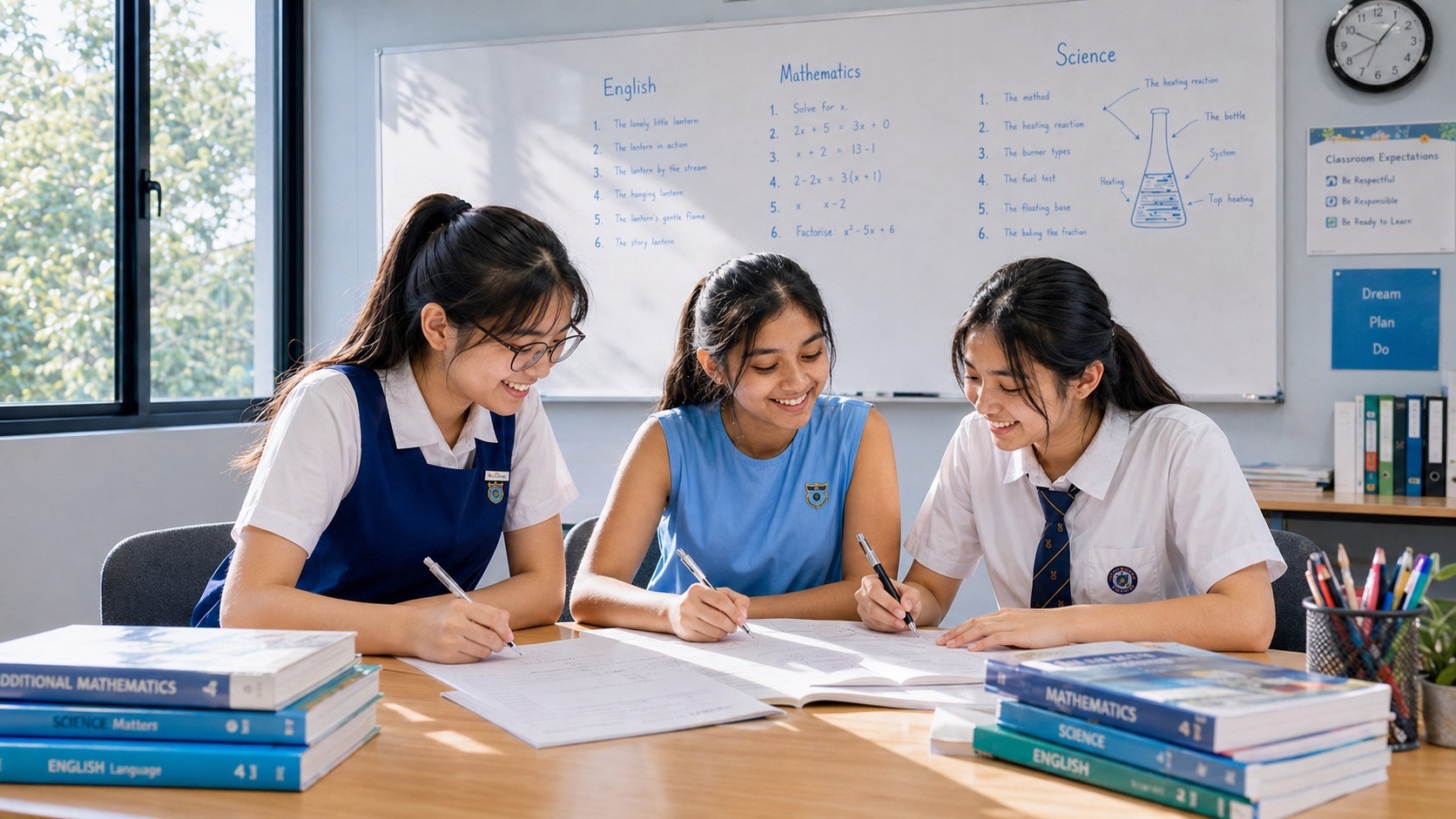
Bukit Timah Tutor · Mathematics Capability Atlas · Updated 29 September 2026
Why does advanced Mathematics fail when a student seems to have understood the current topic? Often the visible difficulty is not the real starting point. The present question is being carried by an earlier capability that has become unstable: number sense, fractions, ratio, algebraic equivalence, graph reading, function notation, geometric reasoning or another prerequisite.
The Lower-Floor Law of Mathematics describes this dependency. Higher mathematical work sits on lower mathematical floors. When an essential lower floor moves, the upper work becomes harder, slower and more error-prone even if the new topic itself is explained clearly.
This does not mean every struggle is a “weak foundation”. That phrase is too broad to guide teaching. The useful task is to identify the specific floor carrying the current work, repair only what is unstable, and then reconnect the learner to the present topic.
Quick Read
- Mathematics is cumulative because later ideas reuse earlier structures.
- A weak lower floor can make an upper topic look harder than it really is.
- The correct repair is the earliest relevant unstable prerequisite, not a return to the beginning of Mathematics.
- Different topics share floors, so one good repair can improve several areas.
- Strong students can also have hidden floor weaknesses because familiar methods may have masked them.
- Teaching ahead works best when the supporting floors remain stable.
- The goal is not endless remediation; it is enough stability for the next layer of independent work.
What Is a Mathematical Floor?
A floor is a prerequisite capability that supports later work. It can be a concept, representation, procedure, notation system or reasoning habit.
- Place value supports written calculation and estimation.
- Multiplication and division support fractions, ratio and algebra.
- Fraction equivalence supports percentage, probability and algebraic fractions.
- Signed numbers support algebra, coordinate geometry and functions.
- Algebraic equivalence supports equations, graphs, trigonometry and calculus.
- Function notation supports advanced graph work and calculus.
- Similarity supports scale, geometry and trigonometric reasoning.
A floor is not simply an earlier chapter. It is an earlier capability that is still active inside the present task.
Why Lower Floors Become Invisible
As students progress, earlier skills are compressed. Teachers stop explaining them because they are expected to be available automatically. A Secondary algebra lesson does not pause to re-teach integer arithmetic. A calculus lesson assumes algebraic manipulation. A trigonometry question assumes fractions, ratio and equation solving.
This compression is efficient when the floors are stable. It becomes expensive when they are not. The learner is trying to understand a new idea while simultaneously reconstructing an old one.
The result is overload. The student may appear slow, careless or confused in the new topic when the real cost is being paid lower down.
The First Mistake: Calling Everything a Foundation Problem
The Lower-Floor Law should not be used as a slogan. Not every error comes from the past. Students can misunderstand a new concept directly. They can misread a current question, choose an inefficient method, or lose control under examination pressure.
A good diagnosis asks whether the current topic is genuinely understood and then traces only the dependency that appears unstable. If the new concept is the problem, teach the new concept. If an older floor is carrying the error, repair the floor.
The Second Mistake: Repairing Too Far Down
When a Secondary student struggles, it is rarely useful to restart the entire Primary syllabus. Repair should be precise.
Suppose a student cannot simplify an algebraic fraction. The relevant floor may be factorisation, fraction structure or cancellation of common factors. Going back to basic addition would not help. The repair should descend only until the missing dependency becomes visible.
This protects lesson time and the learner’s sense of progress. The message becomes “this specific floor is unstable” rather than “your whole Mathematics foundation is weak”.
Primary Mathematics Floors
Primary Mathematics builds many of the floors later school Mathematics assumes.
Number sense
Magnitude, place value, decomposition and estimation support nearly every later numerical topic. Students who can calculate but have weak magnitude sense often accept implausible answers because numbers remain procedures rather than quantities.
Operations
Addition, subtraction, multiplication and division are not isolated algorithms. They describe relationships among quantities. Later algebra generalises the same operations symbolically.
Fractions
Fractions are a major structural floor. They support ratio, percentage, probability, rates, algebraic fractions and many later formulas. Weak fraction magnitude can remain hidden when calculators carry the arithmetic.
Ratio and proportional reasoning
Ratio supports scale, rate, percentage, similarity, trigonometry and modelling. Additive thinking often has to expand into multiplicative thinking here.
The PSLE Floor Is Not the End of the Primary System
PSLE Mathematics samples Primary capability under examination conditions. A strong PSLE result is valuable evidence, but it does not mean every floor is equally deep. Students can compensate through heuristics, pattern familiarity or intensive revision.
Secondary Mathematics changes the compression. Algebraic symbols replace some numerical cues. Topic interactions increase. A student who succeeded through familiar Primary question forms may discover a hidden weakness when the representation changes.
This is why the Primary to Secondary Mathematics Transition Hub is important: the transition is not simply harder numbers; it is a change in mathematical language and structure.
Secondary 1: Signed Numbers and Algebra Reveal Lower Floors Quickly
Secondary 1 often exposes weak signed-number structure, fraction control and operation sense. Algebra depends on these floors but hides them inside symbols.
A student who repeatedly loses negative signs may not have an “algebra problem” in the broad sense. They may have an unstable directed-number floor. A student who struggles with algebraic fractions may have fraction equivalence or factorisation problems. The repair should follow the dependency.
Secondary 2: The System Becomes More Connected
By Secondary 2, algebra supports graphs and coordinate geometry. Ratio and percentage reappear in rates and applications. Geometry increasingly depends on organised reasoning. Topics stop behaving like separate boxes.
This means a weak shared floor can create several symptoms. If algebraic rearrangement is unreliable, graph and geometry questions that require equations may also suffer. One repair can therefore have multiple downstream effects.
Secondary 3 and Additional Mathematics: Shared Floors Become Expensive
Additional Mathematics places heavy demand on algebra, functions, graph interpretation and symbolic fluency. A student can understand the new idea while still losing marks because the shared floor is unstable.
Logarithms depend on indices and algebra. Trigonometric equations depend on algebra and function thinking. Differentiation depends on indices, functions and simplification. Coordinate geometry combines algebra with spatial relationships.
The Additional Mathematics Directory maps the topic system. The Lower-Floor Law explains why several different A-Math chapters may be reacting to the same underlying weakness.
Secondary 4: Examination Compression Reveals Weak Floors
Revision and examination papers compress many topics under time. Weak floors that could be hidden in topical practice become visible because the student has to retrieve and combine them quickly.
A student may know every chapter separately but lose time reconstructing basic algebra inside each question. Another may understand advanced work but make repeated fraction or sign errors. Examination preparation should therefore distinguish content gaps from dependency friction.
A Floor Can Be Conceptual, Procedural or Representational
Not all floors are facts or algorithms. A student may have stable arithmetic but weak representation. They cannot turn words into diagrams, graphs or equations. Another student can represent well but lacks retrieval fluency. A third knows procedures but not the underlying concept.
The repair must match the floor type. Representation weaknesses need translation practice. Retrieval weaknesses need spaced return. Procedure weaknesses need controlled repetition. Concept weaknesses need a better model or explanation.
The Shared-Floor Principle
Some floors support many later topics. These are high-leverage repair points.
| Shared floor | Downstream areas |
|---|---|
| Fraction structure | Ratio, percentage, probability, algebraic fractions, rates. |
| Signed numbers | Algebra, coordinates, functions, trigonometry, calculus. |
| Algebraic equivalence | Equations, functions, graphs, A-Math, calculus. |
| Proportional reasoning | Percentage, scale, similarity, trigonometry, modelling. |
| Graph interpretation | Functions, coordinate geometry, calculus, statistics. |
| Checking habits | Every topic and every examination paper. |
A tutor who finds a shared-floor fracture can improve the efficiency of the whole learning programme by repairing it once and then reconnecting it across several contexts.
Strong Students Can Have Weak Floors Too
High marks do not guarantee uniform depth. Strong students often compensate. They may use memory, pattern recognition, speed or intuition to carry a weak floor until the subject becomes too compressed.
A student can score well in lower Secondary Mathematics while avoiding fractions whenever possible, then struggle in A-Math. Another may handle familiar graph questions but lack function understanding, which later affects calculus.
Repair should not be framed as going backwards. It is strengthening the structure required for the next level of work.
Teaching Ahead Must Respect the Lower-Floor Law
Teaching ahead of school can create a calm first encounter with future topics. It works best when the supporting floors are stable.
If a student previews calculus while algebra remains unreliable, the new topic may become another layer of memorised procedure. A better route may be to preview the concept while repairing the algebra that will carry it.
Acceleration without floor health can create impressive exposure and fragile capability at the same time.
How to Locate the Correct Floor
- Choose a current problem the student cannot solve reliably.
- Identify the first incorrect or uncertain step.
- Ask which earlier skill that step depends on.
- Test the prerequisite directly with a simpler item.
- Stop descending once the prerequisite becomes stable.
- Repair the first unstable floor.
- Return to the original problem and check whether performance improves.
This method keeps diagnosis bounded. We are not looking for every imperfection in the learner’s mathematical history. We are looking for the dependency currently limiting progress.
The Repair Sequence
locate → isolate → stabilise → reconnect → vary → mix → verify → revisit
Once the floor is found, repair it in isolation long enough to create reliable control. Then reconnect it to the upper topic quickly. A floor is useful only when it carries the structure above it.
The Lower-Floor Law and Confidence
Students often lose confidence when they believe the whole subject has become too hard. A precise floor diagnosis can reduce that feeling.
Instead of “I cannot do calculus”, the student learns “my differentiation idea is sound, but negative indices are slowing me down”. Instead of “I am bad at word problems”, the learner discovers “I can calculate once the relationship is represented; I need to improve translation from language to model”.
Specificity turns a global identity judgment into a bounded learning job.
The Lower-Floor Law and Small-Group Mathematics Tuition
In a three-student class, the tutor can inspect working closely enough to find the first unstable dependency. That is one of the practical advantages of genuinely small-group Mathematics tuition.
The canonical class-mechanism page remains Why Three Students? How 3-Pax Mathematics Tuition Works. The Lower-Floor Law explains one reason the visibility matters: diagnosis can move beneath the topic label to the specific prerequisite carrying the work.
What Parents Can Watch
- The same error appears across several topics.
- Advanced work becomes slow because basic transformations require too much attention.
- The child understands explanations but cannot execute reliably.
- Past topics disappear quickly when not practised.
- A calculator or worked example hides weak underlying structure.
- Mixed papers are much weaker than topical worksheets.
These are not proof of a foundation problem, but they justify a closer look at shared dependencies.
Frequently Asked Questions
Does every Mathematics problem come from weak foundations?
No. Current-topic misconceptions, representation problems, method selection and examination-control issues can all cause difficulty. The Lower-Floor Law applies only when evidence shows that an earlier prerequisite is unstable.
How far back should a student go?
Only as far as the first relevant unstable dependency. The aim is precise repair, not restarting Mathematics from the beginning.
Can a student be strong overall and still have a weak floor?
Yes. Strong students often compensate through memory, speed or pattern familiarity until later topics make the hidden dependency more expensive.
Should tuition always repair before moving ahead?
Not always. A student can preview future work while repairing a prerequisite, provided the new topic does not become another layer of fragile memorisation.
The Principle to Keep
Advanced Mathematics does not float above earlier learning. It stands on it.
When the upper floor shakes, do not rebuild the whole building. Find the load-bearing part that moved, stabilise it, and let the learner climb again.
For a broader starting-point diagnosis, use Find My Mathematics State or Bukit Timah Mathematics Tuition.
The Dependency Map: Mathematics Carries Its Past Forward
Mathematics does not leave earlier learning behind. It compresses it. When a Secondary student solves an equation, whole-number operations, signed numbers, fractions, equality and notation may all be active at once. When an A-Math student differentiates a function, indices, algebraic simplification, function notation and graph meaning may all be carrying the work.
This is why the Lower-Floor Law is useful. It asks which earlier capability is silently supporting the current task. If that capability is stable, the learner can focus on the new idea. If it is unstable, the student has to solve two problems at once: reconstruct the old floor and learn the new layer.
The visible symptom may therefore appear one or two levels above the real fracture.
The Floor Beneath Number Work
Number sense is often invisible because school moves quickly into written methods. Yet magnitude, place value, decomposition and estimation remain active in later work.
A student can perform an algorithm and still have weak number sense. They may accept an answer of 7,500 when the original quantities suggest something near 75. They may misread decimal place value or fail to notice that multiplying by 0.2 should reduce a positive quantity.
When later topics become dense, weak magnitude sense removes an important checking system. The learner may execute steps without a feel for whether the result belongs in the right region.
The Floor Beneath Fractions
Fractions are one of the most important load-bearing floors in school Mathematics. They support ratio, percentage, probability, rates, algebraic fractions and many formulas.
A learner who treats fractions only as rules may survive Primary calculations but struggle when fractions become embedded inside algebra. The deeper floor includes magnitude, equivalence, part-whole meaning, division meaning and multiplicative structure.
For example, simplifying an algebraic fraction requires the student to understand factors and cancellation. If the fraction floor is weak, the symbolic form increases confusion. Repair may need to return briefly to numerical examples where the same structure is easier to see.
The Floor Beneath Ratio and Percentage
Ratio and percentage depend on multiplicative comparison. Students who remain strongly additive may treat every change as “how much more” rather than “how many times as much”.
This floor later supports scale, similar figures, rates, trigonometry, compound growth and financial Mathematics. A weakness can therefore reappear in several forms.
A learner who confuses percentage points with percentage change, or uses the wrong reference base, may need more than another percentage worksheet. They may need a clearer understanding of what quantity the comparison is relative to.
The Floor Beneath Algebra
Algebra sits on several lower floors: signed-number structure, arithmetic operations, equivalence, fractions and the meaning of equality. When these are stable, letters become a natural generalisation. When they are not, algebra feels like a new and arbitrary rule system.
A student who repeatedly changes signs incorrectly may not need another explanation of linear equations. They may need a narrow repair of negative numbers and distribution. A student who cancels terms illegally may need factor structure. A student who “moves” terms without understanding balance may need equality made visible again.
The earlier floor is not childish material. It is the structure the new notation assumes.
The Floor Beneath Graphs
Graphs depend on coordinate structure, variables, scale, rate and function relationships. A learner can plot points accurately while still misunderstanding what the graph represents.
Later, graph interpretation supports simultaneous equations, functions, trigonometry, calculus and statistics. A student who sees graphs only as pictures may struggle to connect symbolic and visual forms.
The repair may involve returning to the meaning of axes, paired values, gradient or intercept rather than practising more advanced graph questions immediately.
The Floor Beneath Geometry
Geometry depends on spatial language, measurement, angle relationships, proportionality and proof habits. A learner may know formulas but remain weak at identifying which lengths or angles correspond.
Similarity is especially important because it becomes a floor for scale and trigonometry. If corresponding sides are not understood, trigonometric ratios can become calculator routines without geometric meaning.
The repair should therefore target the relationship the later topic assumes.
The Floor Beneath Functions
Functions depend on algebraic language, variables, input-output structure and graph interpretation. The notation f(x) can be memorised as “replace x” without the learner understanding that a function describes a mapping from allowed inputs to outputs.
This shallow floor becomes expensive when students meet composite functions, inverse functions, transformations or calculus. The symbolic manipulation may be possible while the conceptual object remains unclear.
A function repair may therefore need to move between tables, graphs, verbal rules and algebra rather than remain inside notation.
The Floor Beneath Trigonometry
Trigonometry uses ratio, geometry, algebra and later functions. Students can memorise SOHCAHTOA and still have an unstable trigonometric floor if they cannot identify the relevant triangle, distinguish opposite and adjacent relative to an angle, or interpret a ratio as a geometric relationship.
At higher levels, trigonometry becomes a function system involving identities, equations and graphs. The lower geometric ratio floor still matters, but new floors are added.
When a student struggles, the tutor needs to ask which layer is actually moving.
The Floor Beneath Calculus
Calculus is often blamed when the real issue is algebra. Differentiation and integration require reliable manipulation of powers, functions, fractions and equations. Optimisation adds modelling. Kinematics adds units and interpretation.
A learner may understand rate of change perfectly and still lose marks because simplifying the derivative is unreliable. Another may differentiate accurately but not understand what a stationary point means. These are different floors.
The diagnosis should separate calculus concept from algebraic carrier and application interpretation.
The Floor Beneath Probability
Probability depends on fraction and ratio structure, counting, logical events and sample-space representation. A student may know the formula for probability but double-count outcomes or assume equally likely cases where they are not equally likely.
Later conditional probability and distributions add more structure. If the simple sample-space floor is weak, formulas become difficult to interpret.
The Floor Beneath Statistics
Statistics depends on data representation, proportional thinking, averages, variation and interpretation. Students can calculate a mean while failing to understand what it summarises or when it is misleading.
At higher levels, sampling and inference require a new floor: reasoning from a sample to a population under uncertainty. Calculation alone is not enough.
The Floor Beneath Examination Performance
Examination performance sits on the entire mathematical system plus additional control skills: retrieval, pacing, reading, method selection, checking and recovery.
A student may therefore score below their conceptual level because the examination-control floor is unstable. Conversely, a student may score well on familiar papers while deep conceptual floors remain weak.
This is why marks alone cannot locate the floor. The working and error pattern matter.
The Symptom Map: What an Unstable Floor Can Look Like
- The student is much slower than expected on advanced questions.
- Simple arithmetic or algebra consumes attention inside a harder topic.
- Errors appear across several chapters but share the same mechanism.
- The learner understands explanations but cannot execute reliably.
- Topical work is strong but mixed work collapses.
- The learner relies heavily on calculator output without estimation.
- Old topics need to be re-taught every time they return.
- The student knows a formula but cannot identify when it applies.
- Working becomes messy when several operations interact.
- Confidence falls because each new topic seems to produce the same failure.
None of these signs proves a foundation problem on its own. They are prompts for diagnosis.
The Difference Between a Floor and a Gap
A gap is missing knowledge. A floor is a capability that actively supports later work. Some gaps are low priority because they are not currently load-bearing. Some floors deserve urgent repair because several current topics depend on them.
This distinction helps with limited lesson time. The tutor does not need to repair every historical imperfection before the student can progress. They need to protect the dependencies that matter now and soon.
The Difference Between a Floor and a Habit
Some recurring problems are not content floors but operating habits. The learner may skip units, compress too many steps mentally, fail to reread the question or never check a final answer.
These habits can behave like floors because every topic sits on them. A poor checking habit can damage algebra, geometry and statistics equally.
Repair therefore includes mathematical habits as well as concepts and procedures.
The Difference Between a Floor and Confidence
Confidence can influence performance, but it should not be used as a catch-all explanation. A student may feel anxious because the mathematical floor is genuinely unstable. Another may understand the work but still hesitate after previous failures.
The tutor should look for evidence. If performance improves immediately when a representation is supplied, the issue may be structural rather than motivational. If the learner can perform independently in calm conditions but freezes under time, examination control may be the limiting layer.
The Difference Between a Floor and Memory
A student may have understood an idea and simply fail to retrieve it after a delay. This is a memory-access problem, not necessarily a conceptual foundation problem.
Retrieval practice and spaced return can restore access without re-teaching the whole concept. The diagnosis matters because the intervention should match the mechanism.
The Difference Between a Floor and Language
Word problems can make a learner look mathematically weak when the main bottleneck is language. Terms such as “remaining”, “difference”, “at least”, “per”, “increased by” or “consecutive” carry structure.
A useful diagnostic separates the wording from the calculation. If the student succeeds once the relationship is represented, the numerical floor may be stable while translation needs work.
When the language difficulty is broader than Mathematics, the correct response is a handoff to the appropriate English support rather than pretending every reading problem is a Mathematics topic.
How a Tutor Tests a Floor Without Humiliating the Learner
Diagnostic questions should feel like ordinary Mathematics, not a return to kindergarten. The tutor can choose clean examples that isolate the dependency without attaching a school-year label.
For an A-Math student, a quick numerical fraction or index item can test the floor in seconds. For a Secondary student, a simple signed-number or ratio item can reveal whether the lower structure is stable. The language should be neutral: “I want to see which part is carrying the error.”
This protects dignity and keeps diagnosis focused on capability rather than identity.
The Minimum-Repair Principle
Repair the smallest structure that unlocks the current work. If the student is weak only in negative distribution, do not re-teach all algebra. If ratio is stable but percentage base selection is weak, repair the reference relationship directly.
Minimum repair makes tuition efficient. It also gives the learner fast evidence that the problem is bounded and solvable.
The Reconnection Principle
A repaired floor should return to the upper topic quickly. Otherwise the learner may become good at the isolated prerequisite but still fail to recognise it inside the original context.
After repairing signed-number distribution, return to the equation or function where the sign problem first appeared. After repairing fraction equivalence, return to the ratio or algebraic fraction problem. Reconnection proves that the floor is carrying weight again.
The Delayed-Return Principle
Immediate success after repair is encouraging but weak evidence. The learner has just seen the explanation. A stronger test happens after delay.
If the floor remains stable a week later and inside mixed work, the repair is becoming durable. If it collapses, more retrieval or practice is needed.
The Transfer Principle
A stable floor should support more than the original question. Algebraic equivalence repaired in one equation should help in functions and graphs. Proportional reasoning repaired in percentage should help in similarity or rates.
Transfer is one of the strongest signs that the repair reached the underlying structure rather than the surface example.
The Lower-Floor Law Does Not Mean Progress Must Be Slow
Precise repair can accelerate learning. Once a shared floor becomes stable, several upper topics may improve together.
A student who finally stabilises algebraic manipulation may find functions, coordinate geometry, trigonometry and calculus all become easier. The time spent repairing the floor can be repaid many times.
The Lower-Floor Law and Strong Learners
Strong learners can hide lower-floor weaknesses because they compensate. They may use memory, pattern familiarity, intuition or speed. This can work for years until advanced Mathematics increases interaction among topics.
The repair should be framed as refinement, not remediation. High-performing students often respond well when shown that a small structural upgrade can make advanced work more elegant and efficient.
The Lower-Floor Law and Students Who Are Falling Behind
For a struggling learner, the danger is opposite. Too many weak floors can make current work feel impossible. The tutor has to prioritise.
Start with the floors that unlock the greatest amount of current Mathematics. Stabilise one, reconnect it, then choose the next. The goal is not to repair the entire past before the student can rejoin the present.
The Lower-Floor Law and Teaching Ahead
Teaching ahead is safe when future content can sit on stable present floors. A preview should not require the tutor to carry every missing prerequisite artificially.
Sometimes a student can preview a new idea conceptually while still repairing the procedural floor. That is a useful compromise. The learner gains recognition without pretending the topic is mastered.
The separate Teaching Mathematics Ahead of School guide develops this timing question directly.
The Lower-Floor Law and the Parent Conversation
Parents often hear broad explanations: “foundation weak”, “careless”, “needs more practice”. A higher-resolution conversation should name the actual floor.
- “Signed-number distribution is unstable, and it is affecting current algebra.”
- “Fraction equivalence is making percentage and probability slower.”
- “The student knows the formulas but graph interpretation is weak.”
- “The Mathematics is understood; the current limitation is mixed-paper method selection.”
Specificity makes the plan auditable. Parents can later see whether the targeted mechanism improved.
A Floor-Health Checklist
- The learner can retrieve the prerequisite without a worked example.
- The learner can explain the core relationship.
- The procedure is reliable enough not to consume excessive attention.
- The skill survives a change of representation.
- The learner can recognise when the skill is relevant inside mixed work.
- An independent check is available.
- The floor remains available after a delay.
A floor does not have to be perfect. It needs to be stable enough to carry the next layer.
Worked Example: When Algebra Is Not Really the Main Problem
Suppose a Secondary student is solving 3(2x − 5) = 4x + 7 and repeatedly produces a sign error during expansion. It is tempting to label the whole topic “linear equations” as weak. A closer inspection may show that the learner understands equality, knows how to collect like terms and can isolate x correctly once the expansion is valid.
The first unstable floor is distribution across a negative term. A precise repair isolates expressions such as 3(a − 4), −2(x + 5) and −(2y − 7), makes the multiplication structure visible, then reconnects the skill to the equation. The student does not need the whole algebra chapter re-taught.
That is the Lower-Floor Law in practice: locate the load-bearing dependency, stabilise it, and return to the upper work.
Worked Example: When Percentage Is Really a Reference-Quantity Problem
A student may remember the percentage-change formula and still choose the wrong base. The error can survive many worksheets because the arithmetic is correct once the base has been chosen.
The lower floor is not multiplication. It is understanding what percentage change is comparing. The repair begins with ordinary language: what quantity did we start from, and what are we measuring the change relative to? Bar models, multipliers and simple numerical examples can make the reference relationship visible.
When the student later meets compound growth, depreciation or finance, that same floor continues to carry the work.
Worked Example: When Trigonometry Is Really a Similarity Problem
Trigonometric ratios can be taught as three calculator formulas. That route may produce early success. But the deeper floor is that right triangles sharing an acute angle are similar, so the ratios of corresponding side lengths remain constant.
A student who does not see this proportional structure can memorise SOHCAHTOA and still remain fragile. They may struggle when diagrams rotate, when the unknown changes position, or when trigonometry becomes a function rather than a single triangle calculation.
The repair may therefore return briefly to similarity and ratio before coming back to trigonometry.
Worked Example: When Calculus Is Really an Indices Problem
A student differentiates x³ correctly but repeatedly fails on x^(−2) or expressions involving roots. The calculus concept may be secure. The unstable floor is index notation and algebraic rewriting.
Instead of adding more differentiation questions, the tutor isolates negative and fractional indices, connects roots to powers, and checks whether the student can move between forms confidently. Once the floor stabilises, the same differentiation rule suddenly works across a wider range of expressions.
This kind of repair often creates a noticeable jump because one small floor was limiting many upper examples.
Worked Example: When Geometry Is Really a Correspondence Problem
A student may know similarity theorems but repeatedly pair the wrong sides. The issue is not theorem recall. It is correspondence.
The repair slows the diagram down. Mark corresponding angles, name matching vertices in order, and trace one side pair at a time. Once correspondence becomes reliable, ratio equations and scale factors become easier because the representation floor is stable.
Worked Example: When Probability Is Really a Counting Problem
A student can state probability as favourable outcomes over total outcomes and still fail because the sample space is incomplete. The floor is systematic counting, not the probability formula.
A table, tree diagram or organised list may repair the structure. Once the outcome set is correct, the probability calculation becomes straightforward.
Why the Same Floor Can Look Different at Different Ages
A floor does not always return in the same visual form. Proportional reasoning in Primary school may appear as bar models and unitary method. In Secondary school it appears in rates, similarity and scale. In Additional Mathematics it appears in trigonometric relationships. In finance it appears in growth factors and returns.
This is why curriculum progression can disguise continuity. The chapter name changes, but the underlying capability remains active.
Recognising these cross-level identities helps tutors diagnose more efficiently and helps students see Mathematics as a connected system.
The Lower-Floor Law and Working Memory
Working memory is limited. When a lower-floor operation is not fluent, it consumes attention that the student needs for the new idea.
Consider a student learning simultaneous equations who must pause repeatedly to compute signed arithmetic. The concept of elimination may be understood, but each arithmetic interruption increases the chance of losing the larger route.
Fluency therefore matters not because speed is a virtue by itself, but because reliable lower-level operations free attention for higher-level reasoning.
The Lower-Floor Law and Notation
Notation can also be a floor. A learner may understand the underlying idea but misread the symbolic language used to express it.
Function notation, interval notation, vector notation, logarithms, indices and statistical symbols all compress meaning. If the notation is not stable, the student spends attention decoding symbols instead of reasoning with the idea.
A notation repair can be small: name each symbol, connect it to an ordinary-language meaning, and practise translating in both directions.
The Lower-Floor Law and Mathematical Language
Words such as “difference”, “at most”, “consecutive”, “constant”, “proportional”, “intercept” and “gradient” are part of the mathematical system. Language can therefore become a floor.
Students may know the operation but fail to recognise the relationship because the wording is unfamiliar. The repair is not necessarily more arithmetic. It may be paraphrasing, vocabulary work and translation from words to representation.
The important boundary is to distinguish mathematical language from broader English difficulty. If the student struggles across subjects, Mathematics tuition should not claim ownership of the entire language problem.
The Lower-Floor Law and Study Habits
Study habits can become operational floors because every topic depends on them. If a learner never revisits old work, retrieval decays. If corrections are copied without retesting, recurring errors remain active. If notes contain formulas but no conditions, method selection stays weak.
A good Mathematics learning system therefore protects not only topic knowledge but also retrieval, correction, checking and mixed practice.
The Lower-Floor Law and Examination Anxiety
Pressure can expose weak floors because fragile knowledge requires more conscious attention. Under time, the learner has less capacity to reconstruct missing steps.
This does not mean every examination problem is caused by foundations. But stable lower floors make performance more robust because fewer basic decisions have to be rebuilt during the paper.
For students whose Mathematics is stable in calm conditions but collapses only under assessment, the next floor may be examination control rather than content.
The Lower-Floor Law and Speed
Slow work can come from many causes. Sometimes the student is careful and methodical. Sometimes method selection is inefficient. Sometimes a lower-floor procedure is consuming too much attention.
The tutor should not push speed indiscriminately. First identify where time is being spent. If the student pauses on basic algebra inside every advanced problem, targeted fluency work may improve speed naturally. If the student spends time rereading because the language is unclear, a different repair is needed.
The Lower-Floor Law and Careless Errors
Repeated “careless” errors often have a structural component. The learner may compress too many steps, use inconsistent notation, omit units or rely on mental arithmetic beyond their stable fluency.
A stable floor reduces this risk because more of the working becomes automatic and checkable. But carelessness should not automatically be reclassified as foundation weakness. The evidence must show a repeated mechanism.
The Lower-Floor Law and Confidence Loops
When a lower floor remains unstable, the student repeatedly experiences failure in upper topics. The visible story becomes “I am bad at this subject”, even though the same small mechanism may be causing many errors.
Precise repair can break this loop. The learner sees that the problem has a name, a bounded scope and a repair route. Confidence then grows from evidence rather than reassurance alone.
The Floor Stack Is Different for Every Question
There is no single universal list of prerequisites that must be mastered perfectly before a student can progress. Each question activates a particular stack.
A coordinate geometry problem might activate algebra, gradient, distance, ratio and graph interpretation. A statistics question might activate percentage, reading, averages and data interpretation. A calculus optimisation problem might activate functions, algebra, differentiation and modelling.
Diagnosis should therefore begin with a real task, not a generic assumption about what the student “should” know.
The Floor Stack Changes as Expertise Grows
What is an upper topic today becomes a lower floor tomorrow. Algebra is new in Secondary 1 and foundational in Additional Mathematics. Differentiation is advanced in school and foundational in university analysis, differential equations and optimisation.
This is one reason education is cumulative. Capability that was once the learning target later becomes assumed infrastructure.
Repair Does Not Mean Waiting for Perfection
If students had to master every floor perfectly before moving on, progress would stop. The practical standard is sufficient stability.
The learner should be able to retrieve the floor, use it with reasonable reliability, recognise it inside current work and check major errors. Later use will deepen the floor further.
Education is iterative. Repair and progression can operate together.
A Tutor’s Lower-Floor Diagnostic Routine
- Read the student’s current school problem or marked work.
- Locate the first point where the route becomes invalid or uncertain.
- Name the mathematical operation or relationship required at that point.
- Test that prerequisite in a cleaner context.
- If stable, return upward and inspect the next dependency.
- If unstable, teach the smallest repair.
- Practise the floor enough to reduce cognitive cost.
- Reconnect immediately to the original topic.
- Change the surface to test transfer.
- Return later to test durability.
This routine prevents both over-diagnosis and superficial correction.
A Student’s Lower-Floor Self-Check
- Which earlier skill is this question using?
- Where did I first become unsure?
- Can I do that smaller skill on its own?
- Is the difficulty understanding, remembering or executing?
- Can I represent the same idea another way?
- How can I check whether the repaired step is now correct?
Students do not need to diagnose every learning problem alone, but these questions build metacognition and reduce the feeling that the entire topic is mysterious.
A Parent’s Lower-Floor Conversation
Parents can support diagnosis without teaching the content. Instead of asking only “What mark did you get?”, ask what kind of error repeated and whether the tutor or teacher found an earlier skill underneath it.
Bring actual marked work to a consultation. The best evidence is usually in the student’s own working: the place where the route first changed from valid to invalid.
The Lower-Floor Law and the Mathematics Capability Atlas
The Lower-Floor Law is one part of a larger learner record. BTT’s Mathematics Capability Atlas also considers current level, subject level, lifecycle state, zoom, depth, error pattern, independence and motion.
A student can have stable floors but weak examination control. Another can have strong current-topic understanding but an unstable prerequisite. Another can be ready to extend rather than repair.
The floor is therefore one coordinate, not the whole child.
When the Best Decision Is Not Tuition
If the learner’s floors are stable, school performance is consistent, independent study works and there is no meaningful current constraint, additional tuition may not be necessary.
The Lower-Floor Law is not a reason to search endlessly for hidden weakness. It is a diagnostic tool to use when actual evidence shows that present work is being limited by an earlier dependency.
When the Best Decision Is Focused Repair
If one shared floor is clearly limiting several topics, a short period of targeted repair may have more value than broad syllabus coverage.
This can feel counterintuitive near examinations, but the correct shared repair can improve many questions at once. The timing and scope should still be proportionate to the assessment horizon.
When the Best Decision Is to Move Ahead
If lower floors are stable and current work is secure, moving ahead can create useful anticipation. The student can meet future language and representations calmly.
Progression should not be delayed merely because perfection is impossible. The Lower-Floor Law protects load-bearing structure; it does not demand complete mastery of everything before learning continues.
A Quiet Definition of Foundation Strength
A strong foundation is not the ability to redo old worksheets flawlessly. It is the ability to use earlier Mathematics reliably inside new work.
That is the real release test. The floor has become infrastructure rather than a separate topic requiring constant attention.
Frequently Asked Questions: Deeper Answers
Can tuition repair several floors at the same time?
Sometimes, but priority matters. If too many mechanisms are targeted at once, the learner can become overloaded. Start with the floor that unlocks the greatest amount of current work, then move outward.
How long does foundation repair take?
There is no universal duration. A narrow sign or notation issue may improve quickly. A broader fraction or algebra structure may require repeated use over weeks. The relevant measure is whether the repair survives delay and transfer.
Should a student stop current school work while repairing?
Usually not. Repair and current participation should be connected. The tutor may simplify the current task temporarily while rebuilding the floor, then return the learner to the full school demand.
Can a calculator hide weak floors?
Yes. A calculator can hide arithmetic or fraction weaknesses, but it can also free attention for higher reasoning. The question is whether the delegated computation is part of the target skill and whether the learner can still estimate and interpret the result.
Does a good mark prove the floors are stable?
No. It is useful evidence, especially across several varied assessments, but students can compensate through familiarity, memorisation or intensive recent revision. Mixed and delayed performance provide stronger evidence of durable floors.
The Release Standard
A floor is stable enough when the student can retrieve it, execute it reliably, recognise it inside new work, connect it to the upper topic and check major errors without heavy prompting.
At that point, the floor no longer needs to dominate the lesson. It can return to its proper role: quiet infrastructure beneath the learner’s next layer of Mathematics.
Return to the Mathematics Map
Use Find My Mathematics State when the problem has not yet been located. Use the Mathematics Fracture and Repair Map when a recurring error is already visible. Use Teaching Mathematics Ahead of School when the learner is stable enough to open the next corridor.
The Lower-Floor Law connects these decisions. It asks one quiet question before acceleration, repair or examination training: what earlier capability is carrying this work, and is it stable enough to bear the load?
The Lower-Floor Law Across a Full Mathematics Year
The Lower-Floor Law becomes most useful when it is applied across time rather than only after a crisis. At the beginning of a school year, a tutor can identify which prerequisite floors the coming topics will rely on. During the year, small signs of instability can be repaired before they become large examination problems.
This does not require endless diagnostic testing. A few well-chosen questions embedded inside normal teaching are enough. The tutor watches how the student handles fractions, signed numbers, algebra, graph reading, proportional reasoning and checking whenever those capabilities naturally reappear.
The result is preventative maintenance rather than emergency reconstruction.
January–March: Reopen the Floors
At the start of the year, previously learned Mathematics may be less accessible after a long break. The first task is not to assume that forgotten access means forgotten understanding. Short retrieval tasks reveal what returns quickly and what needs repair.
For Primary learners, this may include operations, fractions and word-problem representation. For Secondary learners, signed numbers, algebraic manipulation and graph interpretation often deserve attention. For A-Math students, functions and algebraic fluency are especially important.
The goal is to reopen the system before new content places heavier load on it.
April–June: Watch for Shared Weak Links
As more topics accumulate, shared floors become easier to identify. If the same algebra error appears in graphs, geometry and equations, the pattern is now strong enough to justify targeted repair.
This is also the period when students may begin to feel that several subjects or chapters are becoming harder simultaneously. A shared-floor diagnosis can prevent the problem from being misread as a general loss of ability.
July–September: Integrate the Floors Under Mixed Work
Later in the year, mixed practice becomes increasingly important. A floor that is stable in isolation may still fail when several topics compete for attention.
For example, a student may simplify fractions correctly on a fraction worksheet but forget the same structure inside probability. Algebra may be reliable in an algebra set but collapse inside coordinate geometry. Mixed work reveals whether the floor has become portable.
At this stage, the tutor should avoid re-isolating every skill for too long. The floor must carry the upper system under realistic conditions.
October–Examination Period: Commission the Whole Structure
Near major examinations, the question changes from “Can the student learn this?” to “Can the student retrieve and operate it under time?”
Weak floors may now show themselves as slow execution, repeated checking failures or sudden drops in mixed papers. The tutor has to balance repair against examination practice. A narrow repair can still be worthwhile if it affects many questions, but broad rebuilding may need to be scheduled beyond the immediate paper.
This is a judgement problem, not a fixed formula. The repair should be proportionate to the time available and the leverage of the floor.
The Lower-Floor Law and Curriculum Changes
Curriculum labels can change while mathematical dependencies remain recognisable. Singapore’s Full Subject-Based Banding and SEC transition affect subject levels, assessment routes and course structures, but number sense, proportional reasoning, algebra, graphs and checking remain load-bearing mathematical capabilities.
This is why a dependency-based learning system is durable. It can be updated for current syllabus details without rebuilding the whole educational logic every time a qualification label changes.
For current syllabus and assessment information, official MOE and SEAB sources remain the final authority. The Lower-Floor Law is about the stable learning structure underneath those dated policy layers.
The Lower-Floor Law and International Mathematics Routes
The same principle applies outside Singapore. Cambridge IGCSE, IB, UK GCSE, A-Level, AP and other Mathematics routes organise content differently, but advanced work still depends on earlier mathematical objects and operations.
A student moving between curricula may therefore have a sequencing gap rather than a genuine mathematical gap. The learner may know the underlying concept but not the notation or order in which the new programme expects it.
The World Mathematics Atlas separates curriculum route from mathematical object so these transitions can be read more accurately.
The Lower-Floor Law and Transfer Students
Students entering Singapore from another school system may appear ahead in some topics and behind in others. A simple year-level comparison can therefore be misleading.
The useful question is which capabilities the current Singapore topic assumes. A student may have strong algebra but little experience with bar models or certain problem-solving conventions. Another may have advanced calculator experience but weaker non-calculator fluency.
Floor mapping turns a curriculum transition into a set of specific crosswalks rather than a global judgement about level.
The Lower-Floor Law and Students Returning After a Break
Long absence, illness, school change or reduced study time can weaken retrieval without erasing underlying understanding. Returning students often need a reactivation phase.
The tutor can test whether the old floor returns quickly with one reminder or whether it has become genuinely unstable. This distinction prevents unnecessary reteaching and helps the learner regain momentum faster.
The Lower-Floor Law and High-Ability Extension
Strong students are often accelerated because they complete current work quickly. The Lower-Floor Law suggests a second option: deepen the existing floor so it can carry more sophisticated reasoning.
A learner can generalise a pattern, prove a relationship, compare methods, construct counterexamples or connect the topic to a wider application. This form of extension strengthens the structure without necessarily moving into next year’s syllabus.
Acceleration and depth are not competitors. The tutor chooses based on evidence of current floor stability and the learner’s goals.
The Lower-Floor Law and Olympiad Mathematics
Olympiad work often exposes whether school foundations are genuinely flexible. A student may know arithmetic, algebra and geometry procedures but struggle to use them in unfamiliar configurations.
This does not necessarily mean the floor is weak in routine school terms. It may mean the floor has not been extended into non-routine transfer. Olympiad training therefore builds a different kind of load-bearing strength: generalisation, invariants, organised search and proof.
The Mathematics Olympiad & Competition Hub owns the competition route; the Lower-Floor Law explains why ordinary school knowledge must become flexible before it can support advanced problem solving.
The Lower-Floor Law and University Mathematics
At university, school topics become assumed infrastructure. Algebra, functions, proof language, trigonometry and calculus are no longer the main destination; they are tools used inside analysis, linear algebra, probability, differential equations and other fields.
This transition makes the Lower-Floor Law even more visible. A student can have strong examination results and still need to strengthen proof, abstraction or independent study before university Mathematics feels stable.
The School to University Mathematics Bridge develops that transition directly.
A Lower-Floor Diagnostic for Primary Students
- Can the child compare quantities without relying only on written algorithms?
- Can they decompose numbers flexibly?
- Do multiplication and division have relational meaning?
- Can they estimate fraction magnitude?
- Can they identify the whole in a fraction or percentage problem?
- Can they translate a word problem into a useful representation?
- Can they check whether an answer is reasonable?
These questions are not a test battery. They indicate where the tutor may look when current Primary work becomes unstable.
A Lower-Floor Diagnostic for Secondary Students
- Are signed-number operations reliable?
- Can fractions be simplified and compared confidently?
- Does the learner understand equality and equivalence?
- Can they expand, factorise and rearrange without excessive hesitation?
- Can they connect tables, graphs and equations?
- Can they identify proportional relationships?
- Can they interpret units and scale?
- Can they check algebraic results by substitution or estimation?
A Lower-Floor Diagnostic for Additional Mathematics
- Are indices and surds stable?
- Is factorisation flexible enough for equations and functions?
- Is function notation meaningful rather than procedural?
- Can graphs be read as behaviour, not only plotted points?
- Is trigonometric ratio structure secure?
- Can the learner manipulate fractions and algebra under longer chains?
- Can they connect a derivative to graph behaviour?
- Can they verify results independently?
What a Repair Lesson Should Feel Like
A repair lesson should be narrower than a normal topic lesson but still connected to the current syllabus. The learner should understand why the floor is being revisited and where it will be used.
The tutor may begin with a clean example, make the governing relationship visible, practise until the vulnerable move becomes stable, then return immediately to the original advanced question.
The learner should leave feeling that the current topic has become more accessible, not that they have been sent backwards indefinitely.
What a Repair Lesson Should Not Feel Like
Repair should not become a punishment for getting a question wrong. It should not involve large volumes of easy work unrelated to the actual dependency. It should not reduce the learner’s identity to “weak foundations”.
The language matters: “This floor is carrying several current topics, so strengthening it will make the rest easier.” That statement is both accurate and forward-looking.
Why Small Repairs Can Produce Large Effects
Shared floors create leverage. A student who stabilises algebraic manipulation may improve equations, graphs, trigonometry and calculus. A student who strengthens proportional reasoning may improve ratio, percentage, similarity and rate problems.
This is one reason precise diagnosis matters more than worksheet volume. The right small repair can change a large part of the system.
Why Large Repairs Sometimes Need Patience
Some floors are broad and have been unstable for years. Fraction structure, algebraic equivalence or mathematical language may require repeated use across many contexts before becoming reliable.
Progress can still be visible before full stability. The student makes fewer errors, needs fewer prompts, transfers better and recovers faster. The Parent Mathematics Dashboard helps track those intermediate signals.
The Lower-Floor Law as a Parent Decision Tool
When a child struggles, parents often face a choice between more practice, a new tutor, a harder class, a slower class or waiting. The Lower-Floor Law does not make the decision automatically, but it improves the question.
Ask whether the current difficulty has been located. If a specific prerequisite is unstable, targeted support makes sense. If the floors are stable and the issue is paper timing, the intervention should move to examination craft. If the learner is already independent and progressing, more tuition may not be necessary.
The Lower-Floor Law as a Student Decision Tool
Students can use the same idea during independent study. When stuck, do not immediately conclude that the whole chapter is impossible. Identify the exact step that feels uncertain and ask which earlier skill it uses.
Sometimes ten minutes repairing that smaller skill is more effective than an hour rereading the current chapter.
The Lower-Floor Law as a Tutor Decision Tool
Tutors need to resist two opposite errors: teaching only the current syllabus surface, and descending endlessly into historical foundations.
The correct depth is evidence-driven. Go down only until the first relevant unstable dependency is found. Repair it. Reconnect upward. Then continue the learner’s present route.
The Final Distinction: Foundation Strength Is Functional
A foundation is strong when it functions inside later work. It does not need to look perfect in isolation.
The student may not remember every old textbook method, but if they can retrieve the necessary relationship, apply it accurately, adapt it to the new representation and check the result, the floor is doing its job.
The Closing Principle
Higher Mathematics becomes possible because earlier Mathematics becomes infrastructure. The purpose of foundation repair is not to keep the learner looking backwards. It is to restore enough structural stability that the learner can move forward with less friction.
Find the floor that carries the present problem. Repair only what moved. Reconnect it to the current work. Then let the learner climb.
The Last-Mile Test: Can the Floor Work Without Being Announced?
A floor is not fully functional if the student uses it only when the tutor says which prerequisite is being tested. The strongest release condition is unannounced use. The learner meets a mixed question, recognises the relevant structure and brings the lower skill into service without a label.
This is especially important for algebra, ratio, graph interpretation and checking. These capabilities rarely appear as isolated end goals in advanced Mathematics. They operate inside other topics. Their value comes from being available at the right moment.
Mixed questions therefore provide a final bridge from repair to real use. The tutor can stop protecting the floor and see whether it now carries the system naturally.
A Floor Can Be Stable but Still Too Slow
Accuracy is not the only release condition. A student may perform an earlier skill correctly but so slowly that it consumes the attention needed for the upper topic.
In that case, the floor needs fluency work rather than conceptual repair. Short, focused practice can reduce execution cost while preserving meaning. The objective is not speed for its own sake. It is to make the lower operation cheap enough that the learner can think about the current mathematical problem.
A Floor Can Be Fast but Too Brittle
The opposite profile also occurs. A student completes routine examples quickly but fails when notation or context changes. The floor is fluent locally but not transferable.
The next task is variation: change the representation, embed the skill inside another topic, alter the required unknown or remove the familiar cue. If the learner can still recognise and use the structure, the floor is becoming robust.
A Floor Can Be Deep but Hard to Retrieve
Some learners can explain a concept beautifully once reminded but cannot bring it back after a delay. The issue is access rather than understanding.
Spaced retrieval is the correct response. The tutor does not need to deliver the full explanation again every time. A small cue followed by independent reconstruction may be enough to strengthen the retrieval route.
The Best Foundation Work Eventually Disappears From View
When a floor becomes strong, lessons stop talking about it explicitly. The student uses it automatically inside harder Mathematics. That disappearance is success.
Strong foundations are quiet. They allow attention to move upward. The learner can think about modelling because arithmetic is reliable, think about calculus because algebra is stable, or think about proof because notation and definitions are available.
This is the long-term purpose of the Lower-Floor Law: not to keep students permanently revisiting the past, but to make earlier Mathematics reliable enough that it can become invisible infrastructure.
The Parent Summary
If advanced Mathematics is failing, do not assume the child needs more advanced explanation. Inspect the first unstable step. If an earlier prerequisite is carrying the error, repair that specific floor and return to the current work. If the floor is stable, look elsewhere: representation, method selection, examination control, language or current-topic understanding.
The useful question is never simply “Are the foundations weak?” It is “Which exact prerequisite is limiting this exact work, and what evidence would show that it is stable again?”
One More Distinction: A Floor Can Be Temporarily Unavailable
Students sometimes appear to have lost a foundation when the real issue is temporary access. Fatigue, long gaps between practice, examination pressure or competing new material can make a normally stable skill harder to retrieve.
This is why diagnosis should sample the floor more than once and under more than one condition. If a short reminder restores performance quickly and the learner can then use the skill independently, the problem may be retrieval rather than conceptual weakness.
The distinction matters because the repair is different. Retrieval needs spaced return and active recall. Conceptual weakness needs explanation or representation. Procedural instability needs focused practice. Treating all three as “foundation weak” wastes time and can frustrate the learner.
The Best Evidence Is Functional
Parents and tutors do not need a perfect historical record of every Mathematics topic. The strongest evidence is functional: can the student use the earlier idea correctly inside the present task?
If the answer is yes, the floor is doing its job even if old worksheets are forgotten. If the answer is no, locate the exact dependency, repair it and test again in context. This keeps foundation work attached to progress rather than nostalgia.
The Practical Promise of the Lower-Floor Law
The law is not a reason to slow every student down. It is a way to prevent hidden instability from making future Mathematics unnecessarily expensive. Stable floors let learners accelerate with less friction, recover more quickly when they make errors and spend more attention on the ideas that are genuinely new.
That is the end goal: earlier Mathematics becoming quiet, reliable infrastructure beneath later capability.
A final check is useful before calling any floor repaired. Ask the student to use the skill in a problem that does not announce it. Change the numbers, wording or representation, and remove the tutor’s immediate cue. Then return to the same dependency after enough time has passed that short-term memory no longer carries the answer.
If the learner can still recognise the need for the skill, execute it with reasonable reliability and use an independent check, the floor is becoming functional infrastructure. If the student succeeds only when the original example is visible, more stabilisation or retrieval work is needed.
This release test keeps foundation work honest. The purpose is not to collect remedial exercises or prove that the student can repeat old material. It is to restore the load-bearing capability that the present and future Mathematics actually require.
Once that evidence is present, move on. The best floor is one the learner no longer has to think about constantly because it has become dependable enough to support the next mathematical layer.
The Lower-Floor Law is therefore a forward-looking principle. It asks us to protect the pieces of Mathematics that later work will silently assume. When those pieces are stable, the student can spend attention on the new idea instead of rebuilding the old one inside every question. When they are unstable, the correct response is not shame or endless revision, but a precise repair linked directly back to present work. The measure of success is simple: the learner can climb again with less friction, less prompting and a stronger ability to recognise when the same supporting structure returns in another topic.
For families, this creates a calmer interpretation of difficulty. A hard chapter does not automatically mean the child has reached a permanent limit. Sometimes the upper work is exposing one lower dependency that was previously good enough but is no longer strong enough for the new load. Once that dependency is named, repaired and retested, the student often discovers that the advanced topic itself was not the whole problem. The floor had moved; the building was reacting.
The practical outcome is not endless foundation work. It is a learner whose earlier Mathematics has become stable enough to disappear into the background, leaving more attention available for the new structures, representations and decisions that define the next stage.
When that happens, foundation strength is no longer a separate programme. It becomes the quiet infrastructure of confident, increasingly independent mathematical progress.