
Junior College 2 is where a large mathematical system must operate as one. The syllabus is cumulative, the problems can cross topic boundaries, and A-Level conditions require the student to retrieve, select and execute with much less external structure than in earlier schooling.
The Engineer Series treats JC2 as a final school-based commissioning stage. The learner is still developing Mathematics, but the larger question is whether the system can carry sustained load, recover from faults and remain available when the exact route is not signposted.
The whole system is now in play
Functions, calculus, trigonometry, vectors, sequences, probability and statistics are no longer safely isolated by chapter. A question may depend on several earlier ideas before its main technique becomes visible. This makes topic recognition and connection increasingly important.
A student who knows each chapter separately can still struggle on mixed work. A student with a connected model can move more efficiently because the underlying structures are easier to recognise.
Archimedes: meaning is still an error-control system
Advanced notation can create the illusion that intuition and magnitude no longer matter. In fact, they become valuable safeguards. A derivative has a behavioural meaning. An integral represents accumulation. A probability must live within logical bounds. A vector result must make geometric sense.
When an algebraic route becomes long, structural meaning provides another way to detect whether the final answer is plausible.
Tesla: the challenge is dependable availability
JC2 students often possess enough knowledge to solve a problem after seeing the first step. The examination asks whether they can generate that first step themselves. This is why retrieval and recognition should become explicit parts of revision.
Delay matters. Mixed work matters. Changed surfaces matter. Timed sections matter. These conditions reveal whether the capability is actually available or still depends on cues from notes, teachers or familiar worksheet sequences.
Brunel: integration under load
A-Level Mathematics is a systems test. The student must manage topic switching, longer chains, accuracy, time and checking. Full papers therefore become useful, but only when the underlying components are sufficiently functional.
If the same algebraic or conceptual fault damages multiple questions, repeated papers may simply keep measuring the fault. Repair first, then return to whole-system testing.
Reserve separates fragile performance from robust performance
A learner operating at full cognitive capacity on every routine question has little room for surprise. Reserve comes from fluency, organised knowledge, method recognition, sensible sequencing and emotional steadiness when a route fails.
This does not mean the student should never feel challenged. It means challenge should not consume every available resource before the real reasoning begins.
The A-Level result is a receipt, not an endpoint
A-Level performance matters for progression, but it is still one measurement environment. Students moving into university will meet different mathematical cultures. Some will need proof. Others will need modelling, computation, statistics, optimisation or quantitative reasoning inside another discipline.
The stronger JC2 outcome is therefore a learner who has not only accumulated methods but learned how to maintain and extend a mathematical system: identify gaps, retrieve knowledge, compare approaches, verify results and seek specialised help intelligently.
The school handover
By the end of JC2, the balance of responsibility should have shifted substantially. Teachers and tutors can still provide expertise, but the learner increasingly decides what to practise, what evidence indicates a weakness, how to plan revision and when a result needs independent verification.
That handover is one of the most important products of Mathematics education. The student leaves school not with a finished mathematical mind, but with greater capacity to build the next version themselves.
Quick read: JC2 is the final school-based commissioning test
JC2 asks whether a large, cumulative mathematical system can operate under A-Level conditions without constant external structure. The learner must retrieve across long time gaps, recognise which system is relevant, coordinate several methods, manage time, preserve accuracy and recover when a planned route fails. The stage therefore tests much more than whether each topic has been covered.
What JC2 inherits from JC1
JC1 should have handed forward stronger functions, calculus, trigonometry, vectors, probability and statistics together with growing self-diagnosis. JC2 adds cumulative pressure. If prerequisite algebra remains costly, it will continue consuming capacity across advanced topics. If knowledge is organised only chapter-by-chapter, mixed papers expose slow switching and weak recognition. If revision is still largely externally planned, examination preparation becomes unnecessarily fragile.
A JC2 diagnostic map
- If the learner needs the first step before they can continue: strengthen method recognition and independent starting.
- If calculus understanding is sound but marks leak in working: inspect algebraic execution, notation and checking rather than reteaching the concept.
- If statistics answers are computationally correct but poorly interpreted: separate calculation from assumptions, context and conclusion.
- If full-paper scores vary sharply: inspect retrieval, pacing, topic switching and recovery under load.
- If revision becomes endless rereading: move toward delayed retrieval, mixed discrimination and complete independent attempts.
Commissioning measurement: can the system start, recover and finish?
Strong JC2 preparation should test more than final correctness. Can the student start a changed question without a cue? Can they recognise when one approach is inefficient? Can they preserve intermediate truth across a long solution? Can they abandon a failing route without losing the whole paper, then return later with another representation? These behaviours show whether capability is robust enough to operate beyond rehearsed conditions.
Parent decision support: identify the conversion loss
A low JC2 score can come from very different mechanisms: a genuine concept gap, weak prerequisite algebra, slow retrieval, poor route selection, interpretation errors, unstable execution or examination sequencing. Increasing hours without identifying the conversion loss can simply make the learner more tired. The useful intervention is the one matched to the point where available mathematical capability stops becoming reliable output.
The long arc: school hands ownership to the learner
University and professional learning will not preserve the school structure around the student. Courses become more specialised, mathematical cultures diverge, and some problems no longer arrive with a guaranteed method or even a guaranteed clean answer. JC2 therefore succeeds most deeply when the student leaves with the ability to maintain, diagnose and extend their own mathematical capability rather than only reproduce a completed syllabus.
Frequently asked questions
Should JC2 revision become mostly full papers?
Full papers are important commissioning tests, but they should remain diagnostic as well as evaluative. When the same bottleneck repeats, isolate and repair it, then return to full-paper conditions to check whether the change survives.
What should remain after A-Levels?
Not every formula needs to remain instantly retrievable. More durable are mathematical structure, estimation, representation, proof-minded checking, modelling judgement, uncertainty awareness and the ability to rebuild knowledge when a new discipline requires it.
Continue to University Mathematics | The Engineer Series.
One-sentence answer
JC2 Mathematics is the final school-based commissioning stage: a large cumulative system must start, integrate, recover and finish under A-Level conditions while responsibility shifts decisively to the learner.
A worked diagnostic example: when the first step is the bottleneck
Suppose a student can complete a difficult integration problem once the first substitution or identity has been suggested, but repeatedly cannot generate that starting move alone. The visible outcome may be a low score on integration, yet the concept and execution can both be reasonably strong. The active weakness is route recognition and independent starting.
The repair should therefore withhold the cue rather than repeat the worked solution. Mix several candidate methods, ask the learner to compare what each would expose, and require a short justification before beginning. Then return after a delay with a changed surface. If the student can now identify a viable first move and continue without assistance, the commissioning state has genuinely changed.
Why a three-student Mathematics class can still be useful at JC2
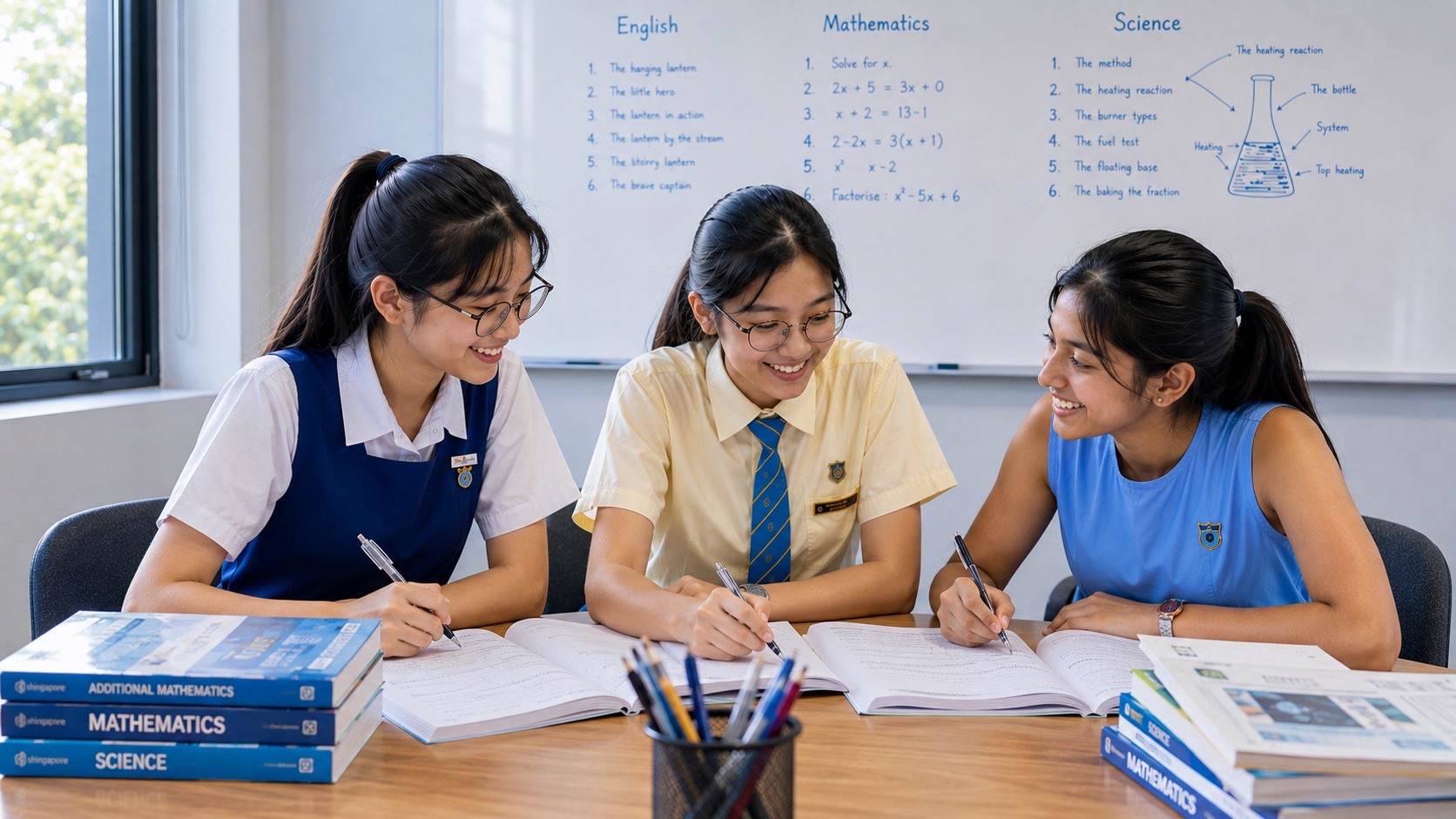
By JC2, the tutor should not be controlling every question, but a three-student setting can still provide unusually good diagnostic visibility. One student may need a conceptual repair, another may need retrieval and method recognition, while a third may understand the Mathematics but lose marks through pacing or interpretation. Timed independent attempts followed by route comparison make those differences visible without turning the lesson into permanent one-to-one prompting.
The group can increasingly operate like an engineering review: students defend a method, identify assumptions, compare efficiencies and inspect where an error first entered the route. The tutor becomes a verifier and specialist resource rather than the continuous driver of the work.
The school handover receipt
- The learner can generate first steps on changed questions without waiting for a cue.
- Functions, calculus, trigonometry, vectors, probability and statistics can interact inside mixed problems without collapsing into chapter silos.
- Supporting algebra is reliable enough to preserve reserve for interpretation and strategy.
- The student can distinguish concept failure, prerequisite failure, recognition failure and execution failure.
- Revision is increasingly self-planned from evidence rather than entirely assigned by another person.
- External help is called deliberately and leaves the learner with more control than before.
That is the capability university needs to inherit: not a finished mathematical mind, but a learner who can maintain and extend a technical system whose next destination is no longer prescribed by one common school syllabus.