
Quick Read
A three-student Mathematics Tutorial should not feel like a miniature lecture. Its value comes from something more demanding: keeping one coherent lesson while allowing three learners to need different amounts of explanation, practice, checking and independence at different moments.
Small-group Mathematics works when the group moves together without forcing every learner to receive identical help.
One-Sentence Answer
In a strong three-student Tutorial, the Tutor protects the shared mathematical direction while rotating attention so each learner receives the smallest useful intervention and enough independent space for their own thinking to appear.
Why Three Students Changes the Teaching Problem
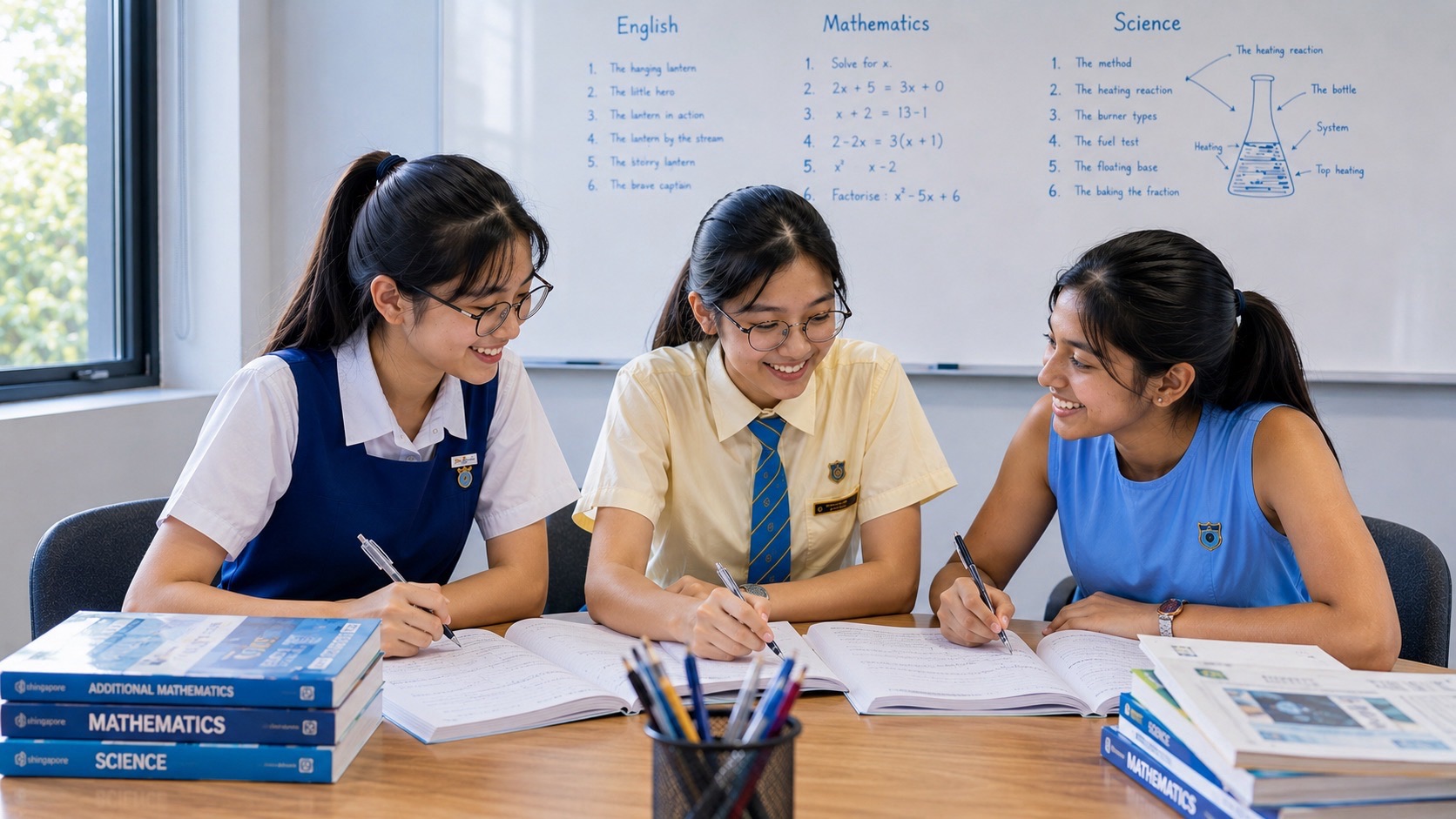
With one student, the Tutor can respond continuously. With a large class, instruction often has to be designed around the group average. Three students creates a different environment: there is enough variation for learners to hear different explanations and see different routes, but the Tutor can still inspect individual working closely.
That does not make the number three a universal scientific optimum. It is an eduKate design choice. The educational question is whether the group size preserves three things at once: individual visibility, coherent lesson movement and genuine independent working time.
The Shared Mission Comes First
A small group becomes chaotic when every learner is effectively in a different lesson. A strong Tutorial therefore begins with a shared mission broad enough to connect the students but precise enough to guide the session.
For example, all three Secondary students may be working on algebraic route selection. One learner may need a short prerequisite repair, another may need varied independent questions, and the third may need help explaining why a familiar method works. The class still has one mathematical centre even though the support is different.
Attention Should Rotate, Not Pool
A common failure in small-group teaching is to let one learner consume the Tutor for too long. The other students then become passive, wait for rescue or complete work without useful feedback.
Strong rotation looks different. The Tutor gives one learner a bounded explanation, leaves them with a meaningful attempt, moves to the next learner, checks another student’s working, and returns only when there is new evidence to inspect.
The Tutor’s absence for a few minutes can be educationally valuable when it protects an independent attempt rather than creating neglect.
Different Students Can Need Different Support
- Student A: needs a worked example because the concept is new.
- Student B: needs the example removed because dependence on examples is now the problem.
- Student C: understands the method but needs a mixed question that forces independent route selection.
Giving all three the same intervention would look tidy but may be educationally weaker. Fairness in a Tutorial does not mean identical help. It means the help remains proportionate to the active learning need.
The Group Can Become a Thinking Resource
Peers are useful when they make mathematical structure more visible. One learner may explain a diagram another learner solved symbolically. Two students may compare methods. A student who has just repaired an error may explain why the incorrect route looked attractive.
But peer interaction should not become uncontrolled copying. The Tutor must still know when a learner needs to produce their own route before hearing someone else’s.
A Practical Three-Student Cycle
- Set the shared mission. Make clear what mathematical relationship or capability the lesson is trying to strengthen.
- Start everyone. Give enough common explanation or framing that all three can enter the work.
- Observe early divergence. Watch where one learner hesitates, another rushes or a third chooses an unexpected route.
- Intervene narrowly. Help the learner who needs it without taking over the whole attempt.
- Protect independent time. Move away so the learner has to continue personally.
- Return to evidence. Check what changed after the help.
- Reconnect the group. Bring useful contrasts back into shared discussion when they help everyone.
What Can Go Wrong
- One student dominates. The Tutor’s attention becomes permanently attached to the loudest difficulty.
- The fastest learner sets the pace. Others begin copying rather than understanding.
- Everyone receives the same worksheet sequence. The class looks orderly while individual weak links remain invisible.
- The Tutor explains continuously. Independent routes never have time to appear.
- Peer help arrives too early. A learner borrows another person’s thinking before producing their own.
How to Repair the Lesson When It Drifts
If one learner is consuming too much time, narrow the intervention and leave a bounded next step. If two students are waiting, give them independent variation or checking work that serves the same mission. If the group has split into three unrelated topics, reduce the scope and identify the shared mathematical dependency beneath them.
Sometimes the correct repair is to stop the shared discussion and let everyone work silently. Small-group teaching is not valuable because students are always interacting. It is valuable because interaction and independence can be deliberately alternated.
How We Know the Small Group Is Working
The evidence should appear in the learners, not merely in the smoothness of the lesson.
- students begin work with less waiting for the Tutor;
- different learners can explain different routes without losing the shared concept;
- prompts become less necessary over time;
- errors are found earlier and corrected more independently;
- students can continue productively while the Tutor attends to someone else;
- learning survives mixed questions, delay or ordinary school conditions.
Parent Decision Guide
When evaluating small-group tuition, parents can ask questions that go beyond group size:
- Can the Tutor see individual working rather than only final answers?
- Can one learner receive a different explanation without stopping the whole class?
- Do students get genuine independent working time?
- Is a stronger student still challenged rather than used as an assistant teacher?
- Can a struggling student receive repair without being publicly labelled?
- Does the group eventually produce more independence outside tuition?
Three Students and Mathematics Development
The balance changes with age and stage. Younger learners may need shorter cycles and more concrete shared activity. Primary students can increasingly work independently between Tutor check-ins. Secondary students need longer stretches of route selection and error recovery. JC learners may need specialist discussion followed by substantial autonomous problem solving.
The direction is consistent: the Tutor remains available, but the learner should gradually become more capable of carrying the Mathematics while the Tutor is helping someone else.
Frequently Asked Questions
Is three students always better than one-to-one tuition?
No. One-to-one support can be appropriate when a learner needs unusually intensive repair or when circumstances require it. A three-student Tutorial offers a different balance: close visibility together with peer contrast and independent working intervals.
Will my child get enough attention?
The more useful question is whether attention arrives at the right moment. Continuous attention can create dependence. Strong small-group teaching gives timely help, then deliberately returns responsibility to the learner.
What if the three students are at different levels?
Some difference is manageable when the learners share enough mathematical territory for one coherent mission. If their needs are unrelated, forcing them into one lesson becomes inefficient.
Does the strongest student lose out?
They should not. Stronger learners can receive more variation, proof, reverse questions, transfer tasks or reduced support rather than waiting while another learner catches up.
The Long Arc
The mature aim of small-group Mathematics is not to make the Tutor equally busy with three students. It is to create a room where each learner can receive specialist help without losing ownership of their own thinking.
The strongest three-student Tutorial is one in which Tutor attention becomes more precise while learner independence becomes more continuous.
Three-student tutorial tools
- Three-Student Mathematics Lesson Patterns | Keeping One Class Coherent
- Tutor Attention in a Three-Student Mathematics Class | Who Needs Help Now?
Rolling search: show related newly published pages.