
Quick Read
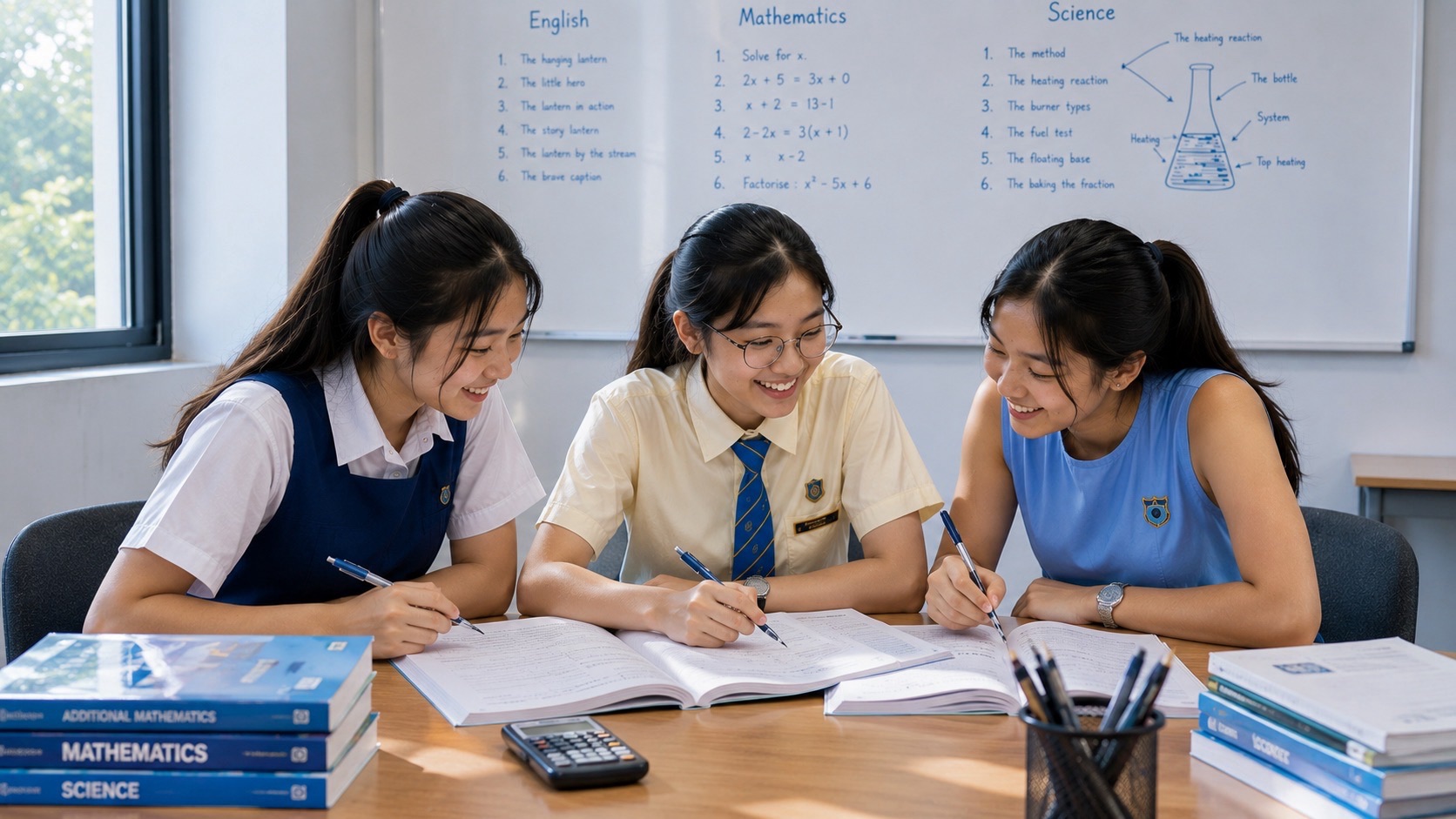
A three-student Mathematics Tutorial needs more than good explanations. It needs a rhythm that keeps all three learners moving while allowing the Tutor to respond to different needs without turning the room into three unrelated private lessons.
The strongest lesson pattern is one in which every student knows what to do when the Tutor is with someone else.
One-Sentence Answer
Three-student lesson patterns work by alternating shared instruction, individual attempts, targeted Tutor intervention, peer contrast and support reduction around one common mathematical purpose.
Why a Lesson Pattern Matters
Without a pattern, small-group tuition can drift. The Tutor explains to Student A while Students B and C wait. Then Student B needs help and Student A forgets what to do next. The group is small, but the learning becomes fragmented.
A good pattern solves this by giving each learner a productive state: listening, attempting, checking, explaining, comparing or extending. No learner should depend on the Tutor’s continuous presence to remain academically active.
Pattern 1: Shared Start → Individual Attempt → Targeted Return
This is the simplest and most useful pattern for a shared topic. The Tutor introduces the central relationship to all three students. Each learner then attempts a carefully chosen task independently. The Tutor rotates only after there is enough learner work to inspect.
- Brief shared explanation.
- Each learner starts alone.
- Tutor checks the earliest divergence.
- One student receives a narrow intervention.
- The others continue with variation or checking.
- Tutor returns to see whether the intervention changed the next attempt.
This pattern protects independent starting. It also prevents the Tutor from explaining for so long that student thinking disappears.
Pattern 2: One Concept, Three Levels of Support
Three learners can work on the same mathematical idea with different support.
- Learner A: receives a worked example because the concept is new.
- Learner B: receives the same question type without the example.
- Learner C: receives a changed representation or reverse problem that requires route selection.
The shared concept keeps the lesson coherent. The support level changes because the learning state is different.
Pattern 3: Error Contrast
When two learners make different errors, the Tutor can use the contrast carefully. Instead of announcing who is wrong, place the two routes side by side and ask where they first diverge.
This helps students learn that Mathematics can be inspected line by line. Error analysis becomes a thinking skill rather than a judgement of the person.
An error becomes educationally valuable when it helps the group see a relationship more clearly.
Pattern 4: Tutor With One, Others on Independent Commissioning
Sometimes one learner genuinely needs several minutes of focused repair. The other two should not merely receive more routine questions. They can work on tasks that test independence: mixed questions, delayed retrieval, route selection, self-checking or explaining a previous correction.
The Tutor’s temporary absence becomes part of the lesson design. The students are practising operation without immediate rescue.
Pattern 5: Explain → Compare → Reattempt
A student who can explain a method may reveal a relationship another learner had memorised only procedurally. After hearing the explanation, the second learner should not simply agree. They should reattempt a fresh question so the group can see whether the explanation actually changed independent performance.
Peer explanation is strongest when it leads back to personal action.
What Can Go Wrong
- Pattern becomes routine. The Tutor follows a fixed sequence even when the evidence says the lesson needs to change.
- Fast student becomes a permanent peer tutor. This can under-challenge the stronger learner and create dependency in another.
- Everyone waits for checking. Students stop self-verifying because only the Tutor’s approval counts.
- Different worksheets become different lessons. The group loses a common mathematical centre.
- Too much talking. Small-group discussion replaces the silent attempt needed to expose each learner’s own route.
How to Repair a Weak Pattern
If students are waiting, give every learner a clear independent next state before moving attention. If one learner dominates, shorten the intervention and leave them with an evidence-producing attempt. If the group is drifting across unrelated topics, return to the shared dependency or separate the work into a more appropriate session structure.
The pattern serves the Mathematics. It should change when the learning evidence changes.
How We Know the Pattern Is Working
- students can continue productively while attention rotates;
- the Tutor can identify individual errors without stopping the whole class;
- students increasingly start without waiting;
- peer contrast clarifies Mathematics rather than merely sharing answers;
- support can differ without producing three disconnected lessons;
- students show useful independent evidence after help is removed.
Parent Decision Guide
Parents can ask what their child does during the minutes when the Tutor is helping someone else. A strong answer is not “wait”. It may be: continue a changed problem, check a previous route, explain a correction, retrieve a method, or prepare a question from genuine uncertainty.
This is one of the clearest differences between a merely small class and a deliberately engineered small-group Tutorial.
Frequently Asked Questions
Should all three students be on the same chapter?
Not necessarily, but there should be enough shared mathematical territory for one coherent lesson direction. If needs are completely unrelated, the group structure becomes inefficient.
Can students learn from each other’s mistakes?
Yes, when mistakes are treated as mathematical objects to inspect rather than as public labels attached to a student.
Why not give every student continuous Tutor attention?
Because Mathematics also requires independent starting, route selection, checking and recovery. Continuous rescue can make those capabilities harder to observe and build.
The Long Arc
The mature small-group learner does not require the room to stop whenever the Tutor turns away. They can hold the mission, continue the next useful action and return with better evidence or a better question.
A good lesson pattern keeps the class coherent while making each learner progressively less dependent on the pattern itself.