
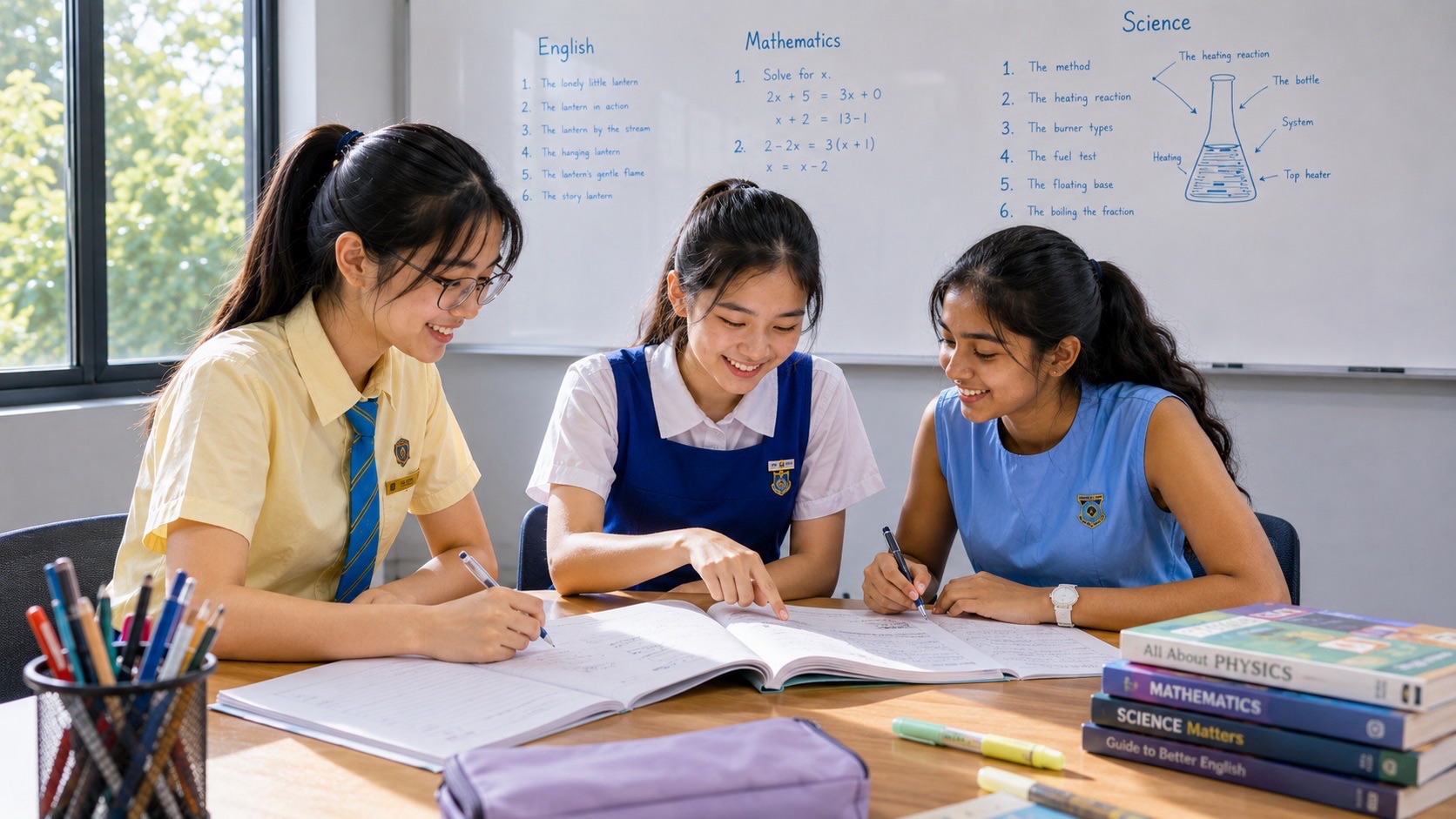
Secondary 1 G2 Mathematics works by turning separate mathematical procedures into a connected problem-solving system.
The learner arrives with methods from Primary Mathematics. Secondary 1 now asks a more difficult question: can those methods be recognised, selected, combined and explained when the question no longer announces which chapter it belongs to?
That is the central G2 transition.
G2 Mathematics is where “I know the method” must become “I know when this method belongs, what it preserves, and what it connects to.”
Where G2 Mathematics Sits in Full SBB and the SEC
Under Full Subject-Based Banding, Mathematics can be offered at G1, G2 or G3 as a subject-level choice aligned to the student’s strengths, learning needs and eligibility. G2 is mapped from the previous N(A) subject standard, but it should not be treated as an old stream identity. The learner can take different subjects at different levels.
From 2027, the Singapore-Cambridge Secondary Education Certificate (SEC) combines the former N(T), N(A) and O-Level examination certificates into one qualification reflecting the subjects and subject levels sat. SEAB lists G2 Mathematics as K210 for the 2027 school-candidate SEC syllabus.
Official references: SEAB: Secondary Education Certificate and 2027 SEC G2 syllabuses for school candidates.
The First Principle: Connection Before Complexity
A student can know many methods and still be weak at Mathematics if those methods live in isolation.
G2 Mathematics becomes powerful when the learner sees the common structures running across topics. Fraction work connects to ratio. Ratio connects to rate and percentage. Algebra connects to patterns and graphs. Geometry connects to proportion and measurement. Data connects to percentage and comparison. Units connect to rates and formulas.
The curriculum starts behaving less like a shelf of chapters and more like a network.
The G2 Mathematics Operating Cycle
A strong G2 learner increasingly performs seven operations:
- Parse — identify what the question is saying mathematically;
- Represent — convert words or diagrams into a useful mathematical form;
- Classify — identify the family of relationship involved;
- Select — choose a valid method;
- Execute — carry out the operations accurately;
- Verify — check sign, scale, unit, substitution or reasonableness;
- Transfer — recognise the same structure when the surface changes.
The weakness of many worksheet-only approaches is that they over-train Step 5 while under-training Steps 1, 2, 3, 4, 6 and 7.
Why Algebra Becomes the Central Language
Algebra allows a student to express a relationship without needing all quantities to be known in advance.
This is a major cognitive upgrade. A number describes one case. An algebraic expression can describe a family of cases.
For example, the expression 3n + 5 is not just a string of symbols. It describes a structure: take a quantity, scale it by three, then increase the result by five. That structure can represent a pattern, a cost model, a perimeter relationship, a sequence rule or many other contexts.
G2 students need to learn algebra as compressed meaning. If algebra is taught only as rules for moving symbols, the learner may manage routine exercises and struggle badly when algebra appears inside another topic.
Equivalence: The Hidden Engine of Algebra
Much of algebra can be understood through one powerful idea: the form may change while the mathematical value or relationship is preserved.
Simplifying an expression changes its form. Expanding a bracket changes its form. Factorising changes its form. Solving an equation transforms the equation. The mathematics is valid because the transformation preserves the relevant equivalence.
This is why “move it across and change the sign” is a dangerous explanation. It describes a surface shortcut without explaining the invariant. A student who understands inverse operations and equality can reconstruct the process even if the shortcut is forgotten.
See Why the Equal Sign Becomes Difficult in Secondary Mathematics.
Number Sense Still Controls Algebra
Students sometimes think Secondary Mathematics means leaving arithmetic behind. The opposite is true. Arithmetic becomes infrastructure.
Signed numbers, fractions, decimals, percentages, factors and multiples now appear inside longer chains. If those basics consume too much attention, algebraic reasoning becomes harder because working memory is already occupied.
A G2 student therefore needs both fluency and judgement:
- Can the student estimate a result?
- Can the student predict the sign?
- Can the student see common factors?
- Can the student move between fraction, decimal and percentage representations?
- Can the student recognise when a calculator output is implausible?
These are not “easy skills”. They are load-bearing skills.
Proportional Reasoning: One of the Great Connectors
Ratio, rate, scale and percentage are often taught as different units of work. Mathematically, they belong to the same broad family of multiplicative comparison.
Proportional reasoning asks how one quantity changes in relation to another. This structure later supports speed, density, similarity, gradient, trigonometry, financial mathematics and scientific relationships.
G2 students should therefore learn to ask:
- What quantities are being compared?
- Are the units the same or different?
- Is the relationship additive or multiplicative?
- What stays constant when the scale changes?
- Can I represent the comparison as a ratio, fraction, rate, table or equation?
This creates transfer rather than chapter-specific memory.
Graphs: Where Relationships Become Visible
A graph is not a picture added after the calculation. It is a representation of a relationship.
G2 students should learn to move among:
- verbal description;
- table of values;
- coordinates;
- graph;
- equation or rule.
The same relationship may become easier to understand in one representation than another. That is why representational flexibility is a mathematical advantage.
See Why Graphs Feel Hard in Secondary Mathematics.
Geometry: From Visual Recognition to Constraint Reasoning
Secondary geometry increasingly depends on what is logically forced by properties.
A diagram may suggest a relationship, but the mathematics must establish it. Students need to distinguish:
- what is given;
- what is a known property;
- what follows from those facts;
- what only appears true because of the drawing.
This habit is the seed of proof. It also trains a broader mathematical discipline: do not confuse appearance with evidence.
See Why Students Misread Mathematics Diagrams.
Measurement: Formulas Must Return to Meaning
A formula is useful because it compresses a relationship. It should not become a magic incantation.
Students should know what each symbol represents, what units are involved, how the dimensions relate and what kind of output is expected.
For example, area and volume use different dimensions because they measure different kinds of magnitude. Speed is a rate because it compares distance with time. Density compares mass with volume.
Units are therefore a built-in mathematical check. See The Unit at the End Is Part of the Mathematics.
Data: Correct Calculation Is Not Enough
Data questions require students to reason about collections rather than single values. Averages, charts and comparisons can all be computed correctly and still interpreted badly.
A G2 learner should ask what a summary reveals, what it hides, whether groups are comparable and whether a conclusion is supported by the available data.
This is important because later Mathematics increasingly deals with uncertainty, distributions, sampling and inference.
The Real Skill in Word Problems: Build the Mathematical Model
A word problem is a translation problem before it is a calculation problem.
The student has to decide which parts of the story matter, which quantities vary, which conditions restrict the problem and what mathematical relationship connects everything.
A reliable sequence is:
- identify the target quantity;
- identify known quantities and constraints;
- choose a representation;
- write the mathematical relationship;
- calculate;
- interpret the answer in context;
- check whether the result is plausible.
See Why a Student Can Calculate but Cannot Solve Mathematics Word Problems.
Why Mixed Practice Matters More in G2
Blocked practice tells the student which method to use by grouping similar questions together. It is useful for initial fluency, but it can create an illusion of mastery.
Mixed practice removes that cue.
Now the learner must discriminate: is this ratio, percentage, equation, geometry, data interpretation, or a combination?
That discrimination is part of mathematical competence. It is why interleaving becomes increasingly useful as the curriculum expands.
Retrieval: Can the Student Still Do It Next Month?
Immediate performance is not the same as durable learning.
A student may complete twenty similar questions after watching a worked example and still be unable to solve one of them three weeks later.
G2 study should therefore include spaced retrieval. Old material should return after delays and inside mixed sets. See How Spaced Practice Works for Mathematics.
The G2 Error Taxonomy
“Careless” is often too crude a diagnosis. G2 errors can be classified more usefully:
- concept error — the idea itself is misunderstood;
- representation error — the problem was converted into the wrong mathematical form;
- route error — the wrong method was selected;
- execution error — the right method was carried out incorrectly;
- notation error — signs, brackets, equality or symbols were mishandled;
- unit error — the quantity type was lost;
- transfer error — the learner knew the method only in a familiar surface form;
- verification failure — an implausible answer was accepted without checking.
Once the error type is known, the repair becomes much more precise.
What a Strong G2 Solution Looks Like
A strong solution is not necessarily long. It is inspectable.
It should make clear:
- what relationship is being used;
- where important values came from;
- how one line follows from the previous line;
- which units apply;
- what the final value means.
Readable working protects the student from hidden errors and allows a teacher to diagnose the actual failure point.
The G2 Independence Ladder
Students often move through a predictable sequence:
- I can follow the teacher.
- I can copy the worked example.
- I can solve the same form alone.
- I can solve the form after a delay.
- I can distinguish it from nearby forms.
- I can solve it in a new context.
- I can explain why the method works.
- I can detect and repair my own error.
Worksheet completion measures only part of this ladder.
When G2 Students Get Stuck Halfway
Getting stuck halfway often means the student can identify the first operation but does not understand the full structure of the problem.
The solution is not always another hint. Sometimes the student needs to return to the target:
- What are we trying to find?
- What intermediate quantity would make that possible?
- What information can produce that intermediate quantity?
This is backward planning. It teaches the learner to design a route instead of waiting for one. See My Child Can Start a Mathematics Question but Gets Stuck Halfway.
Calculator Discipline in G2 Mathematics
Calculators are legitimate mathematical tools. The issue is not whether students use them, but whether the tool is embedded in a reasoning system.
A good calculator workflow is:
- predict the sign and rough magnitude;
- enter the expression carefully;
- read the display correctly;
- round only when appropriate;
- attach the correct unit;
- compare the output with the prediction.
This preserves mathematical ownership. See Why a Student Relies on a Calculator for Simple Mathematics.
What Parents Should Watch in G2 Mathematics
Instead of asking only “What mark did you get?”, ask questions that reveal the architecture:
- Can the student explain why a method was chosen?
- Can the student work without a chapter cue?
- Can the student retrieve last month’s work?
- Can the student explain an error?
- Can the student connect ratio, rate and percentage?
- Can the student move between words, algebra, tables and graphs?
- Does the student check answers independently?
These signals often predict future stability better than one isolated test.
What Tutors Should Build in G2 Mathematics
- secure arithmetic infrastructure;
- algebra as a language of relationships;
- representation switching;
- proportional reasoning across contexts;
- geometric constraint reasoning;
- data interpretation;
- mixed-problem route selection;
- error classification;
- independent checking;
- spaced retrieval and transfer.
The tutor should not simply solve difficult questions in front of the student. The tutor should expose the decision system that allows the student to solve the next one.
What Readiness for More Demanding Mathematics Looks Like
Full SBB permits subject-level flexibility at appropriate junctures, subject to school processes and eligibility. A useful capability lens asks whether the learner can reliably carry greater abstraction and complexity.
Signs of increasing readiness include:
- fast and accurate prerequisite arithmetic;
- stable algebraic manipulation with meaning;
- independent route selection;
- ability to combine two or more topics;
- strong retrieval after delay;
- consistent checking;
- ability to explain why a method works;
- successful transfer to unfamiliar forms.
This is not an official placement checklist. It is a way to think about mathematical load honestly.
How G2 Differs from G1 and G3
G1, G2 and G3 are different subject standards, not personality types.
As a first-principles teaching model:
- G1 often places heavier emphasis on making mathematical meaning and execution reliable enough to support independence.
- G2 increasingly emphasises connection, discrimination and route selection across a broader network of ideas.
- G3 carries a higher abstraction and generalisation load, with faster compression and more complex integration.
The difference is demand profile. The discipline underneath remains Mathematics.
Where This Article Sits in the Secondary 1 Mathematics System
This page is the G2 mechanism guide inside How Secondary 1 Mathematics Works | SEC G1, G2 & G3.
For the existing Bukit Timah Tutor architecture, see Singapore Mathematics Hub, Secondary 1 Mathematics Tutorial, Secondary 1 Mathematics | The Engineer Series and Secondary 1 Mathematics Tuition | The Beginning of SEC G1, G2 and G3.
Final Answer
Secondary 1 G2 Mathematics works by joining mathematical methods into a connected reasoning system. The student must move beyond knowing procedures toward recognising structures, choosing routes, switching representations, checking results and transferring knowledge to unfamiliar forms.
The most important change is not that the questions become longer.
It is that the learner is increasingly responsible for deciding what the mathematics is.