
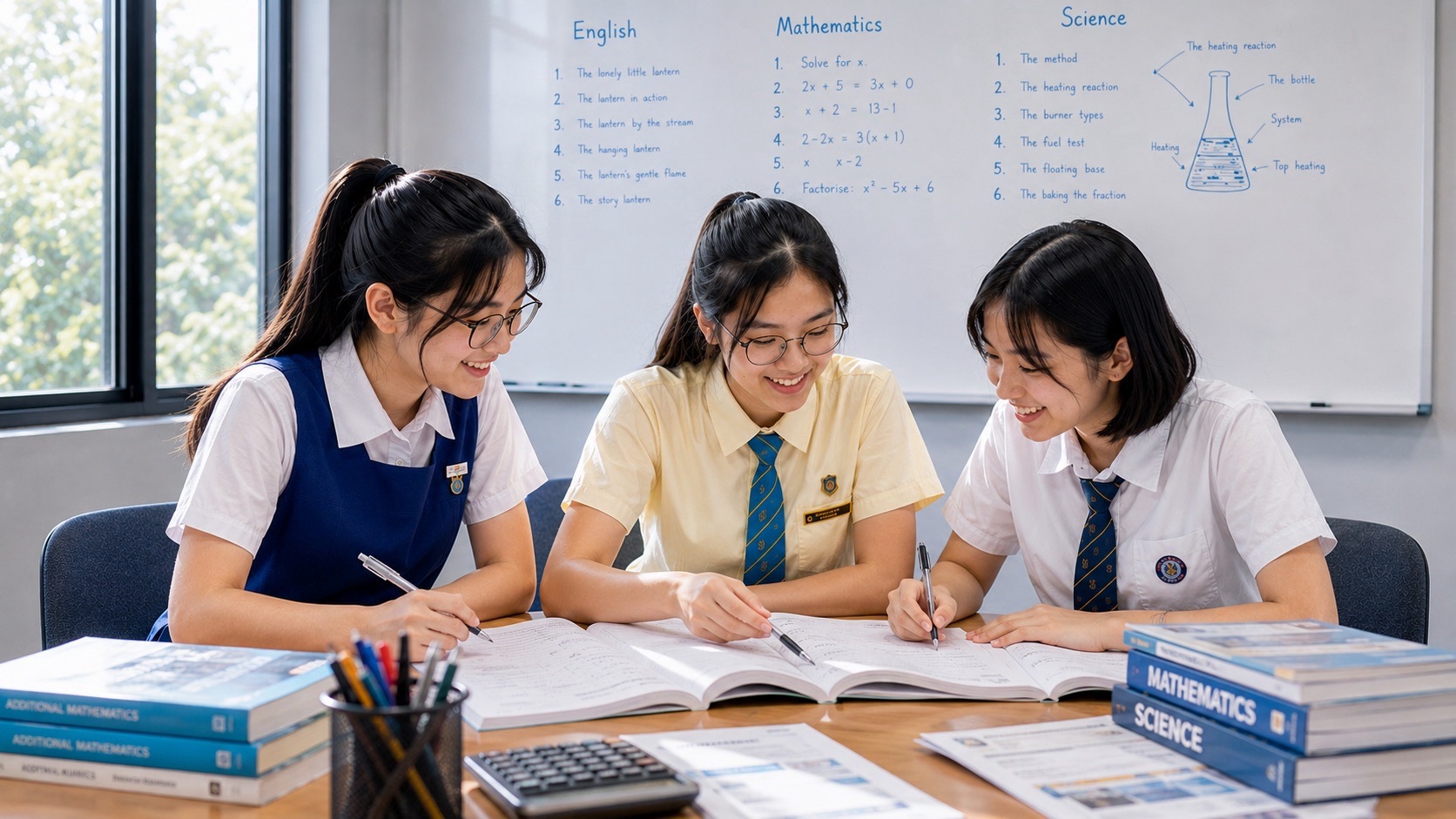
Mathematical communication changes from G3 Additional Mathematics to H2 Mathematics because the student must make longer, denser and more varied mathematical arguments readable without sacrificing efficiency.
G3 Additional Mathematics K341 already requires essential working, correct notation, algebraic clarity, proof, graph interpretation and reasoned conclusions.
H2 Mathematics 9758 increases the communication load because the mathematics itself becomes more integrated. A solution may move through functions, calculus, vectors, probability, statistics, modelling or technology-assisted evidence before reaching its conclusion.
The student therefore needs writing that preserves the mathematical state from line to line.
Good mathematical communication is not writing more. It is making the logic visible enough that the mathematics can be checked.
The Short Answer
H2 mathematical communication requires the student to communicate not only calculations, but also definitions, assumptions, method choices, restrictions, reasoning and interpretation.
- variables must be defined clearly;
- notation must remain consistent;
- essential transformations must be shown;
- restrictions and conditions must remain visible;
- proof and reasoning must form a connected argument;
- calculator output must be interpreted mathematically;
- statistical conclusions must be stated in context;
- final answers must answer the actual task.
Why Communication Becomes More Important as Mathematics Gets Harder
Longer solutions contain more opportunities for information to be lost.
A missing bracket, undefined parameter, omitted domain, unexplained substitution or ambiguous conclusion can make correct mathematics difficult to audit.
Clear writing therefore becomes part of error control.
It helps the student see:
- what is known;
- what has changed;
- what result is being reused;
- which assumption is active;
- where the first wrong line occurred.
Communication is therefore not separate from thinking.
It is one of the ways thinking is stabilised.
Essential Working Becomes More Valuable
Students sometimes interpret “show working” as an examination formality.
At H2 level, essential working serves several mathematical jobs:
- it shows the method selected;
- it preserves intermediate results;
- it makes restrictions visible;
- it allows partial reasoning to be audited;
- it exposes errors early enough to repair them.
The strongest working is neither minimal nor verbose.
It shows every mathematically meaningful handoff.
Notation Must Carry More Information
H2 introduces denser notation through functions, sequences, vectors, complex numbers, calculus, probability and statistics.
Notation is useful because it compresses meaning.
It becomes dangerous when symbols are copied without understanding.
A mature student should know what each symbol represents and keep roles distinct:
- variable;
- parameter;
- function;
- vector;
- random variable;
- sample statistic;
- population parameter;
- derivative;
- probability statement.
Good notation reduces ambiguity.
Definitions Matter More in H2
Many H2 ideas are defined more precisely than their Secondary counterparts.
Functions have domains and ranges. Inverses have existence conditions. Statistical tests have hypotheses. Vector objects have geometric meaning. Differential equations describe relationships involving rates of change.
Students should therefore practise writing definitions that are short but mathematically complete.
Loose everyday language can hide an incomplete concept.
Proof Requires Connected Sentences of Mathematics
A proof is not a collection of true statements placed near each other.
The statements must be connected so that each one supports the next.
Useful communication habits include:
- state the starting condition;
- name the theorem or identity when useful;
- show the key transformation;
- explain why the conclusion follows;
- avoid claiming more than has been established.
The goal is not literary style.
The goal is logical continuity.
Linked Parts Require Result Handoffs
H2 questions can contain several parts where an earlier result becomes a later input.
Good communication makes the handoff visible.
The student should indicate:
- which earlier result is being used;
- what it represents;
- why it is valid in the next stage;
- which conditions travel with it.
This reduces the risk of carrying a result forward after its assumptions have changed.
Graphs Need Mathematical Annotation
Graphing calculators make graphs easier to generate, but an examination graph still needs mathematical communication.
Depending on the task, the student may need to identify:
- axes;
- intercepts;
- turning points;
- asymptotes;
- intersections;
- relevant intervals;
- key coordinates.
A calculator display is not automatically a communicated solution.
Calculator Output Needs Context
Technology can produce numerical values very quickly.
The student must still communicate what the value means.
A root should be attached to the equation being solved. A coordinate should be attached to the intersection it represents. A probability should be attached to its event. A regression coefficient should be interpreted relative to the variables.
Unsupported numbers are weak communication even when numerically correct.
Statistics Changes the Language of Conclusions
Probability and Statistics create one of the largest communication changes from A-Math.
The student must learn to state conclusions that reflect uncertainty.
- A hypothesis test does not “prove” the alternative hypothesis.
- A correlation does not automatically establish causation.
- A regression model supports prediction only within reasonable conditions.
- A probability statement must identify the event being measured.
The wording is part of the mathematics because it controls the strength of the claim.
Modelling Requires Returning to the World
In modelling questions, the final mathematical result is often not the final communication task.
The student must translate back:
- include units;
- respect physical constraints;
- identify the meaning of a parameter;
- state what an optimum means;
- acknowledge model limitations when relevant.
A solution that never returns to the context has completed the algebra but not the communication loop.
Concise Communication Is a Mathematical Skill
Students sometimes respond to demands for explanation by writing too much.
H2 does not reward unnecessary prose.
The ideal is concise sufficiency:
enough information to make the mathematical logic unambiguous, no more than needed.
This is especially important under examination time pressure.
Communication Errors Form Their Own Error Family
- undefined variables;
- missing units;
- ambiguous notation;
- several risky transformations compressed into one line;
- missing domain restrictions;
- unsupported calculator answers;
- proof steps without reasons;
- statistical conclusions stated too strongly;
- final answers that do not answer the question asked.
These are not necessarily knowledge errors.
They are failures in transmitting mathematical state.
A G3 → H2 Communication Readiness Diagnostic
- Can the student define variables clearly?
- Can the student show essential working without over-writing?
- Can the student preserve domain and interval conditions?
- Can the student write a connected proof?
- Can the student annotate a graph meaningfully?
- Can the student explain what a calculator result represents?
- Can the student state a statistical conclusion at the correct strength?
- Can the student interpret a modelling answer with units and context?
A student who can do these consistently is much better prepared for the denser H2 communication load.
How Bukit Timah Tutor Treats the Communication Transition
At Bukit Timah Tutor, the G3 A-Math to H2 communication transition is treated as a reliability problem.
The working should preserve enough information that the student can:
- audit the route;
- locate the first wrong line;
- reuse intermediate results safely;
- justify decisions;
- communicate conclusions precisely.
The goal is not prettier working.
The goal is mathematics that remains intelligible while it becomes more complex.
Complete H2 Transition Route
- How G3 Additional Mathematics Builds the H2 Mathematics Runway
- How Functions Bridge Additional Mathematics to H2 Mathematics
- How Algebraic Fluency Changes From G3 Additional Mathematics to H2 Mathematics
- How Calculus Changes From G3 Additional Mathematics to H2 Mathematics
- How Graphing Calculators Change Mathematics in H2
- How Probability and Statistics Change the H2 Mathematics Workload
- How to Diagnose H2 Mathematics Readiness Before JC Begins
- How Mathematical Reasoning Changes From G3 Additional Mathematics to H2 Mathematics
- How Mathematical Modelling Changes From G3 Additional Mathematics to H2 Mathematics
- H2 Mathematics | How the Subject Works
- JC Mathematics | From Secondary Mathematics to A-Level Mathematics
Official Singapore Reference
Final Principle
Mathematical communication changes from G3 Additional Mathematics to H2 Mathematics when the mathematics becomes too dense for implicit thinking to remain safely hidden.
The student must make the important state visible.
Define clearly. Show the meaningful step. Preserve the condition. Justify the claim. Interpret the output. State the conclusion precisely.
That is how mathematical communication becomes part of H2 mathematical control.