
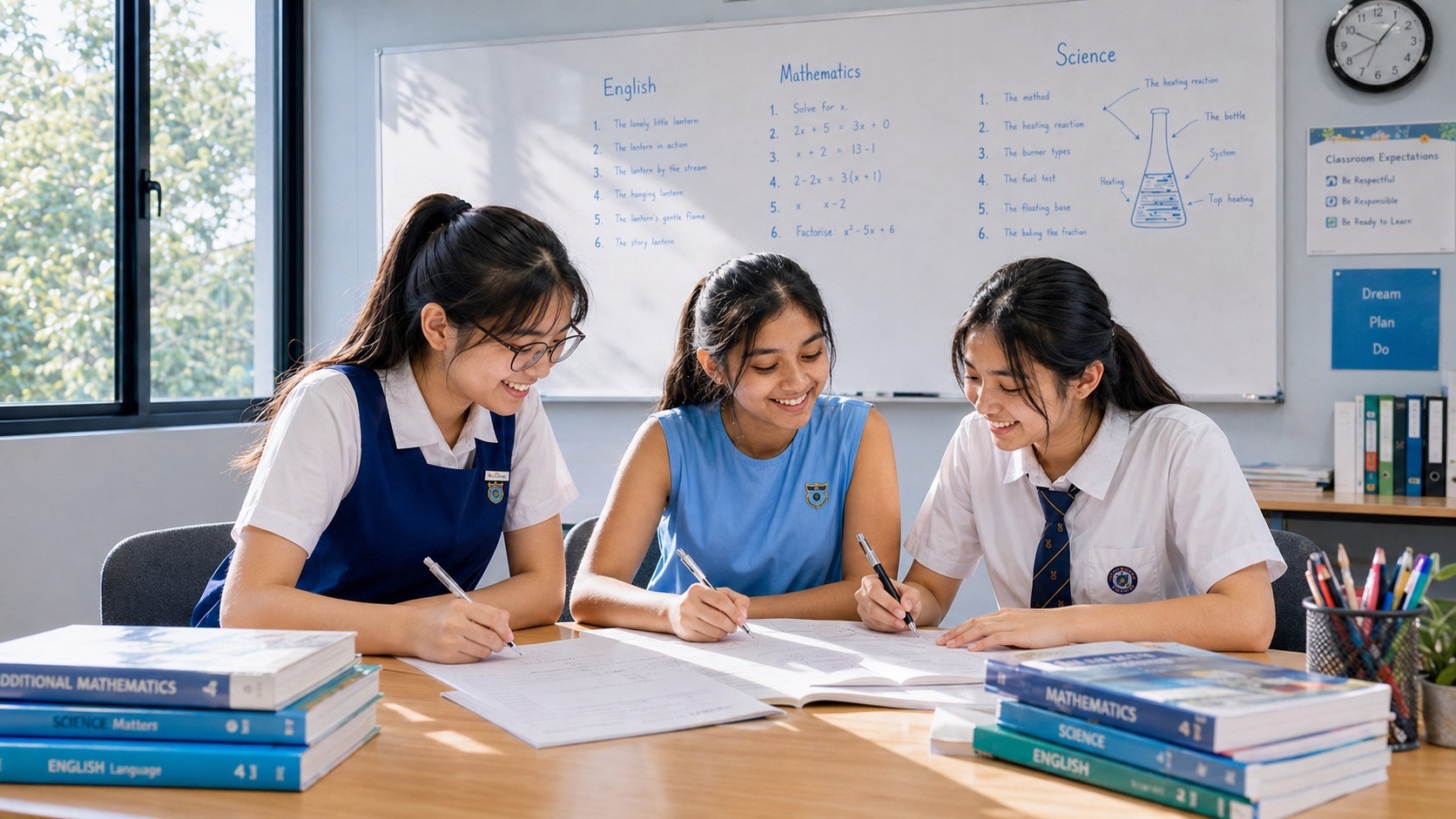
Functions are one of the clearest places where Additional Mathematics turns into H2 Mathematics.
In G3 Additional Mathematics, students already work with quadratic, exponential, logarithmic and trigonometric functions, coordinate geometry, graph behaviour and calculus. They learn that the same mathematical relationship can be written, transformed, graphed, differentiated and interpreted in several ways.
H2 Mathematics 9758 takes that foundation and makes the function idea more explicit.
Now the student must control domain and range, one-one functions, inverse functions, composite functions, graph transformations, asymptotes, equations and inequalities, and the strategic use of a graphing calculator. Functions stop being merely expressions that produce values. They become mathematical objects with inputs, outputs, structure, restrictions, inverses, compositions and behaviour.
That is the bridge.
A-Math teaches students to work with functions. H2 Mathematics asks students to think about functions themselves.
This guide explains what changes, what stays the same, and what a G3 A-Math student should build before JC so H2 functions become expansion rather than reconstruction.
The Short Answer
Functions bridge Additional Mathematics to H2 Mathematics by turning familiar algebraic relationships into objects that must be controlled through their domains, ranges, compositions, inverses, graphs and transformations.
The strongest transition happens when the student already understands five ideas before H2 begins:
- a function is a rule connecting an allowed input to an output;
- the graph is a representation of the function’s behaviour;
- different algebraic forms reveal different properties;
- restrictions matter because not every expression is valid for every input;
- calculus describes how functions change.
H2 then formalises and extends these ideas.
Why Functions Are an Apex Topic in H2 Mathematics
Current high-ranking H2 Mathematics resources repeatedly centre the same function vocabulary: functions and graphs, domain and range, inverse functions, composite functions, graph transformations, one-one functions, asymptotes, equations and inequalities.
That concentration is not accidental.
The official 2027 H2 Mathematics 9758 syllabus places Functions and Graphs at the beginning of Pure Mathematics. It includes domain and range, inverse and composite functions, conditions for their existence, domain restriction for inverses, graph transformations, asymptotes, modulus and reciprocal graph relations, parametric graphs, equations and inequalities.
Functions are therefore not simply one early JC chapter to finish and forget.
They become a language used by later topics.
- Calculus acts on functions.
- Sequences can be interpreted as functions of an integer variable.
- Graphing calculators operate on function representations.
- Modelling uses functions to connect variables.
- Equations and inequalities often ask where function values satisfy conditions.
- Differential equations describe relationships involving functions and their rates of change.
So the function chapter is not a room at the front of H2 Mathematics.
It is part of the building’s structural frame.
What G3 A-Math Already Gives the Student
The transition is easier because G3 Additional Mathematics already contains substantial function thinking.
A student may already have worked with:
- quadratic functions;
- maximum and minimum values;
- roots and discriminants;
- exponential and logarithmic functions;
- trigonometric functions and graphs;
- coordinate geometry;
- graph transformations;
- differentiation and stationary points;
- integration and accumulated area;
- kinematics as linked functions of time.
This means the student already knows many function families.
What changes in H2 is that the function itself becomes more explicit as an object of study.
The Big Shift: From Formula to Mapping
Secondary students often read a function as a formula:
Put x in. Calculate y.
H2 Mathematics requires a richer view.
A function is a mapping from an allowed input set to an output set.
This introduces questions that were easy to ignore when the function was treated merely as an expression:
- Which inputs are allowed?
- Which outputs are actually produced?
- Is every input assigned exactly one output?
- Can two different inputs produce the same output?
- Can the mapping be reversed?
- Can one function be fed into another?
These are domain, range, one-one, inverse and composite questions.
The mathematics has not abandoned algebra.
It has become more precise about what the algebra means.
Domain: Not Every Input Is Allowed
Domain is one of the most important H2 function keywords because it controls where the function exists.
G3 A-Math already contains many domain ideas even when students do not label them formally.
- A denominator cannot be zero.
- A logarithm requires an appropriate positive argument.
- A real square root requires a non-negative radicand.
- A trigonometric reciprocal function is undefined where the original denominator function is zero.
H2 Mathematics makes this restriction logic explicit.
The student should no longer treat domain as a small note written after the main answer.
Domain is part of the definition of the function.
Range: Which Outputs Can the Function Actually Reach?
Range is the output-side partner of domain.
This is where several A-Math ideas suddenly become part of one H2 function system.
- Completing the square can reveal the minimum or maximum of a quadratic.
- A graph can reveal asymptotic restrictions.
- Trigonometric amplitude restricts possible outputs.
- An exponential function may remain strictly positive.
- A logarithmic function may cover all real outputs while accepting only restricted inputs.
Range therefore requires the student to connect algebra and graph behaviour.
That is exactly the sort of cross-representation reasoning H2 rewards.
Domain and Range Are Not Administrative Details
Students often lose marks because they treat domain and range as notation rather than mathematical constraints.
But domain and range control whether later operations are legal.
- An inverse may not exist on the original domain.
- A composite function may not exist if the inner function produces invalid inputs for the outer function.
- A graph transformation can change visible behaviour while preserving or altering restrictions.
- An equation solution may need to be rejected because it falls outside the function’s domain.
This is why high-quality H2 function resources repeatedly emphasise domain restrictions.
The restriction is not bureaucracy.
It tells you where the mathematical machine is allowed to operate.
One-One Functions: When the Mapping Can Be Reversed
A function can assign every allowed input one output while still failing to have an inverse function.
The problem occurs when different inputs share the same output.
If the mapping is reversed, that output would have to return to more than one input. The reverse mapping would no longer be a function.
This is why H2 Mathematics studies one-one functions.
The student can test one-one behaviour through algebra, monotonic behaviour or a graph.
The familiar horizontal-line idea becomes especially useful:
If one horizontal line meets the graph more than once, the function is not one-one on that domain.
This is a strong example of H2 turning a graph into logical evidence.
Domain Restriction: Do Not Change the Rule—Change Where It Is Allowed to Operate
A quadratic function is a perfect bridge example.
Over the full real line, a typical parabola is not one-one because two x-values can share the same y-value.
But if the domain is restricted to one side of the turning point, the function can become one-one.
The formula has not changed.
The operating region has changed.
This is a sophisticated but important function idea:
Sometimes the mathematical object becomes reversible not by changing its rule, but by controlling its domain.
Inverse Functions: Reversing the Mapping
An inverse function reverses the action of the original function on the relevant domain.
This creates a precise relationship:
- the domain of the inverse comes from the range of the original function;
- the range of the inverse comes from the domain of the original function;
- the graphs of a one-one function and its inverse are reflections in the line y = x.
This is why the common student shortcut “swap x and y” is incomplete.
Before rearranging anything, the student must know whether the function is invertible on the stated domain and what its range is.
H2 is not simply asking the student to rearrange algebra.
It is asking whether the reverse mathematical object is valid.
Composite Functions: One Machine Feeds Another
Composite functions formalise something students already do throughout mathematics: use the output of one process as the input to another.
If one function acts first and another acts second, the intermediate result must be valid for the second function.
This is why the existence condition for a composite is fundamentally a domain-range question.
The output set of the inner function must fit inside the allowable input set of the outer function.
The deeper idea is system compatibility.
One mathematical machine can feed another only if its outputs are acceptable inputs.
This way of thinking scales far beyond the functions chapter.
Why Composition Order Matters
Students often assume that two operations can be composed in either order with the same result.
Usually they cannot.
Applying one function and then another creates a different process from reversing the order.
This is another important H2 habit:
Order is part of the mathematical structure.
The student should read a composition from the inside out and track which function acts first.
Graphs and Transformations: Behaviour Becomes Visible
H2 Maths graph transformations are another major apex keyword because they test whether students understand how algebra changes behaviour.
G3 A-Math has already introduced many transformation instincts.
H2 makes the system broader and more explicit.
- vertical shifts;
- horizontal shifts;
- vertical stretches and reflections;
- horizontal scalings and reflections;
- modulus transformations;
- reciprocal transformations;
- combined transformations;
- asymptotic behaviour.
The strongest student does not memorise each transformation as an unrelated picture.
The student asks whether the change acts on the input or the output.
Input Changes and Output Changes Behave Differently
This is one of the main sources of confusion in graph transformations.
A change applied outside the function acts directly on output values.
A change applied inside the function changes the input required to produce a given output.
This is why horizontal transformations can feel reversed compared with the visible algebra.
The student who understands input-output structure can reconstruct the transformation.
The student who memorises arrows is much more vulnerable when several transformations are combined.
Asymptotes: Graph Behaviour Near a Boundary
H2 graph work gives greater attention to asymptotes and rational function behaviour.
This is another area where G3 algebra becomes useful.
A denominator condition may produce a vertical asymptote. Algebraic division or comparison of dominant terms may expose longer-run behaviour. Transformations move asymptotes along with the graph.
The useful runway habit is to see an asymptote as more than a dashed line.
It represents function behaviour near a boundary or at large magnitude.
Modulus Graphs: One Symbol Changes the Geometry
Modulus transformations are frequently emphasised in H2 functions-and-graphs resources because they expose whether the student understands which quantity the modulus acts on.
The difference between applying modulus to the output and applying it to the input is structural.
- Modulus on the output changes negative y-values.
- Modulus on the input changes how the two sides of the x-axis domain are represented.
A student who sees only the vertical bars may confuse the transformations.
A student who asks “is the modulus acting on input or output?” has a reliable decision rule.
Reciprocal Graphs: Values Near Zero Become Large
The reciprocal transformation creates another important behaviour shift.
Where the original function approaches zero, its reciprocal can grow very large in magnitude or become undefined.
Where the original function is large, the reciprocal can become small.
This turns roots, asymptotes and sign regions of the original graph into structural clues for the reciprocal graph.
The bridge from A-Math is again algebra plus graph interpretation.
Equations and Inequalities: Functions Turn Solving Into Comparison
H2 Mathematics places equations and inequalities inside the function-and-graph system.
This creates a useful shift.
An equation can be interpreted as asking where two function values are equal.
An inequality can be interpreted as asking where one function lies above or below another.
That means algebraic solving and graphical solving are not competing methods.
They are two representations of the same mathematical condition.
This is exactly the kind of translation H2 expects students to perform.
The Graphing Calculator Changes the Workflow, Not the Mathematics
One of the biggest practical changes from Additional Mathematics to H2 Mathematics is the expected use of an approved graphing calculator without a computer algebra system.
This can create two opposite mistakes.
The first is refusing to use graphical technology when it is useful.
The second is allowing the calculator to replace mathematical reasoning.
The official H2 syllabus makes the intended balance clear: graphing-calculator access is assumed, but students must still provide mathematical steps when required, and graphical solutions may require sketches.
The runway habit should therefore be:
Use the calculator to see and solve. Use mathematics to know what the result means and whether it can be trusted.
A-Math Calculator Discipline Still Matters
Students who develop strong calculator habits in A-Math transition more smoothly into graphing-calculator work.
- estimate before trusting a numerical result;
- preserve exact values when exactness matters;
- check degree or radian state;
- distinguish numerical evidence from proof;
- understand what a graph window can hide;
- recognise that technology can return a technically correct answer to a poorly modelled question.
The instrument becomes more powerful in H2.
The judgement must become more powerful too.
Functions Connect Directly to Calculus
One reason the functions-and-graphs topic matters so much is that calculus depends on function thinking.
Differentiation asks how a function changes.
Integration reconstructs or accumulates function behaviour.
H2 calculus then adds a wider range of function representations and methods, including implicit and parametric relationships, second-derivative reasoning, connected rates, Maclaurin series, broader integration techniques and differential equations.
A student who enters H2 with a strong function concept has a major advantage.
The new calculus is being applied to a familiar type of mathematical object.
Functions Connect Directly to Modelling
A model often begins by deciding that one quantity is a function of another.
That decision contains assumptions.
Which variable is independent? Which variable depends on it? What domain makes sense in the real situation? Which outputs are physically meaningful? Does the mathematical form fit the observed behaviour?
H2 explicitly assesses modelling and interpretation.
The function chapter therefore supplies the grammar needed to describe mathematical models precisely.
Functions Connect Directly to Sequences
The H2 syllabus treats a sequence as a function of a positive integer variable.
This is an elegant extension of the function idea.
Instead of allowing every real input, the function is evaluated only at positive integers.
This shows why domain matters conceptually.
The mathematical rule may resemble an ordinary function, but the permitted input set changes the object being studied.
Functions Connect Directly to Complex Numbers and Vectors
Not every later H2 topic is literally a function chapter, but function thinking still supports the transition.
Complex numbers extend the number system and introduce new geometrical representations.
Vectors introduce objects with magnitude, direction and geometric relationships in two and three dimensions.
The transferable habit is the same:
Learn the object, learn its valid operations, learn its representations, then learn how it connects to the rest of mathematics.
Functions are one of the first places students learn to operate this way explicitly.
The H2 Function Shock: Precision
The transition from A-Math to H2 functions often surprises students because the calculations can look familiar while the definitions become stricter.
A student may know how to rearrange an inverse formula but lose marks because the inverse domain is wrong.
A student may know how to substitute one function into another but fail to check whether the composite exists.
A student may sketch a transformed graph correctly in shape but omit asymptotes, turning points or required restrictions.
This is not because H2 has become pedantic.
It is because the mathematical object is now being defined more completely.
The H2 Function Shock: Composition
Composition also changes the cognitive load.
The student must keep track of:
- which function acts first;
- the intermediate output;
- whether that output is legal for the next function;
- the final domain;
- the final range;
- whether an inverse or restriction is involved.
The algebra itself may be straightforward.
The challenge is system control.
The H2 Function Shock: Transformations in Chains
A single translation or stretch is usually manageable.
Several transformations combined together can expose whether the student understands the logic or has memorised isolated rules.
A strong student separates the chain into input and output effects, tracks key points and asymptotes, and checks the resulting behaviour.
This is exactly why A-Math representation work matters before JC.
The H2 Function Shock: Technology Can Hide Weak Understanding
Graphing calculators make function behaviour easier to inspect.
They can also create an illusion of understanding.
A student may reproduce a graph without understanding why an asymptote exists, why an inverse needs a restricted domain, or why a composite fails to exist.
The correct workflow is therefore:
predict → graph → inspect → explain → verify.
The calculator should reduce mechanical burden while leaving mathematical judgement intact.
A-Math Skills That Transfer Directly Into H2 Functions
- Completing the square: useful for range and graph structure.
- Discriminant reasoning: useful for intersections and solution existence.
- Surds: preserve exact values.
- Logarithms: introduce domain restrictions and inverse relationships.
- Trigonometry: builds periodic function thinking.
- Coordinate geometry: reinforces graph-equation translation.
- Differentiation: connects function and local behaviour.
- Integration: connects function and accumulation.
The strongest bridge is therefore not a separate pre-JC function course.
It is better ownership of the functions already present throughout A-Math.
A-Math Weaknesses That Become Expensive in H2 Functions
- weak algebraic rearrangement;
- poor graph interpretation;
- ignoring domain restrictions;
- premature decimal approximation;
- memorising transformations without understanding input-output effects;
- using a calculator without estimating first;
- knowing procedures only when the chapter is labelled;
- difficulty explaining why an inverse or composite exists.
These problems are better repaired before JC than after the H2 workload becomes dense.
A Function-Bridge Diagnostic Before JC
A useful transition diagnostic can ask:
- Can the student state the natural domain of an algebraic, logarithmic or radical expression?
- Can the student determine a range from algebra or graph behaviour?
- Can the student explain why a quadratic is not one-one on its full domain?
- Can the student choose a suitable domain restriction?
- Can the student find an inverse and state its correct domain?
- Can the student interpret the inverse graph geometrically?
- Can the student evaluate and reason about composite functions?
- Can the student track restrictions through a composition?
- Can the student predict graph transformations before using technology?
- Can the student identify asymptotes and turning points?
- Can the student connect graph behaviour to calculus?
- Can the student explain why a numerical or graphical answer is plausible?
The pattern across these questions gives a much better picture of H2 function readiness than simply asking whether the student has started JC notes early.
Green, Amber and Red Function-Bridge States
Green
The student has stable algebra, reads graph behaviour confidently, respects restrictions, understands inverse ideas conceptually and can explain function transformations. H2 functions should feel like formalisation and extension.
Amber
The student understands the main A-Math function families but has one or two recurring weaknesses—perhaps domain restrictions, graph transformations, logarithms, exact values or method explanation. These should be repaired during the transition.
Red
The student depends heavily on memorised forms, struggles to read graphs, loses algebraic control and rarely checks whether solutions are valid. The priority should be rebuilding the A-Math function foundation before accelerating into H2 function notation.
These states describe current readiness, not permanent mathematical ability.
A Practical Transition Programme for Functions
Stage 1: Rebuild the A-Math function families
Review quadratics, exponentials, logarithms, trigonometric functions and calculus links through graphs rather than isolated formulas.
Stage 2: Make restrictions explicit
Practise natural domains, ranges and contextual restrictions.
Stage 3: Introduce one-one and inverse thinking
Use familiar A-Math graphs to ask when a function can be reversed and why domain restriction is sometimes necessary.
Stage 4: Introduce composition as system compatibility
Track inputs and outputs rather than memorising notation alone.
Stage 5: Use graph transformations as reasoning
Predict transformations before graphing them.
Stage 6: Add graphing-calculator workflows
Use technology after prediction, and require interpretation afterward.
This builds the H2 function language without trying to consume the whole JC syllabus before JC begins.
What Parents Should Watch
A parent does not need to know composite-function notation to understand whether the transition is healthy.
- Can the student explain what a function means?
- Can the student say which inputs are not allowed and why?
- Can the student describe a graph rather than only draw it?
- Can the student explain why a function may need a restricted domain before it has an inverse?
- Can the student distinguish a calculator graph from a mathematical explanation?
- Can the student connect A-Math calculus to function behaviour?
- Can the student solve a changed-form question without needing the chapter title?
These are strong indicators that the H2 function runway is being built.
A Five-Minute Parent Function Check
- What inputs are not allowed for this function?
- What outputs can this function actually produce?
- Could this function be reversed? Why or why not?
- What would this transformation do to the graph before you use a calculator?
- How does this function connect to calculus?
If the student can answer these in ordinary language, the function idea is becoming more than notation.
How Bukit Timah Tutor Treats the Function Bridge
At Bukit Timah Tutor, the transition from G3 A-Math functions to H2 functions is treated as a change in mathematical precision, not simply a change in syllabus label.
We look for whether the student can already operate the underlying ideas:
- input and output;
- restriction;
- graph behaviour;
- representation change;
- inverse relationships;
- composition;
- calculus connection;
- technology with judgement.
The small-group format allows us to see whether a student genuinely understands the function object or is reproducing familiar templates.
The objective is not to make JC functions feel familiar because the student has seen the pages before.
The objective is to make JC functions understandable because the underlying mathematical ideas are already strong.
Route Through the Bukit Timah Mathematics Estate
- How G3 Additional Mathematics Builds the H2 Mathematics Runway
- How Secondary 3 G3 Additional Mathematics Works | SEC K341
- How Secondary 4 Additional Mathematics Functions & Graphs Work
- How Algebra Works in Secondary 3 Additional Mathematics
- How Calculus Works in Secondary 3 Additional Mathematics
- How Mixed-Topic Questions Work in Secondary 3 Additional Mathematics
- H2 Mathematics | How the Subject Works
- JC Mathematics | From Secondary Mathematics to A-Level Mathematics
- Singapore Mathematics Hub
Official Singapore Reference
Keywords and Concepts This Bridge Must Own
The current H2 search landscape repeatedly clusters around these terms, and they also describe the mathematical job accurately:
- H2 Maths functions
- H2 Maths functions and graphs
- domain and range
- inverse functions
- composite functions
- one-one functions
- graph transformations
- modulus graphs
- reciprocal graphs
- asymptotes
- equations and inequalities
- graphing calculator
- functions and calculus
- A-Math to H2 Mathematics
- G3 Additional Mathematics to H2 Mathematics
The purpose of using these terms is not to stack keywords. It is to make the article speak the same language students, parents, schools and examination resources already use while preserving a distinct transition job.
Where the Series Goes Next
With the overall H2 runway and the function bridge established, the next natural transition mechanisms are:
- How Algebraic Fluency Changes From G3 A-Math to H2 Mathematics
- How Calculus Changes From G3 A-Math to H2 Mathematics
- How Graphing Calculators Change Mathematics in H2
- How Probability and Statistics Change the H2 Mathematics Workload
- How to Diagnose H2 Mathematics Readiness Before JC Begins
Final Principle
Functions bridge Additional Mathematics to H2 Mathematics when the student stops reading a function as merely a formula that returns a value.
A function has a domain. It has a range. It can be one-one or many-to-one. It may or may not have an inverse. It can feed another function. Its graph has structure. Transformations change its behaviour in predictable ways. Calculus describes how it changes. Technology can reveal its behaviour, but mathematical reasoning must still decide what the evidence means.
G3 A-Math already contains the pieces.
H2 Mathematics formalises the machine.
Know the input. Know the output. Respect the restriction. Read the graph. Reverse only when valid. Compose only when compatible. Use technology with judgement.
That is how function thinking crosses the bridge from G3 Additional Mathematics into H2 Mathematics.