
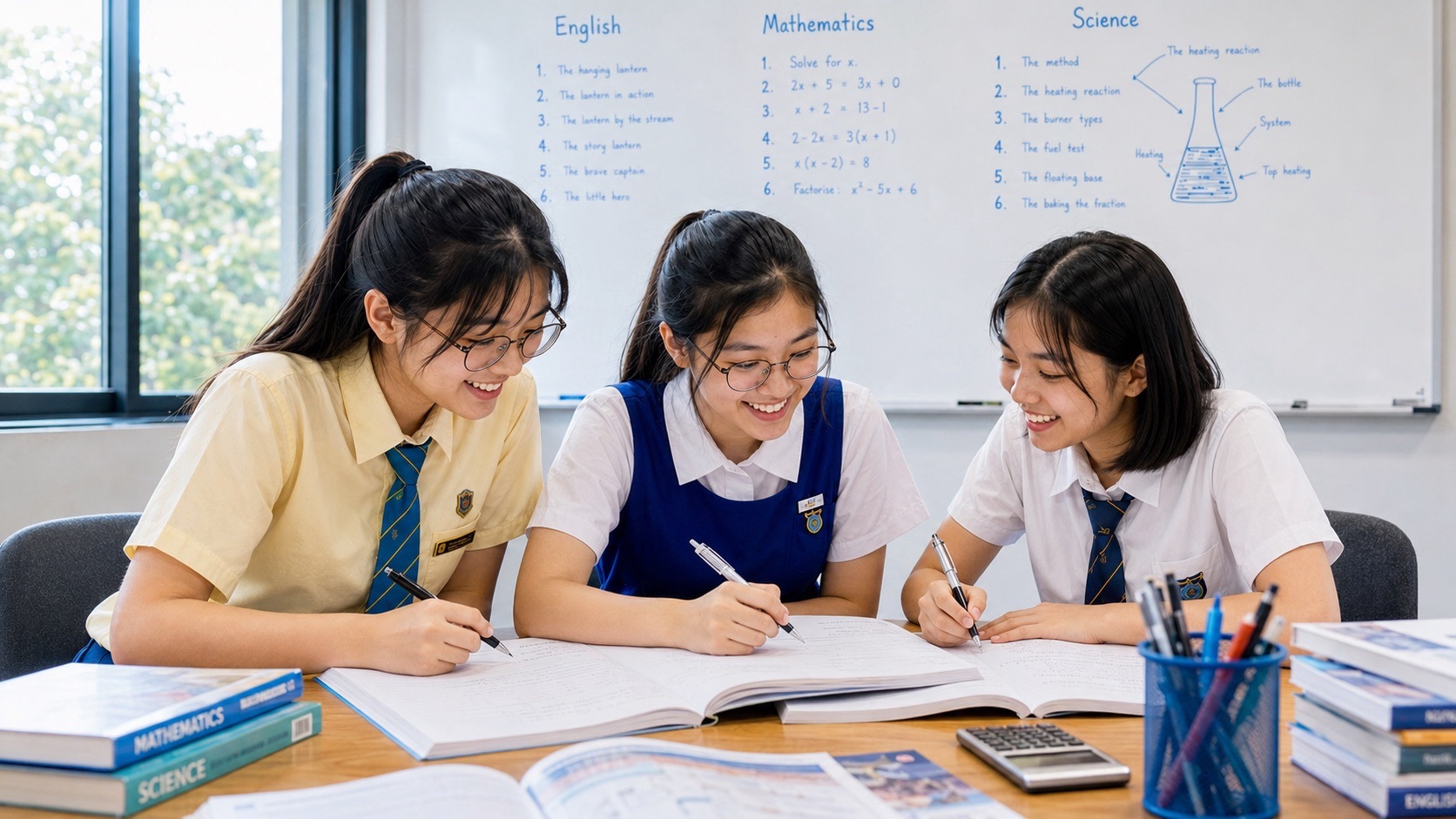
Secondary 4 G3 Additional Mathematics Paper 1 and Paper 2 form one assessment system for the K341 course.
For the 2027 Singapore-Cambridge Secondary Education Certificate, G3 Additional Mathematics K341 is assessed through two papers. Each paper is 2 hours 15 minutes, carries 90 marks and contributes 50% of the total assessment. Candidates answer all questions and may use an approved calculator.
The paper pair therefore tests more than chapter knowledge. It tests whether the student can sustain algebraic control, recognise method families, connect topics, reason mathematically, communicate essential working and manage time across two long independent examination sessions.
This guide owns the G3 two-paper architecture. For the whole G3 route, use How Secondary 4 G3 Additional Mathematics Works | SEC K341. For general paper strategy, use How Secondary 4 Additional Mathematics Paper Strategy Works. For AO1–AO3, use How Secondary 4 Additional Mathematics Assessment Objectives Work.
1. Two Papers Mean Two Full Performance Windows
The student does not sit one long paper split in half. The learner has to produce two complete performances.
That makes recovery between sessions, consistency of preparation and score stability part of the final outcome.
A strong one-paper peak is less valuable than reliable mathematical control across both.
2. Equal Weighting Makes Both Papers Non-Negotiable
Each paper contributes half of the final assessment.
There is no strategic basis for treating one paper as the one that “really matters”.
Training should therefore prepare the full course to travel across both paper environments.
3. Two Hours Fifteen Minutes Makes Endurance a Serious Variable
One hundred and thirty-five minutes is long enough for attention quality to change.
Reading can become shallower, algebra more compressed and checking less disciplined as the paper progresses.
Endurance therefore has to be trained, not assumed.
4. Ninety Marks Creates a Dense Allocation Problem
The student must convert time into marks across a broad paper.
Questions vary in demand, and difficult parts can create large opportunity costs if the learner persists without a visible route.
Paper strategy should protect accessible marks while preserving room for deeper reasoning.
5. Answering All Questions Requires Broad Coverage
There is no optional-question structure that allows the student to avoid entire topic families.
The learner needs retrieval across Algebra, Geometry and Trigonometry, and Calculus.
Revision built around narrow prediction is therefore fragile.
6. K341 Has a Higher AO2 Emphasis
The 2027 G3 profile places approximately 50% of the assessment weighting on AO2.
That means the paper pair is designed to test selection, application, connection and problem solving at scale.
Mixed and unfamiliar work should therefore be central to preparation.
7. AO1 Still Has to Be Reliable
Approximately 35% of the G3 profile remains AO1.
Standard techniques need enough fluency to support the larger problem-solving load.
Weak routine algebra can consume the reserve capacity needed for AO2 and AO3.
8. AO3 Matters Across Long Solutions
Approximately 15% of the G3 profile is AO3.
Reasoning, communication, proof and interpretation should therefore remain visible across both papers.
Long working that hides the logical spine can be weaker than concise working that preserves it.
9. Paper Labels Do Not Define Topic Ownership
Students should not build rigid assumptions that one topic belongs to Paper 1 and another to Paper 2 unless the official syllabus explicitly states such a distinction.
The safer model is that both papers belong to the K341 course.
Question mixes can vary, so preparation should remain syllabus-wide.
10. Calculator Access Is Continuous, but Judgment Remains Human
An approved calculator may be used in both papers.
That supports numerical execution but does not replace method choice, exactness decisions, interval reasoning or proof.
Calculator state should become routine enough that it does not consume attention.
11. Formulae Reduce Memory Load, Not Decision Load
A formula sheet can supply a relationship.
The student still has to recognise when the relationship belongs, interpret the symbols and execute the mathematics correctly.
The examination remains a test of mathematical ownership.
12. Essential Working Is Part of the Assessment
The published syllabus explicitly warns that omission of essential working can result in loss of marks.
Students should therefore preserve the method spine rather than compressing everything into calculator outputs.
Good working supports both marking and self-recovery.
13. Long Papers Magnify Small Habits
A minor sign error habit repeated several times becomes expensive over 90 marks.
A slow recognition habit repeated across ten questions can consume a large amount of time.
Paper length amplifies recurring mechanisms.
14. Algebraic Fluency Protects the Whole Paper
Algebra appears inside many topics.
When routine manipulation remains effortful, the student pays the cost repeatedly across the paper.
Secondary 4 G3 preparation should therefore treat algebra as shared infrastructure.
15. Topic Switching Is a Core Paper Demand
The learner may move from logarithms to geometry to calculus to trigonometry in a short span.
Each switch requires a new representation and method family.
Mixed practice trains this reset process before the full paper arrives.
16. Multi-Topic Questions Increase Integration Demand
A question may begin in one strand and finish in another.
The challenge often lies in recognising the handoff and preserving intermediate results.
This is a direct expression of the higher AO2 demand in K341.
17. Linked Parts Need Result Control
Earlier results can become assets for later parts.
Exactness, units, conditions and notation should be preserved across the handoff.
Re-deriving everything wastes time and increases error exposure.
18. The First Pass Should Protect Reachable Marks
High-level students sometimes allow the hardest question to dominate because challenge is attractive.
The examination rewards total marks, not heroic persistence on one item.
Accessible questions should be secured with controlled working before expensive uncertainty takes over.
19. Strategic Leaving Is Especially Important in a 135-Minute Paper
There is enough time for serious thinking, but not unlimited time.
If the next valid step is no longer visible, preserve the working and move.
Returning with a fresh representation can be more productive than forcing one failing route.
20. Leaving Must Be Practised
Students who have never practised strategic leaving may interpret it as panic or surrender.
Timed mixed sections can train the behaviour deliberately.
The learner should know how to leave a restart point and how to choose which question to revisit first.
21. Late-Paper Fatigue Should Be Measured
Compare error rates and reading quality in the first and final third of a paper.
If signs, command words or calculator mistakes cluster late, the issue may be endurance rather than topic knowledge.
Training can then target the actual mechanism.
22. Endurance Is Not Built by Exhaustion
Repeatedly forcing long papers while the student is already cognitively depleted can rehearse poor habits.
Build endurance progressively and preserve sleep and recovery.
The objective is sustained quality, not maximum suffering.
23. Partial Papers Can Isolate Performance Layers
A 45- or 60-minute mixed section can test recognition, switching and pacing without the full endurance demand.
This is useful when the tutor needs diagnostic resolution.
Full papers remain essential later, but they are not the only examination-training instrument.
24. Build Toward the Full Paper
Untimed mixed work can become timed sections, then partial papers, then full 135-minute papers.
Each stage adds a performance variable while keeping enough control to diagnose failure.
The assembled system should be tested only after its major components are reasonably stable.
25. Paper Pairs Should Be Analysed Together
Two papers create richer evidence than one.
If the same algebraic error, timing collapse or recognition problem appears in both, the pattern is stronger.
If performance differs sharply, inspect the question-demand profile before calling the difference random.
26. Score Variance Is a Capability Signal
A student who alternates between very high and very low paper scores may possess strong peak capability but weak reliability.
Secondary 4 preparation should reduce avoidable variance through retrieval, mixed practice, checking and paper control.
Reliability is part of readiness.
27. One Paper May Expose AO1, Another AO2
A paper heavy in familiar direct technique may reveal whether standard machinery is secure.
Another may contain more connected or unfamiliar demands and expose method-selection weakness.
Paper analysis should therefore classify demand, not only topic.
28. Proof and Communication Must Survive Time
Students sometimes know how to reason but compress the explanation too aggressively under pressure.
Timed practice should preserve the essential logical spine.
AO3 performance must become efficient enough for the real paper.
29. Checking Needs a Personal Risk Map
The paper is too long for indiscriminate rereading.
Check the locations where the student’s own mathematics is most likely to fail: sign changes, intervals, exactness, transferred values, derivative algebra, calculator mode and final command words.
Selective checking preserves time for higher-value work.
30. Paper Order Should Be Tested, Not Assumed
Some students perform best sequentially. Others benefit from controlled skipping and return.
The strategy should be tested across several complete papers before the examination.
A routine becomes useful only when it improves actual performance.
31. Prelims Are a Full-System Stress Test
Preliminary examinations can reveal whether knowledge survives school-specific difficulty, time pressure and two-paper sequencing.
The post-prelim analysis should examine paper behaviour as well as marks.
Which failures were mathematical and which were caused by allocation, fatigue or recovery?
32. The Post-Prelim Map Should Narrow
After prelims, do not simply “do more papers”.
Identify the small set of recurring mechanisms still damaging both papers.
Repair, re-enter and then test again under realistic conditions.
33. Strong G3 Students Need Decision Economy
High-level learners may know several methods and therefore spend time choosing among them.
Paper refinement should develop quick recognition of the most reliable route.
Knowing more should reduce search, not increase it.
34. Strong G3 Students Need Restraint
Do not expand useful factors, approximate exact values or derive from scratch when an earlier result already provides the bridge.
Restraint protects time and reduces error exposure.
Mathematical maturity includes knowing what not to do.
35. Recovering G3 Students Need Strategic Triage
A struggling student should stabilise high-impact algebra, core recognition and standard question families first.
The paper strategy should protect reachable marks and reduce complete collapses.
Later stretch becomes possible once the base performance is dependable.
36. The Two-Paper System Should Feed Revision
Every paper pair should update the revision map.
Which topics became inactive? Which AO2 patterns repeated? Which late-paper errors appeared? Which parts consumed too much time?
The next revision cycle should be evidence-driven.
37. The Two-Paper System Should Feed Error Diagnosis
Recurring failures across different papers are especially valuable diagnostic evidence.
If the same mechanism survives changes in topic and question wording, it is likely to be upstream.
Repair the mechanism, not only the latest question.
38. The Two-Paper System Should Feed Independence
The learner should gradually become able to analyse their own paper.
Where did time disappear? Which answers need rechecking? Which topic was forgotten? Which question should have been left earlier?
Self-analysis is part of examination readiness.
39. A Useful K341 Paper Audit
- Can mathematical quality be sustained for 135 minutes?
- Are all syllabus strands retrievable?
- Can unfamiliar questions be classified quickly?
- Are linked parts and result handoffs controlled?
- Is essential working visible?
- Are calculator state and exactness reliable?
- Does the student leave strategically rather than emotionally?
- Are Paper 1 and Paper 2 scores becoming more stable?
40. The BTT Mathematical Lab Can Probe K341 Paper Failure
The BTT Mathematical Lab can shorten or alter one variable in the paper environment.
Compare untimed and timed mixed sections. Test first-half and late-half performance. Remove one topic switch. Supply the method and test execution.
The aim is to distinguish mathematical weakness from paper-system weakness.
41. Official SEC Reference
SEAB’s 2027 G3 school-candidate listing identifies Additional Mathematics as K341. The published K341 syllabus specifies two 2 hour 15 minute papers of 90 marks each, each contributing 50% of the assessment, with approved calculator use and essential-working requirements. Use the official 2027 G3 syllabus listing for current examination truth.
42. The Deeper Idea
K341 Paper 1 and Paper 2 are two long tests of whether the mathematical system remains available, connected and controlled.
The learner needs technique, problem solving, reasoning, stamina and judgment to survive both.
The strongest preparation is not two separate piles of paper practice. It is one coherent mathematical system trained to perform twice.