
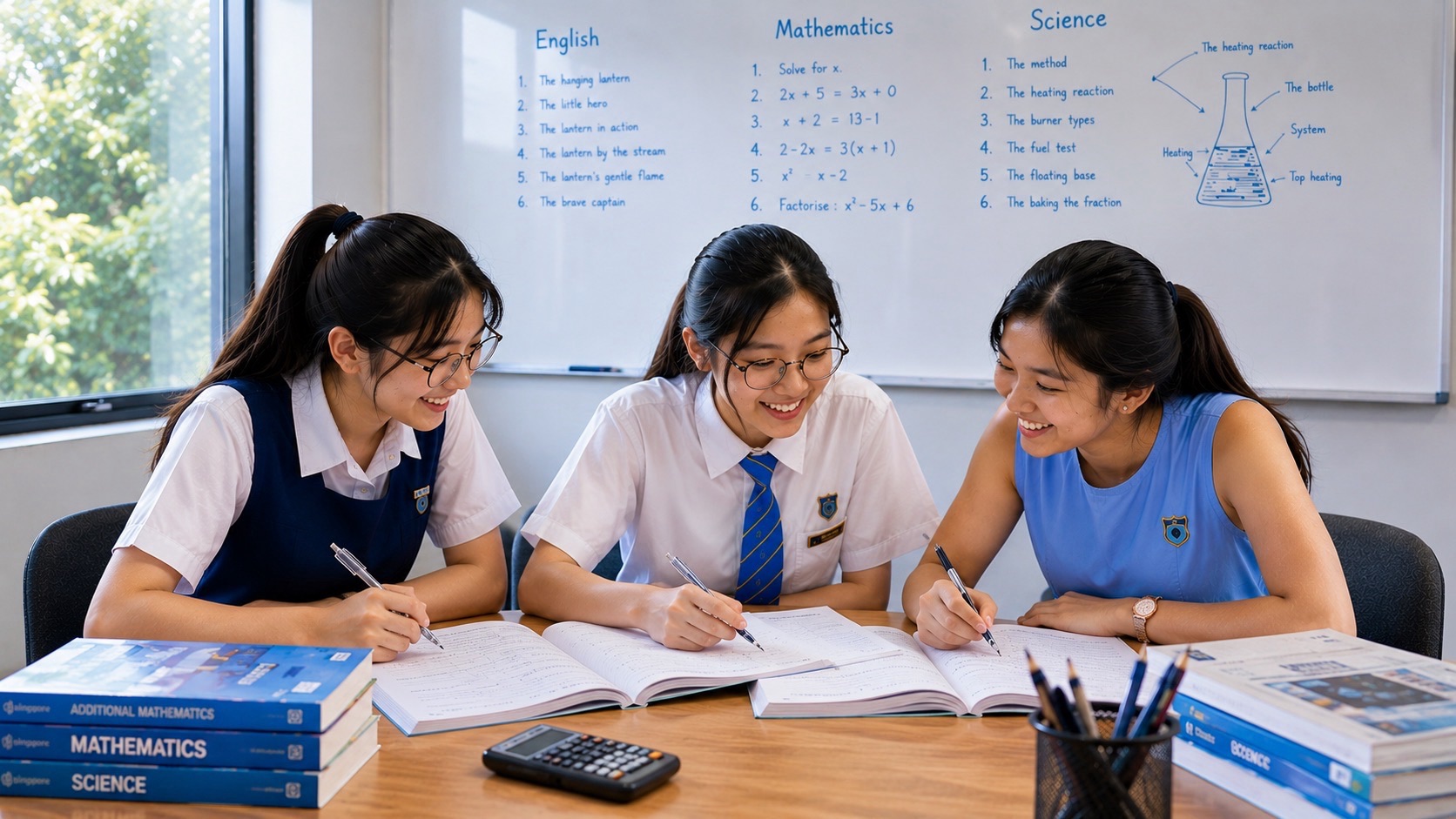
Secondary 4 G3 Additional Mathematics is the point at which algebra, geometry, trigonometry and calculus have to operate as one coherent mathematical system. For the 2027 Singapore-Cambridge Secondary Education Certificate, SEAB lists G3 Additional Mathematics as syllabus K341.
The official syllabus is unusually clear about the destination. It is intended to prepare students for higher mathematical study including A-Level H2 Mathematics, and it emphasises not only conceptual understanding and skill proficiency but also reasoning, communication, application and connections across topics.
This article owns the Secondary 4 G3 route. Use the Additional Mathematics Directory for the wider A-Math knowledge library, and the BTT Mathematical Lab when a visible weakness needs to be turned into a controlled mathematical experiment.
1. K341 Is a Reasoning Course, Not a Formula Course
The formulae matter. The techniques matter. But the official assessment architecture shows that G3 A-Math is not designed as a memory contest.
SEAB’s 2027 syllabus groups assessment into three objectives: use and apply standard techniques; solve problems in a variety of contexts; and reason and communicate mathematically. The published approximate weightings are 35% for standard techniques, 50% for problem solving, and 15% for reasoning and communication.
That structure explains why a student who is excellent at repetitive chapter practice can still struggle on a full paper. Technique is necessary, but the larger examination also asks the learner to identify relevant mathematics, translate information, connect topics, formulate problems, interpret results, justify statements and construct arguments.
2. The Three-Strand System
K341 is organised into Algebra, Geometry and Trigonometry, and Calculus. In Secondary 3 these may feel like separate departments. By Secondary 4 they have to behave more like one organisation.
Algebra provides the symbolic language. Geometry and trigonometry provide structure, transformation and spatial relationships. Calculus provides a language for change, rates, gradients and accumulation.
A strong G3 student is therefore not merely strong in three collections of chapters. The student can move information across the boundaries between them.
3. G3 Mathematics Is Assumed Infrastructure
The K341 syllabus assumes knowledge of G3 Mathematics. That means foundational Mathematics remains active infrastructure even when it is not tested as a standalone A-Math topic.
Fractions, equations, graphs, geometry, basic trigonometry and numerical control can all reappear indirectly. A weakness in that infrastructure can sabotage a more advanced question.
This is why diagnosis must trace the first failure rather than accepting the chapter title as the cause.
4. Quadratics Become a Structure
At G3 A-Math, quadratics connect algebraic form, roots, discriminants, graphs, maxima and minima, tangency and modelling.
Completing the square is not simply one method among several. It is an example of mathematical re-representation: the same function is expressed in a form that reveals a different property.
This is one of the habits that higher mathematics repeatedly rewards—change the form while preserving the object.
5. Equations and Inequalities Require Logical Control
Solving an equation and solving an inequality are different logical tasks. An equation looks for values that make two expressions equal; an inequality identifies a region where a relationship holds.
Quadratic inequalities therefore require attention to intervals and signs, not merely roots. Simultaneous equations require the learner to preserve the meaning of both relationships while eliminating one variable.
The deeper skill is constraint management.
6. Surds Protect Exactness
Surds teach an important mathematical discipline: irrational does not mean approximate.
Exact forms preserve structure, allow algebraic manipulation and avoid unnecessary loss of information. Rationalisation and equations involving surds therefore train more than a technique—they train the learner to control representation.
In Secondary 4, that exactness discipline should extend into trigonometry, logarithms and calculus.
7. Polynomials Teach Global Structure
Polynomial division, factor and remainder reasoning, cubic equations and partial fractions all require the learner to see beyond one visible expression.
The Factor Theorem turns a root relationship into a factor relationship. The Remainder Theorem extracts information about division without performing the whole operation. Partial fractions decompose a complicated rational expression into simpler components.
These are examples of structural mathematics: transform the object so the next question becomes easier.
8. The Binomial Theorem Compresses a Pattern
Binomial expansion is a good example of mathematical compression. Rather than repeatedly multiplying brackets, the theorem describes the entire expansion pattern.
The learner must understand coefficients, powers, term position and the general term. The real power is not speed alone. It is the ability to predict structure before carrying out every local multiplication.
That kind of compression becomes increasingly important in higher mathematics.
9. Exponentials and Logarithms Are Inverse Views
Logarithms often feel strange because they reverse a familiar question. Exponentiation asks for a result given a base and power; a logarithm asks for the power.
Understanding this inverse relationship makes logarithmic laws and equations more coherent. It also connects graphical, algebraic and modelling views of exponential change.
A Secondary 4 learner should be able to move among these representations without treating each as a separate trick.
10. Trigonometry Becomes Periodic Function Mathematics
G3 trigonometry extends far beyond triangle calculation. The six trigonometric functions, exact values, radians, transformed graphs, identities, compound-angle and double-angle relationships, R-form transformations and equations all sit inside a periodic function system.
The student has to control both identity manipulation and solution conditions. The same equation can have multiple answers within an interval, and calculator mode can change the numerical interpretation.
This is where symbolic reasoning, graphical intuition and calculator discipline meet.
11. Identity Proof Is an Equivalence Test
A trigonometric identity proof requires the learner to preserve truth through every transformation.
The target is not obtained by assuming the result. The student must work from valid expressions and show an equivalent chain.
This tests whether algebraic manipulation is being used as reasoning rather than decoration.
12. Coordinate Geometry Connects Equation and Space
Lines and circles can be studied geometrically or algebraically. Coordinate geometry makes the translation explicit.
Parallel and perpendicular relationships become gradient conditions. Circle geometry becomes equation structure. Linearisation turns selected relationships into straight-line forms that reveal unknown constants.
The mature learner learns to choose the representation that exposes the information needed.
13. Plane Geometry Proofs Train Necessity
A diagram can suggest a conclusion, but proof asks whether the conclusion is forced by known properties.
Parallel-line relationships, triangle properties, congruence, similarity, midpoint reasoning and circle theorems create a chain in which each statement needs a reason.
This is a different mode from numerical calculation. It develops argument, justification and mathematical communication directly.
14. Differentiation Is Local Change
Differentiation turns the gradient at one point and the rate of change into mathematical objects that can be calculated and reasoned about.
The derivative rules matter, including products, quotients and the chain rule, but those rules are meaningful because they describe how functions change.
Secondary 4 students should therefore connect symbolic derivatives back to graphs, tangents, rates and optimisation.
15. Integration Is Reconstruction and Accumulation
Integration reverses differentiation in important ways, but it also expresses accumulation and area.
The constant of integration reminds the learner that a derivative does not uniquely determine the original function without further information.
Definite integration introduces another layer: the result can represent signed accumulation, so area below an axis affects the algebraic integral differently from geometric area.
16. Kinematics Makes Calculus Move
Kinematics shows calculus acting on a changing physical quantity. Displacement, velocity and acceleration become related views of the same motion.
The student must interpret signs, turning points and initial conditions rather than performing derivatives and integrals mechanically.
This is a good example of the official emphasis on application and interpretation.
17. AO1 Is Necessary but Not Sufficient
Standard techniques include facts, notation and routine procedures. They form the installed machinery.
But if the student only practises AO1 conditions, the learner may become dependent on visible cues. The chapter is named, the method family is known and the search space is artificially small.
Secondary 4 training must progressively remove those supports.
18. AO2 Is Where the Examination Becomes a Problem
Problem solving asks the student to determine what mathematics belongs, translate between forms, select information, connect topics and interpret results.
This is why unfamiliar wording can feel much harder than familiar mathematics. The challenge begins before the calculation.
A good G3 programme therefore trains the entrance to the problem, not only the middle.
19. AO3 Changes the Standard of “Correct”
Reasoning and communication require more than a correct endpoint. The student may need to justify a statement, explain a conclusion or construct a proof.
This makes essential working part of the mathematical object submitted for assessment.
A compressed answer that hides the logic may be weaker than a slightly longer answer whose reasoning is visible and defensible.
20. The Paper Structure Demands Endurance
For K341 in 2027, the official scheme shows two papers, each 2 hours 15 minutes, each worth 90 marks and each contributing 50% of the assessment. Candidates answer all questions.
That structure creates a substantial endurance and pacing problem. There is no optional-question strategy that removes whole parts of the course.
The student has to maintain mathematical control across a long performance window.
21. Paper 1 and Paper 2 Are Not Just Long Worksheets
A full paper creates interactions that do not exist in isolated practice. The learner must switch topics repeatedly, manage emotional residue from difficult questions and decide how long to persist before moving.
Time becomes a resource. Attention becomes a resource. Working memory becomes a resource.
Secondary 4 preparation therefore needs paper-level engineering, not merely more chapter questions.
22. Essential Working Is Explicitly Required
The official K341 notes state that omission of essential working results in loss of marks. This is important because a formula sheet and a calculator do not remove the need for reasoning.
The learner should show enough structure for the mathematical path to be assessed. Good working also improves self-debugging because intermediate states remain visible.
This is examination communication and cognitive control at the same time.
23. Formulae Are Provided, but Method Is Not
Relevant formulae are provided to candidates. That does not solve the problem for the student.
The learner still has to recognise when a formula applies, map the question’s quantities into the symbols, preserve conditions, rearrange correctly and interpret the output.
A formula sheet therefore reduces memory load without replacing mathematical judgment.
24. Calculator Permission Does Not Remove Calculator Risk
An approved calculator may be used in both K341 papers. The calculator has a state, and that state can become part of the error chain.
Degree/radian mode, brackets, stored values, premature approximation and the interpretation of displayed results all matter.
Strong students treat calculator execution as a layer that must agree with the mathematical model.
25. Accuracy Rules Are Part of Communication
The official syllabus specifies conventions for non-exact numerical answers and angles unless a question states otherwise. This is not administrative trivia.
Accuracy communicates what level of precision the result is intended to carry. Premature rounding can alter later calculations, while excessive digits can obscure whether the student understands the requested precision.
Secondary 4 students should learn to preserve exactness and round deliberately.
26. G3 A-Math Requires Transfer
Transfer means the student can use an idea when the surface changes.
A question may replace familiar numbers, reverse the direction of reasoning, combine two chapters or hide the standard structure inside a context.
The learner who memorised examples may feel that each variation is new. The learner who extracted the invariant structure sees the family resemblance.
27. Controlled Variation Tests Understanding
One of the fastest ways to test whether a method is understood is to change one important feature after a correct solution.
Change a sign, parameter, interval, representation or target. Ask what must change and what stays the same.
This makes the student’s internal model visible.
28. Mixed Practice Should Become the Default
Once the main topics are sufficiently installed, revision should increasingly mix them.
Mixed practice forces method selection. It reveals which chapter cues were doing hidden work and whether the learner can switch mental frameworks.
The discomfort is useful because the examination itself is mixed.
29. A Strong G3 Student Must Learn Restraint
Advanced students often know many methods. Their new problem can be overproduction.
They expand expressions that should remain factored, substitute too early, approximate too soon or pursue elegant routes that are unnecessarily expensive under examination time.
Mathematical maturity includes knowing what not to do.
30. A Struggling G3 Student Needs High-Impact Repair
When the course is large and the examination is approaching, every weakness cannot receive equal time.
The priority should go to upstream skills with broad consequences: algebraic control, core recognition, major inactive topics, recurring error patterns and paper completion.
This is not a shortcut around the syllabus. It is an attempt to repair the mechanisms that damage the most mathematics.
31. Prelims Should Produce a Map
A preliminary examination is valuable when it produces a better model of the student.
Which topics were unavailable? Which questions were recognised but not executed? Where did time disappear? Which errors repeated? Which marks were lost after correct mathematics because the final command was missed?
The grade is important, but the map is what changes the next lesson.
32. The Final Phase Should Narrow to Risks
Late in Secondary 4, revision should become less encyclopedic and more surgical.
The student should know the small set of recurring failures that still threaten the paper. Each should have a prevention or recovery routine.
The aim is to enter the examination with stable mathematics, not with the maximum possible number of recently seen questions.
33. The Link to H2 Mathematics
K341 explicitly identifies preparation for H2 Mathematics as part of its role. That does not mean Secondary 4 should prematurely teach the A-Level syllabus.
It means the habits being built now matter later: symbolic fluency, function thinking, reasoning, connected representation, proof discipline and calculus understanding.
The strongest preparation for future mathematics is often deeper control of present mathematics.
34. The Learner Must Eventually Become the Router
At the beginning of learning, teachers and worksheets route the student: this is a logarithm question; use this identity; differentiate here.
By the end of Secondary 4, the learner must perform that routing internally.
Seeing the problem, selecting the tool and knowing why it belongs are part of mathematical capability.
35. What G3 Readiness Looks Like
Readiness is not perfection. It is reliable control.
- old topics can be retrieved after delay
- unlabelled questions can be classified accurately
- algebra remains stable inside higher-level problems
- working communicates a defensible route
- calculator use supports rather than overrides reasoning
- the student can recover after a wrong turn
- time is allocated across the whole paper rather than one question
- checks target known risk zones
- confidence increasingly agrees with observed performance
36. Where This Route Fits in the BTT Architecture
The Additional Mathematics Directory owns the knowledge map. The Secondary 4 A-Math stage floor owns the year-level stage. Mathematics Examination Craft owns paper conversion. The BTT Mathematical Lab is used when a symptom needs a controlled probe rather than another general explanation.
37. Official Reference Point
SEAB lists G3 Additional Mathematics as K341 for the 2027 SEC. Use the official G3 syllabus listing for current subject-code truth and the SEC syllabus materials linked there for the current examination specification.
38. Final Idea
Secondary 4 G3 Additional Mathematics is not the year in which students simply collect the final missing formulas.
It is the year in which the mathematics has to become organised, callable and independent. The learner must see structure beneath unfamiliar surfaces, preserve truth through symbolic transformations, connect ideas across topics and operate the whole system under time.
The final product is not a student who has seen every question. It is a student whose mathematics can travel into a question they have not seen.
39. Why the Same Error Can Appear in Several Chapters
A recurring algebraic weakness may surface in logarithms, trigonometry and calculus. A weak habit of preserving conditions may surface in inequalities, trigonometric intervals and modelling. A weak checking routine may surface everywhere.
When the same failure appears across different chapters, the tutor should suspect an upstream mechanism rather than three unrelated topic gaps.
This is one reason a cross-topic error log can be more valuable than a chapter-by-chapter mistake list.
40. Mathematical Communication Reduces Internal Confusion
Students sometimes think writing is only for the examiner. In long G3 solutions, writing is also for the future self who reaches line nine and needs to know what line three established.
Named variables, visible substitutions, stated conditions and clear conclusions keep the solution state legible.
The page becomes an external memory system.
41. Proof and Modelling Pull in Opposite Directions
Proof asks the learner to move from premises toward a necessary conclusion. Modelling often asks the learner to move from a real situation into a simplified mathematical representation and then return to the world.
Both require reasoning, but the direction of thought is different. Proof protects logical necessity; modelling protects interpretive relevance.
A mature G3 student learns to recognise which kind of justification the question is asking for.
42. The Strongest Check May Use a Different Representation
Verification is more powerful when it is independent of the original route. A solved root can be substituted back. A derivative can be inspected graphically. A calculated coordinate can be tested against the original geometric condition.
Different representations create different failure modes, which makes agreement between them stronger evidence than simply repeating the same algebra.
Secondary 4 students should collect checking strategies, not merely reminders to “be careful”.
43. Time Pressure Reveals What Is Automated
Under generous time, a learner can compensate for slow recognition or fragile algebra by thinking longer. Under examination time, those hidden costs become visible.
This does not mean timed work should begin before understanding. It means timing eventually has to test whether routine parts of the system have become fluent enough to leave attention for reasoning.
The target is not haste. It is spare cognitive capacity.
44. Reserve Capacity Matters
A student operating at maximum mental load on every standard question has little reserve for an unfamiliar problem.
Fluency, clean notation and reliable routines create spare capacity. That reserve can be used for interpretation, checking, proof or recovery when the paper becomes difficult.
This is why automaticity in routine operations and deep understanding in non-routine operations complement rather than oppose each other.
45. Examination Confidence Should Be Calibrated
Confidence is useful when it agrees with evidence. Overconfidence can reduce checking and retrieval practice; underconfidence can prevent a student from starting a solvable question.
The best calibration comes from repeated performance under realistic conditions. A learner should know which topics are secure, which need deliberate checks and which still require caution.
Specific evidence is stronger than vague reassurance.
46. Secondary 4 Should Produce a Smaller Error Vocabulary
At the beginning of the year, a student may describe every failure as “careless”. By the end, that category should disappear into more precise descriptions.
- lost a condition
- misread the command
- selected the wrong identity
- calculator in radians
- expanded a useful factorisation
- rounded before substitution
- forgot the second trigonometric solution
- continued after the question had already been answered
Precision in error language is a sign that self-correction is becoming possible.
47. The Final Examination Is a Systems Test
Each individual chapter is only one component. The paper tests whether the components can operate together for more than two hours while the learner manages time, uncertainty and attention.
That is why a student can know the syllabus and still be unready, or perform imperfectly in individual lessons yet become a strong paper performer after the system is coordinated.
Secondary 4 training should therefore test the assembled system, not only the parts.
48. The End of K341 Is a Beginning
The SEC examination closes one stage, but the mathematical habits built through K341 continue into future study.
Functions, algebraic representation, trigonometry, calculus and proof are not disposable examination topics. They are foundations for more advanced mathematics, science, engineering, computing and quantitative reasoning.
The best Secondary 4 preparation therefore serves both immediate performance and future intellectual runway.