
Protecting Continuity in Education · How Mathematics Tuition Works
Mathematics tuition works when every lesson moves the student from visible error to independent control.
More worksheets do not automatically produce stronger Mathematics. A useful tuition system observes what repeatedly breaks, traces the difficulty to the earliest weak dependency, teaches the missing structure from first principles, guides the student through deliberate practice and gradually removes support. Choose the part of the process you want to understand, then read the full guide below.
01 / Visible Signal
What is the student actually showing?
Begin with the repeated error, hesitation or loss of control that can be observed.
02 / Starting Point
Where should the repair actually begin?
Trace the present difficulty backwards to the earliest useful weak link.
03 / Teach
How is the missing Mathematics taught?
Teach from first principles without leaving hidden assumptions inside the repair.
04 / Repair Loop
How does explanation become performance?
Move through modelling, guided practice, feedback, correction and return.
05 / Three Students
How does the small-group class work?
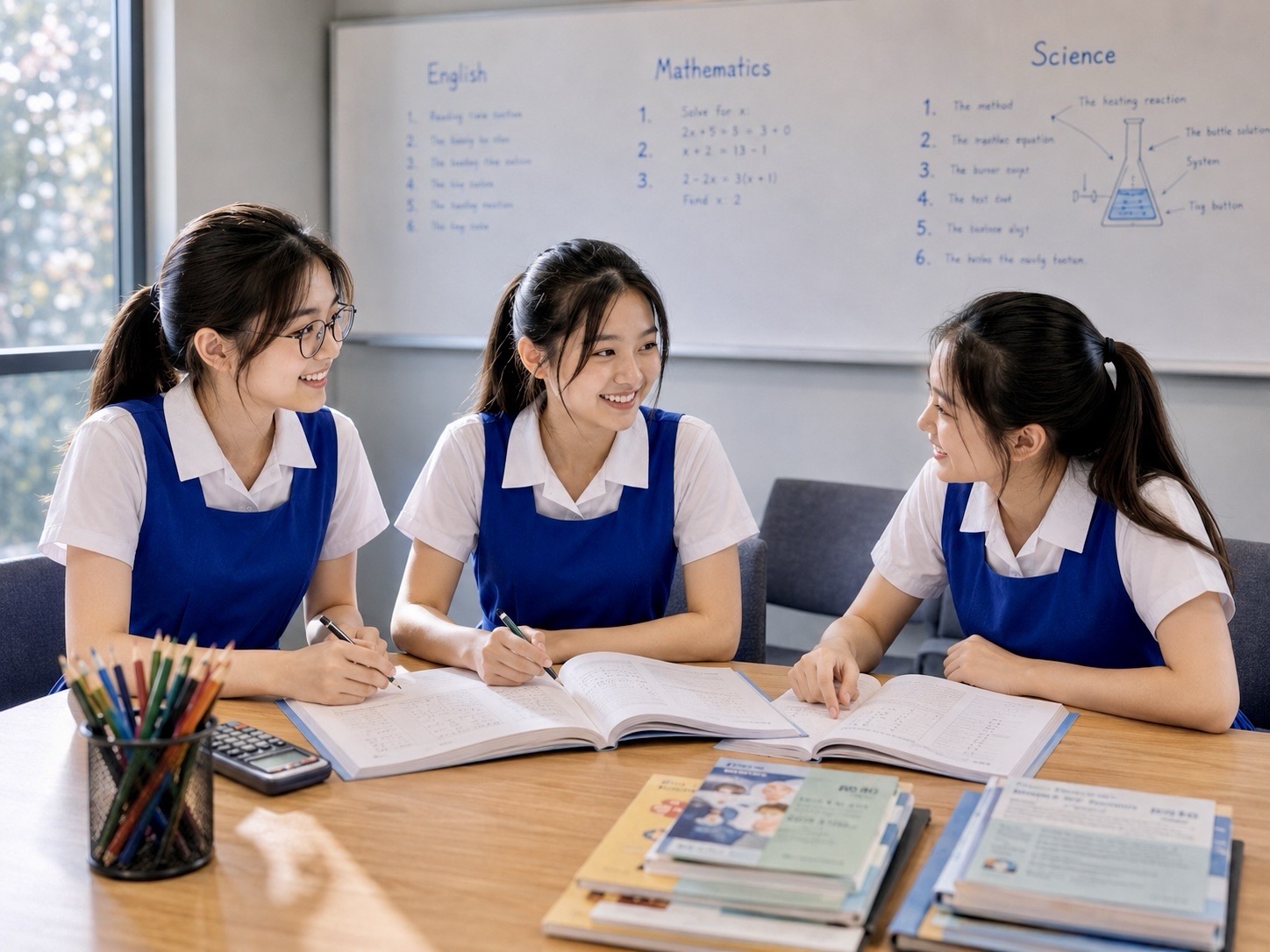
Use a maximum of three students for direct teaching, observation and correction.
06 / School + Exam
How does tuition connect to school and examinations?
Build the subject ahead of assessments without turning lessons into random paper drilling.
07 / Independence
When is the tuition working?
Measure progress by the student’s growing ability to choose, explain and verify methods alone.
08 / Consultation
How do we choose the right tuition route?
Begin with the student’s position, curriculum, concern and intended direction.
Read the whole learning system. Follow the path from visible mistakes to the earliest weak link, deliberate repair, examination control and independent Mathematics—or begin with a consultation when the student’s current position is already clear.
Read the Full Method Guide Ask About Mathematics TuitionBukit Timah Tutor · Mathematics Tuition Method
How Mathematics Tuition Works.
A parent usually sees the result of the problem before seeing the mechanism. The student loses marks, works slowly, forgets methods, avoids showing steps, cannot begin unfamiliar questions or becomes anxious before a test. These are real signals, but they are downstream signals. They tell us that the Mathematics system is not holding somewhere; they do not yet tell us where it first became unstable.
Bukit Timah Tutor therefore does not define Mathematics tuition as an extra worksheet session. It is a controlled sequence: observe the visible signal, look one step earlier, locate the earliest useful weak link, teach the missing structure, guide the repair, revisit it after time has passed, mix it with other topics and reduce support until the student can choose and execute the method independently.
This same architecture can support Primary Mathematics, Secondary G1, G2 and G3 Mathematics, Additional Mathematics and selected IP, IB or IGCSE pathways where the curriculum and class fit are suitable. The syllabus changes. The underlying tuition logic remains consistent.
01 / Observe the Visible Signal
The wrong answer is evidence, but it is not yet the diagnosis.
Mathematics makes hidden thinking visible through working. A blank page may show that the student cannot identify the topic or translate the wording. A correct first step followed by collapse may show that the concept is recognised but the algebra cannot be controlled. A fully correct untimed answer followed by failure in a test may point towards retrieval, pacing, checking or anxiety rather than basic understanding.
This is why a mark alone is insufficient. Sixty-five per cent can describe a student recovering from forty, drifting from eighty-five or performing strongly in geometry but weakly in algebra. Tuition begins by looking for the repeated pattern around the score: where the student pauses, what is omitted, which errors return and what happens when the question changes shape.
The tutor listens to explanations as well as checking answers. A student may perform a memorised procedure without understanding when it applies. Another may understand the principle but use imprecise working. The visible signal becomes useful when it is connected to the student’s actual reasoning process.
02 / Find the Starting Point
Look one step earlier until the present chapter can hold.
Mathematics is cumulative. Later ideas compress earlier ideas and assume they are available on demand. Algebra assumes control of number operations and equivalence. Simultaneous equations assume equation manipulation. Quadratics assume factorisation, expansion and symbolic fluency. Functions assume algebra, graphs and a stable understanding of variables. Calculus assumes functions, algebraic manipulation and interpretation of rate or change.
When a student struggles with the visible chapter, the tutor tests the dependencies beneath it. The aim is not to travel backwards forever. It is to find the earliest point where a focused repair unlocks the largest amount of forward work. That is the earliest useful weak link.
Diagnosis occurs through teaching, not only testing. A student may fail a question because the explanation was never clear. Once the missing idea is taught properly, the student’s response reveals whether the weakness was local or whether an earlier dependency still needs rebuilding. Bukit Timah Tutor therefore teaches while observing rather than delaying all instruction until a perfect diagnosis exists.
Name the current signal
Identify the exact question type, topic, working stage or examination condition where control is lost.
Test the immediate dependency
Check the prerequisite concept, representation, language or algebraic operation directly beneath the visible difficulty.
Teach the missing structure
Provide the explanation and guided example instead of treating every gap as a test the student should already pass.
Watch what now becomes possible
If later work stabilises, the repair point was useful. If it still collapses, move one dependency earlier and rebuild there.
03 / Teach From First Principles
Remove hidden assumptions from the explanation.
A student can appear to know a topic because the steps look familiar. The understanding is tested only when the numbers, diagram, wording or context changes. First-principles teaching rebuilds the idea beneath the familiar procedure: what the quantities mean, how they are related, why the operation is valid and what tells the student that this method belongs here.
The tutor controls the cognitive load. New notation is named. The question language is unpacked. Visual or concrete representations are used where they clarify the structure. Worked examples make the decision points visible rather than displaying only polished final steps. The student is asked to explain what changes from one line to the next.
“Teach from scratch” therefore means no unexplained gap inside the selected repair route. It does not mean making an advanced student repeat material already held securely. The tutor preserves what is strong, rebuilds what is unstable and connects the repaired idea back to the present curriculum.
Meaning
What does the Mathematics describe?
Identify the quantities, relationship, constraint or change before compressing them into symbols.
Representation
How can the structure be seen?
Use number lines, diagrams, tables, graphs, models or symbolic forms to make the relationship available to thought.
Method
What sequence of operations is valid?
Model the working, expose the decision points and show why each transformation preserves the mathematical relationship.
Connection
Where does this idea sit in the wider subject?
Connect the current method to earlier foundations, related topics, later applications and the forms used in school assessments.
04 / Build the Repair Loop
Explanation must survive time, variation and independent use.
Students often say, “I understood it in tuition, but I could not do it later.” This usually means the lesson ended at recognition. The explanation felt clear while the tutor and example were present, but the student did not yet retrieve the method from memory, choose it independently or apply it when the question changed.
The repair loop extends beyond explanation. The tutor models the method, then guides the student through selected steps. Prompts are reduced. The student attempts a complete question. Errors are corrected while the reasoning is still visible. The idea returns after time has passed and is mixed with neighbouring topics so that the student must identify it rather than merely follow a chapter heading.
Feedback is specific. “Be careful” is replaced by a usable correction: define the variable before forming the equation, preserve the negative sign when expanding, state the theorem being used, check the domain, substitute into the original relation or estimate whether the final magnitude is reasonable.
Teach and model
Make the concept, decision and complete working sequence visible.
Guide the first attempts
Use prompts and partial scaffolds while requiring the student to perform the thinking that has just been taught.
Release the question
Ask the student to identify the structure and complete the method without the tutor carrying each decision.
Correct the mechanism
Repair the exact point where interpretation, method choice, algebra, working or checking failed.
Return after time
Use spaced retrieval so the student must reconstruct the method after the immediate lesson context has faded.
Mix and transfer
Interleave topics and vary question forms so recognition depends on mathematical structure rather than page position.
05 / Small-Group Instruction
A maximum of three students keeps the reasoning visible.
Mathematics cannot be taught only by broadcasting an explanation. The tutor must see what each student does with the explanation. A three-student class allows shared instruction where the topic and route align, followed by close observation of individual working, targeted questioning, immediate correction and independent practice.
At one moment, all three students may be examining the same idea. At another, one student may be completing a guided repair, one may be applying the method independently and one may be receiving a short correction. The class changes mode as the students reveal what they understand.
Peer presence can also improve explanation. A student hears another method, compares working or explains why a step is valid. But the group remains useful only when placement is coherent. Students need not be identical; they must be close enough in curriculum, pace and teaching direction for the tutor to maintain one purposeful class rather than three unrelated private lessons happening at once.
06 / School, Syllabus and Examination
Build understanding first, then train performance under assessment conditions.
Tuition should remain connected to what the student is expected to learn in school. The current syllabus, topic sequence, school pace and assessment format define the practical route. Where appropriate, teaching can move ahead of the school schedule so that classroom lessons become consolidation rather than first exposure. Moving ahead, however, is useful only when earlier foundations can carry the new work.
The learning sequence usually progresses from clear teaching to selected topic practice, mixed application, school-style questions, past-paper work and timed examination conditions. Past papers are valuable because they reveal recurring structures and mark demands, but they are not a substitute for the concept and method needed to answer them.
Examination preparation adds a second layer: recognising what is being tested, allocating time, deciding how much working to show, protecting method marks, checking signs and restrictions, recovering when a question is unfamiliar and selecting which question to leave temporarily rather than allowing one difficulty to consume the paper.
Catch Up
Repair the dependency that is blocking present school work.
Prioritise the earliest foundation that unlocks the current topic, then reconnect the repair to the school sequence.
Keep Up
Stabilise understanding, practice and weekly rhythm.
Teach the topic clearly, reinforce it before it fades and prevent small gaps from accumulating into a later collapse.
Move Ahead
Prepare the structure before the school demand arrives.
Introduce later ideas carefully, connect them to secure foundations and use harder applications when the student is ready.
Perform
Convert knowledge into reliable examination execution.
Train question recognition, working discipline, time allocation, checking and recovery under realistic paper conditions.
07 / Build Independent Mathematics
The tutor should gradually become less necessary inside each solved problem.
Scaffolding is useful because it gives the student access to a task that is not yet manageable alone. It becomes harmful only when it is never removed. Bukit Timah Tutor therefore reduces prompts deliberately. A full worked example becomes a partial example. A guided question becomes an independent question. A familiar block becomes a mixed set where the student must decide which method belongs.
Independence does not mean the student never asks for help. It means the student can locate uncertainty more accurately. Instead of saying “I do not understand Mathematics,” the student can say, “I can form the equation, but I lose control when rearranging the fractional terms,” or “I know the theorem, but I cannot see which information proves the triangles are similar.” Better questions are evidence of a better internal map.
Confidence follows the same path. Praise can protect morale, but durable confidence comes from repeated control: beginning questions more calmly, making fewer repeated errors, explaining the method, checking independently and recovering after a difficult item without abandoning the rest of the paper.
08 / Choose the Route
Begin with the student’s position, not only the programme name.
Primary Mathematics, Secondary Mathematics and Additional Mathematics identify the broad programme. The consultation identifies the likely instructional route within that programme. The student may need foundation repair, present-topic consolidation, greater stretch, examination preparation or a combination sequenced over time.
Share the observable pattern: what the student can do, where control is repeatedly lost, the recent result or grade trend, the current topics and the next important assessment. You do not need to locate the earliest weak link yourself. The purpose of the first conversation and opening lessons is to make that route clearer.
Because classes are capped at three students, placement also depends on curriculum, pace, class composition, available timing and whether the intended teaching direction fits the existing group. A consultation begins the process but does not guarantee that an appropriate class space is currently available.
Begin a Bukit Timah Tutor Mathematics consultation.
Open the prepared WhatsApp message, add the student’s details and send it to +65 8823 1234.
Final Method Review
Which part of the Mathematics tuition system should you review?
Return to the selector, revisit a method stage or begin the consultation with the student’s current position.
Programme route, fee, start date and space remain subject to consultation, curriculum fit and class availability. Classes are capped at a maximum of three students.