
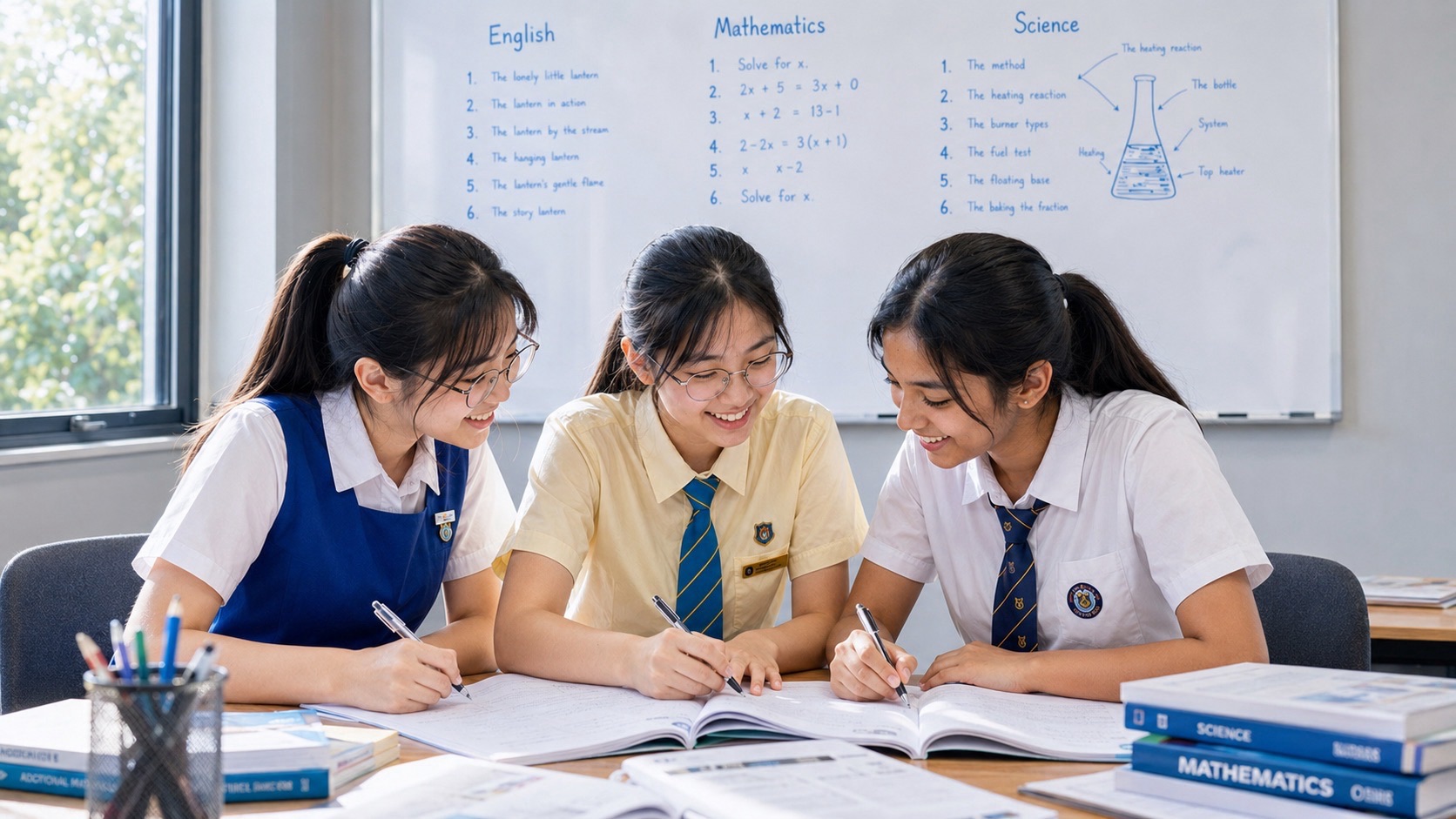
Singapore SEC G3 Mathematics K310 is the current 2027 examination owner for the route previously known as Singapore-Cambridge O-Level Mathematics 4052. BTT keeps 4052 visible only as a legacy/search bridge; students sitting the 2027 SEC examination should use K310.
2027 examination structure
| Paper | Duration | Structure | Weight |
|---|---|---|---|
| Paper 1 | 2 h 15 min | About 26 short-answer questions; all questions attempted | 50% |
| Paper 2 | 2 h 15 min | 9–10 questions of varying length; final question focuses on a real-world scenario; all questions attempted | 50% |
An approved calculator may be used in both papers. Relevant formulae are provided, but the syllabus explicitly states that omission of essential working can result in lost marks.
What K310 assesses
The syllabus organises content through Number and Algebra, Geometry and Measurement, and Statistics and Probability, while also assessing reasoning, communication and application. The last question of Paper 2 explicitly integrates Mathematics in a real-world context.
Method marks and working
Do not confuse “calculator allowed” with “answer-only”. Show the mathematical route: equation formation, substitution, transformations, key intermediate values and reasoning. The aim is to leave enough evidence for a marker to see a valid method even if an arithmetic error occurs later.
A recovery system
- If a question is not moving, write the useful relationship you do know.
- Check units, diagram labels and what the question actually asks.
- Leave enough space and move on when time cost becomes excessive.
- Return with a fresh representation or alternative method.
- Use the last minutes for high-value checking: signs, units, rounding and incomplete parts.
For curriculum understanding, use How SEC G3 Mathematics Works. This page owns the examination-performance layer.
Official source checked 26 September 2026: SEAB 2027 K310 G3 Mathematics syllabus.
Singapore SEC G3 Mathematics K310: build the examination system, not a formula list
The 2027 SEC transition changes the label, not the need for mathematical control
Students need the current subject code, paper structure and syllabus language, but examination preparation still depends on secure concepts, fluent procedures, representation, reasoning and complete working. This page should therefore separate current examination facts from durable mathematical preparation.
Paper preparation begins with topic architecture
Organise the syllabus into connected domains rather than revising chapter by chapter forever: number and algebra, functions and graphs, geometry and measurement, statistics and probability, and problem solving across domains. Identify prerequisite chains so a weakness in algebraic manipulation is repaired before it contaminates equations, graphs and later topics.
Method marks reward visible mathematical reasoning
A correct final answer is valuable, but working can matter when a question awards method credit or when an arithmetic slip occurs after a valid setup. Students should write equations, substitutions and transformations clearly enough that the mathematical route can be followed. ‘Show working’ is not a request for decorative extra lines; it makes reasoning inspectable.
Paper 1 and Paper 2 preparation should not become two separate subjects
Where papers differ in tools or emphasis, train those conditions explicitly, but keep one underlying Mathematics system. Calculator fluency should support reasoning rather than replace estimation, algebra or checking. Non-calculator work strengthens number sense and symbolic control that also improves calculator-paper performance.
Algebra is the highest-leverage repair domain
Weak expansion, factorisation, fractions, indices and equation manipulation spread into many later questions. A diagnostic should distinguish conceptual misunderstanding from procedural instability. Repair one operation, then test it inside an unfamiliar problem so the learner cannot rely on chapter cues.
Graphs require translation among representations
Students should move among equation, table, graph and verbal description. Gradient, intercepts, intersections and shape carry meaning. A graphing or calculator tool can generate a display, but the student still needs to interpret scale, relevant domain and what an intersection means in the problem.
Geometry needs reasons, not visual guesses
Diagrams are not necessarily drawn to scale. Angle, similarity, congruence, trigonometric and measurement arguments should cite the relationship used. Students who rely on appearance are vulnerable when a diagram is deliberately distorted or embedded in a multi-step problem.
Statistics and probability need interpretation
Calculation is only part of the task. A student should know what a summary measure says, how a graph represents a distribution and whether a probability answer is reasonable. Context determines whether a result should be exact, estimated or interpreted cautiously.
Build a mixed-paper error taxonomy
After each timed set, classify losses: knowledge gap, retrieval failure, wrong representation, algebra slip, calculator entry, misread condition, incomplete working, time management or checking failure. The repair should target the category. Repeating another full paper is inefficient when the same algebra error appears in five questions.
Timed practice should come after enough untimed repair
A student who cannot solve a question untimed will not fix the concept by adding a clock. First stabilise the method, then reduce support, then mix topics, then apply examination timing. This progression turns speed into fluency rather than panic.
Checking is a mathematical skill
Estimate magnitude, substitute solutions back into equations, inspect units, test boundary cases and compare graph behaviour with the answer. Calculator re-entry alone is weak checking because the same setup error can be repeated perfectly.
Final preparation should narrow, not expand
In the final weeks, prioritise recurring high-value weaknesses, mixed retrieval and realistic papers. Avoid adding large new resource systems without a diagnosed need. Reliability under the actual paper conditions matters more than the number of books completed.
World Mathematics route: return to the World Mathematics Atlas for the wider map across examinations, curricula, competitions, mathematical objects and university routes.