
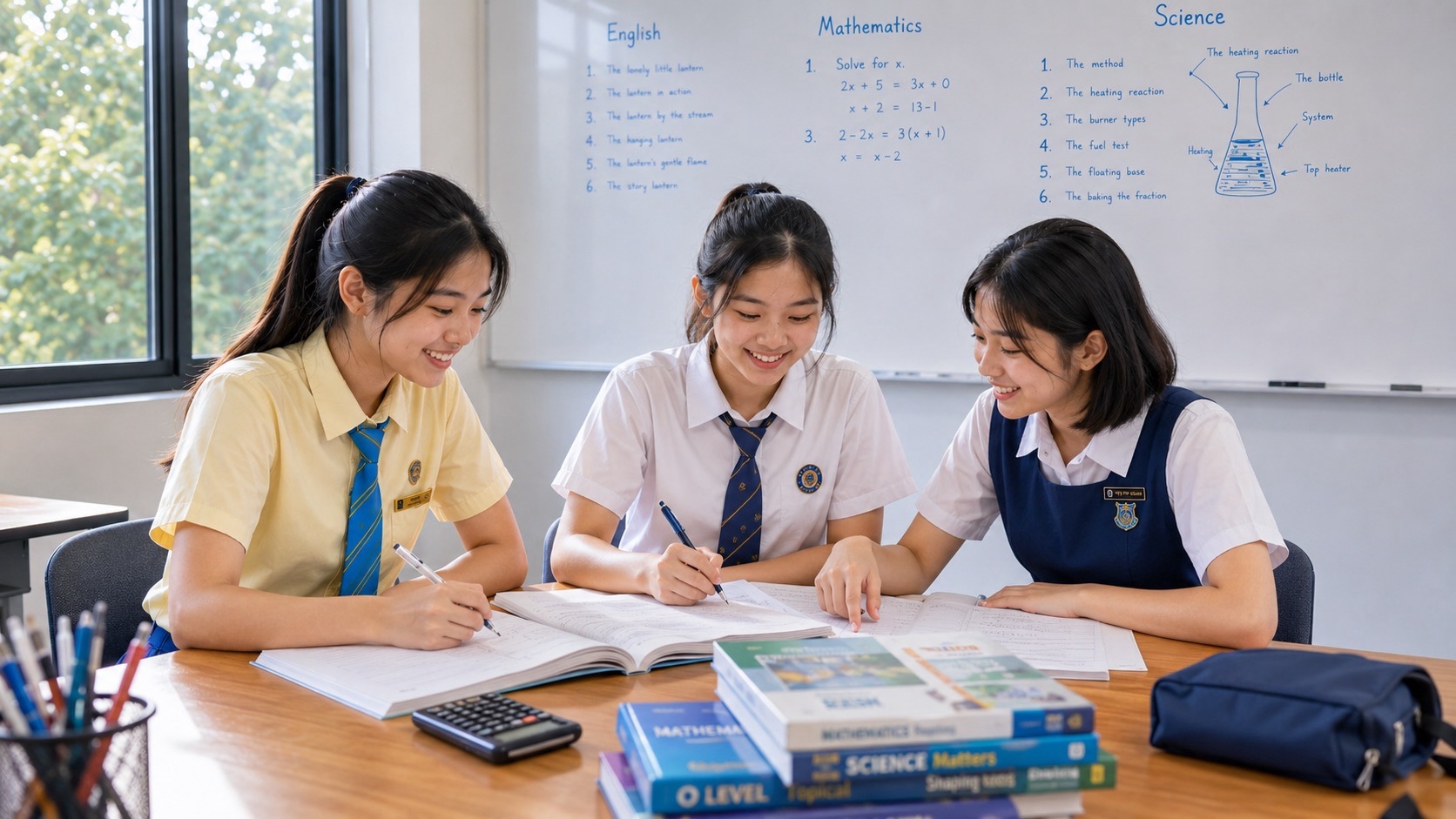
Secondary Mathematics Tuition · Unseen problems, first attempts, hint control and independent transfer
Adrian opens a Mathematics question he has never seen before.
The topic is not named.
No worked example sits beside it.
The wording is unfamiliar enough that he cannot match it to yesterday’s worksheet.
For several seconds, nothing obvious happens.
That moment matters.
Many students interpret the absence of an immediate method as evidence that they do not know the Mathematics.
Often the real problem is different.
They have learned methods inside environments that supplied the route family in advance.
The chapter heading said “Simultaneous Equations”.
The worksheet said “Percentages”.
The teacher drew the useful diagram.
The worked example showed the first line.
The tutor asked the question that identified the hidden relationship.
Now those supports are gone.
The Mathematics may still be present, but the learner must perform the work that the environment used to perform.
Jo sees the same kind of unseen question and responds differently.
She does not know the complete route either.
She begins by identifying the target, separating known quantities from conditions, choosing a representation and making one move that creates information.
The first move may not finish the problem.
Its job is to reduce uncertainty.
Clara sometimes starts down a route that later becomes expensive.
Her independence appears not in never making a false start, but in noticing that the route is failing, returning to a trustworthy state and trying another representation or method.
This worldwide guide is about that capability: solving unseen Secondary Mathematics problems independently when the method is not announced in advance.
It does not replace the generic BTT owner How Independent Mathematics Works, which answers the broader question of when a learner can carry more of the route. It does not replace How to Use Worked Examples in Maths, which owns example fading; How to Solve Math Problems, which owns the full problem-solving system; or the Singapore-specific SEC Mathematics Support Fading owner.
This page owns the adjacent practical question:
When a secondary learner meets a fresh problem with no route cue, how do they make a useful first attempt, use help without surrendering the decisions, recover from a false start, and prove that the method transfers?
Adrian, Jo and Clara are fictional recurring learners. Their scenes are explanatory examples, not reported student cases or permanent labels.
The central sequence is:
ORIENT → EXTRACT → REPRESENT → GENERATE CANDIDATES → CHOOSE A LOW-COST FIRST MOVE → OBSERVE WHAT THE MOVE REVEALS → CONTINUE, SWITCH OR ASK FOR THE SMALLEST USEFUL HINT → VERIFY → EXPLAIN WHAT TRANSFERRED.
That sequence is not a ritual for every problem. Easy questions may collapse to two or three steps. Hard questions may loop between representation, candidate methods and recovery. The purpose is to give the learner a way to create movement without waiting for rescue.
1. An unseen Maths problem is not necessarily a new piece of Mathematics
“I have never seen this question before” can mean several things.
The exact numbers are new.
The wording is new.
The context is new.
The representation is new.
The required unknown has moved.
Two familiar ideas have been combined.
The method is familiar but the cue is missing.
Or the problem really does require a relationship the learner has not yet been taught.
These states should not be treated as identical.
Suppose Adrian has learned percentage increase and decrease.
He can solve:
“A jacket costs 120 and is discounted by 15%. Find the sale price.”
Then he meets:
“After a 15% discount, a jacket costs 102. What was the original price?”
The second question may feel unseen.
The underlying relationship is not new.
The direction changed.
Sale price = 85% of original.
So 102 = 0.85 × original.
The learner who has memorised “multiply by 0.85 for a discount” may freeze because the visible procedure no longer fits.
The learner who owns the relationship can reconstruct.
This is the first independence principle:
Separate unfamiliar surface from unfamiliar structure.
When a problem looks new, ask:
What has actually changed?
The numbers?
The direction?
The representation?
The context?
The combination of topics?
The condition?
The absence of a method label?
If the mathematical structure is familiar, the problem is a transfer problem rather than a content-introduction problem.
That distinction changes the next action.
For a genuinely untaught relationship, the learner may need explanation.
For a changed surface, the learner needs to recover the invariant.
For a missing cue, the learner needs method recognition.
For a combined-topic problem, the learner needs to coordinate more than one familiar structure.
Calling every unfamiliar question “hard” hides these differences.
A strong first question is:
What familiar mathematical object might be hiding underneath the unfamiliar presentation?
That question does not guarantee an answer.
It turns novelty into something inspectable.
2. The first sixty seconds should create information, not prove intelligence
Students often believe that strong problem solvers know the method immediately.
That belief makes the first pause dangerous.
If no method appears within ten seconds, the learner concludes they are stuck.
Then they look for a hint.
Independent problem solving needs a different first-minute job.
The goal is not to produce the full route immediately.
The goal is to improve the state of the problem.
Use a first-minute scan.
Target: what quantity, object or proof is required?
Given: what information is explicit?
Conditions: what restrictions, relationships or assumptions control the problem?
Representation: what form would make the structure easier to inspect?
Candidates: what two or three method families might plausibly connect the given information to the target?
First move: what legal step would create new information even if it does not finish the problem?
Consider:
“A rectangle has area 96 cm². Its length is 4 cm more than its width. Find its dimensions.”
An inexperienced learner may search memory for “rectangle question method”.
A stronger first minute produces:
target: length and width;
given relationship: length = width + 4;
area relationship: length × width = 96;
representation: let width = x, then length = x + 4;
first move: x(x + 4) = 96.
The route now exists because the problem was converted into algebra.
Suppose the learner does not know how to finish the quadratic.
They are not at the original blank state anymore.
They have located the missing capability more precisely.
This is why a useful first move matters.
It turns “I don’t know” into a smaller statement such as:
“I can model the problem, but I cannot solve the resulting quadratic.”
That smaller statement supports better learning and better help.
The first minute should therefore be judged by information gain.
Did the learner identify the target?
Did they expose a relationship?
Did they rule out an invalid route?
Did they create a useful diagram?
Did they find the exact point where knowledge becomes missing?
Any of these can be progress.
The blank page becomes less threatening when the learner knows that the first move is allowed to be exploratory.
3. Extract the target, quantities and conditions before searching for a formula
Formula hunting is a common response to uncertainty.
The learner sees a triangle and searches for a trigonometric formula.
They see percentages and search for a multiplier.
They see two equations and assume simultaneous equations.
Sometimes this works.
Sometimes it creates fast misclassification.
A safer order is:
target → quantities → conditions → relationship → method.
Jo reads:
“A ladder of length 8 m rests against a vertical wall. Its foot is 3 m from the wall. Find the height reached.”
The target is a length.
Known quantities are two sides of a right triangle.
The wall-ground relationship gives a right angle.
The simplest candidate is Pythagoras.
Now change the problem:
“A ladder of length 8 m rests against a vertical wall at an angle of 68° to the ground. Find the height reached.”
The visual context is nearly identical.
The information pattern changed.
Now one side and an angle are known.
A trigonometric ratio becomes more natural.
Keyword-driven learners see “ladder” twice and expect one method.
Condition-driven learners inspect what is mathematically available.
This distinction generalises.
Two quantities can look like a ratio problem, but the relationship may actually be additive.
A straight-line graph can look like direct proportion, but a nonzero intercept changes the structure.
A quadratic expression can invite factorisation, but the target may make completing the square more revealing.
A probability question can mention “at least one”, making complement reasoning attractive, but only after the event is defined correctly.
Conditions are often where unseen questions hide their real demand.
Train a pre-method sentence:
“This method is plausible because…”
Examples:
“Pythagoras is plausible because the triangle is right-angled and two side lengths are known.”
“Weighted mean is necessary because group sizes differ.”
“A linear model is plausible because there is a fixed amount plus a constant rate.”
“Similarity is plausible because corresponding angles establish the same shape.”
“Substitution is cheap because one variable is already isolated.”
The sentence can disappear later.
Its job is to connect selection to evidence while independence is forming.
4. When you cannot see the route, change the form of the problem
Many unseen problems become easier after representation changes.
Words become equations.
Equations become graphs.
Data becomes a table.
A geometric description becomes a labelled diagram.
A probability story becomes a tree.
A long expression becomes a factorised or expanded form.
This is not cosmetic rewriting.
Representation can expose relationships that the original form hides.
Clara reads:
“A plan charges 18 per month plus 0.12 for each message beyond the included allowance.”
She keeps rereading the sentence.
Once she writes:
C = 18 + 0.12m,
where m is the number of chargeable messages, the structure becomes visible.
Now questions about total cost, message count or comparison with another plan become algebraic rather than verbal.
Adrian reads a geometry question involving two similar triangles.
The original diagram contains many labels.
He redraws only the two relevant triangles and marks correspondence.
The problem becomes smaller.
Jo sees a function question where algebraic substitution becomes messy.
She asks whether a table of values or graph feature would reveal the pattern first.
Representation is especially useful because it creates an independent action when the learner does not know the final method.
“Draw what you know” is often better than “guess a formula”.
“Define the unknown” is often better than waiting for a complete equation.
“Tabulate the values” can reveal a rate or pattern.
“Factor the expression” can expose roots or common structure.
“Expand it” can expose equivalence.
Use a representation test:
Does the new form make the target clearer?
Does it make a relationship visible?
Does it reduce the number of things being held mentally?
Does it suggest a candidate method?
Does it create a way to check later?
If yes, the representation is earning its cost.
Independent learners do not need to know the whole route before they change form.
Changing form is one way of discovering the route.
5. Generate a small candidate set instead of waiting for one perfect method to appear
When the route is not obvious, some learners search mentally until one method feels certain.
That can create long pauses.
A better strategy is to generate a small candidate set.
Not ten methods.
Two or three plausible families.
Then use the problem’s cues to discriminate.
Suppose Jo meets a quadratic equation.
Candidate methods might include:
factorisation;
quadratic formula;
completing the square;
or a graphical route if approximation is acceptable and the representation is available.
Now inspect the actual coefficients and target.
If x² − 9x + 20 = 0 appears, factorisation is cheap because integer factors 4 and 5 are obvious.
If x² − 9x + 17 = 0 appears, factorisation is less attractive.
If the question asks for vertex form or a minimum, completing the square may expose the desired structure directly.
The candidate set creates movement without pretending certainty.
In geometry, candidates might be:
Pythagoras;
trigonometric ratio;
similarity;
angle relationships.
The diagram and given information eliminate most options.
In probability, candidates might be:
direct enumeration;
tree;
table;
complement.
The event structure determines which is cheapest.
In data problems, candidates might include mean, median, proportional comparison or weighted mean.
Group sizes and the question target discriminate.
This approach can be summarised as:
candidate → discriminating cue → selection.
It is especially useful in unseen problems because it replaces blank waiting with an active narrowing process.
A candidate can be wrong.
That is acceptable if the learner knows how to test it cheaply.
For example:
“Could this be direct proportion?”
Check whether the relationship passes through the origin or has the form y = kx.
“Could these triangles be similar?”
Check whether sufficient angle or side relationships are established.
“Could elimination be cheaper?”
Inspect coefficients.
“Could complement simplify the event?”
Compare the number of cases required directly versus through the complement.
Independent problem solving is not the absence of uncertainty.
It is the ability to reduce uncertainty deliberately.
6. Choose a first move that creates information, not merely activity
When students do not know the whole route, they often make one of two mistakes.
They wait.
Or they calculate something simply because a calculation is available.
Neither guarantees progress.
A useful first move should have a job.
It should expose structure, reduce uncertainty, test a candidate method, create a simpler subproblem or produce a quantity that later relationships need.
Consider:
“The perimeter of a rectangle is 34 cm. Its length is 5 cm more than its width. Find its dimensions.”
A random move might be dividing 34 by 4 because rectangles have four sides.
That produces a number but not the right relationship.
A useful first move is to represent the dimensions.
Let width = w.
Then length = w + 5.
Perimeter gives:
2w + 2(w + 5) = 34.
The first move earns its place because it converts the verbal constraints into a solvable relationship.
Now consider:
“The product of two consecutive positive integers is 132. Find the integers.”
A useful first move is not trial-and-error multiplication of random numbers.
Let the smaller integer be n.
Then the next is n + 1.
So n(n + 1) = 132.
Again, representation creates the route.
For geometry, a first move might be marking the target and known relationships.
For graphs, it might be identifying scale and intercepts.
For probability, defining the event can be the most useful first move.
For algebra, rewriting an expression into a more revealing form can be useful.
For a multi-part problem, completing an earlier part may create a quantity needed later.
A useful first move should answer at least one question:
What relationship is active?
Which method becomes more plausible?
Which candidate can now be rejected?
What new quantity is now known?
What smaller target has been created?
What check becomes possible?
Adrian practises first moves without always finishing the question.
He is shown ten fresh problems and given ninety seconds each to write only:
target;
representation;
candidate method;
first mathematical move.
This is useful because method selection can be trained separately from full execution.
Jo sometimes chooses a first move that fails to create information.
She learns to ask afterward:
“What did that step reveal?”
If the answer is “nothing important”, the step may have been activity rather than progress.
Clara learns that first moves can be provisional.
A provisional move is not a commitment to an entire route.
It is a low-cost probe.
This matters because learners can become trapped by sunk-cost thinking:
“I started this method, so I must continue.”
No.
If the move makes the problem more complex without revealing useful structure, reassess.
The unseen-problem learner should become comfortable with:
make a justified move → inspect what changed → continue only if the new state is better.
7. Productive struggle has an endpoint; unproductive looping does not
Independent problem solving is not the same as being left alone indefinitely.
A learner should struggle long enough to create evidence.
They should not struggle so long that the same failed state repeats without learning.
This distinction matters because “try harder” is not a mathematical strategy.
Use three states.
Productive struggle: the learner is generating representations, testing candidates, making progress, discovering constraints or narrowing the unknown.
Stalled struggle: the learner is repeating the same unsuccessful move, rereading without extracting anything new, or cycling through guesses.
Unsupported novelty: the problem requires a concept or relationship the learner genuinely has not yet learned.
The correct response differs.
Productive struggle can continue.
Stalled struggle may need a small hint.
Unsupported novelty may require teaching.
Adrian is solving a geometry problem.
For five minutes he redraws the same diagram and keeps trying the same angle relationship.
No new information appears.
That is looping.
A useful hint might be:
“What other pair of triangles in the diagram might be related?”
The hint does not name similarity directly.
It redirects attention.
Jo is solving an algebra problem.
She has tried factorisation, found no convenient integer factors and then checks the discriminant.
Her work is productive because she is testing route viability.
Clara has never learned completing the square but is expected to derive a vertex form independently from scratch.
That may be unsupported novelty.
More struggle does not automatically create the missing concept.
Use a progress test every few minutes on a difficult problem:
Do I know more than I knew before?
Have I created a new representation?
Have I ruled out a method?
Have I reduced the unknown?
Have I identified a precise missing idea?
If none is true, the struggle may have stopped being productive.
This test protects two extremes.
It prevents premature rescue.
It also prevents romanticising confusion.
The goal is not maximum struggle.
The goal is maximum learner-owned progress.
8. Use the smallest hint that restarts thinking without taking over the route
Hints are not binary.
A hint can preserve nearly all the mathematical decision-making.
Or it can reveal the entire method.
Independent learning improves when hints have levels.
Level 1 — orientation hint.
“What exactly is the question asking you to find?”
Level 2 — information hint.
“Which given condition have you not used yet?”
Level 3 — representation hint.
“Would a diagram, table or variable definition make this easier to inspect?”
Level 4 — relationship hint.
“What connects these two quantities?”
Level 5 — method-family hint.
“Could a simultaneous-equation model help?”
Level 6 — procedural hint.
“Try eliminating y by adding the equations.”
Level 7 — worked step.
The next mathematical transformation is supplied.
Level 8 — full route.
The solution is demonstrated.
The independence rule is:
climb the hint ladder only as far as necessary to restore productive work.
If Level 2 unlocks the whole problem, do not jump to Level 6.
The size of the hint is also diagnostic evidence.
If one orientation question unlocks the route, the learner may have the mathematics but weak task orientation.
If a method-family cue unlocks the route, recognition is the missing layer.
If even a procedural hint does not restore movement, the weakness may be conceptual or prerequisite-based.
Jo keeps a hint record for difficult questions.
Not to score herself.
To see whether the support requirement is decreasing.
Week 1: method-family hint.
Week 2: representation hint.
Week 3: no hint on a changed surface.
That is meaningful independence growth.
Adrian learns to ask for a better kind of help.
Instead of:
“How do I do this?”
he asks:
“I represented the cost as a linear model, but I do not know whether I should compare the two plans algebraically or graphically.”
The second question preserves ownership.
It tells the tutor where uncertainty begins.
Clara sometimes asks for a hint too early because the discomfort of not knowing feels like failure.
She begins using a pre-hint checklist:
Have I written the target?
Have I used every condition?
Have I changed representation?
Have I generated at least two candidates?
Have I made one legal move?
Only then does she decide whether help is justified.
This does not mean every learner must exhaust a rigid checklist before asking for help.
It creates a small buffer between discomfort and rescue.
9. Look at worked solutions after the attempt has produced a precise question
Worked examples are most useful when they answer a question the learner is ready to notice.
If the solution is opened before any attempt, it can remove the most valuable decision.
Which representation?
Which method?
Which first move?
The learner may then confuse recognition with independent generation.
A stronger sequence is:
attempt → locate the stall → inspect only the needed part → close the solution → reconstruct → solve a changed problem.
Suppose Adrian cannot solve:
2x + y = 11
x − y = 1.
He identifies the system but hesitates over method choice.
If he immediately reads the full solution, he may copy elimination.
Instead, he asks:
“What feature of the coefficients would make one route cheap?”
The worked example reveals that adding the equations removes y immediately.
Now close it.
Adrian solves:
3x + y = 14
x − y = 2.
The surface changed, but the same coefficient relationship remains.
Next, use:
x = 2y + 3
4x + y = 18.
Now substitution becomes more attractive.
The learner should not merely reproduce elimination.
They should extract the decision rule.
This is where the 330 worked-example owner and this unseen-problem owner connect.
Worked examples teach hidden decisions.
Unseen problems test whether those decisions can be regenerated when the example is absent.
A solution can be consulted in slices.
Reveal only the diagram.
Reveal only the first representation.
Reveal only the first mathematical line.
Reveal only the method name.
Reveal only the verification step.
Then close it.
This prevents the answer from becoming transportation through the entire problem.
The crucial question after consulting a solution is:
What decision can I now make next time without the solution?
If the answer is unclear, the example has not yet transferred.
10. Extract the invariant: what stays the same when the problem changes?
Transfer becomes easier when the learner can state what is structurally stable across examples.
The numbers change.
The context changes.
The order changes.
The diagram rotates.
The variable changes.
The wording changes.
But some relationship remains.
That stable relationship is the invariant the learner needs to carry.
For reverse percentage:
final = multiplier × original.
For a fixed-fee linear model:
total = fixed amount + rate × usage.
For weighted mean:
combined mean depends on combined total and combined count.
For a right-triangle Pythagoras problem:
the square relationship applies only when the triangle is right-angled and the hypotenuse is identified correctly.
For no-replacement probability:
the state changes after a draw.
For similar figures:
corresponding lengths share a common scale factor.
For simultaneous equations:
the solution must satisfy both independent relationships at once.
Jo keeps an “invariant line” after difficult problems.
Not a summary of the whole solution.
One sentence describing what must remain true across changed versions.
Adrian uses a second line:
“What can change without changing the method?”
Numbers can change.
Context can change.
Variable names can change.
Diagram orientation can change.
This prepares the learner for new surfaces.
Clara adds a third line:
“What change would force a different method?”
For example:
remove the right angle;
make group sizes equal;
change direct proportion to fixed-fee linear;
change replacement state;
change exact answer requirement to approximation or vice versa.
This third line creates boundaries.
A method is learned more deeply when the learner knows both its invariant and its failure condition.
This matters in unseen problems because independence is not just recognising similarities.
It is discriminating between near neighbours.
Transfer improves when the learner can say what stays the same, what may change, and what would invalidate the route.
11. Compare near-neighbour problems so method selection becomes discriminating rather than reflexive
Unseen problems often become difficult because two question types look similar but require different decisions.
That makes close contrasts powerful.
Consider these pairs.
Pair A — percentage versus reverse percentage.
“A price of 200 increases by 15%.”
“A final price of 230 is after a 15% increase. Find the original.”
The same percentage relationship is present.
The direction changes.
Pair B — direct proportion versus fixed-fee linear relation.
“Cost is 3 per item.”
“Cost is 8 plus 3 per item.”
The second does not pass through the origin.
Pair C — Pythagoras versus trigonometry.
Both may involve right triangles.
The information pattern decides which relationship is useful.
Pair D — ordinary mean versus weighted mean.
Equal group sizes may permit a simple average of group means.
Unequal group sizes do not.
Pair E — replacement versus no replacement.
The state remains stable in one and changes in the other.
Pair F — factorisation versus another quadratic route.
Some coefficients make factorisation cheap.
Others do not.
Adrian studies pairs before full mixed sets.
For each pair he writes:
what looks similar;
what condition differs;
what decision the condition changes.
This is a better preparation for unseen questions than memorising more surface templates.
Jo uses one more question:
“What is the fastest discriminating cue?”
For direct proportion, check whether the relationship has a zero intercept and constant ratio.
For weighted mean, check group sizes.
For no replacement, check whether the total state changes after an event.
For Pythagoras, check right-angle condition and known-side pattern.
Clara sometimes has the right method in memory but chooses the wrong neighbour.
Her practice target is not more execution.
It is faster discrimination.
This is important because students can look weak on unseen problems even when their individual methods are strong.
The missing skill may be deciding which familiar method owns the current state.
Near-neighbour training makes the boundary visible.
12. Unseen algebra problems often hide the decision in the form, not the topic name
Algebra is especially revealing because many methods operate on the same symbolic material.
Expand.
Factorise.
Substitute.
Eliminate.
Rearrange.
Complete the square.
Compare coefficients.
Graph.
The difficulty is often not executing these actions.
It is deciding which form makes the target easier.
Jo sees:
x² − 6x + 5.
If the target is roots, factorisation is attractive:
(x − 1)(x − 5).
If the target is minimum value or turning point, completing the square exposes more useful information:
(x − 3)² − 4.
The same expression supports different routes because the target changes.
Adrian sees two equations:
3x + 2y = 12
x − 2y = 4.
Elimination is cheap because y coefficients are opposites.
Now he sees:
x = 3y − 2
4x + y = 11.
Substitution becomes more natural because x is already isolated.
Clara sees a rational expression and wants to cancel matching symbols.
She pauses to ask whether the matching pieces are factors.
That condition protects the route.
For unseen algebra, use four questions:
What form am I in?
What form would expose the target?
Which transformation preserves equivalence or the required relationship?
What condition or restriction must survive the transformation?
A strong algebra learner does not merely know procedures.
They can move between forms strategically.
This is one reason the What Works Clearinghouse algebra guide’s moderate-evidence recommendation about intentionally choosing among alternative algebraic strategies matters here. The recommendation is not “always use multiple methods”. Its value is in helping learners recognise that equivalent algebraic routes can differ in efficiency and usefulness.
For unseen problems, this becomes a selection skill.
Ask not only:
“Can I do this method?”
Ask:
“Does this method expose what the problem wants?”
13. Unseen geometry problems become manageable when the learner builds an evidence map
Geometry can feel uniquely unfamiliar because the same theorem may appear in many visual arrangements.
Rotated diagrams make familiar shapes look different.
Extra lines create distraction.
Labels appear in unfamiliar positions.
A diagram may not be drawn to scale.
The learner needs an evidence map.
Mark what is actually known.
Right angles.
Parallel lines.
Equal lengths.
Given angles.
Known side lengths.
Circle conditions.
Coordinate information.
Then ask which relationships become authorised.
Adrian sees two triangles that look similar.
He does not use similarity because of appearance.
He looks for sufficient angle or side evidence.
Jo sees a right triangle inside a larger diagram.
She redraws only the triangle relevant to the target.
The clutter disappears.
Clara sees a triangle with two known sides and one unknown side.
She nearly uses Pythagoras automatically.
Then notices no right angle has been established.
The evidence map blocks an invalid route.
A useful geometry first-attempt protocol is:
1. circle or mark the target;
2. mark only given or provable conditions;
3. isolate the smallest relevant shape;
4. generate candidate relationships;
5. check whether each candidate’s conditions are present;
6. calculate only after method authority is established.
This can make the first minute slower.
It often makes the whole problem faster by preventing theorem guessing.
For similarity, write correspondence explicitly when orientation is confusing.
For trigonometry, identify the reference angle and side roles relationally.
For scale problems, decide whether the quantity is one-dimensional, two-dimensional or three-dimensional.
For coordinate geometry, consider whether the visual picture can be translated into algebraic relationships.
Unseen geometry becomes less mysterious when the learner knows that every legal theorem needs evidence.
The diagram may be new.
The evidence logic is not.
14. Unseen graph and function problems reward switching between visual and symbolic evidence
Graphs and functions are powerful because the same relationship can be viewed in several forms.
Equation.
Table.
Graph.
Verbal description.
An unseen problem often tests whether the learner can switch rather than stay trapped in the presented form.
Jo receives a graph and is asked where two conditions are simultaneously true.
She recognises an intersection question.
Adrian receives two equations and is asked for an approximate common solution.
He realises a graph can provide an independent representation.
Clara receives a table and notices constant first differences.
She considers a linear relationship.
A graph/function first-attempt can ask:
What does each axis mean?
What is the scale?
What behaviour is visible?
Where are intercepts, intersections or turning points?
What symbolic form could produce this behaviour?
What quantity in context does the gradient represent?
Does the graph domain match the real situation?
Changing representation can also help verify.
An algebraic root can be checked against an x-intercept.
A linear-model intercept can be checked against the stated fixed amount.
A negative gradient should correspond to decreasing behaviour.
An impossible graph may reveal a sign or modelling error.
Do not force graphical methods where exact algebra is required.
Do not force algebra where the graph already answers an approximation task cheaply.
The unseen-problem skill is choosing the representation that best matches the target and required precision.
15. Unseen probability and data problems require state control before calculation
Probability and data questions often look arithmetic-heavy.
The arithmetic is frequently the easy part.
The real demand is organising the state correctly.
For probability, ask:
What is the event?
What outcomes are possible?
Does the state change after an action?
Are cases mutually exclusive?
Would direct counting, a table, a tree or a complement be cheaper?
Adrian sees:
“A bag contains 5 red and 4 blue counters. Two are drawn without replacement. Find the probability of two reds.”
The key unseen-problem move is not multiplication.
It is recognising that after the first red, the state changes from 5 red out of 9 to 4 red out of 8.
Jo sees:
“Find the probability of at least one success in three independent trials.”
She generates two candidates:
enumerate one, two and three successes;
or use complement.
Complement is cheaper if “no success” is simple.
For data, ask:
What quantity is being summarised?
Do group sizes matter?
What does the graph scale imply?
Is the question asking for calculation or interpretation?
What cannot be concluded from the given summary?
Clara sees two group means and nearly averages them.
She checks group sizes first.
If group sizes differ, she reconstructs totals.
This is the kind of independence unseen problems require: not faster arithmetic, but correct organisation before arithmetic.
A good state-control sentence is:
Before I calculate, what has to remain true about the sample, event or group?
That question often exposes the real route.
16. Unseen word problems become easier when the learner models relationships instead of chasing keywords
Word problems create two layers of work.
First, interpret the situation.
Then do the Mathematics.
Students often try to collapse both layers into one keyword rule.
“More” means add.
“Of” means multiply.
“Per” means divide.
Sometimes those cues help.
Sometimes they mislead.
A stronger route is to identify quantities and relationships.
Suppose:
“A theatre charges 12 for entry and 3 for each ride. Another charges 5 for entry and 4.50 per ride. For how many rides do the costs match?”
There is no single keyword that solves the problem.
Model each system.
Plan A: C = 12 + 3r.
Plan B: C = 5 + 4.5r.
Matching costs means:
12 + 3r = 5 + 4.5r.
Now the word problem has become an equation.
Adrian learns a modelling grammar:
quantity → variable → relationship → equation → domain → interpretation.
Jo adds a unit check.
Entry fees are currency.
Rates are currency per ride.
Multiplying rate by rides produces currency.
Clara adds a boundary check.
If the number of rides must be a whole number, the final interpretation should respect that.
For rates, ask:
what quantity changes?
per what unit?
is the rate constant?
is there a starting amount?
For ratio, ask:
what two quantities are compared multiplicatively?
what is the total if parts are combined?
does the ratio describe parts of the same whole or separate quantities?
For percentage, ask:
what is the 100% base?
is the problem moving from original to final or backward?
For motion, ask:
what relationship connects distance, rate and time?
are units compatible?
For mixture or average problems, ask:
what total quantity is conserved or aggregated?
Keyword matching can be fast on familiar worksheets.
Relationship modelling survives unseen wording.
17. Use calculators, formula sheets and digital tools without surrendering the mathematical decisions
Independence does not mean refusing tools.
It means retaining ownership of what the tool is being asked to do.
A calculator can evaluate an expression.
It cannot decide whether the expression represents the problem correctly.
A graphing tool can display behaviour.
It cannot decide whether the domain matches the real context unless the learner supplies the model correctly.
A formula sheet can provide a relationship.
It does not identify the conditions under which the relationship applies.
Adrian uses a calculator on:
(14 + 10)/(7 − 3).
Before entering anything, he writes the grouping explicitly.
The output 6 is then interpretable.
Jo uses a graphing tool to check two equations.
She already knows that an intersection represents a common solution.
The tool verifies or visualises; it does not choose the meaning.
Clara checks a trigonometric calculation.
She confirms angle mode before trusting the output.
Tool independence can be tested with four questions.
Before: can I state what I want the tool to compute or display?
During: can I enter the mathematical structure faithfully?
After: can I interpret the output in the original problem?
Challenge: can I recognise an impossible or implausible output?
If the learner cannot answer these questions, tool use may be replacing rather than supporting judgement.
The same principle applies to formula access.
Seeing a formula should not end the selection problem.
The learner still needs to map variables, check conditions and decide whether the relationship fits the target.
A tool should reduce low-value computational load while preserving high-value mathematical decisions.
That is tool-supported independence.
18. False starts are normal; independence appears in how the learner recovers
Some learners believe an independent solution must be clean from the first line.
That belief can make them afraid to start.
Real problem solving often contains provisional routes.
A route can be legal and still become expensive.
A representation can be useful initially and later become awkward.
A method can reveal information without completing the problem.
The important capability is recovery.
Use a recovery loop.
1. Detect. Something is inconsistent, too complex or unproductive.
2. Return. Identify the last state you still trust.
3. Classify. Was the problem representation, method selection, execution, condition, or arithmetic?
4. Change one thing. Switch representation, choose another candidate, repair the local error or ask for a small hint.
5. Re-enter. Continue from the repaired state.
Adrian tries to solve a geometry problem with algebra and produces a complicated system.
The route is not invalid, but it is expensive.
He returns to the diagram and notices a similarity relationship that makes the target direct.
Jo factorises a quadratic but obtains a pair that does not multiply back to the original constant.
She does not restart the entire problem.
She returns to the factor pair selection.
Clara builds a probability tree but realises the branches do not reflect the no-replacement state.
She repairs the second-stage denominators rather than discarding the whole structure.
Recovery also includes knowing when to abandon a route.
Use a route-cost test:
Is the algebra becoming longer without exposing the target?
Are numbers becoming unnecessarily awkward?
Am I introducing more unknowns than I remove?
Has the representation hidden the original conditions?
Did another candidate method become cheaper after the first step?
A false start can still be useful if it reveals why another route is better.
After solving, ask:
“What early signal could help me switch sooner next time?”
This converts recovery into future recognition.
Independent learners are not defined by never getting stuck.
They are defined partly by being able to change the state of being stuck.
19. Verification completes the unseen problem because the learner has no template to reassure them
When a question is familiar, students sometimes trust the route because it resembles a known example.
Unseen problems remove that comfort.
This makes verification more important.
The learner needs evidence that the constructed route and result actually satisfy the problem.
Verification should match the failure risk.
Equation solution: substitute into the original.
Factorisation: expand.
Reverse percentage: apply the percentage change forward.
Geometry: check theorem conditions, units and magnitude.
Probability: confirm event logic and bounds between 0 and 1.
Graph: check behaviour, scale and relevant coordinates.
Model: test whether the result fits domain and context.
Average: check whether the combined value lies in a plausible range and whether weighting was needed.
Adrian solves:
2x + y = 11
x − y = 1
and obtains x = 4, y = 3.
He substitutes into both originals.
8 + 3 = 11.
4 − 3 = 1.
Jo obtains a negative length from a geometry model.
The algebra may be internally valid, but the physical interpretation rejects that root.
Clara obtains probability 1.14.
No further sophistication is needed before recognising failure.
A useful final check asks four things:
Did I answer the requested quantity?
Did I preserve every condition?
Is the result mathematically valid?
Is the result sensible in context?
Verification should not become a second complete solution unless the stakes justify it.
Choose an independent signal whenever possible.
The 240 checking owner develops this deeply.
In unseen problems, the key point is that independence includes challenging your own route before accepting it.
20. Confidence should come from evidence of control, not from immediate familiarity
Unseen problems can feel harder before any Mathematics has been attempted.
The learner sees unfamiliar wording and experiences uncertainty.
That feeling can be mistaken for lack of knowledge.
Metacognitive independence means describing the state more precisely.
Instead of:
“I can’t do this.”
say:
“I do not yet know which representation is useful.”
Or:
“I know the method family but cannot see the first move.”
Or:
“I can model the problem but cannot finish the algebra.”
Or:
“I have two plausible methods and need a discriminating cue.”
These statements are not positive-thinking slogans.
They are better state descriptions.
Jo uses a three-column review after difficult questions:
What I knew.
Where uncertainty began.
What restored control.
Adrian tracks whether he needed:
no hint;
orientation hint;
representation hint;
method cue;
worked step.
The trend matters more than one problem.
Clara notices another important signal:
she can now tolerate sixty seconds of uncertainty without opening the solution.
That is not a score.
It is evidence that the blank page no longer triggers immediate rescue.
Good confidence grows from repeatable control.
I can start.
I can create information.
I can test a candidate.
I can ask for a precise hint.
I can recover after a mistake.
I can verify the result.
This kind of confidence is more durable than “I have seen this exact question before.”
21. Mixed practice matters because the learner must identify the method before using it
Topical worksheets are useful when a new method is being stabilised.
They also contain a hidden support.
The page title announces the family.
If every question is “Linear Equations”, the learner never has to decide whether a linear equation is the right representation.
That support should eventually disappear.
Mixed practice introduces selection.
Adrian receives five questions:
one reverse percentage;
one ratio;
one fixed-fee linear model;
one weighted mean;
one direct proportion.
He does not solve them immediately.
First he writes only:
target;
relationship family;
first move.
This separates method recognition from arithmetic execution.
Jo receives a mixed geometry set where Pythagoras, trigonometry and similarity appear together.
The point is not difficulty inflation.
The point is condition discrimination.
Clara receives algebra questions where expansion, factorisation and substitution are all plausible at first glance.
Her task is to justify the chosen form.
Mixed practice should be purposeful.
Do not throw unrelated topics together merely to create chaos.
Start with close neighbours that are genuinely easy to confuse.
Then widen the mix.
A useful progression is:
blocked execution → paired contrast → small purposeful mix → larger mixed set → changed representation → delayed mixed return.
The learner is independent when the method can be recognised without the worksheet doing the labelling.
This is one reason mixed practice often feels harder despite using familiar Mathematics.
The additional demand is selection.
That is not noise.
It is part of the target capability.
22. Delay the return so the learner must reconstruct rather than continue from recent memory
Immediate unseen performance can still be supported by the freshness of the lesson.
The worked example may no longer be visible, but its route may remain active in memory.
Delayed return tests a stronger form of independence.
Can the learner rebuild enough of the structure after other Mathematics and other subjects have intervened?
Jo learns a modelling relationship on Monday.
On Tuesday, she solves a changed problem.
On Friday, the same structure appears in a mixed set without a topic label.
Two weeks later, it appears again inside a different context.
If the route survives, independence is becoming durable.
Adrian performs a method correctly immediately after a hint.
The next test is not another near-identical problem five minutes later.
Return later without the hint.
Clara can identify similarity while the recent geometry lesson is fresh.
A delayed rotated diagram tests whether the relationship truly transfers.
Delay should not be treated as a fixed ritual.
The exact spacing can vary.
The important distinction is between:
“Can I continue while the lesson is active?”
and
“Can I reconstruct after the lesson is no longer carrying the route?”
The 320 memory owner handles retrieval and spacing in depth.
Here, delayed return is one independence test.
If the learner fails after delay, do not assume the original understanding was false.
Identify what disappeared:
the relationship?
the representation?
the method name?
the first move?
the checking routine?
Then repair that layer and return again.
23. Tutors should ask questions that return decisions rather than quietly making them
A tutor can solve a learner’s uncertainty very quickly.
That is both useful and dangerous.
Useful because explanation can prevent wasted struggle.
Dangerous because repeated route selection by the tutor can create invisible dependence.
Consider two responses to:
“I don’t know how to start.”
Response A:
“Use simultaneous equations. Let x be the adult ticket and y the child ticket.”
Response B:
“What two unknown quantities are changing in this situation, and what independent relationships does the problem give you?”
Response A is faster.
Response B preserves more of the learner’s decision work.
The tutor should choose the smallest intervention justified by the state.
Useful prompts include:
What is the target?
Which condition has not been used?
What representation would make this visible?
What are two plausible method families?
Which one has a stronger cue?
What is one legal move?
What changed after that move?
Where is the last line you trust?
How could you challenge the final answer?
These prompts can also fade.
At first, the tutor asks them.
Later, the student carries them internally.
Track intervention size.
If a student repeatedly needs only:
“What is the target?”
then task orientation may be the remaining weak layer.
If they need:
“Use elimination,”
method recognition remains dependent.
If they need a complete worked step, execution or prerequisite knowledge may still be unstable.
Small-group teaching becomes powerful when this visibility is used to return control rather than provide more constant prompting.
The tutor’s success is not only how many problems become correct during the lesson.
It is how many decisions the learner can make next time without the tutor.
24. Parents should look for the quality of the first attempt, not only whether homework gets finished
Parents often see the end product.
Worksheet complete.
Answer correct.
Time taken.
These are useful signals.
They do not reveal how much of the route belonged to the learner.
Ask occasional process questions instead.
Could the student start without someone naming the topic?
Could they explain why the method fit?
Did they use a worked example immediately or after a genuine attempt?
What kind of hint was needed?
Could they recover after a wrong first move?
Could they solve a changed version later?
Did they check the result independently?
Do not turn home study into an interrogation.
The purpose is to notice support dependence.
Adrian finishes a worksheet quickly because every example remains open.
That may be useful practice, but it is not yet strong evidence of unseen independence.
Jo takes longer because she closes the example and reconstructs the route.
The slower page may contain stronger learning.
Clara asks a parent:
“Can you tell me whether this diagram suggests the right relationship?”
The parent can redirect:
“What condition in the question would prove that relationship?”
This keeps the decision mathematical.
Parents do not need to become substitute tutors.
A useful role is to protect the attempt window.
Give enough time for the learner to orient, represent and try.
Then help them identify what kind of support is needed rather than immediately supplying a solution.
Progress often appears before marks jump.
The learner starts sooner.
Questions become more precise.
Fewer hints are needed.
Changed problems cause less panic.
Recovery becomes more local.
Those are meaningful signs that independence is growing.
25. AI should reduce help as the learner’s control grows
AI can be a powerful mathematics support tool.
It can also remove exactly the decisions an unseen-problem learner needs to practise.
If every fresh question is pasted into AI for a full solution, the learner never has to perform:
target extraction;
representation;
candidate generation;
method selection;
first move;
recovery;
verification.
A better use pattern is graduated.
Stage 1 — clarify the task.
Ask AI to restate a confusing question without solving it.
Stage 2 — request a discriminating question.
Ask for one question that helps distinguish between the learner’s two candidate methods.
Stage 3 — request a representation hint.
Ask whether a diagram, table or equation might expose the structure, without revealing the full route.
Stage 4 — request one next-step hint.
Only after an attempt has located the stall.
Stage 5 — compare solutions after completion.
Use AI to inspect whether another valid route exists or whether a check has been missed.
Stage 6 — solve without AI when independence is being tested.
Adrian pastes a fresh problem and asks:
“Do not solve it. Ask me one question that will help me decide what the target relationship is.”
Jo says:
“I think this is either similarity or trigonometry. Give me one discriminating cue, not the answer.”
Clara completes the problem first, then asks:
“Check my method and show one independent verification route.”
These uses preserve more ownership.
AI output should still be checked.
Tools can be wrong, overconfident or mismatched to the curriculum.
The learner remains responsible for whether the mathematics is valid.
The long-term direction is:
AI WITH → AI LESS → AI CHECK → AI WITHOUT when independence is the thing being measured.
The strongest tool use is not permanent dependence on a powerful answer source.
It is using the tool in a way that gradually transfers the decisions back to the learner.
26. Build unseen-problem independence through a weekly release architecture
Independence is easier to build when support reduction is planned rather than left to chance.
A useful week contains several conditions.
Condition 1 — supported reconstruction.
Study a new or recently repaired method. Explain the relationship and reconstruct it with limited support.
Condition 2 — same structure, changed surface.
Change numbers, wording, orientation or unknown position.
Condition 3 — no topic label.
Place the method beside close alternatives.
Condition 4 — delayed return.
Bring the relationship back after time has passed.
Condition 5 — first-attempt training.
Give fresh problems where the student writes target, representation, candidate and first move before asking for help.
Condition 6 — selective hinting.
If stalled, use the smallest hint that restores progress.
Condition 7 — review transfer.
After solving, name the invariant and the boundary that would force a different route.
Adrian’s week might look like:
Monday: learn and reconstruct one new algebraic relationship;
Tuesday: solve two changed-surface versions;
Thursday: identify the method in a small mixed set;
Saturday: complete three first-attempt prompts without hints;
Sunday: review one false start and identify the earlier signal that could improve route choice.
Jo’s week might focus on geometry:
Monday: worked example with condition explanations;
Wednesday: rotated diagrams with the same theorem family;
Friday: mixed Pythagoras, trigonometry and similarity;
Sunday: one unseen composite problem with no chapter cue.
Clara’s week might focus on modelling:
Monday: translate three word relationships into equations;
Wednesday: change contexts while preserving the same model;
Friday: compare fixed-fee linear, direct proportion and reverse percentage;
Sunday: solve a fresh problem and record the smallest hint, if any, that was needed.
The exact days do not matter.
The architecture matters:
teach → reconstruct → vary → mix → delay → attempt unseen → fade help → review the decision.
Do not require every skill to follow the same calendar.
Some relationships become independent quickly.
Others need repeated return because prerequisites are fragile or the method family has close neighbours.
The learner should move forward based on evidence:
can start;
can select;
can execute;
can recover;
can verify;
can transfer.
27. Examination independence is unseen-problem independence under additional constraints
An examination adds pressure.
Time.
Sequence.
Marks.
Fatigue.
No tutor.
No worked solution.
Often no topic label.
This makes examinations a demanding independence environment.
But exam independence should not be trained first.
The learner should first be able to solve the Mathematics under ordinary conditions.
Then add paper constraints.
Adrian meets a difficult unseen question early in a paper.
His first-attempt routine helps him decide whether progress is occurring.
If not, he marks the state, moves on and returns later.
Jo meets a question that resembles one familiar method but fails its conditions.
She avoids the reflex because mixed-practice discrimination has been trained.
Clara makes a wrong start.
Recovery fluency lets her return to the last trusted line rather than restart the entire paper segment.
Examination independence includes:
reading the target quickly;
choosing a reasonable route;
deciding when to leave a stalled question;
maintaining enough working for recovery;
using the calculator without losing control;
checking high-value answers selectively;
and returning to unfinished items with the earlier state still visible.
Do not confuse paper speed with unseen-problem competence.
A learner may be mathematically independent but still need pacing practice.
Another may be fast at familiar paper routines but dependent on pattern recognition that collapses when the question changes.
The examination-craft owner retains full paper strategy.
This article contributes the unseen-question layer:
when no route is obvious, create information without surrendering the whole problem to panic or rescue.
28. When unseen-problem independence stalls, identify which decision is still being supplied externally
Students can work hard on unseen problems without becoming more independent if the same hidden support remains.
Use stall patterns.
Stall 1 — cannot start without a topic label
Missing decision: recognition.
Repair: small purposeful mixed sets; first-move classification before full solving.
Stall 2 — can identify method but cannot create a representation
Missing decision: translation.
Repair: low-calculation representation exercises: words→equation, diagram→relationship, table→model.
Stall 3 — needs the first line of every solution
Missing decision: initiation.
Repair: first-move practice where success is judged by information gain, not complete answer.
Stall 4 — immediately asks whether the method is right
Missing decision: self-validation.
Repair: require a “because” sentence using conditions before tutor confirmation.
Stall 5 — follows hints well but never reduces hint dependence
Missing decision: support fading.
Repair: explicitly track hint level and attempt a smaller hint next time.
Stall 6 — can do changed numbers but not changed wording
Missing decision: structural recognition across language.
Repair: same invariant across multiple contexts, followed by one near non-example.
Stall 7 — can solve independently today but not next week
Missing decision: retrieval.
Repair: delayed closed-book return and mixed recall.
Stall 8 — one wrong start causes complete collapse
Missing decision: recovery.
Repair: last-trusted-state and first-invalid-line exercises.
Stall 9 — learner uses one familiar method everywhere
Missing decision: flexibility and inhibition.
Repair: near-neighbour contrasts and alternative strategy comparison.
Stall 10 — learner consults full solutions too early
Missing decision: attempt tolerance.
Repair: mandatory orientation/representation attempt before solution access; reveal only the smallest needed part.
Stall 11 — learner solves but never checks
Missing decision: verification.
Repair: pair each problem family with one cheap independent check.
Stall 12 — learner is expected to solve genuinely untaught content
Missing decision: none; the problem may exceed current knowledge.
Repair: teach the missing relationship. Independence should not be confused with guessing beyond the curriculum.
This last case is important.
Not every failed unseen problem is an independence failure.
The learner may lack prerequisite knowledge or may never have been taught the required concept.
Good diagnosis distinguishes support dependence from content absence.
29. Frequently asked questions about unseen Maths problems
What should I do when I have no idea how to start a Maths problem?
Identify the target, list the given information and conditions, change the representation if useful, generate two or three plausible method families and make one legal move that creates information. If the state does not improve, ask for the smallest useful hint rather than the full solution.
How long should I struggle before asking for help?
There is no universal number of minutes. Ask whether your struggle is producing new information. If you are testing representations or candidates, continue. If you are repeating the same failed state, use a small hint. If the required concept is genuinely untaught, seek explanation.
Why can I do worksheets but not unfamiliar test questions?
Worksheets may supply topic labels, examples and repeated forms. Tests often remove those supports. The missing capability may be recognition, representation or method selection rather than execution.
Should I memorise more question types?
Some pattern familiarity is useful, but memorising many surface templates is fragile. A stronger system stores relationships, conditions, representations and discriminating cues that survive changed wording and context.
Should I try every formula I know?
No. Extract the target and conditions first, then generate a small candidate set. Test candidates using discriminating cues rather than cycling through formulas blindly.
Is it bad to look at worked solutions?
No. The timing and amount matter. Attempt first, locate the stall, inspect only enough to restart thinking, close the solution, reconstruct and then solve a changed problem.
How do I know whether my first move is useful?
Ask what it reveals. A useful move should reduce uncertainty, expose a relationship, create a needed quantity, test a candidate or simplify the state.
What if my first method is wrong?
A false start is normal. Return to the last trusted state, identify why the route became invalid or expensive, change one thing and re-enter. The aim is not perfect first-route selection; it is controlled recovery.
How can I practise unseen questions safely?
Start with changed-surface questions built from known Mathematics. Then remove topic labels, mix close neighbours, delay the return and add composite questions. Do not make novelty so large that the problem requires untaught content.
How do I know a problem is genuinely new rather than just unfamiliar?
Ask whether you recognise the underlying relationships once the surface is translated. If the problem still requires a relationship or theorem you have never learned, it may be new content rather than transfer.
Can AI help without making me dependent?
Yes. Ask for restatement, a discriminating question, a representation hint or one next-step prompt rather than a full solution. Complete the problem yourself when independence is being tested.
Why does changing the diagram make me forget the method?
You may have learned the visual orientation rather than the relational conditions. Train rotated diagrams and explicitly identify correspondence, right-angle evidence or other authorised relationships.
Why do mixed questions feel much harder?
Because selection has been added. You must identify the method family before executing it. That additional decision is a real part of independent Mathematics.
Should I always find the fastest method?
No. Choose a valid route that is efficient enough and preserves control. A slightly longer route may be safer if another method is fragile or condition-heavy.
What does independent Maths actually look like?
The learner can start, choose a representation, generate and discriminate between methods, execute, notice when the route fails, ask for precise help when justified, recover, verify and transfer the relationship to a changed problem.
30. The complete unseen-problem system: ownership begins before the first calculation
Return to Adrian, Jo and Clara.
Adrian originally believed a blank first ten seconds meant he did not know the Mathematics.
He now knows that the first job is to create information.
Jo originally waited for one method to feel certain.
She now generates a small candidate set and uses conditions to discriminate.
Clara originally treated a false start as failure.
She now sees recovery as part of independent control.
The complete system is:
READ THE TARGET → EXTRACT GIVEN INFORMATION → MARK CONDITIONS → CHOOSE OR BUILD A REPRESENTATION → GENERATE A SMALL CANDIDATE SET → USE A DISCRIMINATING CUE → MAKE A LOW-COST FIRST MOVE → OBSERVE THE NEW STATE → CONTINUE, SWITCH OR REQUEST THE SMALLEST USEFUL HINT → COMPLETE THE MATHEMATICS → VERIFY AGAINST THE ORIGINAL PROBLEM → NAME THE INVARIANT → RETURN LATER ON A CHANGED SURFACE.
This system deliberately stays narrower than BTT’s generic independence owner.
How Independent Mathematics Works remains the owner of broad learner independence across help, tools, transfer and examination conditions.
How to Use Worked Examples in Maths remains the owner of example design and fading.
How to Solve Math Problems remains the owner of the complete problem-solving architecture.
How to Remember Maths remains the owner of retrieval and spacing.
How to Get Faster at Maths remains the owner of fluency and efficient execution.
How to Check Maths Answers remains the owner of specialist verification.
This page owns the moment those systems meet a fresh question and the learner must begin without a route cue.
Evidence and scope note: the first-minute scan, hint ladder, unseen-problem routines, fictional scenes and diagnostic matrices in this guide are original explanatory tools rather than validated psychometric instruments. The What Works Clearinghouse problem-solving guide for grades 4–8 gives strong evidence ratings to recommendations involving monitoring/reflection and visual representations; that scope should not be generalized automatically to every secondary context. The WWC algebra guide rates intentionally choosing among alternative algebraic strategies as moderate evidence. These sources support bounded instructional principles rather than a claim that one unseen-problem routine is universally optimal.
Public references: What Works Clearinghouse — Improving Mathematical Problem Solving in Grades 4 Through 8; What Works Clearinghouse — Teaching Strategies for Improving Algebra Knowledge in Middle and High School Students; NCETM — Five Big Ideas in Teaching for Mastery.
The learner becomes independent on unseen problems when the absence of a route cue no longer means the absence of useful mathematical action.
Appendix A — Unseen-problem checkpoint: twenty-four first-attempt cases
This checkpoint is original explanatory material. It is not a standardised assessment and it has no validated cut score. The important evidence is not only whether the final answer is correct. For each case, inspect whether the learner can identify the target, choose a useful representation, generate a plausible method, explain the discriminating cue, make a first move, recover if necessary and verify the result.
A useful response format is:
Target → Representation → Candidate(s) → Discriminating cue → First move → Solution → Check → Transfer note.
Task 1 — Reverse percentage without the chapter label
An item costs 102 after a 15% discount. What was the original price?
Target: the original price, not the discount amount.
Representation: final price = retained percentage × original price.
Candidates: reverse percentage through an equation; or reconstruct 100% from 85%.
Discriminating cue: the given 102 is the final amount after a known percentage change, so it represents 85% rather than 100%.
First move: write 0.85P = 102.
Solution: P = 102/0.85 = 120.
Check: 15% of 120 is 18, and 120 − 18 = 102.
Transfer note: change the discount to an increase, change the context from price to population or mass, or give the multiplier directly. The invariant is final = multiplier × original.
Task 2 — Two pricing plans and a domain condition
Plan A charges 12 plus 3 per ride. Plan B charges 5 plus 4.50 per ride. At how many rides do the two formulas give the same cost?
Target: the ride count at the algebraic intersection.
Representation: A = 12 + 3r and B = 5 + 4.5r.
Candidates: solve algebraically; graph both lines and locate their intersection.
Discriminating cue: the phrase “same cost” means set the two expressions equal.
First move: 12 + 3r = 5 + 4.5r.
Solution: 7 = 1.5r, so r = 14/3 ≈ 4.67.
Check: substituting r = 14/3 gives 26 in both models.
Interpretation: if rides must be whole numbers, there is no exact whole-number ride count at which the costs are identical. The algebraic crossing still matters because it tells us where one plan becomes cheaper than the other.
Transfer note: the unseen difficulty is not equation solving; it is recognising that two fixed-fee linear models should be compared through equality and then interpreting the domain.
Task 3 — Rectangle modelling that becomes a quadratic
A rectangle has area 96 cm². Its length is 4 cm more than its width. Find its dimensions.
Target: two positive side lengths.
Representation: let width = x, so length = x + 4.
Candidates: algebraic model followed by factorisation or another quadratic method.
Discriminating cue: area is a product and the side relationship reduces two unknowns to one variable.
First move: x(x + 4) = 96.
Solution: x² + 4x − 96 = 0 = (x + 12)(x − 8). Thus x = 8 or −12. Physical length rejects −12, so width = 8 cm and length = 12 cm.
Check: 8 × 12 = 96 and 12 is 4 more than 8.
Transfer note: if perimeter replaced area, the relationship would become linear. The surface “rectangle” alone does not determine the method.
Task 4 — Consecutive integers without trial-and-error dependence
The product of two consecutive positive integers is 132. Find the integers.
Target: two consecutive positive integers.
Representation: n and n + 1.
Candidates: quadratic model; informed factor inspection.
Discriminating cue: “consecutive” supplies a fixed difference of one.
First move: n(n + 1) = 132.
Solution: n² + n − 132 = 0 = (n + 12)(n − 11), so n = 11 or −12. The positive condition gives 11 and 12.
Check: 11 × 12 = 132.
Transfer note: if the problem said consecutive even integers, use n and n + 2 with the parity condition represented appropriately. The word “consecutive” must be translated, not merely recognised.
Task 5 — Gradient from two points
Find the gradient of the line through (−1, 6) and (4, −4).
Target: rate of change between the two points.
Representation: change in y divided by change in x.
Candidates: direct gradient formula; visual graph check.
Discriminating cue: two coordinate points are supplied and the target is gradient.
First move: choose one point order and use it consistently in numerator and denominator.
Solution: m = (−4 − 6)/(4 − (−1)) = −10/5 = −2.
Check: as x increases from −1 to 4, y falls from 6 to −4, so a negative gradient is plausible.
Transfer note: if the graph scale changes, the coordinate relationship still owns the calculation. If a context is added, interpret −2 as a rate with units.
Task 6 — Straight line versus direct proportion
Is y = 5x + 2 directly proportional to x?
Target: classify the relationship, not merely identify it as linear.
Representation: compare with y = kx.
Candidates: direct proportion or general linear relation.
Discriminating cue: direct proportion in the standard school model has zero intercept and passes through the origin.
First move: inspect the constant term.
Solution: no. The intercept is 2, so the relation is linear but not directly proportional.
Check: when x = 0, y = 2 rather than 0.
Transfer note: near-neighbour questions often look almost identical. Independence depends on checking the defining condition rather than reacting to “straight line”.
Task 7 — Combined mean when group sizes differ
One group has 8 values with mean 15. Another has 12 values with mean 21. Find the combined mean.
Target: mean across all 20 values.
Representation: mean = total sum/count, so reconstruct each group’s total.
Candidates: weighted combination; simple average of means.
Discriminating cue: group sizes differ, so the two means cannot be weighted equally.
First move: first group total = 8 × 15 = 120; second group total = 12 × 21 = 252.
Solution: combined total = 372; combined count = 20; mean = 372/20 = 18.6.
Check: 18.6 lies between 15 and 21 and is closer to 21 because the second group is larger.
Transfer note: if group sizes were equal, a simple average of the two means would be valid. The learner should know what condition changes the route.
Task 8 — Probability without replacement
A bag contains 5 red and 4 blue counters. Two counters are drawn without replacement. Find the probability that both are red.
Target: P(red then red).
Representation: sequential state or a short probability tree.
Candidates: direct product of sequential probabilities; combinatorial route if known and appropriate.
Discriminating cue: “without replacement” means the state changes after the first draw.
First move: first red has probability 5/9; after a red, second red has probability 4/8.
Solution: (5/9)(4/8) = 20/72 = 5/18.
Check: the probability is between 0 and 1, and it is smaller than 5/9 because a second red is an additional requirement.
Transfer note: with replacement, the second probability would remain 5/9. The phrase changes the state model, not just one denominator.
Task 9 — Simplification with a preserved restriction
Simplify (x² − 16)/(x − 4), preserving the original restriction.
Target: an equivalent simpler expression on the original domain.
Representation: factor the numerator.
Candidates: difference-of-squares factorisation; unsafe visual cancellation.
Discriminating cue: cancellation is valid for common factors, not arbitrary matching terms.
First move: x² − 16 = (x − 4)(x + 4).
Solution: the expression simplifies to x + 4 for x ≠ 4.
Check: at x = 4 the original denominator is zero, so the simplified expression must not silently restore that excluded input.
Transfer note: unseen algebra often tests whether a familiar simplification keeps its conditions.
Task 10 — Inequality and an order reversal
Solve −3x > 12.
Target: the solution set for x.
Representation: inequality transformation preserving order correctly.
Candidates: algebraic isolation; number-line interpretation.
Discriminating cue: dividing by a negative reverses the inequality direction.
First move: divide both sides by −3 and reverse > to <.
Solution: x < −4.
Check: test x = −5: −3(−5) = 15 > 12, so a value below −4 works. Test x = 0: 0 is not greater than 12.
Transfer note: the rule should be attached to order preservation, not memorised as a disconnected symbol flip.
Task 11 — Similar figures and dimensional scaling
Two similar figures have corresponding length ratio 2:5. What is the ratio of their areas?
Target: area ratio, not length ratio.
Representation: area scales with the square of the linear scale factor.
Candidates: direct ratio 2:5; squared ratio 4:25.
Discriminating cue: the target is two-dimensional area.
First move: square each length-ratio term.
Solution: 2²:5² = 4:25.
Check: if every length were multiplied by 5/2, area would be multiplied by (5/2)².
Transfer note: volume would use the cube of the length scale factor. The dimension of the target changes the relationship.
Task 12 — Factorable quadratic and route choice
Solve x² − 9x + 20 = 0.
Target: the roots.
Representation: factorised form is likely to expose zero-product structure.
Candidates: factorisation, quadratic formula, completing the square.
Discriminating cue: 4 and 5 multiply to 20 and add to 9, making factorisation cheap.
First move: write (x − 4)(x − 5) = 0.
Solution: x = 4 or x = 5.
Check: substitute either root into the original, or expand the factors back to x² − 9x + 20.
Transfer note: do not turn factorisation fluency into a compulsory method. Task 13 deliberately changes the coefficients so another route becomes more attractive.
Task 13 — A quadratic where factorisation is no longer the obvious route
Solve x² − 9x + 17 = 0.
Target: the two real roots.
Representation: standard quadratic form.
Candidates: factorisation, quadratic formula, completing the square.
Discriminating cue: there is no convenient integer factor pair with product 17 and sum −9, so forcing integer factorisation is unlikely to be efficient.
First move: use the quadratic formula with a = 1, b = −9, c = 17.
Solution: x = [9 ± √(81 − 68)]/2 = (9 ± √13)/2.
Check: the sum of roots is 9 and the product is 17, matching the coefficient relationships.
Transfer note: the difference from Task 12 is small on the surface but large in route cost. Independence includes noticing when a fluent familiar method should be rejected.
Task 14 — Elimination becomes cheap from coefficient structure
Solve the simultaneous equations 3x + 2y = 12 and x − 2y = 4.
Target: the ordered pair satisfying both equations.
Representation: two linear equations with opposite y coefficients.
Candidates: elimination or substitution.
Discriminating cue: adding the equations eliminates y immediately.
First move: add the equations: 4x = 16.
Solution: x = 4. Substitute into x − 2y = 4: 4 − 2y = 4, so y = 0.
Check: 3(4) + 2(0) = 12 and 4 − 2(0) = 4.
Transfer note: the invariant is not “always eliminate”. It is “inspect the coefficient structure and choose a cheap way to reduce two unknowns to one”.
Task 15 — Read the relationship from a table
A table gives x = 0, 1, 2, 3 and y = 5, 8, 11, 14. Find a linear rule connecting x and y.
Target: an equation for the relationship.
Representation: inspect first differences and the value at x = 0.
Candidates: linear model; other pattern families if differences were not constant.
Discriminating cue: y increases by 3 whenever x increases by 1, and y = 5 at x = 0.
First move: infer gradient 3 and intercept 5.
Solution: y = 3x + 5.
Check: x = 3 gives y = 9 + 5 = 14.
Transfer note: a changed representation should not destroy the relationship. The same line might later appear as a graph, equation or fixed-fee word problem.
Task 16 — A tank model with a physical boundary
A tank contains 20 litres and fills at 6 litres per minute until it reaches 80 litres. How long does filling take, and what time domain is relevant to this model?
Target: the fill time and the interval over which the linear filling model applies.
Representation: V = 20 + 6t.
Candidates: linear equation; table or graph if helpful.
Discriminating cue: constant starting amount plus constant rate.
First move: set the model equal to the capacity: 20 + 6t = 80.
Solution: 6t = 60, so t = 10 minutes. Under the stated assumptions, the relevant filling interval is 0 ≤ t ≤ 10.
Check: 20 + 6(10) = 80.
Transfer note: a mathematically valid line can become physically invalid outside its intended domain. Unseen modelling requires interpretation after algebra.
Task 17 — “At least one” and a cheaper complement route
In each of two independent trials, the probability of success is 0.4. Find the probability of at least one success.
Target: P(at least one success).
Representation: complement of no successes.
Candidates: add the one-success and two-success cases; or use the complement.
Discriminating cue: “at least one” has a single simple complement: no success in either trial.
First move: P(no success) = 0.6 × 0.6 = 0.36.
Solution: 1 − 0.36 = 0.64.
Check: direct enumeration gives exactly one success: 2(0.4)(0.6) = 0.48; two successes: 0.16; total 0.64.
Transfer note: complement is not automatically best for every probability problem. Its value depends on whether the complement is cheaper to represent.
Task 18 — Ladder geometry and method discrimination
A ladder is 8 m long. Its foot is 3 m from a vertical wall. Assuming the wall and ground are perpendicular, how high up the wall does the ladder reach?
Target: the vertical side length.
Representation: right triangle with hypotenuse 8 and base 3.
Candidates: Pythagoras; trigonometry.
Discriminating cue: two side lengths are known and the third side is required; no acute angle is needed.
First move: h² + 3² = 8².
Solution: h² = 55, so h = √55 m, approximately 7.42 m.
Check: the height must be less than the 8 m hypotenuse and greater than √(64 − 16) if the base were 4; 7.42 is plausible for a 3 m base.
Transfer note: if an acute angle and one side replaced the second side length, trigonometry might become the more natural route.
Task 19 — Unit conversion hidden inside a rate problem
A cyclist travels at 4.5 m/s for 2 minutes. How far does the cyclist travel?
Target: distance in metres.
Representation: distance = speed × time with compatible units.
Candidates: direct rate calculation after unit conversion.
Discriminating cue: speed is per second while time is given in minutes.
First move: convert 2 minutes to 120 seconds.
Solution: distance = 4.5 × 120 = 540 m.
Check: at roughly 5 m/s for 120 s, a result near 600 m is reasonable; 540 m fits the estimate.
Transfer note: unseen problems frequently hide the decisive move in units rather than in difficult algebra.
Task 20 — Area versus perimeter as a close-neighbour trap
A rectangular garden is 12 m by 8 m. How much fencing is needed to go once around the boundary?
Target: boundary length, so perimeter.
Representation: two lengths and two widths.
Candidates: area 12 × 8; perimeter 2(12 + 8).
Discriminating cue: “fencing around the boundary” identifies a one-dimensional boundary measure.
First move: P = 2(12 + 8).
Solution: P = 40 m.
Check: walking around the four sides gives 12 + 8 + 12 + 8 = 40.
Transfer note: if the question asked for turf covering the garden, the target would be area = 96 m². The same dimensions support different mathematics because the target object changes.
Task 21 — Substitution is cheaper when one variable is already isolated
Solve x = 2y + 3 and 4x + y = 18.
Target: the common ordered pair.
Representation: one equation already expresses x in terms of y.
Candidates: substitution or elimination after rearrangement.
Discriminating cue: x is already isolated, so substitution requires little setup.
First move: substitute x = 2y + 3 into 4x + y = 18.
Solution: 4(2y + 3) + y = 18, so 9y + 12 = 18, 9y = 6, y = 2/3. Then x = 2(2/3) + 3 = 13/3.
Check: 4(13/3) + 2/3 = 54/3 = 18 and 13/3 = 4/3 + 9/3.
Transfer note: this is the near-neighbour of Task 14. The method changes because the coefficient state changes.
Task 22 — Locate the first invalid line in a false start
A learner solves −3(2 − x) = 12 as follows:
Line 1: −6 − 3x = 12
Line 2: −3x = 18
Line 3: x = −6.
Find the first invalid line, repair it and solve correctly.
Target: diagnose the first wrong transformation rather than merely produce a corrected final answer.
Representation: distributive multiplication across the bracket.
Candidate diagnosis: sign error during expansion versus later equation-solving error.
Discriminating cue: −3 multiplied by −x gives +3x.
First repair: replace Line 1 with −6 + 3x = 12.
Solution: 3x = 18, so x = 6.
Check: −3(2 − 6) = −3(−4) = 12.
Transfer note: recovery independence means returning to the first broken state, not restarting every later step blindly.
Task 23 — Choose the smallest useful hint
A learner reads a word problem comparing two subscription plans. They correctly define a variable for usage and write both cost expressions, but then stop and ask, “What do I do now?” Which hint best preserves independence?
State analysis: orientation and representation are already complete. The learner’s uncertainty begins at comparison.
Possible hints: “Solve 12 + 3x = 5 + 4.5x” is procedural; “Use simultaneous equations” overstates the method family; “What mathematical statement represents the moment when the two plans cost the same?” returns the missing decision.
Best small hint: ask what equality condition represents “same cost”.
Why: this hint restores the relation without executing the algebra for the learner.
Transfer note: if the learner later asks the equality question independently, the support has transferred. Hint size is evidence about which responsibility remains external.
Task 24 — Transfer failure or genuinely untaught content?
A learner has studied linear equations, percentages and basic right-triangle geometry. They are given a problem whose solution requires a theorem they have never been taught. They make sensible diagrams and test their known relationships but cannot complete it. Is this necessarily an independence failure?
Target: diagnose the learning state rather than force a mathematical answer.
Evidence: the learner orients, represents, tests candidates and can explain why the known methods do not close the gap.
Discriminating cue: the required relationship is absent from the learner’s current knowledge, not merely hidden behind an unfamiliar surface.
Conclusion: no. The state may be unsupported novelty. The correct next action is teaching the missing relationship, not demanding more unaided struggle.
Check: after the new relationship is taught, use a changed problem to see whether the learner can now recognise and apply it independently.
Transfer note: mature independence includes knowing when a problem exposes a missing piece of knowledge. It does not require guessing beyond what has been learned.
How to read the checkpoint
Do not total the tasks into a single “independence score”. A learner may solve many routine calculations but still rely on route cues. Another may miss some arithmetic while showing strong representation and recovery.
Instead classify the first weak responsibility:
orientation — target is not identified;
representation — useful form is not created;
candidate generation — no plausible method family is produced;
discrimination — near neighbours are confused;
initiation — learner cannot make a first move without help;
execution — method is selected but carried inaccurately;
recovery — one false start causes collapse;
verification — result is accepted without challenge;
transfer — the route disappears after wording, representation or time changes.
The next training task should target that responsibility rather than simply adding more full questions.
Appendix B — Unseen-problem routing matrix: evidence → smallest useful intervention → independence test
This matrix is designed for tutors, parents and learners who need to decide what kind of support should come next. It is not a diagnostic scale. Start from observable work, identify the first responsibility that is not yet learner-owned, use the smallest intervention that addresses that responsibility, then retest on a fresh or changed problem.
Evidence: the learner reads the problem repeatedly but cannot state what is being asked
Likely missing responsibility: orientation.
Smallest useful intervention: ask, “What exact quantity or object must your final answer describe?” Do not name the topic yet.
Independence test: give another question with different wording and ask the learner to state only the target before doing any calculation.
If orientation remains weak across several topics, question-reading practice may need its own attention. The problem is not necessarily mathematical execution.
Evidence: the target is clear but the learner keeps all information in prose
Likely missing responsibility: representation.
Smallest useful intervention: ask what diagram, table, variable, equation, graph or event structure would make the relationships visible.
Independence test: use a changed context with the same structure and remove the representation prompt.
Success is not that the learner chooses the same representation every time. Success is that they can create one that reduces the problem’s cost.
Evidence: the learner creates a good representation but says “I still don’t know what method this is”
Likely missing responsibility: candidate generation.
Smallest useful intervention: ask for two plausible method families rather than one certain answer.
Independence test: place the same structure beside two near neighbours and ask the learner to generate candidate methods before solving.
The purpose is to replace blank waiting with a manageable search space.
Evidence: several plausible methods are named but the learner cannot choose
Likely missing responsibility: discrimination.
Smallest useful intervention: ask, “What single feature of this problem would favour one candidate over the others?”
Independence test: change that feature deliberately and see whether the learner changes route.
For example, alter the coefficients of simultaneous equations so substitution becomes cheaper than elimination.
Evidence: the learner names the correct method but cannot write a first line
Likely missing responsibility: initiation.
Smallest useful intervention: ask what quantity should be defined or what relationship should be written first. Avoid providing the entire line unless the learner still cannot act.
Independence test: present a fresh problem from the same family and ask for only the first move.
First-move practice is useful because a learner can know a method conceptually while still depending on examples to launch it.
Evidence: the learner begins correctly but repeatedly asks “Is this right?” after each line
Likely missing responsibility: self-validation.
Smallest useful intervention: require one reason or local check before adult confirmation.
Independence test: withhold confirmation on a similar problem and ask the learner to identify which line they trust and why.
The aim is not to deny feedback. It is to stop feedback from replacing mathematical judgement at every transition.
Evidence: the learner selects the right route but makes routine algebraic or arithmetic errors
Likely missing responsibility: execution.
Smallest useful intervention: isolate the unstable component rather than reteaching the whole unseen-problem routine.
Independence test: return the repaired component to a fresh problem and see whether it remains cheap enough to support the larger route.
At this point, accuracy or fluency may be the more useful focus for the next stage of work.
Evidence: the learner works productively for a while, then repeats the same failed move
Likely missing responsibility: stall detection.
Smallest useful intervention: ask, “What new information has the last two minutes produced?”
Independence test: on another hard problem, see whether the learner can identify a stalled loop without an adult naming it.
Productive struggle should change the state. Repetition without information gain is a signal to switch, seek a small hint or identify missing knowledge.
Evidence: one false start causes the learner to erase everything
Likely missing responsibility: recovery.
Smallest useful intervention: ask for the last line or representation that is still trustworthy.
Independence test: give a partially solved problem with one deliberate wrong turn and ask the learner to repair locally instead of restarting.
This trains the idea that error containment is part of independent work.
Evidence: the learner keeps using one familiar method even when it becomes expensive
Likely missing responsibility: route flexibility.
Smallest useful intervention: compare the current route with one alternative and identify the cost difference.
Independence test: present a matched pair where the preferred method changes because one coefficient, condition or target changes.
The learner should know not only how to use a method but when to stop preferring it.
Evidence: the learner can solve with a worked example visible but not after it is closed
Likely missing responsibility: reconstruction.
Smallest useful intervention: reveal only enough of the example to restore the missing decision, then close it again.
Independence test: solve a near-transfer problem with the example unavailable.
If the learner can reproduce lines but cannot explain why the route applies, the example is still carrying selection rather than only memory support.
Evidence: the learner solves a near-identical question but fails after wording changes
Likely missing responsibility: structural transfer across language.
Smallest useful intervention: ask for the invariant relationship before solving the new wording.
Independence test: use a third context with the same mathematical structure and no shared keywords.
The point is to detach the route from surface vocabulary.
Evidence: the learner succeeds when numbers change but fails when the unknown changes direction
Likely missing responsibility: relational flexibility.
Smallest useful intervention: write the full relationship rather than a one-direction procedure.
Independence test: reverse the problem direction again.
Reverse percentage is a classic example: the invariant final = multiplier × original survives whether final or original is unknown.
Evidence: the learner succeeds immediately after teaching but fails after several days
Likely missing responsibility: durable retrieval.
Smallest useful intervention: use closed-book retrieval of the relationship and condition, then one changed application.
Independence test: return again after delay in a mixed set.
This state routes naturally toward the memory owner if it persists.
Evidence: the learner can solve but accepts an impossible final answer
Likely missing responsibility: verification and interpretation.
Smallest useful intervention: ask for one independent signal: unit, bound, substitution, magnitude, graph behaviour or domain.
Independence test: give a future problem with a plausible but incorrect candidate result and see whether the learner challenges it spontaneously.
Evidence: the learner checks by repeating the same calculation
Likely missing responsibility: independent verification.
Smallest useful intervention: ask for a different signal rather than a second copy of the same route.
Independence test: match each problem family to a cheap check that uses a different relationship where possible.
Evidence: the learner cannot decide whether a tool output is sensible
Likely missing responsibility: tool interpretation.
Smallest useful intervention: require an estimate, expected sign, unit or range before tool use.
Independence test: provide one deliberately absurd calculator or graphing output and ask what evidence rejects it.
Evidence: the learner uses AI for a full solution before attempting
Likely missing responsibility: attempt ownership.
Smallest useful intervention: change the AI request from “solve” to “ask me one question that helps me choose a representation or discriminate between two methods”.
Independence test: use a new problem with AI unavailable and compare whether the learner can now initiate the same questions internally.
Evidence: the learner completes every homework sheet but cannot start a fresh examination question
Likely missing responsibility: cue-free selection.
Smallest useful intervention: remove chapter labels and mix close method families before increasing exam pressure.
Independence test: use a small unseen set under ordinary time first. Only later add examination timing.
Evidence: the learner can start, select and solve, but only after tutor confirmation
Likely missing responsibility: final ownership of judgement.
Smallest useful intervention: delay confirmation until the learner states a condition-based reason and a check.
Independence test: tutor remains silent on a changed problem until the learner completes the whole route and self-verifies.
Evidence: the learner cannot solve a problem requiring a theorem never taught
Likely missing responsibility: none within current learning; this may be content absence.
Smallest useful intervention: teach the missing theorem or relationship explicitly.
Independence test: after teaching, use a changed problem that requires the learner to recognise the theorem without being told.
Do not convert missing instruction into a character judgement about independence.
Evidence: the learner has several weaknesses at once
Likely state: the problem is too complex to isolate the first weak decision.
Smallest useful intervention: reduce the problem’s arithmetic or surface complexity while preserving the decision you want to observe.
Independence test: rebuild complexity one layer at a time.
This is an important design principle. A difficult problem can hide whether failure began in representation, method selection or execution. Simplifying one dimension can make the active bottleneck visible.
Using the matrix without creating dependency on the matrix
At first, a tutor may use these categories consciously.
Later, the learner should internalise a much shorter version:
What am I trying to find?
What relationship do I see?
What representation would help?
What are my plausible routes?
What cue chooses between them?
What first move creates information?
Am I still making progress?
What is the smallest help I need?
How will I check?
What would transfer to the next problem?
The matrix has succeeded when the learner no longer needs to see it.
Appendix C — Eight composite unseen-problem laboratories
These composite cases are designed to show how several responsibilities interact. The Mathematics is familiar secondary-level material; the difficulty comes from removing route cues, changing the surface, combining topics or introducing a false start. The learner should not be expected to follow one rigid script. The purpose is to observe where control remains stable and where help is still required.
Laboratory 1 — The concert-ticket system: from prose to simultaneous equations
A small concert sells adult and student tickets. Seven adult tickets and five student tickets cost 141. Four adult tickets and eight student tickets cost 132. Find the two ticket prices.
First-contact state: no method is named. The learner must decide how two unknown prices can be represented.
Orientation: target = adult ticket price and student ticket price.
Representation: let a be adult price and s be student price. Then 7a + 5s = 141 and 4a + 8s = 132.
Candidate routes: elimination or substitution.
Discriminating cue: neither variable is isolated. Scaling to eliminate s is reasonable: multiply the first equation by 8 and the second by 5, or simplify the second first to a + 2s = 33 if dividing by 4 is noticed.
The simplification route is cheaper. From 4a + 8s = 132, divide by 4 to obtain a + 2s = 33, so a = 33 − 2s.
Substitute into the first equation:
7(33 − 2s) + 5s = 141.
231 − 14s + 5s = 141.
−9s = −90.
s = 10.
Then a = 33 − 20 = 13.
Check: 7(13) + 5(10) = 91 + 50 = 141; 4(13) + 8(10) = 52 + 80 = 132.
Independence evidence: the strongest signal is not whether the learner happened to choose substitution. It is whether they created the two equations correctly, compared plausible routes and verified both originals.
Changed transfer: give the same structure with cinema seats, meal packages or transport fares. Then reverse one equation so subtraction rather than substitution becomes cheaper.
Laboratory 2 — The garden border: separate the shape from the target
A rectangular lawn measures 10 m by 6 m. A uniform path 1 m wide is built all around the outside. Find the area of the path.
First-contact risk: students may multiply 10 × 6 and stop, or add 1 to each dimension rather than 2 because the path is on both sides.
Orientation: target = area of the path only.
Representation: outer rectangle minus inner lawn.
The outer dimensions are 12 m by 8 m because 1 m is added on the left and right and on the top and bottom.
Candidate routes: outer area minus lawn area; or sum four strip/corner regions.
Discriminating cue: subtraction of nested areas is simpler and less error-prone here.
First move: outer area = 12 × 8 = 96 m².
Inner lawn area = 10 × 6 = 60 m².
Solution: path area = 96 − 60 = 36 m².
Check: a strip-based estimate gives roughly perimeter 32 times width 1 = 32 plus four 1 m² corner contributions, giving 36 m². The independent representation agrees.
Transfer lesson: the word “rectangle” does not tell the learner whether the target is area, boundary, difference of areas or a length. The first responsibility is target identification.
Laboratory 3 — The delivery plan: direct proportion or fixed-fee linear model?
A delivery service charges 4.50 for booking plus 1.80 per kilometre. A second service charges 2.10 per kilometre with no booking fee. At what distance do the modelled costs become equal, and which service is cheaper beyond that point?
Orientation: target = break-even distance and comparison after the crossing.
Representation: C₁ = 4.5 + 1.8d; C₂ = 2.1d.
Near-neighbour trap: one relation has a fixed fee; the other is direct proportion to distance.
First move: set 4.5 + 1.8d = 2.1d.
Then 4.5 = 0.3d, so d = 15 km.
Comparison: beyond 15 km, Service 1 has the lower variable rate, so it becomes cheaper despite the initial booking fee.
Check: at 15 km both cost 31.5. At 20 km, Service 1 costs 40.5 while Service 2 costs 42.
Independence lesson: solving the equation is routine. The unseen work is translating each tariff correctly and interpreting what happens on either side of the intersection.
Laboratory 4 — The probability false start: why state matters
A box contains 4 green, 3 yellow and 2 red tokens. Two tokens are selected without replacement. Find the probability that the two tokens have different colours.
First-contact challenge: several routes are possible. Direct enumeration of different-colour pairs is valid, but complement may be cheaper.
Candidate A: add GY, GR and YR in either order.
Candidate B: 1 − P(same colour).
Discriminating cue: “same colour” has only three colour cases, so complement is compact.
Total tokens = 9.
P(two green) = (4/9)(3/8) = 12/72.
P(two yellow) = (3/9)(2/8) = 6/72.
P(two red) = (2/9)(1/8) = 2/72.
So P(same colour) = 20/72 = 5/18.
Solution: P(different colours) = 1 − 5/18 = 13/18.
Check: direct pair counting gives green-yellow 4×3 = 12 pairs, green-red 4×2 = 8, yellow-red 3×2 = 6; total different-colour unordered pairs = 26. Total unordered pairs = C(9,2) = 36, so 26/36 = 13/18.
False-start lesson: if a learner begins enumerating ordered branches and becomes overwhelmed, they can switch representations rather than restart from zero.
Laboratory 5 — The graph/table interface: same structure, different surface
A machine produces the following table:
Input x: 1, 2, 3, 4.
Output y: 7, 11, 15, 19.
Another machine is modelled by y = 5x + 1. For what input do the two machines produce the same output?
Orientation: first infer the equation for the table, then compare the two relations.
Representation: constant first difference 4 indicates a linear relation. At x = 1, y = 7, so y = 4x + 3.
Candidates: solve equations algebraically or compare by table/graph.
First move: set 4x + 3 = 5x + 1.
Solution: x = 2. At x = 2, both outputs equal 11.
Check: the original table indeed lists y = 11 when x = 2; the second equation gives 5(2)+1 = 11.
Transfer lesson: the learner has to carry a relationship across table and equation forms before solving the comparison. This is representation transfer, not merely linear-equation execution.
Laboratory 6 — The scale-factor trap: length, area and volume are not the same target
Two similar solid models have corresponding length ratio 3:5. The smaller model has volume 162 cm³. Find the larger model’s volume.
Orientation: target = volume, a three-dimensional quantity.
Candidates: multiply by 5/3; square the factor; cube the factor.
Discriminating cue: volume scales with the cube of the linear scale factor.
First move: volume multiplier = (5/3)³ = 125/27.
Solution: 162 × 125/27 = 6 × 125 = 750 cm³.
Check: because every length increases by a factor greater than 1, the volume should increase by a much larger factor than 5/3. 750 is plausible relative to 162.
Near-neighbour transfer: change the target to surface area and the factor becomes squared instead. The visible object can stay the same while the mathematical dimension changes.
Laboratory 7 — The quadratic model with two algebraic roots and one contextual answer
A rectangular banner has area 60 m². Its length is 7 m longer than its width. Find the dimensions.
Representation: width = w; length = w + 7; so w(w + 7) = 60.
First move: w² + 7w − 60 = 0.
Candidate methods: factorisation is attractive because 12 and 5 differ by 7 and multiply to 60.
Factor:
(w + 12)(w − 5) = 0.
So w = −12 or 5.
Mathematical solution set: both are algebraic roots.
Contextual interpretation: width must be positive, so w = 5 m and length = 12 m.
Check: 5 × 12 = 60 and the difference is 7.
Independence lesson: completion is not only solving the equation. The learner must return to the original problem and apply the physical condition.
Laboratory 8 — The deliberately incomplete problem: knowing what cannot yet be solved
A triangle has two sides of lengths 7 cm and 10 cm. Find the third side.
First-contact temptation: use Pythagoras because three side lengths are involved.
Condition check: no right angle is stated. No included angle, similarity relation or other sufficient condition is supplied.
Conclusion: the third side is not uniquely determined from the given information alone. Triangle inequality gives a range: 3 < third side < 17, but not one exact value.
Independence lesson: mature problem solving includes recognising underdetermination. The correct action is not always to calculate harder.
Transfer variation: add “the sides of lengths 7 cm and 10 cm meet at a right angle” and the problem becomes determined by Pythagoras. Add an included angle instead and another appropriate relationship may become available depending on the learner’s course.
These composite laboratories show a consistent pattern: unseen problems become manageable when the learner separates the target from the surface, represents the relationships, generates a small candidate set, checks conditions, makes one information-producing move, and returns to the original context at the end.
Appendix D — The first-attempt sheet: a temporary scaffold that should eventually disappear
A first-attempt sheet can help a learner who freezes on fresh questions. It should be short enough to use, and temporary enough that it does not become another dependency.
Line 1 — Target
“The problem wants me to find or show…”
Write the object, quantity, relationship or proof target. Do not write the method yet.
Line 2 — Given information
List only the facts that appear to control the target.
If the page is crowded, separate essential data from decorative or contextual detail.
Line 3 — Conditions
Write the facts that authorise or restrict methods: right angle, no replacement, positive length, integer count, direct-proportion condition, domain restriction, exact/approximate requirement.
Line 4 — Representation
Choose one form that reduces the problem’s complexity: variable, equation, table, graph, diagram, tree, factorisation, number line or another course-appropriate representation.
Line 5 — Candidate methods
Name at most two or three plausible routes.
If the candidate list is huge, the representation or topic knowledge may still be too vague.
Line 6 — Discriminating cue
What feature makes one candidate more appropriate or cheaper?
Examples: opposite coefficients; one variable already isolated; unequal group sizes; right-angle condition; target is area rather than length; final amount is given after a percentage change.
Line 7 — First move
Write one legal move that creates information.
The first move does not need to reveal the whole route.
Line 8 — Progress check
After working for a while, ask:
Do I know more?
Have I reduced the unknown?
Have I ruled out a candidate?
Have I created a cleaner representation?
If not, the route may be stalled.
Line 9 — Smallest help
If help is needed, ask for the smallest missing decision:
target clarification;
condition cue;
representation hint;
method-family cue;
one procedural step.
Do not request the full route unless the state genuinely requires teaching.
Line 10 — Verification
Choose a check matched to the risk:
substitution;
units;
bound;
expansion;
inverse operation;
graph behaviour;
domain;
context.
Line 11 — Transfer sentence
Finish with:
“The relationship that would still matter if the numbers or context changed is…”
and, when useful:
“A change that would force a different method is…”
How to fade the sheet
At first, every line may be visible.
Then remove candidate prompts and ask the learner to generate them.
Then remove the hint line.
Then keep only Target → Representation → First move → Check.
Eventually remove the sheet entirely.
The scaffold has completed its job when the learner can generate the questions internally on a fresh problem.
Appendix E — Twelve near-neighbour pairs for discrimination practice
1. Percentage change / reverse percentage: same multiplier relationship, different unknown direction.
2. Direct proportion / fixed-fee linear: same straight-line family, different intercept condition.
3. Area / perimeter: same dimensions, different target object and units.
4. Pythagoras / trigonometry: same right-triangle environment, different known-information pattern.
5. Similarity / visual resemblance: similar-looking figures versus figures with established correspondence conditions.
6. Ordinary mean / weighted mean: same summary language, different group-size structure.
7. Replacement / no replacement: same draw context, different state transition.
8. Factorisation / formula: same quadratic target, different coefficient convenience.
9. Equation solution / identity: one asks for values that make a statement true; the other may require equality across the domain. Numerical checking is useful but has different logical status.
10. Length scale / area scale: same similar figures, different dimensional exponent.
11. Exact answer / approximate answer: same route may produce both, but rounding policy and representation choices differ.
12. Untaught concept / changed surface: both feel unfamiliar, but one requires new teaching while the other requires transfer of known structure.
For each pair, ask three questions:
What looks similar?
What discriminating condition differs?
What decision changes because of that condition?
This practice is valuable because unseen questions often exploit similarity at the surface while changing one structural feature underneath.
Appendix F — An independence receipt for tutors and learners
Do not record every problem forever. Use a short receipt only while it changes the next instructional decision.
Problem family: what broad mathematical relationships were present?
Unseen feature: wording, context, representation, unknown direction, topic combination, missing cue or delay?
First owned step: what did the learner do without help?
First external support: what decision still required help?
Hint level: orientation, representation, relationship, method family, procedural step or full explanation?
Recovery: could the learner return from a false start without restarting?
Verification: did the learner challenge the final result?
Transfer: what changed in the retest?
Next action: fade support, repair execution, strengthen retrieval, compare neighbours, change representation, or teach missing content?
Receipt example — route recognition
“Reverse percentage — learner modelled 85% correctly after one orientation prompt; no procedural help; next test should change context and remove the prompt.”
Receipt example — representation
“Fixed-fee word problem — learner knew linear equations once model was supplied but could not build equation from prose; next block should isolate word→equation translation.”
Receipt example — recovery
“Algebra — learner chose valid route, made sign error and restarted entire solution; next practice should use first-invalid-line repair and last-trusted-state prompts.”
Receipt example — unsupported novelty
“Geometry — learner exhausted known relationships appropriately; required theorem has not been taught; teach theorem first, then retest recognition on a changed diagram.”
Receipt example — independence achieved for this route
“Weighted mean — learner identified unequal group sizes, reconstructed totals, checked range and solved a changed context after one week with no cue. Move to maintenance and broader mixed work.”
The receipt should disappear when it stops changing what you do next. Independence is not paperwork. It is ownership of the mathematical decisions.
Student route: use hints without losing the Mathematics
This guide owns the Mathematics problem-solving mechanism. For the student-side tutoring relationship—first attempts, precise help-seeking, hint use, feedback, mixed practice and the return to independent performance—continue to How to Work With a Tutor. BTT remains the owner of the Mathematics itself.