
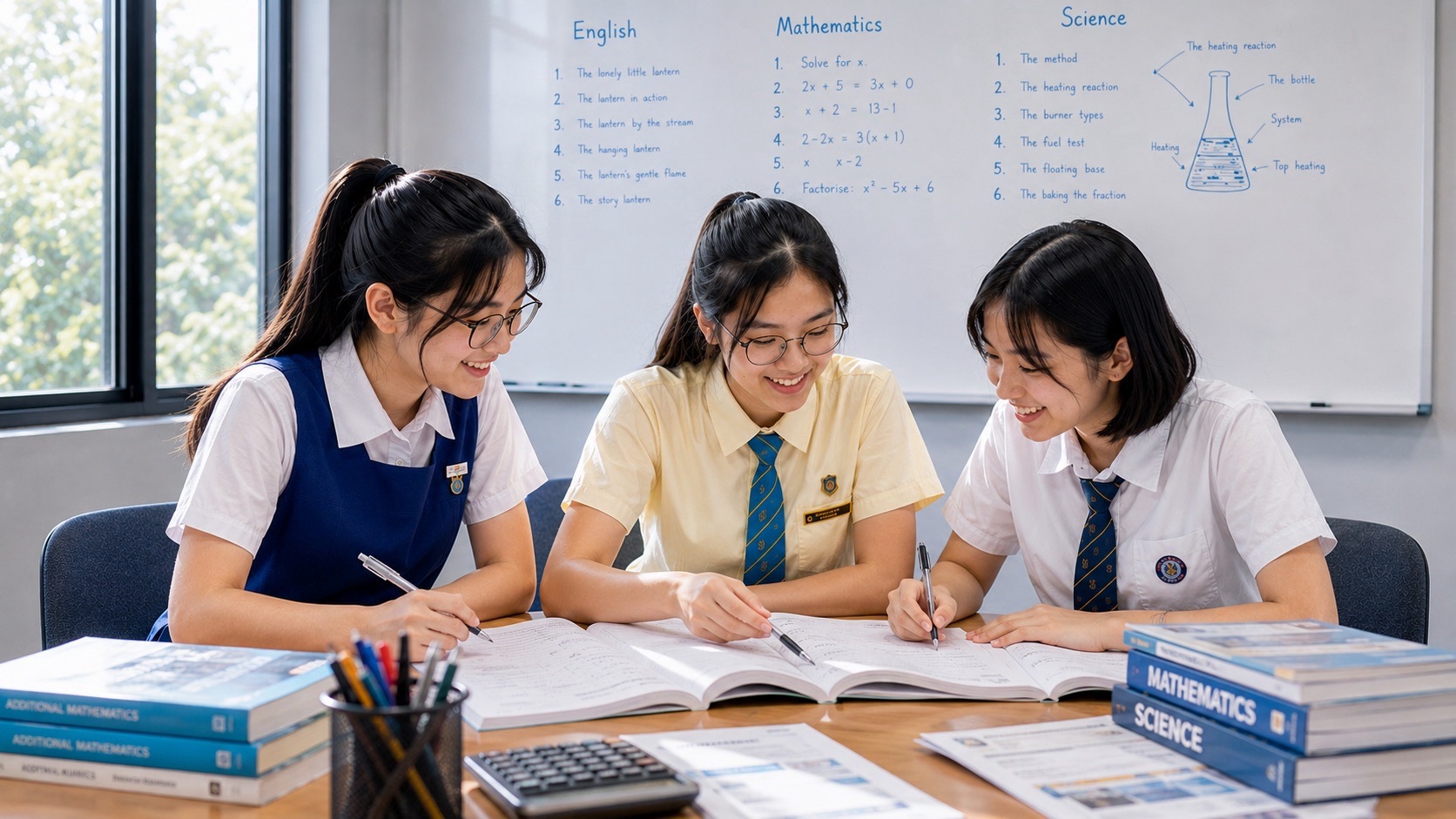
The jump from Secondary 2 Mathematics into Secondary 3 Additional Mathematics is not a jump from easy sums to hard sums. It is a change in mathematical density. Algebra stops being one unit among many and becomes the language carrying functions, equations, graphs, trigonometry and, later, calculus. Students who search for an A-Math jump from Sec 2 often need a bridge more than they need acceleration.
This guide is for students entering Secondary 3 A-Math, parents wondering why a previously strong child is suddenly struggling, and learners already in A-Math Sec 3 who need to locate the missing floor. The central idea is simple: before pushing into more advanced chapters, make the algebraic and representational foundations strong enough to carry them.
For the 2027 Singapore-Cambridge Secondary Education Certificate, Additional Mathematics is offered at G2 as K232 and at G3 as K341. The precise syllabus route matters, but the transition principle is shared: Secondary 3 becomes easier when the student can manipulate symbols accurately, read functions as relationships, move between equations and graphs, and explain what a line of working is doing.
The bridge into A-Math is not “learn A-Math early.” It is “make the earlier Mathematics ready to carry more abstraction.”
1. Why Secondary 2 success can be misleading
A good Secondary 2 result is useful evidence, but it does not prove that every prerequisite is automatic. Lower-secondary assessments can reward strong topic familiarity, careful following of procedures and recent practice. Additional Mathematics increases the cost of small weaknesses because methods become longer and topics interact. A student can therefore move from comfortable marks to uncertainty without having become less intelligent or less hardworking.
The problem is often coupling. In a lower-secondary question, weak factorisation might damage one part. In A-Math, the same weakness can damage quadratic functions, partial fractions where relevant, trigonometric manipulation, differentiation applications and integration steps. The weakness spreads because algebra is now used inside other mathematics rather than only being tested as itself.
This is why “my child was good at Maths in Secondary 2” and “my child is struggling with A-Math in Secondary 3” can both be true. The environments are asking different questions of the same foundation.
2. What actually changes when A-Math begins
| Secondary 2 habit | Secondary 3 A-Math demand | Why the bridge matters |
| Follow a named chapter method | Select a method from structure | Chapter labels disappear in mixed work |
| Do algebra as a topic | Use algebra inside many topics | Symbolic errors spread |
| Read graphs as answers | Use graphs as representations of functions | Graph and formula must inform each other |
| Apply familiar trigonometric ratios | Manipulate identities, equations and functions | Structure becomes more abstract |
| Solve shorter chains | Carry multi-step reasoning with conditions | Working must remain stable for longer |
| Rely on recent practice | Retrieve older skills while learning new ones | Memory becomes part of performance |
None of these changes is exotic in isolation. The difficulty comes from their combination. A-Math makes the learner coordinate more things at once. The bridge therefore aims to reduce the cognitive cost of the foundations so attention can be spent on the new idea rather than on basic symbolic survival.
3. Start with an algebra readiness screen
Before teaching advanced content early, sample the student’s existing algebra. Use short problems that require expansion, factorisation, fractions, equations, substitution, indices, graphs and rearrangement. Do not choose only easy or only difficult items. The goal is to see where ordinary manipulation becomes slow, uncertain or dependent on prompts.
Watch the working. Does the student distribute negative signs correctly? Do equal signs still connect equivalent expressions? Can fractions be combined without inventing illegal cancellation? Can the student solve an equation after a substitution? Can the student factorise in more than one form? Can the student move a term across an equation while understanding that the operation was performed on both sides rather than “changing the sign because it crossed”?
The language of the explanation matters. Students who rely on slogans can often reproduce routine steps but become fragile when the form changes. A strong bridge replaces slogans with mathematical relationships.
4. Signed numbers and negative structure
Negative signs are small symbols with large consequences. Secondary students can carry informal habits for years because simple questions do not stress them enough. A-Math eventually places negatives inside brackets, fractions, powers, substitutions, trigonometric expressions and calculus. A sign error can travel several lines before becoming visible.
The bridge should include deliberate work on negative brackets, substitution of negative values, powers of negative quantities, subtraction of expressions and sign changes during factorisation. Ask the student to explain the scope of the negative sign: what exactly is it acting on? This turns a visual mark into an operation.
Do not treat repeated sign errors as “carelessness” until the structure has been checked. Sometimes the student genuinely lacks a stable internal rule for the scope of operations. Once the rule is secure, checking can address the remaining slips.
5. Expansion and factorisation as reversible thinking
Expansion and factorisation are often taught as separate procedures. A-Math benefits from seeing them as two directions through the same algebraic object. Expansion reveals terms. Factorisation reveals multiplicative structure. The ability to choose the useful form is more important than speed at either procedure alone.
Ask the student to move back and forth. Expand an expression, then refactor it. Compare two equivalent forms and ask what each makes visible. A factorised quadratic makes roots easier to see. A completed-square form makes the vertex easier to see. An expanded form may support coefficient comparison. This is the beginning of representation control.
Students who enter A-Math believing that “simplify” always means “expand” need this bridge urgently. Advanced Mathematics often asks not for the shortest-looking form but for the form that exposes the property needed next.
6. Algebraic fractions: the hidden stress test
Algebraic fractions combine several lower-level skills: factorisation, common denominators, restrictions, signs and cancellation. They are an excellent readiness test because they reveal whether the student treats symbols as structured quantities or as marks that can be moved by appearance.
The bridge should emphasise legal cancellation. Factors may cancel; terms generally do not. Denominators create restrictions. Multiplying numerator and denominator by the same non-zero quantity preserves value. Combining fractions requires a common denominator for the same reason numerical fractions do. The student should be able to explain these principles before procedures become long.
A weak algebraic-fraction floor will later damage rational expressions, equation solving and calculus manipulations. A few hours spent here before A-Math can save many later hours.
7. Linear equations are about equivalence, not moving terms
Students frequently learn equation solving through the language of “move this to the other side.” That language is convenient, but it can hide the invariant: both sides must remain equal. A-Math produces equations in unfamiliar forms, and hidden rules become unreliable.
Rebuild equation solving around balance. Every transformation should preserve the solution set, unless the operation introduces a condition that must be checked. This becomes especially important when squaring, multiplying by expressions that might be zero, or working with inequalities. The student should know why a step is legal, not only what pattern it resembles.
8. Inequalities require a different kind of answer
An equation often asks for values that make two expressions equal. An inequality asks for a region of values that makes a relation true. Students who treat inequalities as equations with a different symbol miss the structural change. The answer may be an interval, multiple regions or a condition represented on a number line or graph.
The bridge should revisit number-line thinking, sign changes when multiplying by negative quantities and graphical interpretation. Later quadratic inequalities become much easier when the student sees them as questions about where a function lies above or below a reference line.
9. Simultaneous equations: one system, two constraints
Simultaneous equations are not two unrelated equations solved in sequence. They describe values satisfying multiple constraints at once. That viewpoint prepares the student for intersections of graphs and more complex systems. It also helps with modelling, because each equation may encode a different condition from the same situation.
Students should be comfortable choosing between substitution and elimination, and they should recognise when one form makes one method cheaper. The point is not to memorise a favourite procedure. It is to reduce the system while preserving both constraints.
10. Indices and exponent structure
Index laws become part of the grammar of later exponential, logarithmic and calculus work. The bridge should check whether the student understands why multiplying like bases adds exponents, why a zero exponent produces one for non-zero bases, and how negative and fractional indices relate to reciprocals and roots.
Students who rely on visual rules without meaning can create plausible-looking but false transformations. Ask them to test a rule with a numerical example. This simple habit—verify a symbolic rule in a concrete case—builds mathematical self-correction.
11. Surds and exactness
Where the student’s route includes surds, exact values matter. The bridge should distinguish exact form from decimal approximation and build comfort with simplifying radicals, rationalising where required by the syllabus, and preserving exactness through multi-step work. Exactness is not aesthetic fussiness. It protects information.
This is a useful place to teach delayed approximation. Keep exact values while the structure is being manipulated; approximate at the end when the question requests it. Premature decimals can create rounding drift and hide relationships.
12. Coordinates: algebra placed in space
Coordinate geometry is an important bridge because it forces algebra and geometry to cooperate. Gradient becomes a rate of change between points. Equations become lines or curves. Intersection becomes simultaneous satisfaction. Distance and midpoint formulas encode geometric relationships in coordinates.
Before Secondary 3, make sure the student can read axes, interpret gradient, form line equations, substitute points and understand what intersection means. Do not teach formulae as isolated strings. Ask what each quantity measures and how changing a coefficient changes the graph.
13. Graphs should become arguments, not pictures
A graph is a representation of a relationship. A-Math increasingly asks students to read behaviour: roots, intercepts, turning points, asymptotes where relevant, intervals of increase or decrease, and transformations. The bridge should train the student to move both ways: from formula to graph and from graph to algebraic conclusions.
One useful exercise is to predict before plotting. If a coefficient changes sign, what should happen? If a constant is added, how should the graph move? If two expressions are set equal, what does their intersection represent? Prediction forces structure to precede visual confirmation.
14. Function notation is a language change
Function notation can feel artificial at first. Students may treat f(x) as a strange variable rather than the output of a function evaluated at an input. The bridge should make the language explicit. What is the input? What transformation does the function perform? What does f(3) mean? What does f(a+1) require? How is f(x)=0 different from f(0)?
Once function notation is secure, composition, inverse thinking, transformations and calculus become easier to organise. A weak function-language floor makes later topics feel more mysterious than they are.
15. Quadratics are the central bridge object
Quadratics connect almost every transition skill. They require expansion and factorisation, equation solving, graphs, exact forms, inequalities, coordinates and later calculus. A student entering A-Math should therefore understand quadratics from several representations rather than only knowing the quadratic formula.
Ask the student to move between expanded, factorised and completed-square forms. Ask what each form reveals. Factorised form reveals roots when factors are real. Completed-square form reveals the vertex and shape. Expanded form reveals coefficients directly. The same function has not changed; the representation has.
This is a model for advanced Mathematics: transform the representation to make the needed property visible.
16. Trigonometry: from triangle procedure to function thinking
Lower-secondary trigonometry may be experienced mainly through right triangles. A-Math broadens the object. Angles, identities, equations and graphs become central. The student must eventually see sine, cosine and tangent as functions with structure, not only buttons selected after SOH-CAH-TOA.
The bridge should protect exact values, angle sense, radian readiness if relevant later, graph interpretation and the meaning of identities. Students do not need to pre-learn the whole A-Math trigonometry course. They do need enough conceptual stability that the new layer has somewhere to attach.
17. Mathematical working is part of the bridge
Secondary 3 solutions are longer. That makes working a memory system. One line should prepare the next. Conditions should remain visible. Equal signs should be used correctly. A student who compresses five operations into one line may be fast when correct but difficult to debug when wrong.
Teach readable thinking before the subject becomes dense. This does not mean forcing one rigid style. It means preserving enough structure that the student can inspect their own reasoning. Good working reduces tutor dependence because the student can locate the problem without someone reconstructing the entire thought process.
18. The bridge should include reading, not only algebra
Some A-Math failures begin before the first symbol is written. The student does not identify what the question gives, what is required, or which conditions restrict the answer. Long sentences, diagram information and multi-stage applications increase the reading burden.
Train translation. Underline conditions sparingly. Restate the mathematical object. Write known relationships. Distinguish information from instructions. Before calculating, ask what kind of answer is expected: a value, an equation, an interval, a proof, a maximum, a coordinate, an exact expression.
19. Build the habit of first attempts
A student cannot become independent if help arrives before uncertainty has had time to work. During the bridge, require a genuine first attempt. The attempt can be short. Identify the topic family, write the known relationship, sketch the graph, or manipulate the expression. The point is to make the learner generate before receiving.
A first attempt also improves diagnosis. If the tutor supplies the opening move immediately, we never learn whether the student could have recognised it. A blank page after two thoughtful minutes tells us something different from a wrong but mathematically sensible start.
20. Use hints that preserve thinking
When help is needed, use the smallest hint that reactivates the student’s own system. “What form is the quadratic in?” is better than “complete the square.” “Which quantity is shared by both conditions?” is better than writing the substitution. “What does the graph tell you about the roots?” is better than supplying the equation.
Then fade the hint. The same capability should be tested later without it. A bridge succeeds when support becomes unnecessary.
21. Do not accelerate before diagnosing
Parents sometimes prepare for Secondary 3 by trying to finish several A-Math chapters during the holiday. This can create familiarity, but it can also hide the foundational problem. A student may learn the mechanics of differentiation early while still carrying unstable factorisation and function notation. The first school term then feels initially easy, followed by a later collapse when the topics connect.
A better order is diagnosis, floor repair, then selective preview. Preview the language of the next course, not the entire course. A calm first encounter is useful. Superficial coverage is not.
22. What selective preview should look like
Selective preview might include function notation, the idea of a function as a mapping, basic quadratic forms, exact algebra, and a first conceptual look at gradient as change. The student should leave with questions and a few stable anchors, not with fifty memorised procedures.
When school later teaches the topic, the experience becomes recognition plus deeper learning. That can reduce anxiety without stealing the teacher’s job or creating the illusion that “we already did this” after only surface exposure.
23. An eight-week Secondary 2 to A-Math bridge
| Week | Primary focus | Evidence of readiness |
| 1 | Algebra screen + signed structure | Student can show where sign rules act |
| 2 | Expansion, factorisation, equations | Student moves between equivalent forms |
| 3 | Fractions, indices, exactness | Legal manipulation without visual shortcuts |
| 4 | Coordinates and graphs | Formula and graph inform each other |
| 5 | Function notation and quadratics | Student can interpret and transform forms |
| 6 | Trigonometric foundations | Angle/function relationships are meaningful |
| 7 | Mixed algebra-function problems | Method selection without chapter labels |
| 8 | Mini A-Math preview + retest | Earlier bridge skills survive a delay |
This is a model, not a compulsory course. A student with a strong floor may move quickly. A student with a specific fracture may spend more time on one area. The important feature is the retest. Readiness is not what the student can do immediately after teaching. It is what remains available after distance.
24. A four-week emergency bridge for a struggling Secondary 3 student
If A-Math has already begun and the student is falling behind, compress the bridge. Week one locates the two highest-spread weaknesses. Week two repairs the first while keeping contact with school content. Week three repairs the second and begins mixed application. Week four re-tests both inside current A-Math questions.
Do not pause the entire current syllabus unless the gap is truly severe. The objective is to rejoin the moving course. Every repair should therefore end by returning to a real current problem. If the repair does not transfer, it is incomplete.
25. The first ten weeks of Secondary 3
The first ten weeks should establish routines that will still work in Secondary 4. One current-topic block, one retrieval block, one correction block, and short algebra maintenance can be enough. The student should keep an error ledger from the beginning, but it should remain sparse. Record patterns, not every wrong answer.
Mixed questions should appear early in small doses. This prevents chapter-based dependence. The student should occasionally meet an old algebra skill inside a new function problem and recognise it. That experience teaches the deeper architecture of the subject.
26. The student who is fast but fragile
Some students enter A-Math with strong speed. They can expand, factorise and solve quickly. But they rely on pattern recognition so heavily that small changes in form cause collapse. For these students, the bridge should slow down enough to expose reasoning. Ask why the method works, what condition makes it legal and what alternative representation exists.
Speed becomes more valuable after structure is secure. Fast fragile work produces high variance: excellent on familiar questions, poor on changed ones. The goal is fast robust work.
27. The student who is slow but deep
Other students understand structure well but work slowly. They should not be labelled weak simply because early A-Math takes time. First preserve the depth. Then improve fluency through deliberate repetition of high-frequency operations. Time familiar algebra separately from complex problem-solving so speed training does not corrupt thinking.
These students often improve strongly once the basic symbolic operations become automatic. The bridge should therefore distinguish conceptual slowness from procedural friction.
28. The student who memorises solutions
Memorised solutions can survive topical practice and fail catastrophically in mixed papers. The bridge must shift from solution memory to structural recognition. After every worked example, change the numbers, the representation or the question direction. Ask the student to identify what remained mathematically the same.
This is especially important before calculus. Differentiation rules can be memorised, but applications require the student to construct equations from meaning. Structural learning begins earlier.
29. The student who refuses to write enough working
A student may believe that writing fewer lines proves mastery. Sometimes it does. Often it hides unstable reasoning. During the bridge, make working serve verification. The student should be able to return to the solution and see where each quantity came from. If a line contains several risky transformations, separate them.
Good working is not about pleasing the marker aesthetically. It protects marks where essential reasoning is required and protects the learner from invisible errors.
30. The student who checks every answer with the tutor
Constant reassurance can become a dependency. The student solves one line, looks up, waits for confirmation, then continues. This feels safe but prevents the internal development of verification. During the bridge, delay confirmation. Ask the student how they would check the line themselves.
Teach substitution checks, graphical checks, dimensional sense where relevant, sign checks and alternative routes. Confidence becomes stronger when it is produced by verification rather than by another person’s nod.
31. Main Mathematics should remain visible
The A-Math bridge should not cannibalise the student’s main Mathematics. The two subjects share foundations but also have distinct content. Use overlap efficiently. A strong algebra repair can help both. Better graph reading can help both. Clear working and calculator discipline can help both.
Where demands differ, keep the curricula separate. Do not assume advanced symbolic work automatically improves statistics, applied geometry or every aspect of main Mathematics. The student needs a whole programme.
32. G2 A-Math: build the bridge as its own route
For 2027, G2 Additional Mathematics K232 should be read as a real curriculum with its own scope and purpose. A student entering G2 A-Math needs the G2 Mathematics foundations that support that route and a deliberate progression toward more advanced symbolic thinking. Do not teach it as a failed imitation of G3.
The bridge principle is especially useful here because the student is building capability that can support movement toward G3 Mathematics or Additional Mathematics where appropriate. Secure learning is the progression engine.
33. G3 A-Math: prepare for a denser mathematical runway
G3 Additional Mathematics K341 carries broader advanced demand and conventionally prepares students for later H2 Mathematics. The bridge should therefore make algebra and function thinking unusually reliable. These are not merely Secondary 3 survival skills. They are part of the longer runway into calculus, vectors, statistics and higher mathematical modelling.
That longer horizon is a reason to build carefully, not to race. The student who enters Secondary 3 with clean algebra and good representation control can spend more attention on the genuinely new ideas.
34. How to know the bridge is working
- The student starts more questions without waiting for a cue.
- Algebraic errors become less frequent and easier to catch.
- Function notation stops feeling like a foreign language.
- The student can explain what different quadratic forms reveal.
- Graph predictions become more accurate before calculator use.
- Old bridge skills remain available after one or two weeks.
- Current A-Math topics require less rescue.
- Homework time becomes more predictable.
Marks may improve after these signals, but the signals themselves matter because they show the internal system becoming more capable.
35. How to know the bridge needs redesign
If the student can complete bridge worksheets but still cannot use the same skills inside current A-Math, the practice is too isolated. If performance disappears after a few days, retrieval is too weak. If the student succeeds only with a solution nearby, support is not fading. If the bridge consumes so much time that school content continues to accumulate, the scope is too broad.
Redesign around the smallest high-spread weakness. A bridge should shorten the distance to current work, not create a second curriculum.
36. Parents: what to ask at the end of each week
- Which old skill helped with a new A-Math topic this week?
- Which error repeated?
- What can you now do without help that needed help last week?
- Which topic is still slow because of algebra rather than the new concept?
- What will be retested next week after a gap?
These questions keep the conversation on capability rather than on vague effort.
37. Tutors: what the bridge should reveal
A tutor should be able to identify whether the student’s first break is conceptual, procedural, algebraic, representational or retrieval-based. The lesson should then target the break and return to a current A-Math problem. If the student receives only more examples from the chapter currently being taught, the underlying transition problem may remain hidden.
In a small group, the tutor can compare how different students represent the same problem and make misconceptions visible. The group is useful when it increases explanation and feedback without reducing individual diagnosis.
38. Schools: use their sequence, but do not confuse it with the dependency map
The school must choose an instructional sequence. Follow it for current work. But when a student struggles, ask which earlier capability the topic is calling. The dependency map may reach backward beyond the current chapter. This is why remediation sometimes looks temporarily unrelated to the test scope: one weak operation can be the cause of several visible failures.
39. Holiday preparation before Secondary 3
The best holiday bridge is not a boot camp. Use two or three sessions a week. Repair algebra, revisit graphs, make function notation familiar, and solve a small number of mixed problems. Leave room for rest. A student should begin Secondary 3 curious and prepared, not exhausted by an unofficial extra term.
If the student is already very strong, use the holiday to deepen representation rather than to collect chapters. Explore how quadratic forms relate, how graphs encode equations, and how gradient can be viewed as change. These ideas create anchors for later formal teaching.
40. The first bad A-Math test
Treat the first bad test as a scan. Where did marks disappear? If errors cluster in one algebraic floor, repair it. If the student did not recognise question types, add method-selection practice. If time ran out, ask whether slow algebra or overlong persistence caused it. Do not immediately add full papers. The first test is too early for paper volume to solve most transition problems.
41. The first good A-Math test
A good first test is encouraging, but keep retrieval. Early tests can be narrow and recent. Give the student one or two older questions a few weeks later. If the skill remains available, the knowledge is becoming durable. If it disappears, improve spacing now rather than discovering the problem in Secondary 4.
42. The bridge into calculus begins before calculus
Calculus often receives the aura of an entirely new subject. In one sense it is new; it introduces powerful ideas about change and accumulation. But its execution rests on old foundations: functions, graphs, indices, algebraic manipulation, equation solving and interpretation. Preparing for calculus therefore means strengthening those foundations, not memorising differentiation rules early.
A student who understands functions as relationships and gradients as rates is already building conceptual landing points for calculus. When the formal rules arrive, they attach to meaning.
43. The bridge into trigonometric identities begins before identities
Trigonometric identities require comfort with equivalent expressions. That is why expansion, factorisation and algebraic fractions matter. The student who sees an identity only as a list of formulas will struggle to transform one side into another. The student who is used to changing representation while preserving value has a familiar mathematical habit to use.
44. The bridge into logarithms begins with exponents
Where logarithms are part of the student’s route, the conceptual bridge is exponent structure. A logarithm answers a question about an exponent. Students who understand index laws and inverse relationships can learn logarithms as a coherent object. Students who memorise rules without that floor experience a new list of arbitrary moves.
45. The bridge into higher Mathematics is a habit of representation
The deepest transition skill is not one algebraic operation. It is the habit of asking: what representation makes this problem easier to see? A function may be represented by a rule, graph, table or equation. A quadratic may be expanded, factorised or completed-square. A geometric constraint may become a coordinate equation. Advanced Mathematics repeatedly rewards students who can change representation without changing the object.
Teach this habit in Secondary 2 and early Secondary 3 and many later topics become less mysterious.
46. A self-test before Secondary 3
- I can expand and factorise expressions without losing signs.
- I can solve linear and simple simultaneous equations and explain why the steps preserve equality.
- I can manipulate algebraic fractions legally.
- I am comfortable with indices and exact values appropriate to my course.
- I can read gradients, intercepts and intersections from graphs.
- I understand function notation as input-output language.
- I can move between common quadratic forms and say what each reveals.
- I can use trigonometric relationships with angle sense rather than button guessing.
- I show enough working to find my own errors.
- I can attempt a mixed question before asking which chapter it belongs to.
No student needs perfection on every line before A-Math begins. The checklist is a diagnostic map. Weak items become bridge targets.
47. Frequently asked questions
Should my child learn A-Math before Secondary 3?
A small preview can reduce first-contact load, but deep prerequisite readiness is usually more valuable than racing through chapters. Repair algebra, graphs and function language first, then preview selectively.
Why is my child strong in E-Math but weak in A-Math?
The subjects overlap but are not identical. A-Math places heavier and more continuous demand on symbolic manipulation, function structure, trigonometry and calculus. A lower-secondary weakness that was manageable can become load-bearing.
How long does the bridge take?
It depends on the gaps. A strong student may need only a few focused sessions. A student with several algebraic fractures may need weeks of repair integrated with current work. The bridge should be judged by transfer into A-Math, not by completion of a fixed course.
Should we use Secondary 3 worksheets during the bridge?
Use some, especially to verify transfer, but do not let advanced worksheets replace the diagnostic. A bridge needs both prerequisite tasks and current A-Math problems so you can see whether the repair changes the real work.
What if A-Math has already become overwhelming?
Narrow the field. Identify the earliest two or three high-spread weaknesses, repair them, and keep minimal contact with current school work. If the subject remains unsustainable after a bounded repair cycle, use the separate route-decision framework rather than simply adding more volume.
48. Reference routes
- SEAB 2027 SEC G2 syllabuses
- SEAB 2027 SEC G3 syllabuses
- How Secondary 2 Algebra Works
- How Algebra Works in Secondary 3 Additional Mathematics
- Additional Mathematics Study Calendar
- Should I Drop Additional Mathematics?
- World Mathematics Atlas
49. Final idea: make Secondary 2 strong enough to disappear
The ideal foundation becomes invisible. The student no longer thinks consciously about every sign, denominator, rearrangement or function input. Those operations become reliable enough that attention can move upward to the new mathematical idea. That is what the bridge is trying to achieve.
Secondary 3 A-Math does not require a child to become a different kind of person. It requires earlier Mathematics to become more precise, more retrievable and more connected. Build that floor, and the jump becomes a staircase. Ignore it, and even talented students may spend the year climbing with loose steps.
The best preparation is therefore not to finish A-Math before A-Math begins. It is to enter the subject with algebra that can carry load, graphs that mean something, functions that have language, and a student who knows how to attempt, check, repair and return.
50. A diagnostic ladder: from arithmetic reliability to A-Math abstraction
The bridge becomes clearer when the foundations are arranged as a ladder. At the bottom is arithmetic reliability: signs, fractions, ratio and numerical estimation. Above that is symbolic reliability: expressions, equations, factorisation and indices. Above that is representational control: graphs, coordinates, function notation and diagrams. Above that is structural selection: recognising what kind of mathematical object a question presents. A-Math sits across the upper layers but continues to lean on every rung below.
When the student fails at a high rung, test the lower rungs quickly. If a function problem fails, ask whether the function notation is understood. If it is, inspect algebraic substitution. If that is secure, inspect graph interpretation. This prevents unnecessary reteaching of the whole chapter. The ladder gives diagnosis a direction.
| Layer | Readiness question | Typical symptom if weak |
| Arithmetic reliability | Can the student control signs, fractions and estimation? | Long symbolic work contains small numerical fractures |
| Symbolic reliability | Can expressions be transformed while preserving value? | Correct ideas collapse in algebra |
| Equation control | Can constraints be represented and solved lawfully? | Student relies on “moving terms” slogans |
| Representation control | Can the student move between formula, graph and diagram? | Visual and symbolic information remain disconnected |
| Structure recognition | Can the student choose methods without chapter labels? | Topical work succeeds; mixed work stalls |
| Transfer | Can the skill survive changed wording and delayed use? | Performance depends on recent examples |
51. The arithmetic floor still matters
Additional Mathematics is symbolic, but arithmetic has not disappeared. Fractions, negative values, exact forms and estimation remain present inside larger structures. A student who hesitates over numerical fractions spends working-memory capacity that should be available for the advanced idea. A student who lacks magnitude sense may accept an obviously unreasonable calculator output.
The bridge does not need pages of primary-school arithmetic. It needs short checks. Can the student manipulate fractions confidently? Can they estimate whether a result should be around 0.2 or 20? Can they see whether a square should be negative? Can they preserve exact values until approximation is appropriate? If not, small daily work can remove a surprising amount of friction.
52. Algebraic syntax: the punctuation of Mathematics
Students learn to read English partly by understanding syntax. Mathematics has syntax too. Brackets indicate scope. Fraction bars group numerators and denominators. Exponents act on particular bases. Function notation identifies an operation on an input. Equal signs connect equivalent statements. A surprising number of A-Math errors are syntax errors: the student misreads what the symbols are attached to.
During the bridge, read expressions aloud in structured language. Instead of “x plus two squared,” distinguish between “the square of x plus two” and “x plus two squared” by pointing to the actual brackets. Ask which part a negative sign acts on. Ask what is in the denominator. This may feel elementary, but it builds the precision required for long symbolic work.
53. Equality is a relationship, not a signal to calculate
Many students experience the equal sign as “the answer comes next.” A-Math needs a stronger idea: equality states that two expressions represent the same value under the relevant conditions. That idea supports equation solving, identities, transformations and derivations.
One bridge exercise is to present a chain of working and ask whether every equal sign is legal. Students quickly discover lines where the relationship has changed but the notation pretends it has not. Correcting this habit improves both reasoning and communication.
54. The difference between expression, equation, identity and function
These words matter. An expression has no claim of equality by itself. An equation states that two expressions are equal for particular values or under particular conditions. An identity states a relationship that is true for all values in its domain. A function describes a mapping from input to output under specified conditions. Students who blur these objects can perform procedures while missing what they are proving or solving.
A-Math uses all four. The bridge should therefore include classification. Show a symbolic statement and ask what kind of object it is. What would count as a solution? What would count as verification? This small conceptual investment later clarifies trigonometric identities, equations and functional reasoning.
55. Domain and restrictions: the conditions that keep Mathematics honest
Lower-secondary work sometimes allows students to manipulate expressions without discussing where they are defined. A-Math increasingly rewards attention to restrictions. Denominators cannot be zero. Square roots and logarithms, where relevant, bring domain conditions. Inverse functions require appropriate domains. Trigonometric equations may require restricted angle ranges.
The bridge should teach the habit of asking “for which values is this object defined?” before treating formulas as universal. This is a mature mathematical habit and a practical examination habit. It prevents extraneous or impossible answers from surviving to the final line.
56. Why quadratics deserve a two-week mini-lab
If time allows, spend two weeks treating quadratics as a laboratory for the bridge. Begin with factorisation and roots. Move to the graph. Rewrite in completed-square form. Connect the vertex to maximum or minimum behaviour. Compare discriminant information with intersections. Solve an inequality by reasoning about where the graph lies above or below the axis. This one object integrates much of the transition architecture.
The student learns that a chapter is not a list of separate tricks. Factorisation, completing the square, graph shape and equation solving are views of the same mathematical object. Once the student experiences this integration deeply, later A-Math chapters are less likely to be stored as disconnected recipes.
57. A five-question quadratic stress test
- Factorise a quadratic and explain what the factors reveal about roots.
- Complete the square and state what the new form reveals about the graph.
- Sketch a quadratic from its structure without plotting many points.
- Solve a quadratic inequality and justify the interval from the graph or sign structure.
- Given a transformed graph, predict how the equation changes.
The questions need not be difficult. The stress test is representational. If the student can move among forms and explain what each form makes visible, the bridge is doing more than teaching procedures.
58. Function machines are useful, but do not stay there too long
Function machines—input, rule, output—are a good first model. They make f(x) less mysterious. But A-Math soon requires a richer view. Functions have domains, ranges, graphs, inverses where appropriate, compositions and transformations. The bridge should use the machine metaphor to enter, then move toward relationships and representations.
Ask the student to give three descriptions of the same function: as a rule, as a graph and as a sentence about how output changes with input. The representations do not need equal detail. The exercise builds flexibility.
59. Coordinate geometry as a proof of transfer
Coordinate questions are excellent for testing whether the bridge transfers. They may require gradient, algebra, equations, distance and graphical interpretation within one problem. A student who can perform each skill separately but cannot coordinate them has a transfer gap rather than a knowledge gap.
Use coordinates after several foundation repairs. If performance improves, the bridge is integrating. If the student still stalls at the first decision, work on problem representation and method selection rather than adding more isolated drills.
60. Trigonometric readiness without rushing into identities
Before formal identities, ensure that sine, cosine and tangent are more than mnemonic ratios. The student should have angle sense, understand how signs change in different regions where relevant, interpret graphs at a basic level, and recognise that trigonometric quantities vary systematically with angle.
Exact values can be used as anchors. Instead of memorising a table without meaning, connect key angles to triangles or unit-circle reasoning as appropriate to the teaching approach. The later identity work becomes less arbitrary when the functions already have shape.
61. Calculus readiness without differentiating early
A student can prepare for calculus by understanding change. Compare average gradients over intervals. Examine how a curve gets steeper or flatter. Discuss maximum and minimum points on graphs. Ask how accumulated quantity could relate to area. None of this requires formal differentiation rules.
This conceptual preview is often more valuable than memorising derivative formulas months early. When calculus arrives, the rules become tools attached to an existing question: how does this quantity change?
62. The role of estimation in symbolic Mathematics
A-Math students sometimes abandon estimation because exact algebra feels separate from numerical sense. That is a mistake. Estimation is a verification layer. A root near 3 should not suddenly become 300 without explanation. A gradient expected to be positive should not be accepted as negative. An area should not have an impossible sign in a context where only magnitude makes sense.
Build estimation into the bridge by asking for a prediction before calculator use. The prediction can be rough. Its purpose is to give the student an independent reference against which to judge the final output.
63. The role of verbal explanation
If a student can perform a procedure but cannot explain what it does, the method may still be usable, but it is often fragile. Short explanations strengthen connections. Ask, “Why are we factorising here?” “What does setting the derivative to zero represent?” “Why does this restriction matter?” “What would the graph look like?”
Do not turn every lesson into an essay. One sentence is often enough. The goal is to force meaning to remain attached to manipulation.
64. The role of comparison
Comparing two similar problems is one of the fastest ways to build discrimination. Show two quadratics, one easily factorisable and one better handled by another method. Show an identity and an equation. Show two graphs with different transformation directions. Ask what feature changes the method.
A-Math performance depends heavily on noticing these distinctions. Blocked practice teaches what to do. Comparison teaches when to do it.
65. The role of counterexamples
Counterexamples teach boundaries. If a student believes cancellation can happen across addition, give a numerical counterexample. If the student believes squaring both sides preserves exactly the same solution set, show how extraneous solutions can appear. If the student assumes every quadratic has two real roots, connect the discriminant or graph to cases where it does not.
A counterexample is compact because it destroys an overgeneralised rule. The bridge should use them whenever a student’s informal shortcut is too broad.
66. The bridge journal: one page a week
Instead of creating a giant notebook, keep one bridge page per week. Divide it into four boxes: “became easier,” “still breaks,” “one useful connection,” and “retest next week.” This keeps reflection operational. It also gives parents and tutors a shared view without demanding daily reporting.
At the end of eight weeks, compare the first and last pages. The student should see fewer broad problems and more specific remaining issues. Specificity is progress because it means the system is becoming legible.
67. When school pacing is faster than the bridge
This is a common problem. The student is repairing foundations while school continues adding content. Use a two-lane week. Lane One protects current survival: enough work to understand the school topic and complete essential assignments. Lane Two repairs the high-spread foundation. Keep Lane Two narrow so it can actually finish.
Every foundation repair should be linked back into Lane One quickly. If factorisation is repaired, use it inside the current quadratic or calculus problem. This prevents remediation from becoming a separate world.
68. When school pacing is slower than the student
A strong student may have spare capacity. Use it for depth before acceleration. Solve one problem in two ways. Derive a relationship. Explore a graph. Predict the effect of a parameter. Try a slightly unfamiliar problem. This builds mathematical taste and transfer.
If acceleration is used, preserve the same standard: understand, retrieve, transfer. Racing ahead with shallow knowledge can create boredom in school without creating durable expertise.
69. The bridge for a student entering G2 A-Math
The student should begin from the G2 Mathematics floor relevant to the course and build symbolic confidence without being constantly compared with G3. The purpose is to learn real Additional Mathematics securely. Use the official K232 specification to identify scope. Build algebra and functions as a progression corridor, not as a remedial identity.
A G2 student who develops clean algebra, function sense and disciplined working is building assets that can support later movement. The bridge should therefore emphasise reliability and transfer.
70. The bridge for a student entering G3 A-Math
The G3 route makes it worth investing heavily in algebraic fluency and representational flexibility before content density rises. The student should be comfortable with longer chains, mixed methods and exact manipulation. This is not because every G3 question is extreme. It is because the course expects more mathematical machinery to remain available simultaneously.
The long-term runway toward H2 Mathematics also makes habits important. Function language, algebraic equivalence, graph interpretation and self-checking will be called again later.
71. The bridge for a student moving between subject levels
If the school supports a move from G2 toward G3, treat the move as a bridge rather than a badge. Map the additional content and demand. Identify which G3 assumptions are not yet secure. Build them before or during the transition. Continue to measure independence.
Movement should mean the student is ready to carry a new load, not merely that the previous score crossed a threshold. Scores are useful indicators; the working tells you what the score is made of.
72. A case study pattern: strong marks, weak algebra
Imagine a student who scored well in Secondary 2 because word problems and geometry were strong, but algebraic fractions were often avoided or solved with help. In Secondary 3, functions and quadratics expose the weakness. The student’s first A-Math results fall. A broad response—more A-Math worksheets—creates frustration.
A better response isolates algebraic fractions and factorisation for two weeks, then reinserts them into quadratic and function work. The student’s current topic improves because the floor improves. The lesson is diagnostic: the student did not need “more A-Math” in general. The student needed a specific carrier skill.
73. A case study pattern: beautiful algebra, weak reading
Another student manipulates symbols cleanly but misreads conditions. The student solves for all roots when the question restricts a range, uses a formula on the wrong quantity, or fails to connect a diagram statement to an equation. Extra algebra practice will not solve this.
The bridge must include reading-to-mathematics translation. Before calculation, the student writes the object, condition and target. This may slow the first line and speed the whole problem.
74. A case study pattern: strong topical work, weak mixed work
A third student scores highly on chapter worksheets and poorly on tests. The issue is method selection. The chapter heading has been acting as a hidden hint. The bridge should remove it. Use small mixed sets, ask the student to name the structure, and vary surface features.
As selection improves, the same underlying knowledge becomes more useful. The student was not ignorant; the retrieval route was too context-dependent.
75. A case study pattern: every correction makes sense, nothing sticks
This is a retrieval problem. The student understands after feedback but forgets within days. Use spacing. Re-test after one day, several days and two weeks. Keep the retests short. If the same method repeatedly disappears, reconstruct it from meaning rather than repeating the same explanation.
The bridge succeeds only when understanding survives time. Immediate clarity is necessary but insufficient.
76. A case study pattern: the student is anxious before every question
Anxiety can grow when the student expects not to know the first move. Reduce the size of the decision. Ask for a classification before a solution: what object is present, what is known, what is required? Train a repeatable entry routine. Over time, the blank page becomes less threatening because the student has a first action even when the whole route is not visible.
If anxiety remains severe or extends beyond ordinary academic stress, school support or appropriate professional help may be relevant. The mathematical bridge can reduce avoidable uncertainty, but it should not be asked to solve every emotional problem.
77. Why copying corrections is weak repair
Copying a worked solution creates a clean page and a strong feeling of recognition. It does not prove generation. A correction should include a blank-start re-solve. The student can look at the solution to understand the route, close it, wait briefly, then reproduce the reasoning. Later, solve a changed question.
This routine should begin before Secondary 3 so that mistakes become learning events rather than administrative chores.
78. Why too many notes can hide weak learning
A-Math students often produce extensive notes because the subject contains many procedures. Notes are useful as references, but creating them can displace solving. The bridge should keep notes functional: definitions, triggers, one representative example, common boundary, one self-check.
If notes grow faster than independent performance, reduce note production and increase retrieval.
79. Why “careless mistakes” deserve decomposition
Carelessness is not one cause. It can be rushing, weak notation, poor sign control, attention fatigue, lack of checking, calculator input or misunderstanding. Label the mechanism. A sign error due to negative-bracket weakness needs algebra repair. A sign error due to rushing at the final line needs a control habit.
The bridge is a good time to build this language, because students who can classify their own errors become easier to teach.
80. Why mixed practice should stay small at first
A full mixed paper can overwhelm a student whose method-selection system is still forming. Use three to six questions from different families. Ask for classification before solving. Review the decision, not only the answer. Once selection becomes reliable, increase the set size.
The aim is to train switching without adding so much volume that diagnosis disappears.
81. Why the first line matters
Many Secondary 3 problems are lost at entry. The student misdefines a variable, writes the wrong equation, ignores a restriction or chooses an unhelpful representation. Train the first line separately. Present ten questions and ask only for the first mathematically useful statement.
This exercise is efficient because it samples method recognition without spending time on full execution. It is particularly useful for a student who knows methods but cannot choose among them.
82. Why the last line matters
The final line converts Mathematics into an answer. Units, exact form, interval restrictions, coordinate notation and requested accuracy can all matter. Students who sprint after the main calculation often lose marks at the finish. Build a final-line check into the bridge.
Ask: did I answer the question asked, in the form requested, under the correct conditions? This habit becomes valuable in every later Mathematics course.
83. The bridge and examination codes
Parents will encounter old and new labels during the SEC transition. For 2027, SEAB’s official listings identify G2 Additional Mathematics as K232 and G3 Additional Mathematics as K341; older reference codes can still appear in legacy resources. Use the mathematical value of older questions where appropriate, but verify whether the topic and examination specification match the current route.
Version awareness prevents a student from training hard against the wrong paper design or studying content that does not belong to the current syllabus.
84. The bridge and resource choice
Use fewer resources more deeply. School notes establish alignment. A clear textbook or reference supports explanation. A suitable question source supports practice. Official or syllabus-aligned material supports examination calibration. The student does not need five competing systems for every topic.
Resource abundance can create false motion: searching, downloading and organising feel productive. The bridge should make learning visible through attempts and retests.
85. The bridge and three-student tuition
In a small three-student Mathematics class, the bridge can be highly diagnostic because the tutor can inspect each student’s working while still creating comparison. One learner may factorise by recognising structure; another may expand first; a third may choose a graphical interpretation. Discussing these differences can make method choice explicit.
The small-group advantage is lost if all three students simply copy the tutor. The lesson should include independent starts, targeted hints and moments when students explain the reason for a method. The group is a feedback environment, not a smaller lecture hall.
86. A 20-minute bridge routine for busy weeks
- Three minutes: retrieve one old rule or representation from memory.
- Seven minutes: solve one high-spread algebra item slowly and correctly.
- Seven minutes: solve one current A-Math question using the repaired skill.
- Three minutes: write the error or connection to retest later.
Twenty minutes cannot repair a whole curriculum. It can preserve continuity during a crowded week. The important feature is that prerequisite and current work are connected.
87. A 60-minute bridge routine
- Ten minutes: delayed retrieval from earlier bridge material.
- Fifteen minutes: targeted repair of one weak operation.
- Twenty minutes: current A-Math application with fading support.
- Ten minutes: mixed problem from a different topic family.
- Five minutes: error classification and next retest date.
This structure can be repeated with different content. It keeps the bridge from becoming pure remedial drill.
88. The bridge is complete when it is no longer a bridge
At some point, the student should stop needing a separate readiness programme. The repaired algebra becomes ordinary. Function notation becomes natural. Graphs and formulas communicate. Mixed questions are entered without waiting for labels. The bridge dissolves into normal A-Math learning.
If a bridge programme continues indefinitely, ask whether it has become a second curriculum. The objective is integration.
89. What Secondary 3 should feel like after a good bridge
Not easy. A-Math should still contain new ideas and hard questions. But difficulty becomes local rather than global. The student can say, “I understand the function but I am unsure about the transformation,” rather than “I do not understand anything.” Errors become specific. Help becomes smaller. Recovery becomes faster.
That specificity is one of the strongest signs that the learner has crossed the transition.
90. The larger lesson
Every advanced subject has an invisible floor. Students often want to move upward because the new material looks impressive. Experts often move downward first, checking assumptions, definitions and simple cases. The Secondary 2 to A-Math bridge teaches that expert habit early.
When a difficult problem appears, ask which lower structure is carrying it. When that structure is weak, repair it. When it is strong, move upward. This is how Mathematics becomes cumulative rather than merely sequential.
A well-built bridge does more than improve Secondary 3. It teaches the student how to enter future mathematical environments: inspect the language, secure the prerequisites, connect representations, practise retrieval, and make support temporary. That is a method worth carrying long after A-Math.
91. The first 30 days after the bridge
A bridge is only valuable if its gains survive the move into ordinary Secondary 3 work. For the first month after the readiness phase, retain a small maintenance loop. Once a week, retrieve two or three bridge skills without notes. Choose them from different layers: one algebraic manipulation, one representation task and one method-selection prompt. Then connect at least one to the school topic currently being taught.
This protects the bridge from the “course-completed” problem. Students often finish a holiday programme, move on, and allow the repaired skills to decay because the next weeks feel new. Maintenance does not need to be large. Ten minutes of well-chosen retrieval can keep a route alive.
At the end of the month, remove anything that is now automatic. Maintenance should become lighter as capability becomes stable. The purpose is not permanent extra homework. It is to help the new state become ordinary.
92. A parent’s one-page bridge dashboard
- Current subject level and examination year.
- Three foundations already secure.
- Two high-spread weaknesses still being repaired.
- One current A-Math topic that depends on each weakness.
- Average independent-start rate on recent work.
- One skill to retest after a one-week gap.
- Next school assessment date.
- One sign that workload is becoming more sustainable.
This is enough. A large dashboard creates administrative work without necessarily improving learning. The one-page version keeps the family focused on motion. Secure items should disappear from the dashboard. New items enter only when evidence shows they matter.
93. The tutor’s bridge handover
When a student completes a readiness block with one tutor and enters normal lessons with another teacher or programme, a short handover can prevent lost information. Record the strongest areas, the repaired areas, the still-fragile operations and the support level currently needed. Avoid long narratives or labels such as “weak in algebra.” Name the actual behaviour: “factorisation secure; algebraic fractions still slow; function notation independent; mixed method selection needs one verbal cue.”
Specific handovers reduce unnecessary reteaching and help the next teacher test the right things. They also protect the student from being permanently defined by an old weakness that may already have been repaired.
94. If the student did not take the bridge before Secondary 3
Nothing is lost. The bridge can be built while the course is running. The main difference is that the design must be narrower because current work cannot stop. Use evidence from the first tests and homework to identify the two or three foundations with the largest spread. Repair those in parallel with school content. Do not try to recreate an entire Secondary 2 syllabus.
The student may even benefit from seeing why the foundation matters. Factorisation can feel more purposeful when it is clearly the reason a quadratic or calculus question is failing. The current problem gives the repair meaning.
95. If the student took a bridge but still struggles
Then the original bridge may have been too procedural, too supported or too isolated. Check whether the student can retrieve the skills after a gap, use them in changed forms and select them without labels. A student can finish an intensive preparatory course and still lack transfer if every question arrived in predictable blocks.
Redesign around independence. Give mixed tasks. Remove solution visibility. Delay hints. Ask the student to explain triggers. Retest after a week. If the foundations still do not stabilise, the information becomes useful for a wider route review.
96. Mathematics readiness is not a single score
Readiness has at least four dimensions: accuracy, independence, retention and transfer. A student can be accurate with help, independent but forgetful, retained but context-dependent, or transferable but slow. The bridge should identify which dimension is limiting the next stage.
That is why a single entrance test cannot tell the whole story. Use it as one sample, then inspect working and re-test a few items after feedback and delay. How the student learns from the first sample is itself evidence.
97. A final seven-question readiness conversation
- What does factorising reveal that expanding may hide?
- What does f(3) mean, in words?
- Why can a graph and an equation represent the same mathematical object?
- When is cancelling in a fraction legal?
- What should you do if a method looks familiar but you cannot remember the first step?
- How would you check whether a final answer is plausible?
- Which Secondary 2 skill do you expect to use most often in A-Math?
The answers do not need textbook language. Listen for relationships. A student who can explain relationships is building a system rather than a set of tricks.
98. Final bridge principle
The Secondary 2 to Additional Mathematics transition is successful when the learner no longer experiences every new topic as a new universe. Algebra, graphs, functions and trigonometry begin to look like familiar languages used to ask new questions. The novelty moves upward from syntax to ideas.
That is the quiet advantage of a good bridge. It does not make A-Math trivial. It makes difficulty arrive in the right place. Instead of spending all attention on signs, brackets and notation, the student can think about structure, change, relationship and proof. That is where Additional Mathematics becomes worth learning.
99. The bridge should leave a cleaner student, not a busier one
A successful transition programme reduces future complexity. The student needs fewer emergency explanations because the algebraic floor is stable. Corrections become shorter because the first break is easier to locate. Notes become smaller because the learner can reconstruct more from meaning. Homework becomes more predictable because fewer lines collapse for avoidable reasons. If preparation only adds more worksheets, more notes and more dependence, it has not yet paid for itself.
Use the beginning of Secondary 3 to keep simplifying. Remove bridge exercises that are now automatic. Keep only the fragile edges. Let school topics become the main vehicle for further strengthening. The student should feel that the preparation is disappearing into the Mathematics itself.
This is the standard worth aiming for: not a child who has seen every A-Math chapter early, but a learner whose existing Mathematics is precise enough to carry what comes next. That learner enters new material with room to think. And room to think is one of the most valuable forms of readiness.
When this foundation is working, Secondary 3 stops feeling like a sequence of mathematical emergencies. New ideas can still be difficult, but the student has a stable way to enter them: identify the object, choose a representation, use the algebra carefully, check the result and repair the first broken link. That method is more durable than any holiday head start because it remains useful when the examples are unfamiliar.
Build the floor carefully, and the advanced subject can begin where it should: with new Mathematics rather than old instability.