
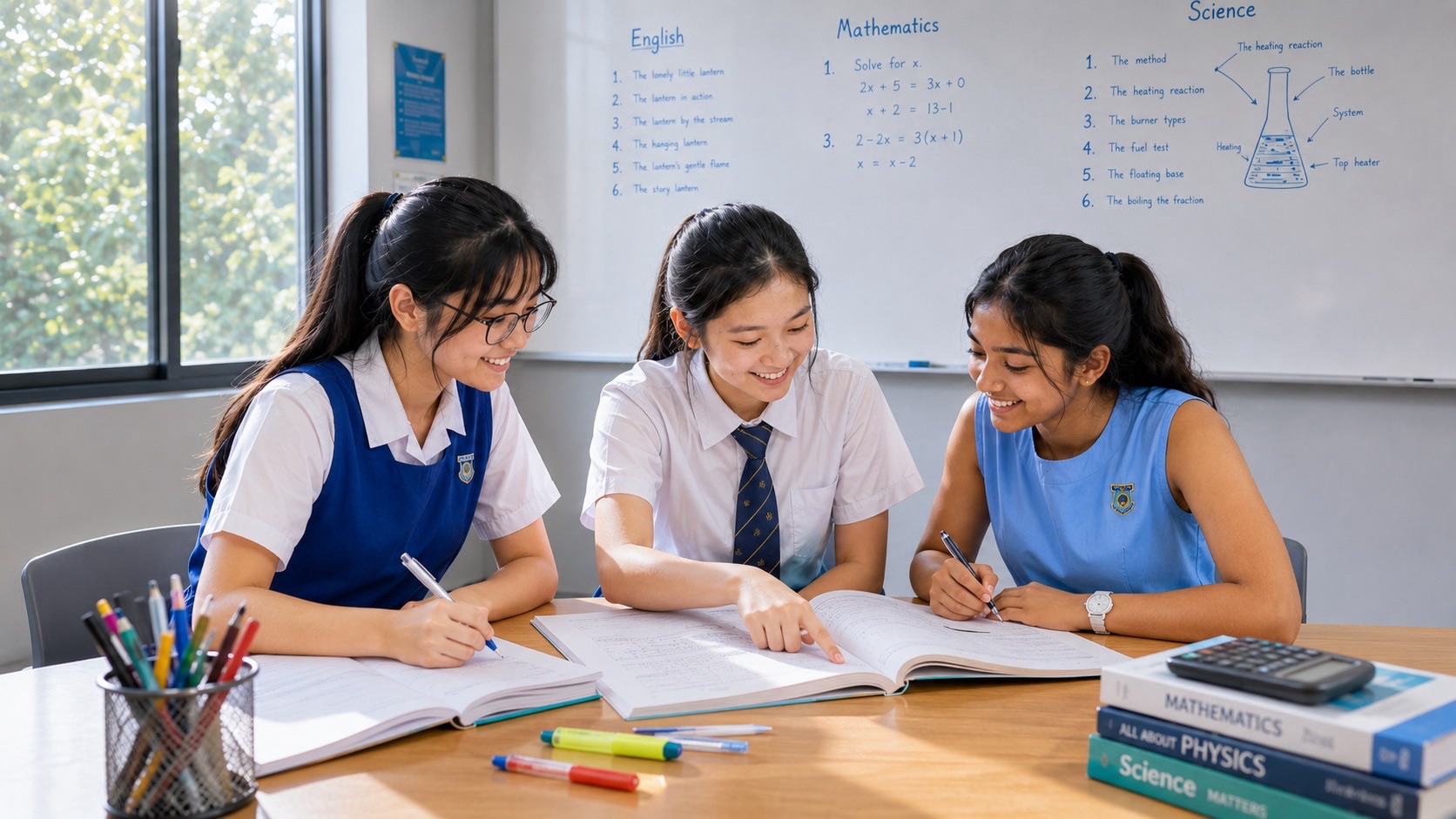
Many students learn Mathematics as though every question has one correct road.
The teacher demonstrates a method.
The student copies it.
The worksheet repeats it.
Eventually the method begins to feel like the Mathematics itself.
Then another student solves the same problem differently.
Both answers are correct.
This can be confusing at first.
It is also one of the most valuable moments in learning Mathematics.
The learner discovers that a method is not merely a ritual to remember.
It is a tool chosen because of the structure of the problem.
The Short Answer
Mathematical flexibility develops when students compare valid solution methods rather than learning each one in isolation.
For two methods solving the same problem, ask:
- What is the shared mathematical principle?
- Where do the routes differ?
- Which assumptions does each method use?
- Which method is shorter here?
- Which method is more transparent?
- Which method generalises better?
- Which method gives the best checking route?
The goal is not to collect as many methods as possible.
The goal is to understand enough alternatives that method choice becomes informed rather than automatic.
Knowing a Method Is Not the Same as Choosing a Method
A student can know substitution and elimination for simultaneous equations.
That does not mean the student can choose efficiently between them.
If one variable is already isolated, substitution may be natural.
If coefficients align conveniently, elimination may be shorter.
If the equations are being interpreted graphically, intersection may be the central representation.
Method knowledge answers:
“Can I use this tool?”
Mathematical flexibility answers:
“Which tool is sensible here, and why?”
Different Methods Reveal Different Structure
Two correct methods are not always redundant.
They may reveal different properties of the same mathematical object.
Factorising a quadratic reveals roots naturally.
Completing the square reveals the turning point and axis of symmetry.
The quadratic formula provides a general route when factorisation is awkward.
The graph shows the same solutions geometrically as intersections with the horizontal axis.
Learning all four as disconnected procedures would be inefficient.
Comparing them reveals that each representation makes different information easier to see.
Compare Methods Side by Side
A useful learning exercise is to solve one problem in two valid ways.
Then place the solutions beside each other.
Do not ask only which is shorter.
Ask:
- Where does each method begin?
- What information does each method use first?
- What remains invariant?
- Where does one method create more algebra?
- Where does one method expose the reason more clearly?
- What kind of error is each method vulnerable to?
This turns solution comparison into analysis rather than preference.
The Shortest Method Is Not Always the Best Learning Method
Students often assume the shortest route is automatically superior.
Under examination pressure, efficiency matters.
During learning, a slightly longer method may reveal more structure.
A diagram may take time to draw but prevent a conceptual mistake.
Completing the square may be longer than using a calculator but reveal the function’s geometry.
Writing a proportional relationship explicitly may be longer than mental calculation but make the base clear.
The best method depends on the job.
Learning Method Versus Performance Method
This distinction is useful.
A learning method may make the principle visible.
A performance method may be chosen later because it is faster and reliable under examination conditions.
The learner should understand both.
Otherwise speed may be purchased by hiding meaning.
Or understanding may remain so cumbersome that the student cannot perform efficiently.
Good Mathematics education gradually connects the two.
Compare Algebraic and Graphical Methods
Many problems can be understood both algebraically and graphically.
Solving two equations simultaneously can be viewed algebraically as satisfying two equations at once.
Graphically, the solution is an intersection.
These views reinforce each other.
The algebra gives exact control.
The graph gives geometric meaning.
If the two methods disagree, the disagreement becomes a checking signal.
Compare Arithmetic and Algebraic Methods
Some problems can be solved numerically in a specific case or algebraically in a general case.
The numerical route may be accessible and intuitive.
The algebraic route may reveal why the pattern always works.
Students benefit from seeing how a concrete case can become a general representation.
This is one route from arithmetic thinking into algebraic thinking.
Compare Direct and Indirect Routes
Some questions allow a direct method and an indirect one.
A probability may be easier to compute directly in one case and through the complement in another.
A geometry result may be found directly from a formula or indirectly through a related figure.
An algebraic quantity may be calculated directly or inferred from a previously established relationship.
Comparing these routes teaches strategic economy.
A Method Has Costs
Every method has a cost profile.
- How many transformations are required?
- How much working must be maintained?
- How many opportunities exist for sign errors?
- Does the method depend on recognising a special form?
- Does it preserve exact values conveniently?
- Does it generalise to harder cases?
- Can the result be checked independently?
Strong students do not calculate these costs formally every time.
With experience, they develop an instinct for them.
Comparison practice helps build that instinct.
Do Not Teach Alternatives as Random Tricks
Multiple methods can become confusing when they are presented as unrelated shortcuts.
The learner accumulates tricks but lacks a model for choosing among them.
Every alternative method should be connected to the mathematical relationship it uses.
Ask why it works.
Ask when it fails.
Ask what information makes it attractive.
Then it becomes a tool rather than a trick.
Method Flexibility Depends on Conceptual Understanding
If a student knows only a memorised sequence, changing methods feels dangerous.
If the learner understands the relationships being preserved, alternative routes become easier to evaluate.
This is because the student can judge the Mathematics underneath the steps.
Conceptual understanding does not eliminate procedures.
It makes procedures comparable.
Method Flexibility Also Depends on Fluency
There is another side.
A student may understand several approaches but execute all of them slowly.
Then choice becomes expensive.
Fluency reduces the cost of deploying a method.
Flexible problem solving therefore needs both:
- understanding sufficient to compare methods, and
- fluency sufficient to execute the chosen method reliably.
Use “Which Method Would You Choose?” Practice
Students can train method selection without solving every problem fully.
Present several questions.
For each one, ask:
- What methods are possible?
- Which would you choose first?
- Why?
- What information makes that route attractive?
- What would make you switch?
This isolates strategic decision-making from calculation.
Use “Same Answer, Different Route” Practice
Choose one problem with at least two useful methods.
Solve it one way.
Then deliberately solve it another way.
Finally compare:
- efficiency,
- clarity,
- generality,
- error risk,
- and checking value.
This turns redundancy into learning.
Use One Method to Check Another
Multiple methods also create verification.
Solve algebraically and inspect graphically.
Calculate directly and check through an inverse relationship.
Use substitution to verify a derived solution.
Estimate before trusting an exact calculator output.
An independent route is often a stronger check than repeating the same arithmetic twice.
Know When Not to Switch
Flexibility does not mean constantly changing methods.
If a reliable route is working, unnecessary switching can create errors.
The learner should switch when there is a reason.
- The current route is producing excessive algebra.
- A special structure has become visible.
- The chosen representation is obscuring the relationship.
- A cleaner checking method is available.
- The problem changes into a form better suited to another technique.
Good flexibility includes commitment as well as change.
Examinations Reward Selective Flexibility
Under examination conditions, the learner does not need to demonstrate every possible solution.
The student needs a valid, efficient and communicable route.
Multiple-method learning pays off before the final solution begins.
It gives the student options.
Options reduce the chance that one forgotten procedure destroys an otherwise solvable problem.
They also improve recovery when a chosen route becomes awkward.
Additional Mathematics and Method Choice
A-Math contains many places where method choice matters.
A quadratic can be handled through factorisation, completing the square, formula or graph depending on the task.
A trigonometric equation may be simplified through identities in more than one way.
An optimisation problem may admit different variable choices.
A function relationship may be attacked algebraically or interpreted graphically.
Students who know only one route are fragile.
Students who know several disconnected tricks are confused.
The goal is connected flexibility.
What Parents Can Notice
A learner developing flexibility begins saying things like:
- “I could do this two ways, but this one is shorter.”
- “The graph helps me see why the algebraic answer makes sense.”
- “I started with substitution, but elimination is cleaner here.”
- “I used a second method to check.”
These statements reveal method ownership.
What Tutors Should Do
When two students solve the same problem differently, do not immediately standardise them to one route.
Compare the solutions.
Ask what each method uses.
Ask which is more efficient under the present conditions.
Ask which is easier to verify.
Then teach the learner how to choose rather than merely which method the tutor personally prefers.
Final Answer
How do you learn to choose between different mathematical methods?
Study more than one valid route when useful. Compare them side by side. Identify the common principle, the different assumptions, the amount of working, the error risks and the information each method reveals.
Practise choosing before calculating.
Use alternative methods as independent checks.
Then, under examination conditions, choose the route that is reliable, efficient and appropriate for the question.
Mathematical flexibility is not having no preferred method. It is knowing why you are choosing one.
Continue the How to Learn Mathematics Series
- Singapore Mathematics Hub
- See Structure Before You See Numbers
- Work Backwards When the Route Is Hidden
- Use Examples and Counterexamples to Test an Idea