
Secondary 4 is a conversion year. By this point, the learner may possess a substantial amount of Mathematics, but examinations ask a different question: can that capability be retrieved, selected, coordinated and verified under time, uncertainty and pressure?
The Engineer Series treats Secondary 4 as a commissioning-and-performance stage. The student is not merely learning more Mathematics. The whole system is being asked to operate reliably when external support is absent and the load is mixed.
Knowing Mathematics and producing marks are related but not identical
A student can understand a topic in class yet lose marks because retrieval is slow, method recognition is weak, algebraic execution is unreliable, or checking is poorly organised. Another student can score reasonably well on familiar papers while remaining fragile when wording changes.
Secondary 4 preparation therefore needs both capability and conversion. We want the Mathematics itself to be sound, and we want the learner to produce it reliably in the target environment.
Archimedes: preserve mathematical meaning under pressure
Examination pressure encourages pattern-matching. Sometimes that is efficient; sometimes it causes a student to force a familiar method onto the wrong structure. The Archimedes lens asks what relationship is actually present. A graph, equation, geometric configuration or rate problem still has underlying meaning even when its surface is unfamiliar.
Magnitude and units are also fast diagnostic tools. They help the learner detect answers that are mechanically produced but mathematically implausible.
Tesla: availability becomes the examination bottleneck
The syllabus may be installed, yet a paper can still fail if capability cannot be called quickly enough. Secondary 4 revision should therefore include retrieval after delay, mixed-topic recognition, changed-question practice and realistic timing.
This is different from repeatedly rereading notes. Recognition feels comfortable because the answer is visible. Retrieval asks the learner to generate the route themselves.
Brunel: a paper is a whole-system test
A full examination paper forces the student to switch between mathematical systems while preserving attention, accuracy and time. That is why full papers are useful later in preparation. They test integration.
But a whole-system test should not replace repair. If the same weak algebraic dependency repeatedly damages several topics, more papers may simply reproduce the same failure. Isolate the fault, repair it, reconnect it, then retest under mixed load.
Reserve and sequencing
Strong examination performance requires reserve. The learner needs enough spare attention to handle unfamiliar wording, a mistake, a temporarily difficult question or the need to change strategy. This is why routine Mathematics should become reasonably efficient before the examination period becomes intense.
Sequencing matters too. Students need a workable policy for when to persist, when to mark a question and move, when to return, and where checking produces the greatest value. These are not substitutes for Mathematics; they help available Mathematics survive the environment.
Recovery is part of mastery
A perfect run is not a realistic standard. The more important question is whether the learner can recover. Can they notice a contradiction? Can they restart from an earlier correct line? Can they use a different representation? Can they prevent one difficult question from damaging the rest of the paper?
Recovery gives the mathematical system resilience. It is especially important for capable students who become distressed when their expected route fails.
What should remain after the examination?
The examination is important, but the learner should not emerge with only short-term paper techniques. Algebraic structure, quantitative judgement, representation, checking and problem decomposition remain useful beyond Secondary 4.
For students continuing to Junior College, polytechnic or other pathways, the best result is a mathematical system that has been tested under load and is still capable of growing. The real handover is not the certificate. It is the ability to keep operating and learning without permanent dependence on the tutor.
Quick read: Secondary 4 is conversion from installed Mathematics into reliable performance
Secondary 4 is not only a knowledge problem. It is a conversion problem. The learner must turn available Mathematics into marks under mixed-topic conditions, limited time and uncertainty. That requires retrieval, structure recognition, method selection, clean execution, checking and recovery. A student can therefore know a great deal and still underperform if the conversion layer is weak.
What Secondary 4 inherits from Secondary 3
Secondary 3 should have handed forward a connected system with stronger algebraic infrastructure, increasing self-diagnosis and enough reserve to work across E-Math, A-Math and related quantitative contexts. Secondary 4 now exposes whether that system remains reliable across a full examination environment. Weaknesses in retrieval, pacing or checking can become just as costly as conceptual gaps.
A Secondary 4 diagnostic map
- If revision feels strong but papers stay weak: test retrieval, recognition and switching rather than rereading again.
- If marks disappear through repeated algebra slips: repair the reusable algebraic dependency before adding more whole papers.
- If difficult questions damage the rest of the paper: build an explicit persist/skip/return policy.
- If checking is random: prioritise high-value checks such as units, sign, magnitude, substituted answers and earlier error-prone steps.
- If confidence collapses after one unfamiliar question: practise recovery and alternative representation under controlled pressure.
Transfer measurement: changed papers, not memorised templates
Reliable examination capability survives when the surface changes. Mix topics, alter wording, change which quantity is unknown and use delayed retrieval. Ask the student to explain why a method applies before executing it. This separates genuine structural recognition from familiarity with one school’s paper pattern.
Then measure recovery. A strong learner should be able to recognise a failing route, protect the rest of the paper, return with a different representation and verify the repaired solution. Examination resilience is part of mathematical control.
Parent decision support: interpret performance loss by mechanism
Not every lost mark needs the same intervention. A conceptual gap needs explanation and reconstruction. Slow retrieval needs spaced recall. Poor method recognition needs mixed discrimination. Repeated execution errors need cleaner working and checking. Weak time management needs sequencing practice. The most effective preparation begins by identifying which mechanism is actually converting usable Mathematics into lost marks.
The long arc: the certificate is a receipt, not the mathematical system
Secondary 4 should leave more than examination technique. Algebraic structure, quantitative judgement, representation, estimation, decomposition, checking and recovery remain useful in Junior College, polytechnic, university, technical work and adult decisions. The best outcome is therefore a system that survives the examination and remains capable of further growth.
Frequently asked questions
Should Secondary 4 students do more full papers or fix weak topics?
Both have different jobs. Full papers reveal whole-system behaviour; focused repair changes a known weak dependency. Use the paper to locate the failure, repair it directly, then return to mixed conditions to verify that the change survives.
Continue to Junior College 1 Mathematics | The Engineer Series.
One-sentence answer
Secondary 4 Mathematics is the stage where installed E-Math and A-Math capability must convert into reliable examination performance while still preserving the mathematical judgement that will matter after the examination.
A worked diagnostic example: when revision knowledge does not become marks
Consider a student who can explain differentiation or coordinate geometry accurately during revision but loses marks in a timed paper because the first method is not recognised quickly, algebraic working becomes crowded, and checking is postponed until there is no time left. The issue is not simply “doesn’t know the topic”. The conversion chain from recognition → execution → verification is breaking under load.
A stronger repair changes the test environment. Mix the topic with alternatives, require the student to state why a method applies before calculating, protect line-by-line working, and practise targeted checks at natural stopping points. Then repeat under realistic timing. If the Mathematics survives without the familiar revision cue, availability and conversion have improved.
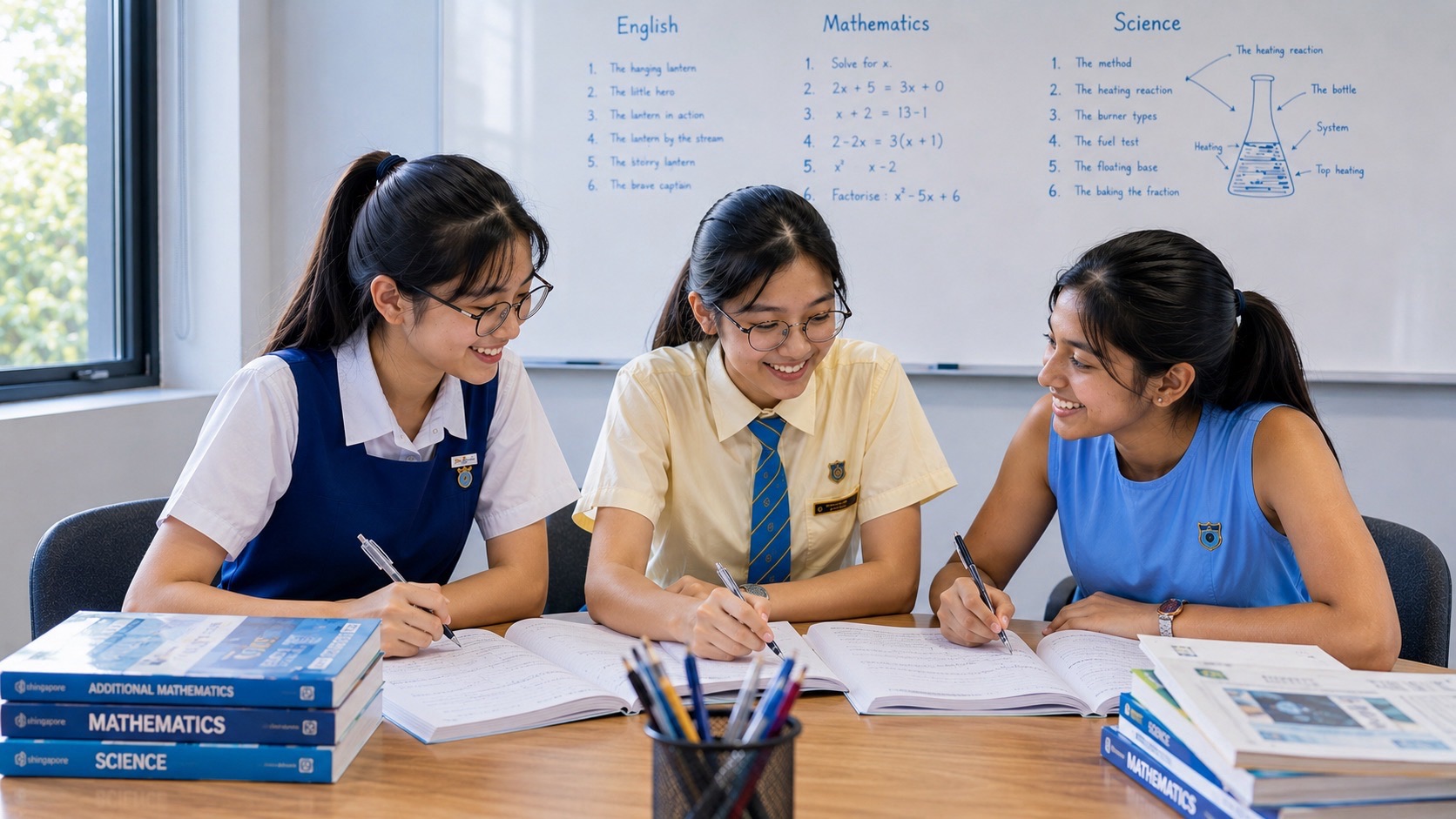
Why a three-student Mathematics class can be useful at Secondary 4
At Secondary 4, a small group lets the tutor see three different examination systems operating under the same question. One learner may misrecognise the structure, another may lose accuracy in long algebra, and another may solve correctly but spend too much time protecting one difficult question. Those distinctions are difficult to infer from the final mark alone.
The three-student format also keeps preparation from becoming permanent one-to-one supervision. Students can sit the same timed section independently, compare route choices afterward, and learn how another capable learner checks or recovers. The tutor then intervenes only where the evidence shows a recurring constraint, which supports the larger handover toward independent examination control.
Repair, convert and position at Secondary 4
Repair when a reusable concept or algebraic dependency is genuinely weak. Convert when the Mathematics is present but cannot yet be produced reliably under mixed examination conditions. Position when sequencing, question choice, time allocation or checking policy is limiting an otherwise capable student. Separating these jobs prevents every lost mark from triggering another round of indiscriminate content teaching.
The Secondary 4 handover receipt
- The learner can recognise structures across mixed E-Math/A-Math conditions without depending on chapter cues.
- Routine symbolic work is stable enough to leave reserve for unfamiliarity, checking and strategic decisions.
- The student has a workable persist/skip/return policy rather than allowing one question to consume the paper.
- Checking targets known failure modes such as sign, units, substitution, magnitude and interpretation.
- Recovery after a wrong route is practised and does not depend on tutor rescue.
- The learner leaves the examination year with mathematical structure that can continue into JC, polytechnic or other pathways.
The certificate records performance at one important frontier. The deeper handover is a learner who can still operate, diagnose and extend the mathematical system after that frontier has passed.